
The problem, especially for emerging curators, should not be how to get inside the sphere and sensibility of rote privilege and power in the art world and exhibition-making, but how to stay out of them.
Niels Van Tomme • 12/9/25
-
Critical Curating is The Curatorial’s section devoted to more theoretically oriented considerations of curatorial research and practice. While of a specialized nature, we seek essays for this section that are written for a broadly engaged intellectual audience interested in curating’s philosophical, historical, aesthetic, political, and social tenets, as well as a labor-based activity and its ramifications.
In “Outsideness, and Other Words of Advice for Young Curators,” Niels Van Tomme reframes the desire to “enter the art world” by proposing outsideness—adapted from Mikhail Bakhtin’s phrase, “excess of seeing”—as a productive curatorial orientation. Reflecting on his directorship of De Appel’s Curatorial Programme, Van Tomme contrasts the institution’s early experimental ethos with the professionalized expectations that later narrowed its scope. He argues for curatorial practices that resist standardized exhibition formats, privilege deep collaboration with artists, and cultivate forms of publicness not bound to art-world norms. Through projects such as the 2016–17 Why Is Everybody Being So Nice?, he demonstrates outsideness as a relational stance that expands how the curatorial can operate. He urges emerging curators—and the programs that train them—to maintain critical distance from institutional insider behaviors, fostering self-reflexive practices in a field increasingly defined by its own mythologization.
“The art world is shutting down,” a curator friend from New York City recently texted me. As previous art-related certainties crumble—like other aspects of our lives affected by our current and seemingly relentless polycrisis—and funding models increasingly become obsolete, without viable alternatives to replace them, there is an undeniable truth to my friend’s claim. Yet, at the same time, the industries surrounding art’s production, circulation, and speculation through monetization continue to thrive. Evidently, there is no significant slowing down in the organizing of blockbuster exhibitions, biennials, art fairs, conferences, or any other type of international contemporary art event. The same trend can be observed for curatorial activities. The past decades’ mushrooming and current plateauing of curatorial programs across universities and art schools internationally is a case in point.
During exchanges with young curators throughout my tenure as director of the De Appel Curatorial Programme, as a visiting lecturer or critic at various curatorial departments, and in everyday exchanges since then, there is one question that regularly returns. It is the young curator’s equivalent to the young artist’s, “How do I get noticed as an artist? How do I become seen and part of the art world?” For curators, this existential inquiry translates into, “How do I get a job? How do I create opportunities for myself and get inside the art world?” Obviously, such questions are nearly impossible to answer for either group. As has been pointed out exhaustively, there is no such thing as “the art world,” monolithic and singular. There are collaterally bouncing interests, networks, values, politics, ideals, talents, and belief systems, but they fluctuate wildly, depending on what purpose they are being cultivated for, as well as in which geographic context they are situated. Additionally, there are no straightforward formulas available for “getting inside,” as our curatorial reality is increasingly defined by heightened idiosyncrasies and oftentimes mythologized personal trajectories. And what if there is no inside?
Even if a young curator’s concerns about how to get “inside the artworld” are understandable (especially when studying at a curatorial program that costs increasing amounts), it is clearly a flawed goal. To counter such misguided aspirations, I would like to invoke the concept of “outsideness” as a potential position one could explore as a curator, and which is easier to aspire to on an individual rather than an institutional level. It is a term that I borrow freely from the Russian philosopher and literary critic Mikhail Bakhtin and which is applied somewhat mischievously here—the same way in which curatorial practices allow one to freely borrow from art-adjacent theoretical frameworks when conceptualizing exhibitions. For Bakhtin, outsideness refers to the position of the outsider who is always in possession of an “excess of seeing,” by which he means that each of us brings an entirely singular perspective when looking at others, and by extension, at the world. This excess is ethical and relational and allows us to form a more coherent understanding of what we are a part of and what our responsibilities toward others should be.1 Seen as such, shouldn’t outsideness be pivotal to curatorial practice as a whole, and shouldn’t curators always activate this excess of seeing in the activities they engage with? What else is curatorial practice, really? So, instead of tirelessly aiming for the inside, wouldn’t it be altogether more inspiring to consciously and creatively practice outsideness when mounting professional curatorial careers?
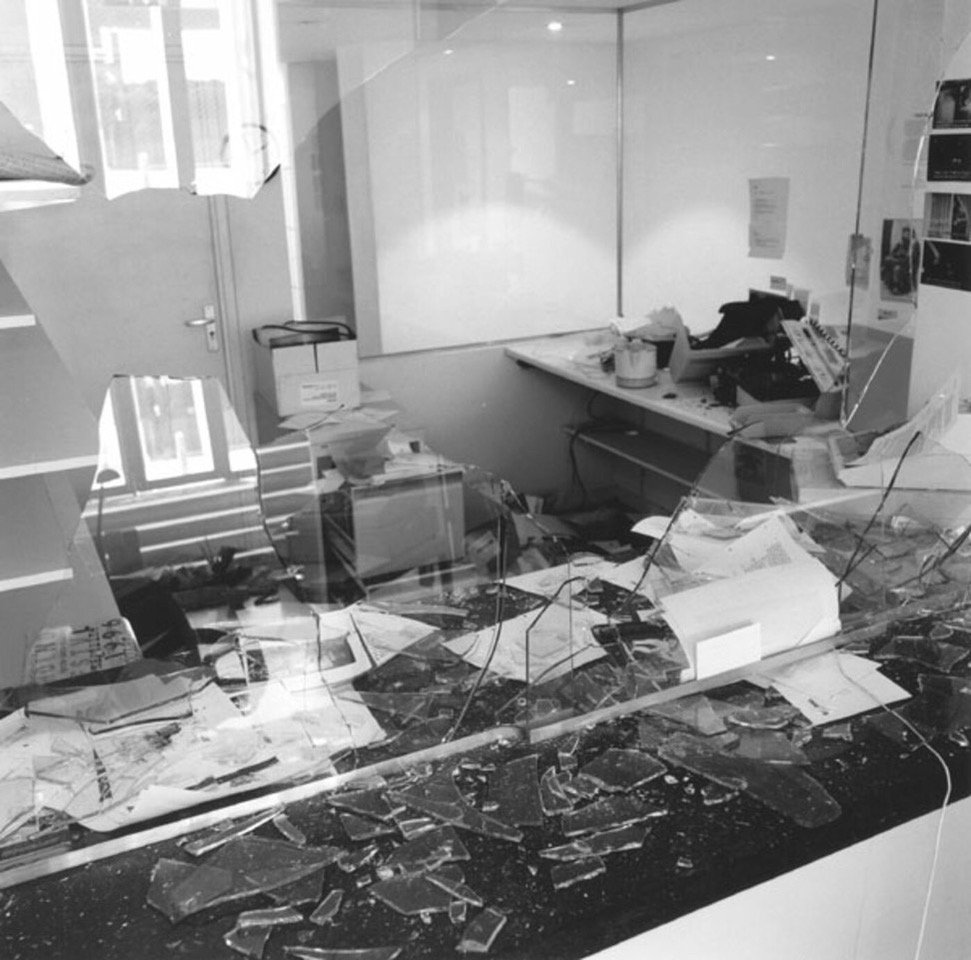
Jes Brinch & Henrik Plenge Jakobsen, Ticket booth, 1996, de Appel, Amsterdam. Photo: Niels den Haan.
Looking back at my work as head of De Appel, as well as of its Curatorial Programme, I was confronted by conflicting impulses. The program is a pioneering one globally, second to Le Magasin’s in Grenoble, and by evoking it here, I wish to emphasize its significant place in contemporary curatorial history. For someone who had practiced outsideness extensively throughout his professional activities, leading up to this job, and who didn’t have a formal training as a curator, I suddenly found myself on the very inside of institutionalized curatorial thinking. What made De Appel’s program unique was that one could trace outsideness throughout its rich history. It included such experimental projects as the notorious Crap Shoot, staged by the 1995-96 participants during founder Saskia Bos’s tenure.2 This project tested the boundaries of what is acceptable as curatorial practice altogether. Later decades, however, slowly pushed the Curatorial Programme into the rigid networks of the niche curatorial world. This is not a reflection on the quality of the participants’ output or the ways in which other directors imagined the program, but of the ways in which there appeared to be less and less self-awareness about the functioning of the program and its position vis-à-vis the fluidly defined “art world.”
From within my position, I tried to communicate the necessity of holding on to De Appel’s initial position of outsideness, even though I didn’t necessarily frame it so explicitly to the program’s participants at the time. One of the key elements to achieve this was to consciously steer the participants away from making proper “exhibitions” when developing their collective final project, which was the culmination of the program. This meant avoiding standardized exhibition formats, such as the solo or group presentation, in favor of something more exploratory. In doing this, I tried to (sometimes successfully) convince the participants that they should avoid adhering to established checklists of proper exhibition-making, as these are mostly restrictive and redundant in nature.
The concept of outsideness within the context of my time at De Appel Curatorial Programme translated to suggesting that the participants radically think along with artists, as opposed to focusing on what exhibitions should look like or do, or how they should be mounted or displayed. Instead, I tried to encourage deep collaborations with artists, and to discover what it is that a particular curatorial interest (theirs) could bring to an artist’s practice—in the best cases, advancing both the artistic and curatorial process. More importantly, it was key that these projects would generate purpose within certain discursive settings (which could also be casual), beyond their status as art-related phenomena. One could interpret this as the Bakhtinian excess of seeing of these projects.
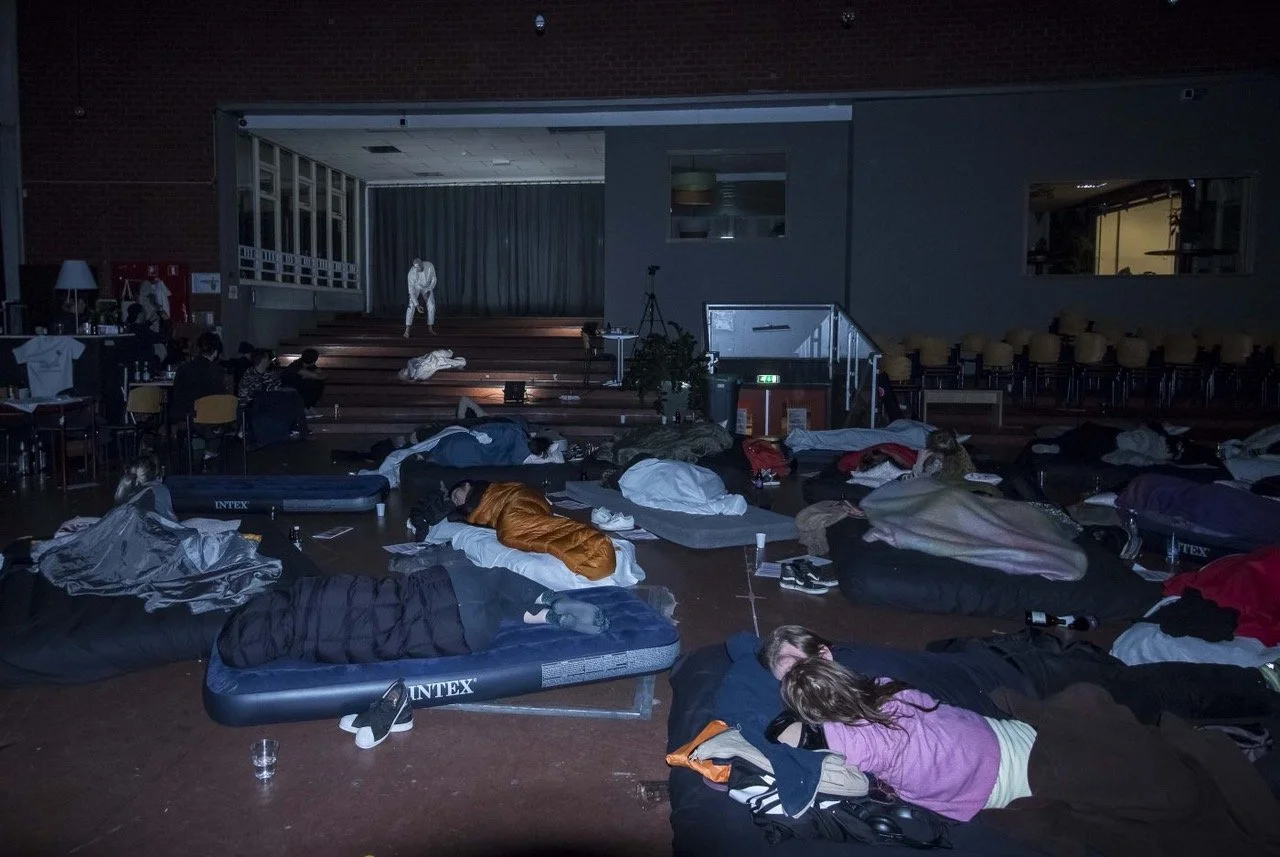
Why Is Everybody Being So Nice? Day 4: The Night of Exhaustion and Exuberance. Performance with Arie de Fijter and Ksenia Perek for the Open Avond(S) series, 2017, de Appel, Amsterdam.
A fine example was the 2016-17 Curatorial Programme’s final project, Why Is Everybody Being So Nice?, which was an extensive investigation into the social pressures of niceness, resulting in a four-day program and closing with a collective sleepover, The Night of Exhaustion and Exuberance. Being driven by such (some would say naïve) beliefs in ideas and positions, the curatorial role here was one of outsideness in order to advance a sense of publicness. The curator, then, became more like a humble public servant who bridges the various worlds they/she/he is engaging with rather than producing or safeguarding one—“the art world”—that remains at all times ungraspable and opaque.
Ultimately, what does outsideness mean for university curatorial departments and programs at art schools? I’m not entirely sure. But aren’t they perhaps too focused on fostering a feeling of being inside, of receiving a certain (but not unlimited) amount of privileged wisdom originating from within that you can’t get anywhere else? The problem then is not how to get in, but how to stay out. Or, more precisely, how to cultivate outsideness as a means to enact the curatorial—more like a basic attitude and state of mind that can be achieved from within curatorial sites of learning as well. Evidently, the knowledge and networks they offer are useful as long as one remains conscious of the pitfalls of their potential insularity. Finally, to young curators, I would offer the following thoughts: Don’t rely on institutions too much. Focus on making strong connections with artists and colleagues. Always doubt everything you do, but do it nevertheless. Trust your intuition. Patiently build a singular position of outsideness, carving a world for yourself in deliberate and open ways, instead of adhering to one that is already solidified in curatorial-institutional mythmaking, which might never have existed in the first place.
NOTES
1. Mikhail Bakhtin, “Author and Hero in Aesthetic Activity,” in Art and Answerability: Early Philosophical Essays by M.M. Bakhtin, eds. Michael Holquist and Vadim Liapunov, trans. Vadim Liapunov (Austin: University of Texas Press, 1990), 22.
2. Saskia Bos founded the curatorial program in 1994, whereas De Appel itself was founded by Wies Smals in 1975.
-
Niels Van Tomme (he/him) is a curator and lecturer who works internationally at the intersection of contemporary culture and critical social awareness. He was director and chief curator at Argos Centre for Audiovisual Arts in Brussels (2018-24) and De Appel in Amsterdam (2016-18), curator at the Bucharest Biennale 7 (2014-16), visiting curator at the Center for Art, Design and Visual Culture in Baltimore (2011-16), and director of arts and media at Provisions Learning Project in Washington, DC (2008-11). In 2014, Van Tomme received the Vilcek Curatorial Fellowship by the Foundation for a Civil Society for his demonstrated experience and excellence in engaging with international contemporary art.
His exhibitions and programs have been shown internationally, including at The Kitchen (New York), Contemporary Arts Center (New Orleans), Akademie der Künste (Berlin), Tallinn Art Hall (Tallinn), Gallery 400 (Chicago), Värmlands Museum (Karlstad), National Gallery of Art (Washington, DC), and P! (New York). His writings have appeared in Artforum, The Wire, Art in America, Camera Austria, Metropolis M, Afterimage, and Art Papers. His edited volumes include Muntadas: About Academia: Activating Artefacts (2017), Aesthetic Justice: Intersecting Artistic and Moral Perspectives (2015) with Pascal Gielen, Visibility Machines: Harun Farocki and Trevor Paglen (2014), and Where Do We Migrate To? (2011). He has additionally contributed to numerous books and exhibition catalogues, such as Christine Sun Kim: Oh Me Oh My (2024) and Tony Cokes: If UR Reading This It’s 2 Late, Vol. 1-3 (2019). Van Tomme regularly writes about music and occasionally provides liner notes for vinyl records by artists such as Hieroglyphic Being and Aki Onda. He has held teaching positions at Parsons School of Design at The New School (New York) and University of Maryland Baltimore County. He has lectured at the School of the Art Institute of Chicago, Queen Mary University of London, Vassar College, University at Buffalo, School of Visual Arts (New York), Valand Academy of Art and Design at University of Gothenburg, and the Jan Van Eyck Academy.
