
Nnena Kalu’s 2025 Turner Prize
Only if institutions move beyond symbolic validation—toward sustained collecting, rigorous criticism, and genuine integration—will this so-called “watershed moment” mark real change rather than a passing gesture.
Andrew Hunt • 2/24/26
-
Roulette is our section for essays, portfolios, videos, conversations, and more that range across a broader purview of culture and politics, not within our current thematic sections. It is, in a sense, a chance encounter with a subject of interest within the extended realm of visual culture.
In this essay, Andrew Hunt follows up on his previous piece to consider whether Nnena Kalu’s 2025 Turner Prize win marks a genuine transformation in contemporary art or a temporary institutional gesture. Situating the award within decades of grassroots advocacy for learning-disabled artists, Hunt contrasts critical responses—from Adrian Searle’s aesthetic praise to Waldemar Januszczak’s accusations of “virtue-signaling”—while highlighting more nuanced curatorial perspectives that call for careful, non-instrumentalizing approaches to disability in art. He challenges the widespread framing of the moment as a “watershed,” arguing that meaningful change depends not on symbolic validation by institutions such as Tate Britain but on sustained commitments to collecting, critical evaluation, and integration into art history. Ultimately, Hunt calls for the development of a new critical language capable of recognizing disability as vital context without collapsing artistic judgment into either tokenism or erasure.
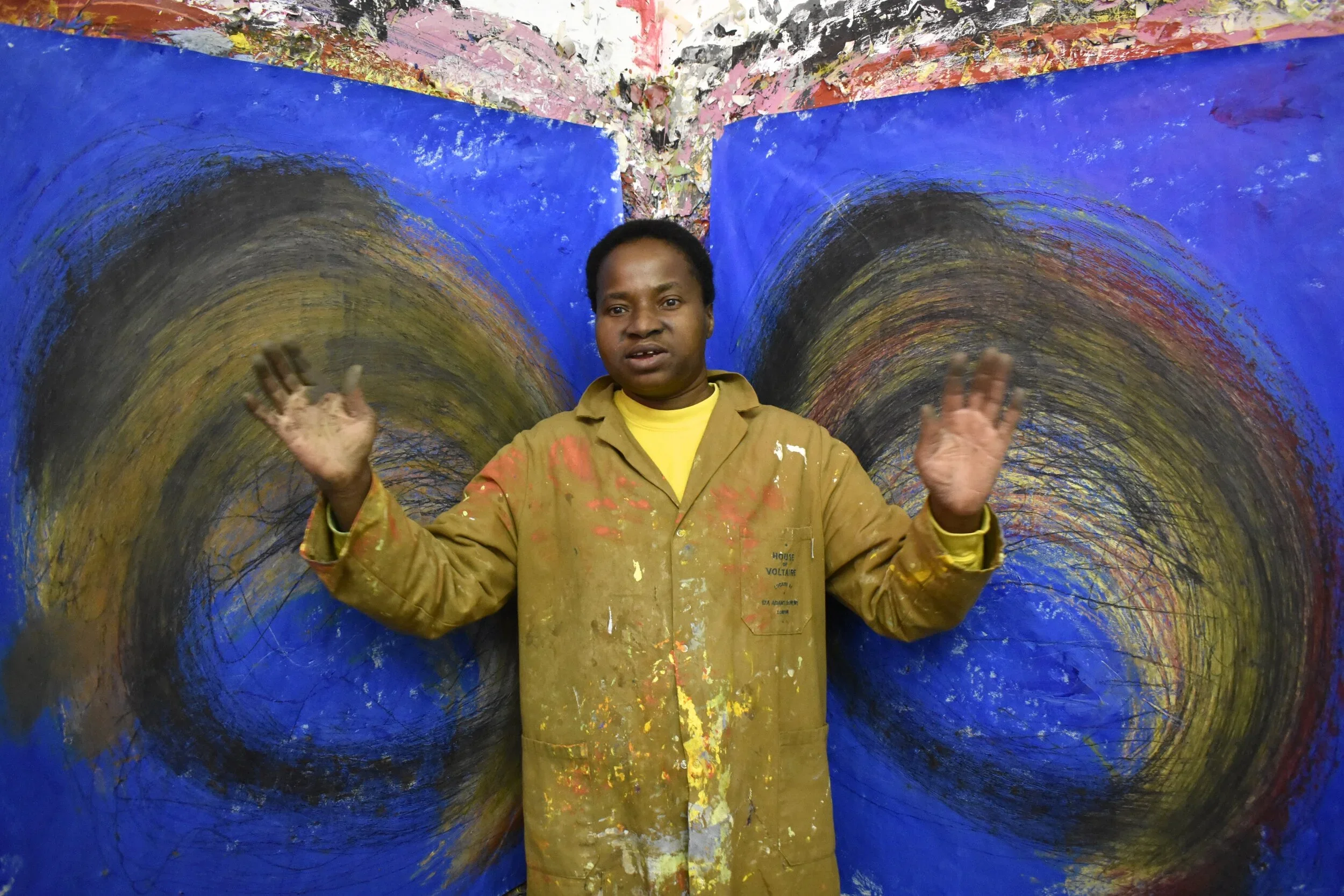
Nnena Kalu in the studio with works from her series of Vortex Drawings. Courtesy the artist and ActionSpace.
Following my piece for The Curatorial, published in September 2025 and titled “On Curating the Art of the Learning-Disabled and Neurodiverse: A Manifesto,” I was invited to write a response to Nnena Kalu’s Turner Prize win on December 9, 2025.1 Rather than provide an immediate reaction or bulletin-like statement, I decided to process possible future trajectories for the development of the art of the learning disabled, especially given the range of reactions, both prior to and after the announcement of the prize. These reactions roundly, and perhaps slightly exaggeratedly, described the prize as a historic moment or “watershed” by journalists and museum directors.2 At the same time, this text provides an opportunity to extend the spirit of the initial piece, which aimed at setting a scene for a range of activist, curatorial, and museological formulas that might continue to incorporate learning-disabled art into mainstream discourse, with and without differentiation from the work of other artistic producers, and to support practical curatorial responses that seek to advance the momentum of this work.
To begin, it’s productive to digest responses to Kalu’s nomination, starting in September 2025, when many journalists began to lobby for Kalu’s work, and continuing through mid-December, when discussions of her win took place, together with where we stand now in early 2026. The British critic Adrian Searle, for example, supported the artist’s work early on. He wrote in The Guardian on September 23, considering all the nominees (which also included Rene Matić, Mohammed Sami, and Zadie Xa), that “everyone has a spiel, but one artist stands out,” and “there’s no fudging. Kalu deserves to win this year’s Turner prize.”3 Searle’s intention is clearly that, beyond the perceived strategies of the other shortlisted artists’ works, Kalu’s sculpture and drawings had a creative impulse that stood apart from any formulaic political agenda or pre-existing academic or identitarian stance, productively and anarchically so. He called Kalu’s form of abstraction “riotous and rhythmic, purposeful and compelling.”
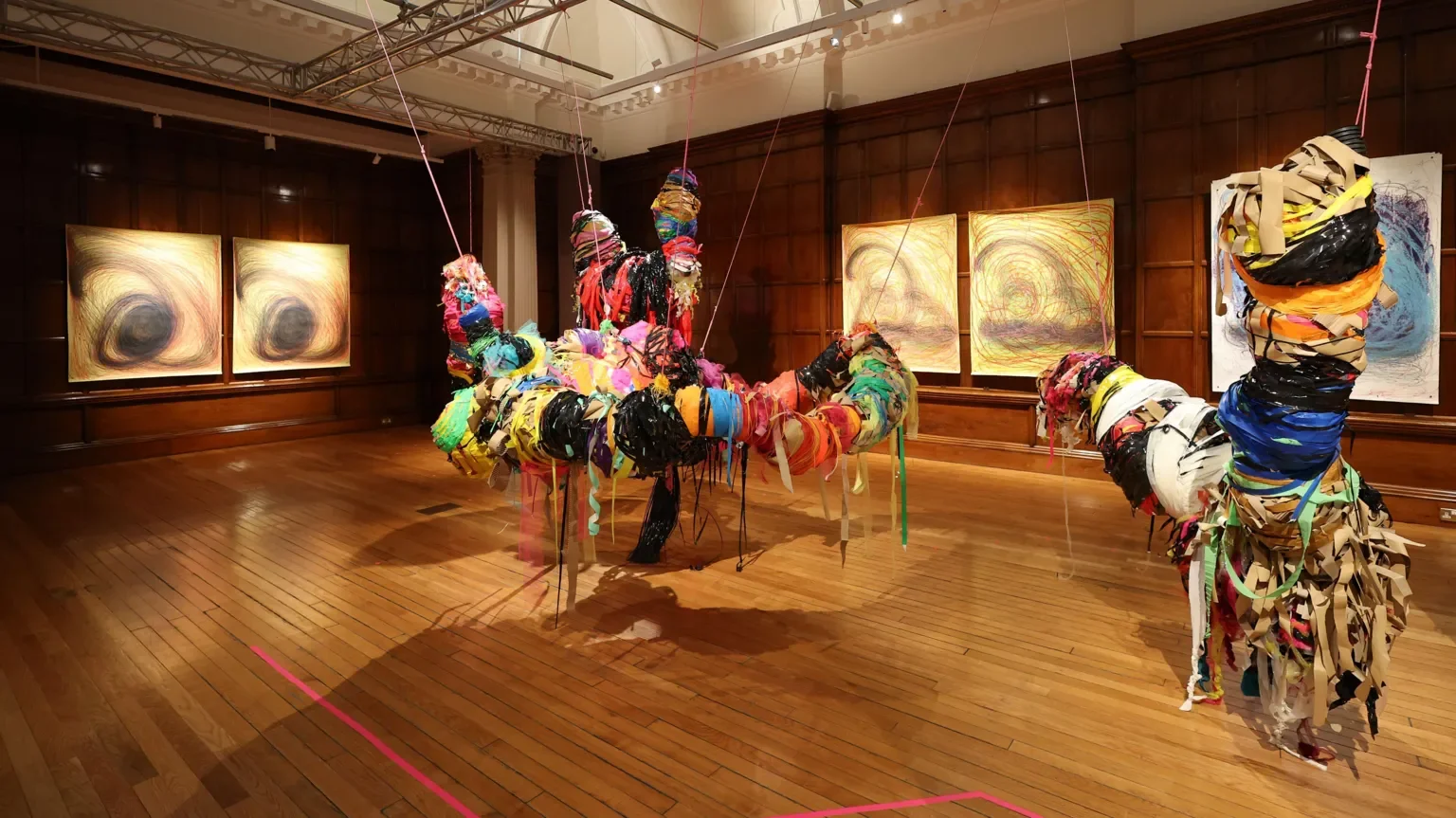
Nnena Kalu’s exhibition at Cartwright Hall Art Gallery, Bradford, UK, 2025. Courtesy EPA Images.
The opposite sentiment was voiced by the critic Waldemar Januszczak, a writer of the same generation as Searle (respectively, they were in born 1954 and 1953) and who has long presented himself as a “bad boy” of art criticism. On October 7, Januszcak wrote in The Sunday Times, that the Turner Prize is “the cockroach of art”—perhaps meaning it’s an established institutional pest that would outlive a nuclear war or alternatively would serve to contain and control any paradigm shift in art and culture. He also pronounced that Kalu’s art was a “sprawling mix of lumpy sculpture,” both disheveled and poorly thought-out artistically and curatorially. After learning from the exhibition text that Kalu was autistic and uses art as a “personal release or therapy,” Januszczak remarked that this raised a dilemma for him, namely whether critics should judge purely on artistic evidence or, like the Turner judges, in his view, be compassionate in broadening what counts as “good art.” Despite his reasoning, it’s not hard to see the innate prejudics in Januszczak’s system of judgment (which may well coincide with populist sentiment), when he concludes that it wasn’t the job of art or the Turner Prize to confuse therapy with talent. In a subsequent Times piece, he criticized the decision as being driven by social politics rather than genuine artistic quality, calling the judges’ choice “virtue-signaling,” and suggesting that compassion or inclusivity might have won out over “tough-minded aesthetic judgment.”4
I’ll come back to look at these perspectives a little later, but keeping the timeline of responses intact for the moment, another piece of interest outside of mainstream newspapers was critic and curator Lisa Slominski’s feature in the London art magazine Art Monthly’s November issue, titled “Curating Difference.”5 Rather than offering praise or a critique of the work—or any form of qualitative perspective—Slominski uses Kalu’s nomination as a starting point to ask deeper questions about how difference, especially neurodiversity and disability, can be represented, contextualized, and interpreted in contemporary art without being reduced to a stereotype or being instrumentalized for other social agendas. In essence, her analysis is rooted in a desire to understand and respect Kalu’s work, and that of others, alongside its context. Rather than reduce criticism to a simple verdict or apply critical judgment, a different criterion is used to ask whether it’s possible to situate Kalu’s art “with care and without instrumentalizing it,” instead of simply celebrating inclusion or forcing aesthetic judgment on the work.
Following the announcement of the prize, the rush to write a newsworthy response included Searle, who reiterated, again in The Guardian, that in his view the judges were correct in affirming Kalu’s work on its own aesthetic merits, which vindicated his position.6 Again, Searle celebrated the physical and sensuous quality of her art, describing it as “embodied” and “sensuous.” He emphasized a deep physical engagement between the artist and her materials, arguing further that it should be appreciated as a powerful and original contribution to contemporary practice.
Perhaps as a response to Januszczak’s claim that the work seen in the gallery in the city of Bradford looked poorly thought out, Searle described the same experience as an “almost alien unknowable presence.” He went on to claim that “the closer you get to Kalu’s endless sinewy trails of old VHS tape, their spews of filigree plastic webbing, their bound-up, sometimes cable-tied suturings, the harder it is to know where their forms stop and the space around them begins.” In my view, this is the closest that any mainstream critic has come to describing what is revelatory about this work: an attempt to start a shift in critical thinking on what makes the work work, outside of standard platitudes or reductive dismissals.
Numerous other responses (including, again, two more in The Guardian, such as the following excerpt from Lanre Bakare) emphasized the director of Tate Britain and chair of the jury Alex Farquharson’s claim that the award, as previously mentioned, represented a “watershed moment” for the international art world. Kalu’s win, he wrote “begins to erase that border between the neurotypical and neurodiverse artist. You suddenly become aware that actually it’s been a boundary around our history, and around contemporary art. But that boundary is dissolving.” Bakare goes on: “Nnena’s work was very much selected for its quality, but given she’s a neurodiverse artist, given her verbal communication is limited, she’s someone who previously would have been on the outside.”7
After this point, coverage, opinion, and news abruptly halted, perhaps in part due to Tate director Maria Balshaw’s decision to make public her resignation two days after the Turner Prize announcement on December 11—a fact that obviously took the focus away from Kalu as the organization’s latest headline.
However, what is most interesting in the ongoing narrative around Kalu is to look at a response to the language of inclusion that was part of the critical response, including, again, this notion of a “watershed moment.” That is the precise wording used by critic Eddy Frankel, an early champion of Kalu’s nomination, published in The Guardian on May 19, and then subsequently repeated by Farquharson. An unsigned editorial in The Guardian on December 12 regarding Kalu’s win stated that her work must be accepted on its own artistic terms, noting that “her sculptures and drawings must speak for themselves.”8
Seeing these patterns, we might ask how can we make something meaningful from a phrase such as “watershed moment” and champion the willing dismissal of disability in the judgment of art? What does this mean in the current cultural climate? The axiom “watershed” is a geographical term that describes the origin of a high natural water source: the mountainous area from which a natural lake drains to create new minor tributaries downstream. Although this wasn’t the intention, applying this metaphor to Kalu’s win from Tate’s perspective can read as slightly misplaced. It speaks of the obvious authorization of the institutional backing of the establishment’s Turner Prize, applying a backhanded gravity to the award and its impact on culture. Here, the hierarchical watershed from above, the lake of “major” institutional consensus and validation that pours down, purportedly nourishes and enriches the great unwashed of public consciousness. This exaggerated sense of importance is weighty with arrogance and touches both the relevance of Tate and of the Turner Prize. In reality, the entire system of support for learning-disabled art has come from the slow and sustained support of “minor” grassroots organizations, initiated in the early 1970s and only recently starting to gain force. This is the reality of the flow of any watershed, one that has trickled down slowly over decades to be finally acknowledged by the cultural elite, often too careful of their reputational profile, and rarely straying outside of critical and market consensus.
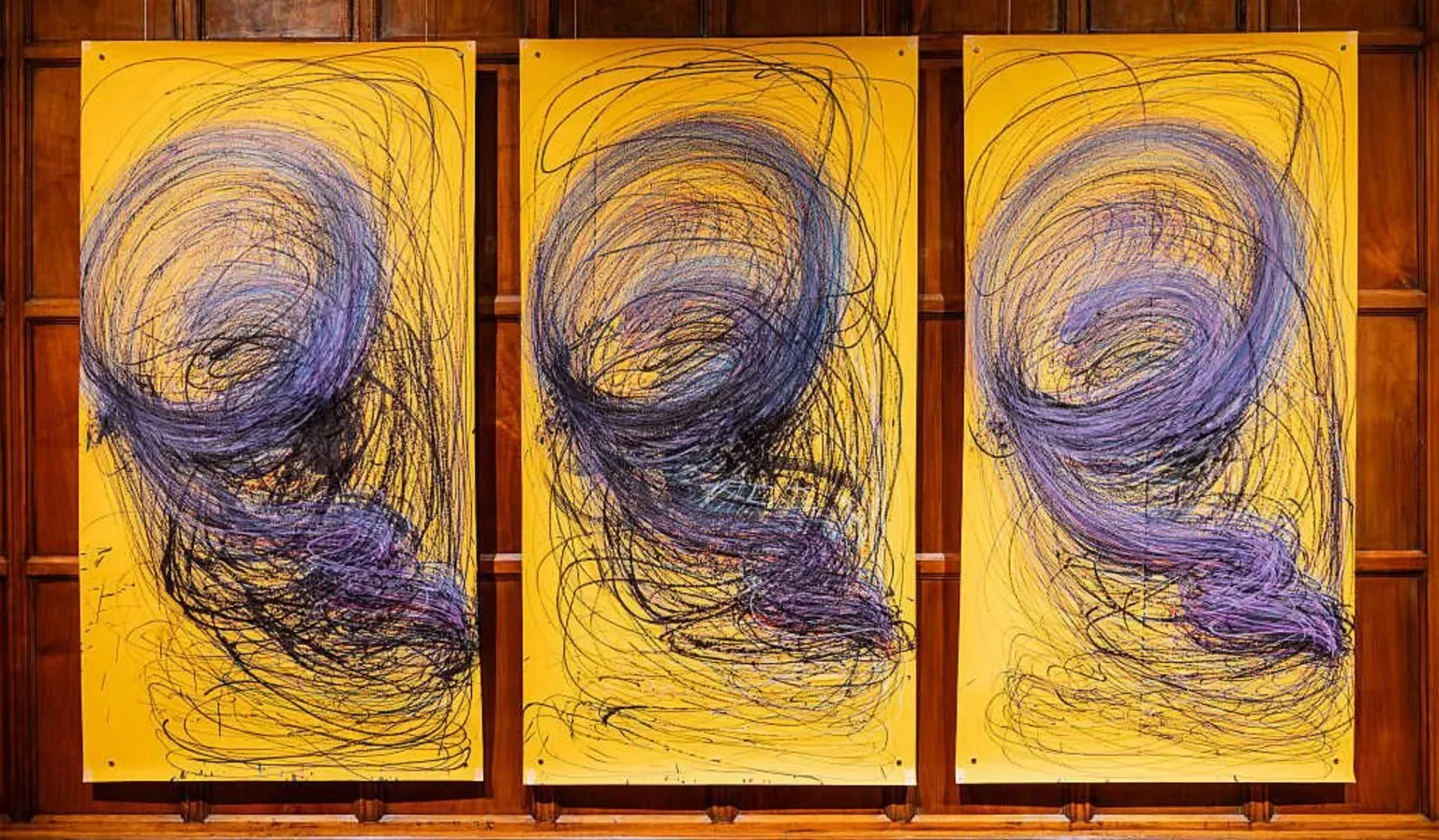
Nnena Kalu’s exhibition at Cartwright Hall Art Gallery, Bradford, UK, 2025. Courtesy Getty Images.
Of course, the story of museums playing catch-up isn’t new, and perhaps what is exciting about Kalu’s exemplary institutional recognition is that hierarchies might be beginning to change. An optimistic view is that supported studios and museums might work together more actively and consistently to create this perceived consensus on learning-disabled art. This would be a real watershed.
As mentioned in my previous piece, the two issues of central importance and urgency are not only the active collecting by museums of learning-disabled work but also the ability to develop a critical language that works in tandem with policies for acquisitions. In terms of the former, two examples of recent museum acceptance of learning-disabled artists (which I strongly suggest paved the way for Tate’s decision to award Kalu the prize) were, as I mentioned in my first piece, SFMOMA’s decision to acquire a large selection of work by Creative Growth in 2024, as well as NIAD’s Marlon Mullen’s solo exhibition at MoMA in New York last year. The increasing inclusion of the Bay Area organizations’ artists by museums over the past few years has acted as a barometer, and it’s worth citing an interview with Tom di Maria, the outgoing director of Creative Growth on the acquisition by SFMOMA, alongside excerpts from another interview I did with him on August 8, 2024.
In the following passage, we can see an existing formula for understanding the perceived importance of this extended moment, alongside how we might measure it and how we might support its development.9
Andrew Hunt: How important do you think this moment is, not only for the Bay Area and its audiences, but also for shaping future perspectives on equality in art and museum collections globally?
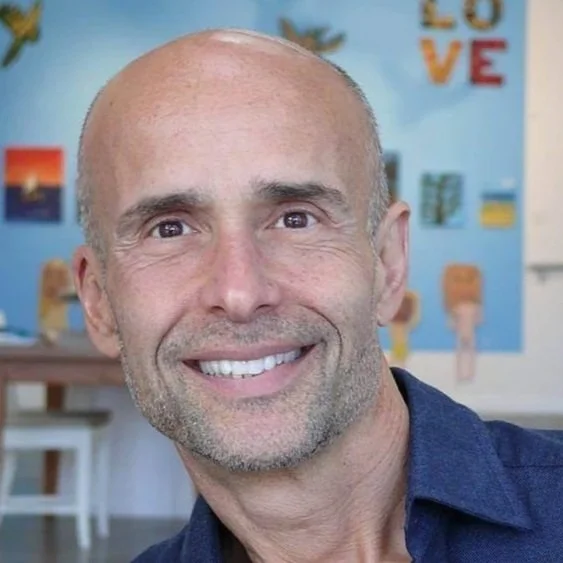
Tom di Maria: I do think this represents a tipping point, a cultural shift in how artists with disabilities are included. The question for me is whether this is something that becomes momentary or fashionable, something that has its moment for a year or two and then fades, like NFTs, for example, or whether it marks a lasting change in the narrative arc of art history. I don’t know the answer yet. But I do believe there’s no going back to how things were before. And that is a historic demarcation.
Despite the fact that, as di Maria states, it’s difficult to see if we’re within a defining moment for learning-disabled art, what is clear is that we need to avoid any lapse in focus in order to keep momentum through a clearly articulated strategy of support, including collaborative work with studios, commercial spaces, and large-scale institutions. Again, what isn’t so straightforward is the critical development of the work: to see it as a genre with discreet differences, and to create an embryonic yet sophisticated evaluative set of criteria that responds to the intelligence of the work alongside its progression over time. With regard to this, it’s worth quoting di Maria again in terms of his and SFMOMA’s practical curatorial strategy for their Creative Growth show:
TdM: One principle quickly became central: respect for artistic practice. In discussions around art and disability, there’s often a negative stereotype: that artists are “one-trick ponies,” that they don’t evolve, that anyone could learn to do one thing. We wanted to counter that directly. So, we focused on showing the evolution of an artist’s work, which meant looking at suites of works rather than isolated pieces.
Moreover, the idea of actively acknowledging artists with disability, with and without distinction, is paramount:
AH: You also talk about the need to level distinctions and labels—self-taught, professional, disabled, outsider—and to resist viewing these artists through any kind of reductive lens. Ideally, they would simply be seen as artists, operating on the same playing field as anyone else. How do you think that kind of leveling can happen in a genuinely progressive way? And what do you see as the current challenges for the arts and disability movement?
TdM: One of the central challenges is bringing the voice of disability fully into the dialogue. That’s complicated, because in some ways it’s about putting ourselves out of business. You want the work to be seen as equal and contemporary, without qualifiers, but at the same time, you can’t entirely step away from the culture of disability that informs the work. So, the question becomes: How do we hold those two positions at once? How do we navigate viewpoints that can seem almost in opposition to each other? Where is the intersection? I think that tension is the challenge, but it’s also what makes the moment exciting. I actually think that’s the future of the field.
This aim of critical evaluation and qualitative judgments to hold “two positions at once” becomes vital in terms of changing critical perceptions around value, and it addresses Januszczak’s apparent inability to form a pluralistic viewpoint alongside other critics’ disinclination to make disability a meaningful context for judgment.10 It’s clear that Kalu’s work differs radically, both formally and aesthetically in philosophical terms, from the other nominated artists in 2025. Yet, to this point, new critical and curatorial ways to address such work needs to be found. What we need to develop is a way to analyze these artistic practices both synchronically, addressing where we are now, as we are currently attempting to do by hitting the pause button, and diachronically: producing a deep form of looking in tandem with the development of the work of artists over time, as di Maria suggests.
Instead of resorting to the ongoing legacy of ironic postmodernism, in relation to the production of work and its interpretation and critical reception, we need a new process that isn’t grounded in something already intellectualized, something pre-formed. Perhaps, any critical interpretation must begin in a more unstructured place, much like the act of making the work, to produce a kind of evaluation that is unexpected, even alien, as Searle suggests, and that subsequently forces a new act of intellection. If one mode of expression and interpretation (the existing professionally trained artist and critic, or those using the legacy of postmodern irony) illustrates intellectual ideas that already exist, the other (learning-disabled and “professionally trained” artists using humor over irony) gives rise to intellectual concepts that might not otherwise have come into being. We may need to develop a new critical language that accommodates the legacy of a critical vocabulary, while making room for considerations fitting this art more specifically. That language doesn’t exist yet.
Of course, this is true for all new movements of art in the past; every conceivable art has spawned a new language to describe it. Perhaps the difference now, however, is that there is very little really new critical language that offers any accommodation to radically different work, certainly when it comes to a nuanced critical approach to learning-disabled art. Perhaps this is inflected by the hangover of postmodernism, which never rose above the shallowness of its form of irony, glibly trading in hollow differences. And so, to hold two positions in the mind at once is not easily accomplished by critical vocabularies that are used to this shallowness, to stylistic surfaces alone, while remaining limited in processing something more profoundly dialectical.
In terms of the practical side of addressing these complex positions critically and curatorially, Christopher Bedford, the director of the San Francisco Museum of Modern Art, who was instrumental in collecting Creative Growth’s work, speaks of siloing and integration.
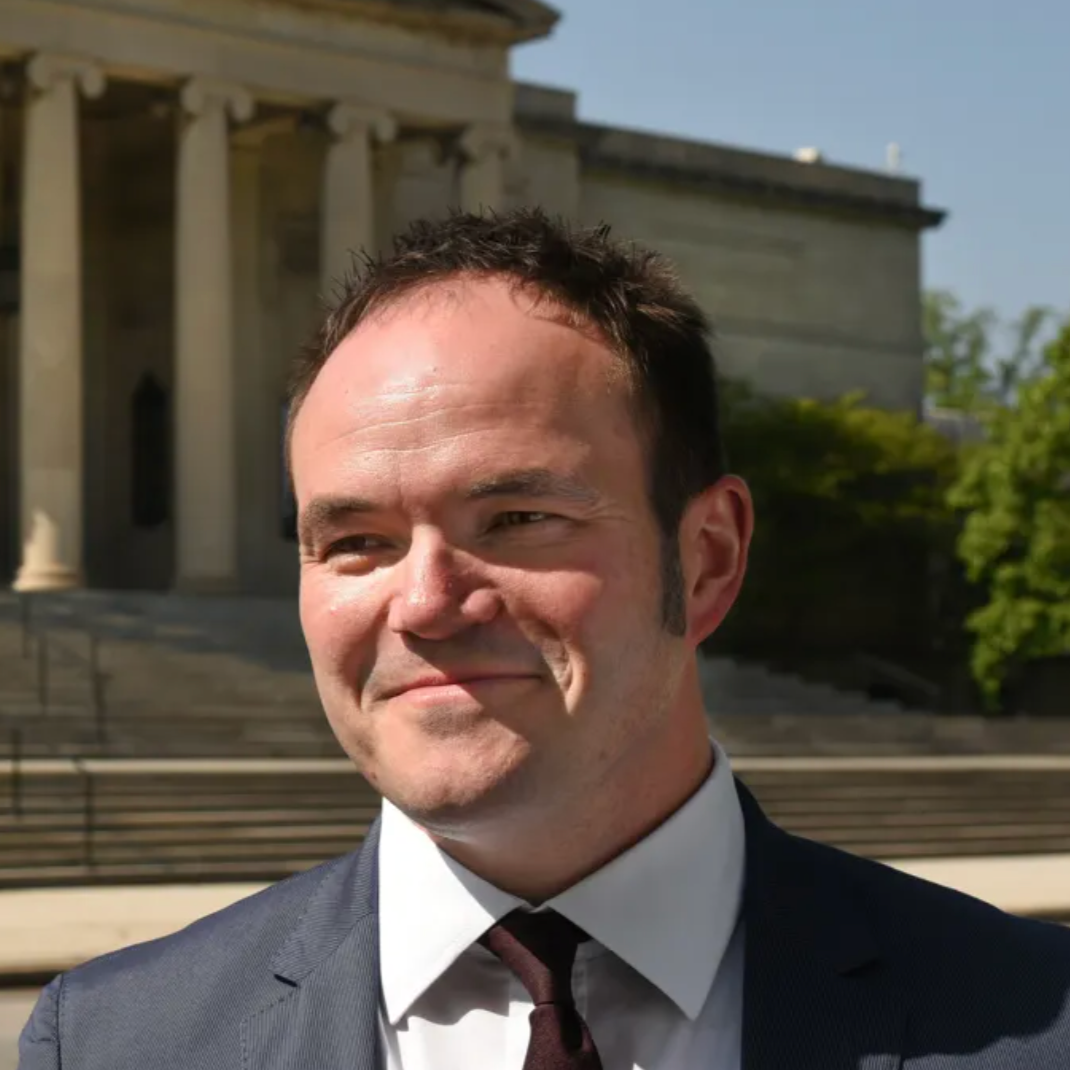
Christopher Bedford: Siloing creates an intensity of attention. It forces a reckoning. Only after that first act can the second act take place, which is genuine integration into a broader art-historical narrative. Applied to Creative Growth, it would have been far too slight a gesture for us to acquire a single strong painting by an artist with disabilities and hang it quietly next to a Jackson Pollock, hoping that the juxtaposition alone would do the work. No one would have noticed. Instead, this was an intentional act of concentration, of insistence. It compels attention. The second act, which is already underway, is integration: weaving this history into the larger fabric of formal, social, and political art histories. But without that initial moment of focus—of forceful visibility—you never reach that point.
With concentrated strategies such as this, there’s reason to be optimistic about the expanding plurality of art. In terms of a perception of 2025’s Turner Prize award being simply that year’s fashionable choice, to stop this from becoming a reality, we need to actively support learning-disabled art from all sides. Will things go back to business as usual? Only time will tell.
NOTES
1. Andrew Hunt, “On Curating the Art of the Learning-Disabled and Neurodiverse: A Manifesto,” The Curatorial, September 1, 2025. https://www.thecuratorial.net/index/roulette/on-curating-learning-disabled-and-neurodiverse-art
2. Eddy Frankel, a journalist for The Guardian, and Alex Farquarson, Director of Tate Britain and Chair of the 2025 Turner Prize, used the phrase “watershed moment” to describe Kalu’s original nomination and subsequent award of the Turner Prize. Frankel referred to Kalu’s initial nomination as “a watershed moment for art” in his piece “Her need to make is off the scale: why Nnena Kalu’s Turner prize nomination is a watershed moment for art” on May 19, 2025, while Lanre Bakare stated in the same newspaper on December 9, 2025, that Farquarson defined the win as a “watershed moment for the international art world” in the piece “Nnena Kalu becomes first artist with a learning disability to win Turner prize,” continuing in its subheading: “Chair of 2025 judging panel says win ‘begins to erase that border between the neurotypical and neurodiverse artist.’” https://www.theguardian.com/artanddesign/2025/may/19/nnena-kalus-turner-prize-watershed-glasgow and https://www.theguardian.com/artanddesign/2025/dec/09/nnena-kalu-first-artist-learning-disability-win-turner-prize
3. Adrian Searle, “Turner prize 2025 review – puzzling banners, tinkling bells, burning landscapes and bum-like sculptures,” The Guardian, September 23, 2025. https://www.theguardian.com/artanddesign/2025/sep/23/turner-prize-2025-review-cartwright-hall-art-gallery-bradford-city-of-culture
4. Waldemar Januszczak, “The Turner Prize is the cockroach of art,” The Sunday Times, September 27, 2025. https://www.thetimes.com/culture/art/article/the-turner-prize-is-the-cockroach-of-art-8sgkb2pjs? gaa_at=eafs&gaa_n=AWEtsqdRckFbo-d1WiR5Bd3WSlBv7Y8xbMazEaPWJpWWgaG92MzBF1t1skLN4iKTS0s%3D&gaa_ts=698dbf91&gaa_sig=J-y0GbN5Yajse075VtbPizw_lzWae5Ksmtsd2eGb6yBwRrUl_SoTJPY1ovi8idF9SejepuqmhbOEhxdLYNx1-w%3D%3D. On December 9, 2025, Januszczak published his judgment of the prize going to Kalu. “Turner prize 2025: Nnena Kalu is first winner with learning disability.” https://www.thetimes.com/culture/art/article/turner-prize-2025-winner-nnena-kalu-0ljqnt6z2
5. Lisa Slominski, “Curating Difference,” Art Monthly, Issue 491, November 2025.
6. Adrian Searle, “Nnena Kalu’s embodied, sensuous art makes her a worthy Turner prize winner,” The Guardian, December 9, 2025. https://www.theguardian.com/artanddesign/2025/dec/09/nnena-kalus-embodied-sensuous-art-worthy-turner-prize-winner
7. Bakare, “Nnena Kalu becomes first artist with a learning disability to win Turner prize.” https://www.theguardian.com/artanddesign/2025/dec/09/nnena-kalu-first-artist-learning-disability-win-turner-prize
8. The Guardian, “The Guardian view on Nnena Kalu’s historic Turner prize win: breaking a glass ceiling,” December 12, 2025. https://www.theguardian.com/commentisfree/2025/dec/12/the-guardian-view-on-nnena-kalus-historic-turner-prize-win-breaking-a-glass-ceiling
9. The following quotations are excerpts from Andrew Hunt’s book, Interviews on Contemporary Painting, forthcoming from Ridinghouse in 2027.
10. Di Maria goes on: “Some people come here [to Creative Growth] already convinced that the work can’t possibly be valuable; that people with disabilities can’t be cultural participants, or that non-academically trained work can’t be intellectually engaging. Others come simply to validate their existing ideas. … But I also don’t want to diminish or denigrate academically trained artists, or the work shown by commercial galleries. That’s not what I’m doing. It’s just not what I personally respond to most strongly. And there are people who don’t respond to what Creative Growth does, and that’s fine too. I think of it a bit like music. Do you listen to hip-hop? Jazz? Classical? If you’ve only ever listened to Beethoven, you may not respond immediately to hip-hop, and that doesn’t mean one is better than the other. Visually, we seem to struggle more with that idea. We don’t always give ourselves permission to like different kinds of work, while simultaneously recognizing that other kinds of work are valuable. For me, it’s about allowing that plurality, about understanding that difference doesn’t require hierarchy.” This is an excerpt from Andrew Hunt’s book, Interviews on Contemporary Painting, forthcoming from Ridinghouse in 2027.
-
Andrew Hunt is a curator and writer. From 2017 to 2025, he was Professor of Fine Art and Curating at Manchester School of Art. He is currently the director of the contemporary art gallery Moon Grove in Manchester, UK. He was previously the founding director of Reading International (in 2016 with Susanne Clausen), director of Spacex, Exeter (2013–2014), and director of Focal Point Gallery, Southend-on-Sea (2008–2013). In 2012, Hunt was a member of the Turner Prize jury. As a curator and artistic director, his research has focused on the ability of new institutions of all sizes to support artists and transform communities. As a writer, he has contributed to many magazines and journals of contemporary art and culture, including Artforum, Art Monthly, The Burlington Magazine, Domus, frieze, Mousse Magazine, Picpus, TATE ETC and The Curatorial.
