
Breaking Out of Dominant Temporalities: Demodernizing the Museum?
Demodernizing is not a return to the pre-modern past, but an attempt to release new potentialities within modern cultural practices by taking modern ideology out of them.
By Charles Esche and Hélène Valance
Demodernizing is not a return to the pre-modern past, but an attempt to release new potentialities within modern cultural practices by taking modern ideology out of them.
Charles Esche and Hélène Valance • 3/19/26
-
Critical Curating is The Curatorial’s section devoted to more theoretically oriented considerations of curatorial research and practice. While of a specialized nature, we seek essays for this section that are written for a broadly engaged intellectual audience interested in curating’s philosophical, historical, aesthetic, political, and social tenets, as well as a labor-based activity and its ramifications.
This interview with Charles Esche, the former director of the Van Abbemuseum in Eindhoven, the Netherlands, explores demodernization as a situated response to decolonial thought and its implications for museum practice. Esche reflects on how modernity and coloniality function as intertwined structures within art institutions, shaping narratives of progress, authorship, and value. Drawing on examples from the Van Abbemuseum, he discusses strategies for pluralizing temporalities, unsettling canonical hierarchies, and foregrounding relational forms of display that challenge the universalizing myths of modern art history. Through exhibitions such as Delinking and Relinking and The Making of Modern Art, Esche considers how museums might reconfigure chronologies, incorporate social histories, and engage with colonial legacies without reverting to singular counter-narratives. The conversation addresses diagrammatic models of art history, the politics of geography, and the future of museums amid contemporary political urgencies. Esche proposes the museum as a site for relationality and provisional community.
This is a republication of Charles Esche and Hélène Valance, “Sortir des temporalités dominantes: démoderniser le musée?” (Breaking Out of Dominant Temporalities: Demodernizing the Museum?). The interview was originally conducted in English and first published in French, translated by Élisabeth Agius d’Yvoire, in Perspective: actualité en histoire de l'art, no. 2: “Anachronismes,” 2025, 75–88. This version presents the original English text, with emendations by Steven Henry Madoff. It has been slightly revised to reflect The Curatorial’s format and style guidelines. See the French publication here: http://journals.openedition.org/perspective/31931 and here: DOI:https://doi.org/10.4000/156gm.
In recent years, curatorial discourse has increasingly engaged with decolonial theory as a means of challenging the epistemological and institutional legacies of Western modernity in museums and art institutions, including their use of linear and uniform chronology. Indeed, time has been described by many thinkers as “a most effective colonizing tool” instrumentalized by Western cultures to assert their dominance over history and to place Western art at the center of a narrative of cultural progress, with museums acting as the preservers of a universality that only perpetuated imperialism.1 Over the past decades, however, curators and museums have sought not only to confront the racist and colonial foundations of cultural institutions but also to reimagine their temporal, spatial, and relational structures. These efforts were meant to go beyond the mere gestures that tried to include artists and artworks from oppressed cultures in otherwise Western collections, gestures that often resulted in institutional tokenism. An early example is Fred Wilson’s intervention in the Maryland Historical Society’s collections with Mining the Museum in 1991–92.2 There the artist interrogated the narrative of history proposed by the institution through a rearrangement of its collections that strove to make invisibilized histories apparent, forcing viewers to go back and forth between moments in time, as well as between the points of views of enslavers and enslaved persons. Recent exhibitions, such as Before Yesterday We Could Fl: An Afrofuturist Period Room in 2021 at New York’s Metropolitan Museum, mobilized anachronism to interrogate the role of the institution as a powerful agent in the history of diverse racial communities at the local and national scale;3 while the one-year research and exhibition program, “UNTIE TO TIE – On Colonial Legacies and Contemporary Societies,” at the ifa-Galerie Berlin in 2017–18, stressed the global reach of such reinterpretations.4
Charles Esche actively participated in this approach in his curating work at the Van Abbemuseum in Eindhoven over the past two decades.5 The interview that follows explores a concept he calls demodernizing—a situated, processual approach grounded in decolonial thought, particularly as articulated by scholars such as Aníbal Quijano and Walter D. Mignolo.6 While Quijano and Mignolo do not use the term demodernizing explicitly, the concept as articulated by Esche stems from their work in decolonial theory, particularly their critiques of modernity and coloniality. Peruvian sociologist Aníbal Quijano introduced the concept of the “coloniality of power,” which describes how patterns of domination established during European colonization continue to structure global hierarchies even after the formal end of colonial rule.7 For Quijano, modernity and coloniality are inseparable: the so-called progress and rationality of Western modernity were made possible through colonial violence and epistemic domination. He calls for a process of “de-linking”—a word borrowed by Esche in his reinstallation of the Van Abbemuseum’s collections in 2021-24—that is, of disengaging from Eurocentric ways of thinking and organizing society, urging a move toward epistemic diversity and the recognition of other ways of knowing and being. Walter D. Mignolo builds upon Quijano’s framework in arguing that modernity functions as a rhetoric of salvation—a narrative of progress and human development that hides its “darker side”: colonialism, genocide, and the suppression of other knowledge systems.8 Mignolo emphasizes “epistemic disobedience” and “decolonial delinking” as a necessary emancipation strategy to evade the structures and logic of Western modernity. His work foregrounds location-based knowledge and relational thinking, insisting that alternatives to modernity are already being enacted in communities historically marginalized by it. This interview addresses the temporal dimension of demodernizing and its potential relation to anachronism. Here, time is not conceived in linear-progressivist terms, as in the dominant narratives of Western art history, but rather as plural, relational, and situated. Drawing on what Esche describes as a “relational temporality,” the interview considers how curatorial practice can function as a space in which heterogeneous times coexist, thereby unsettling the modernist presumption of historical inevitability. —Hélène Valance
Hélène Valance: As [former] director of the Van Abbemuseum, you have introduced decolonial approaches to the museum. Decolonial studies, as well as some trends in anthropology, have increasingly been included in curatorial thinking to challenge linear models of time that have long been prevalent in the history of art and in museums. Tellingly, you have anchored your approach in a perspective you called “demodernizing.” Can you tell us more about this approach, and specifically of its temporal dimension and potential relation to anachronism?
Charles Esche: Demodernizing is for me a situated response to the broader decolonial studies discourse. Decolonizing gives demodernizing its foundation, context, and motivation, and is, above all, a mode of decolonial thinking that takes seriously what [Walter] Mignolo calls “the darker side of western modernity” as the actual experience of modernity for most people on the planet. Decolonizing’s critique of modernity is profound, whether at a philosophical level—where the centering of (white) humans and the reduction of the nonhuman world to dead material is understood as the ethical basis for human enslavement and the destruction of Earth, or at the economic and political level of extraction, expulsion, and expropriation. The “lighter side of modernity” has historically refused to address this dark side or ascribed it to colonial errors that are part of its past—an analysis that decolonizing rejects. Demodernizing is built on these foundations by addressing this “lighter side,” understood as a lived experience of some humans that is largely limited by class and geography.
Class is here defined as the right of some, often by birth, to exceptional economic and cultural privilege at the expense of others, and geography is understood as parts of Europe (mostly in its north and west) and in the genocidal settler colonial states of the Americas, Israel, Australia, and New Zealand, as well as very small, complicit groups of people resident in the colonized territories of the Global South. In both cases, privilege is largely, though not exclusively, defined by ethnicity and gender. This combination of class and geography is where I am personally grounded, and demodernizing emerged as response to decolonizing from that position. Its application outside this terrain is still uncertain for me, but I am interested in any dialogues that might emerge. I will just add that I mostly use the gerunds “demodernizing” and “decolonizing” as activating nouns because I want to denote the ongoing, processual, and never-completed projects that fall under these terms.
In more art historical terms, demodernizing is an attempt at the level of art, architecture, and the broader cultural field (with potential wider applications) to address the erasures and blind spots within this “lighter side of modernity,” and also, by doing so, to help revive relations, knowledge, and traditions that are nevertheless present in modern culture, but that have been ignored or suppressed by what might be called official modern ideology. In doing so, the point is not to encourage feelings of guilt or penance—emotions that usually serve as a way to recenter white European discourse—but rather to construct a propositional project within the lands of “light modernity” that responds in a relational way to the experiences of decoloniality here and elsewhere.
In terms of anachronism, it is not something I have explicitly addressed until now, but I find it an interesting suggestion. The first thing to say is that demodernizing is not advocating for a return to a pre-modern past. It is actively seeking to take modern ideology out of certain modern and contemporary cultural practices (and potentially political and economic practices as well) in order to release new potentialities within them. I cannot ignore that one aspect of anachronism as a concept implies a direction to time, change, and even progress that is, in itself, a modern conceit. However, a more decolonial idea of relationality between times and places built on positionalities that are always specific, but also capable of dialogue and exchange, might encourage anachronism in the sense of bringing social or cultural practices from different time coordinates into relation around artistic sites such as museums or cultural centers. In this way, chronologies are made plural, and a concept like cosmic time can be placed next to the more familiar clock time or the death and life cycles of matter in exhibitions or conferences. I know this is something Yolande Zola Zoli van der Heide is investigating for the next iteration of the Van Abbemuseum’s collection display, which will build on the demodern basis we have created there.
Another possible anachronistic aspect is the degree to which demodernizing can advocate for the re-existence of pre-modernist ways of being and understanding that have been forgotten. This operates at the level of remembering without memory and reconstituting through doing. I am thinking here of certain artistic strategies of remembering ceramic or weaving techniques by learning them anew through practice or the revival/reinvention of traditions and languages such as the Taino people in Puerto Rico, the Pende traditions in Congo, and others.9 These kinds of activities are close to the critical fabulations that Sadia Hartman defines, which I would also want to understand as a demodernizing technique.
A third anachronistic relation could be seen in the attempt to revive the relevance of modern conceptual and minimal art practices through artistic and curatorial re-use. Projects I have been closely involved in include the remaking of many works from the Van Abbemuseum by Li Mu for his home village in Hunan Province, China, or the copying and free distribution of a sculpture by Sol LeWitt initiated by the Danish collective Superflex. I see these projects as releasing a potential that arguably already exists in the work and in the original artists intentions, but that has been silenced or caged by the protocols of modern art (history), its museum collections, and its default display in white cubes. By defining new conditions of reception and new uses for artistic objects, aspects that characterize modern ideology, such as the refusal of relationality or the division into specialisms and knowledge silos, are undermined. An arguably older concept of art as a socially integrational tool and site for connection between people, place, and cosmos is thereby allowed to breathe again.
HV: Demodernizing the museum often means, in your practice, shifting the geographical boundaries of traditional art historical narratives. You have put a lot of effort into situating the museum not only historically but also geographically. Could one say that in this articulation of time and space, escaping the North American and European spaces allows for the revision of history? Are there limitations to this perspective?
CE: Interestingly, I would see the shift in geographies of artistic practice as being more of a straightforward decolonial strategy rather than a specifically demodern one. However, the two are closely connected. The limit, or danger perhaps, of this approach is that it addresses the appearances of coloniality-modernity without challenging the fundamental injustices, silencing, and erasures that are its modus operandi. In this sense, I am very wary, not to say simply opposed, to the idea of inclusion as a tactic of museums and art-history writing. To include “others” beyond the “lighter side of modernity,” while keeping the main narrative of progressive modernist art in place, is simply a superficial pretense at decolonizing Western institutions and more a confirmation of official modernity as it has been written rather than any revision. What is more interesting for me is upending the classical but mythical narrative of modern art as written by the Museum of Modern Art in New York, and which was then exported to Western Europe after 1945, and beyond that after 1989.
An example of how to reorientate such a mythology would be in the current collection presentation, Delinking and Relinking, in the Van Abbemuseum. The exhibition starts with a Wifredo Lam painting in the center of the room as the teacher and Picasso on the side as his pupil. This simple displacement reverses the classical narrative of Picasso as the teacher of Lam. Here the Spanish artist comes to the complexities of Caribbean culture, the influence of non-Christian spiritualities on image-making, and the community of thinkers, such as Amié Césaire, through Lam’s insights. This small adjustment elevates Lam and questions Picasso’s authority in terms of situated experiences. At the same time, Picasso remains a part of the story, so it is not simply an alternative version or a willful erasure, but a challenge to an established hierarchy and the claims of universal value. In this way, I think there’s a possibility for plural narratives to emerge in which Picasso can be both respected for his creativity and challenged by different configurations or stories that are sensitive to the needs and desires of each moment. This time sensitivity hopefully encourages a fluidity that modern ideology lacks, without becoming an attempt to replace one singular narrative with another. Anachronism might be an effective tool here to check the tendency to speak beyond your own time and to respect whatever returns or learns to re-exist from other time coordinates.
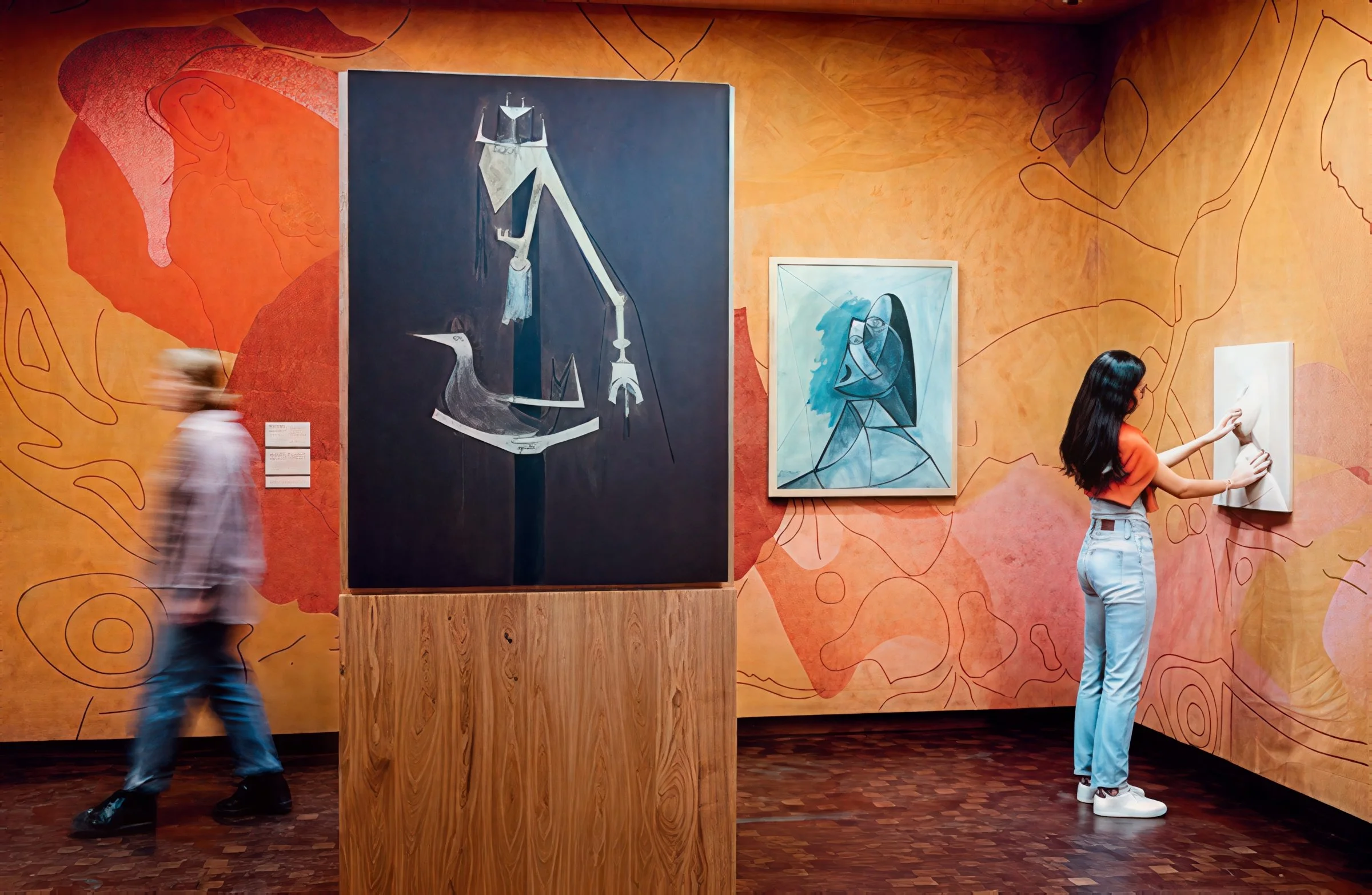
View of the exhibition Delinking and Relinking, Van Abbemuseum, Eindhoven, 2021. © Succession Picasso/photo © Archives Van Abbemuseum, photographer: Joep Jacobs.
In the same exhibition, an Ossip Zadine wood figure from early in the last century stands next to a similar sculpture carved from a tree trunk by Rodan Omomá, an Asmat artist from Papua who created it only a few years ago. Here, both time and place are disturbed. Traditionally, Omomá’s work would be shown in a former colonial/ ethnographic museum, most likely as part of a display of traditional crafts. Zadkine, on the other hand, is part of the twentieth-century modernist canon, an original artist and teacher whose work belongs securely in an art museum. Yet they are each doing very similar things with wood, and both are addressing traditions they feel as their own—Omomá in calling on his Asmat ancestors, Zadine in naming his work after the Greek goddess Demeter, a protagonist in a belief system that modern ideology places at the origin of “light modernity.”
The kinds of small adjustments that bring these two works into connection are valuable if we are to start to write pluriversal art histories in which museums tell different stories about modern, contemporary, and decolonial forms of art that depend on place (the relationship of the Netherlands to Papua or Dutch New Guinea is part of this narrative, for instance) and on the contextual time in which the works are shown. In terms of time here, the possibility that Omomá’s work could be understood as anachronistic hinges on modern ideas of progress and primitivism that Zadkine himself rejects but yet relies on for his status as a modern artist. Thus, within modern protocols, Zadkine is allowed to cite “primitive” art without becoming “primitive,” while the Papuan artist must remain in his ethnographic cage. This bind for artists from the Global South is a key to understanding what demodernizing can offer as a full reorientation of Euro-American value systems and a way to construct museums that can include cultures such as the Asmat within a pluriversal artistic narrative. At the same time, it releases some of the burden that Zadkine’s work has to carry in representing the “primitive” in an acceptable way. In the collection exhibition, the dialogue between these two works is also reinforced for me by a video nearby made by the Dutch artist Roy Villevoye that tells a story of two other Asmat cultural figures visiting the Netherlands in the 2010s and taking advantage of European medical technology to have their sight restored.
Beyond the collection presentations, geography plays a part in temporary exhibitions. I am very fond of duo or trio exhibitions, where different geographies and times can coincide in the museum space. One example I am especially proud of at the Van Abbemuseum is a duo show with Léon Ferrari and Gülsün Karamustafa, two artists from similar generations who never met, but who went through remarkably similar Cold War experiences of suppression and resistance in Argentina and Turkey. In presenting their parallel biographies, the exhibition spoke about the global reach of the binary Cold War and the effects of universalizing ideologies. It also related ways in which artists learned how to resist their marginalization and imprisonment, and challenged national art-historical discourses that stop at the borders. In this way, universalism is not opposed by particularism but by relationality.
HV: Speaking of narratives, your approach is one that multiplies viewpoints. How do you, in curating shows and the display of collections, make stories work in relation to history? How do your display strategies deal with the discrepancies, dissonances, and contradictions of the various levels, or modes of narration, and specifically the fact that they can be out of step with one another and unfold in different temporalities? What challenges does this approach create for the curator? Can you specifically think of successful or, on the contrary, unsatisfying or problematic examples?
CE: It’s interesting to me that you oppose stories and history, whereas I would see them as very compatible. History is composed of stories of the chronologically empowered: in the case of Northern and Western Europe, the United States of America is the hegemonic power here since 1945. Northern and Western Europe’s vassalage is partly one of submitting to stories generated from New York as exportable and applicable to this territory. Decolonizing helps us to see this for the power play it is, rather than a natural consequence of defeat or a “passing of the torch” from some empires to others, as British art historians like Kenneth Clark or Simon Schama would claim. Here, I would rather follow Walter Benjamin, who, at the end of his life, spoke about three parallel forms of history—the past, memory, and tradition—and how all are needed, while none is sufficient as a narrative in and of itself.10
In my sense, the task of a museum in a vassal territory such as the Netherlands would be to indicate how modern art emerges as a story in relation to a particular political, economic, and military moment, and to outline or suggest other parallel (or pluriversal) possibilities that might be more appropriate for our current time. In this sense, the fact that such narratives are out of step, both with dominant histories and within themselves in one exhibition, is crucial. It is this “out-of-step-ness” that creates the cracks into which subjectivity, doubt, and opinion, both communal and individual, can flow. Let me try to illustrate this with some concrete examples.
One of the Van Abbemuseum’s previous collection displays was called The Making of Modern Art and was curated together with an organization called The Museum of American Art, Berlin. The exhibition opened with a quietly didactic display of the (hi)story of art from the Dutch auction houses of the seventeenth century to the two pre-1945 art museum models developed by Alexander Dorner and Alfred Barr in Hannover and New York, respectively. The didacticism inherent in the displays was then undermined by bringing art together that carried very different historical weight. So, a Max Beckmann was shown alongside works borrowed from Hitler’s private collection, and a copy of an ironic Sotsart work by Alexander Kosolapov was hung next to an early example of socialist realism from the DDR. Interestingly, the two paintings held today to be more propagandistic are in the collection of the German Historical Museum [in Berlin] rather than in an art collection, thus showing how works shift from art to artifact, depending on political regimes. In the display, however, they were equalized in a way that made their different original contexts manifest and how they have been used to satisfy different narratives of modern art at different times, all written with little relation to the works themselves. These different modes of display—original, copy, collection, loan, photographic evidence, document facsimile, etc.—pluralized the first narrative and brought its authority into doubt.
It was also important that none of these multiple modes were trying to replace the MoMA myth with a new, singular, or corrective history more relevant for the present. Instead, the alternatives lay side by side within the overall story about the fiction of modern art as a category The exhibition unfolded further with Soviet exhibition histories and the significance of the patronage of American women collectors, such as Peggy Guggenheim or Katherine Dreier, and ended with a fantastical and quizzical look at modern art from a Utopian outside perspective.
My view is that this collection exhibition was crucial for liberating our largely Dutch publics, including myself and my curatorial colleagues, from the burden of carrying MoMA’s art history as a prime justification for the quality of the collection—especially as “quality” was an uninterrogated, almost canonical criterion in museum collecting until recently. The Making of Modern Art created the possibility to make sense of a project like demodernizing because it turned modern art into a contingent category. That’s hard for curators and art historians who are generally trained to uphold the established idea of modern art. To do what we did as a museum needed the authority, charm, and courage of an artist, albeit one who chooses to call himself the Technical Assistant of the Museum of American Art, Berlin. He helped us to release some of our curatorial gatekeeping through his artistic license. In this way, something like critical fabulation could be brought to bear on the museum’s collection without obsessing about its accuracy or defending an idea of history as a recreation of how the past actually was.
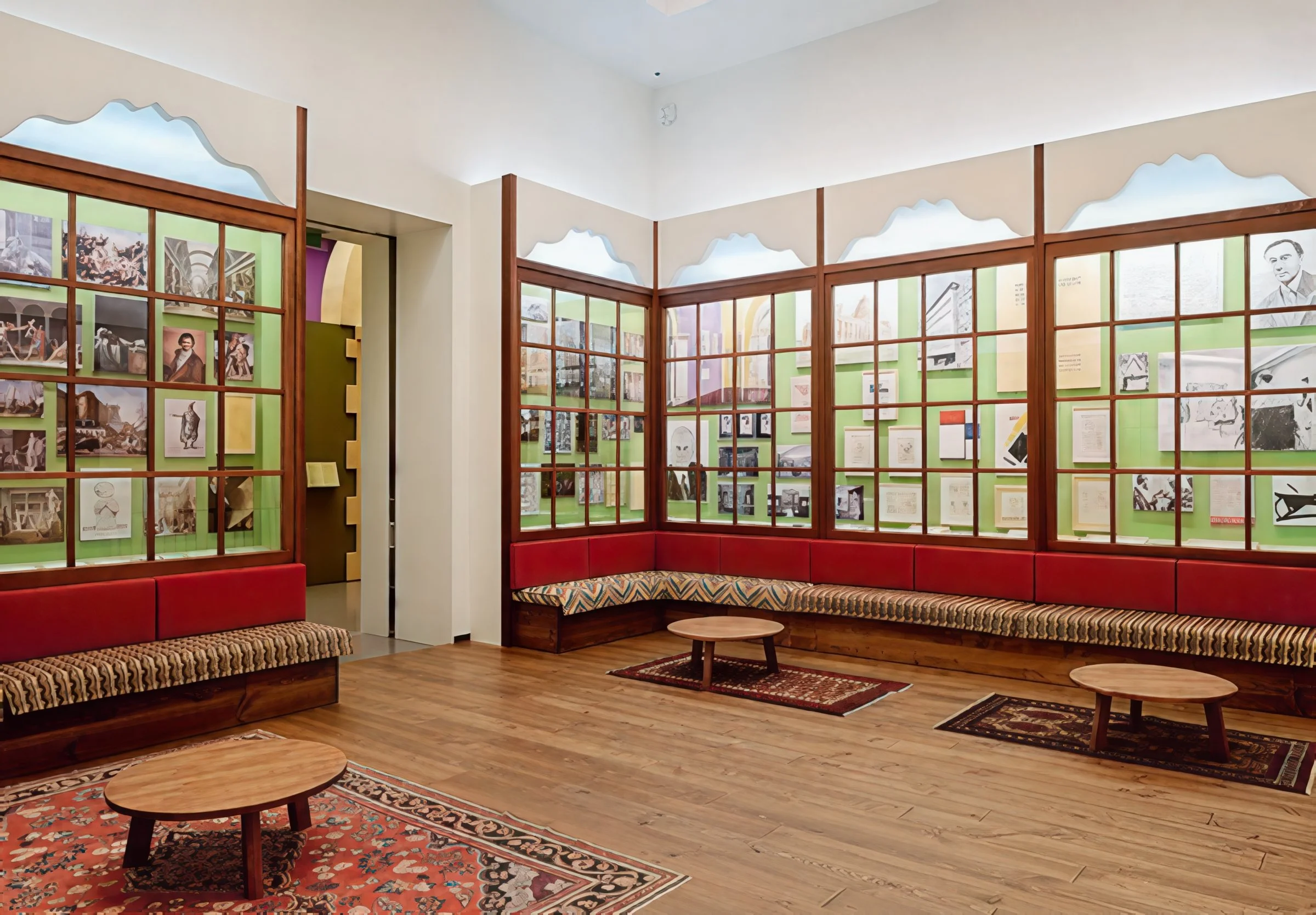
View of the exhibition The Making of Modern Art, Van Abbemuseum, Eindhoven, 2017.
Another positive example of narrative disjunctures is Play Van Abbe 4, which focused not on the art as such, but on the roles of the viewers, running four possible visitor role models for looking in parallel at artworks: the flaneur, the tourist, the pilgrim, and the worker. This was well-liked by the public, but I think the failures are possibly more instructive, especially if we measure intention against public reception. Here I would first think about my only attempt to really create a new singular narrative of the collection, which was called Once Upon a Time. Although it had some good moments, such as an extended modern-art exhibition-histories display, it relied too much on Immanuel Wallerstein’s world systems analysis as a new fixed chronology. The problem as a curator was that this one story (or history) took over and left little room for artistic experimentation or thinking about modes of display and the bodies of the museum users that were essential in later editions of the collection displays. Its didacticism was oppressive rather than playful, which is never a good feel for publics.
A more interesting failure, perhaps, was even earlier with Plug-In [in 2007], where we simply deconstructed any narrative from room to room and took each gallery as a world unto itself that could be changed or swapped about, depending on need and available resources. It borrowed from an Archigram idea of flexible urban architecture and was very much part of the fluid, neoliberal discourse of the pre-2008 financial crash period. Again, it had some great moments, such as the public request facility for works from the collection to be shown. But its fragmented nature was more alienating than stimulating, especially for traditional museum visitors. It remains remarkable for me that local politicians and even moderately successful artists would comment that the collection was no longer shown in the museum, meaning that the protocols of the collection—its semi-permanence, white cube, and familiar chronological narrative—were the defining aspects of identifying a collection, rather than the works themselves. This observation led me to understand that the claims of the presence of the artwork (its immanence) or its inherent “quality” are very dubious indeed. So, there is a balance to be struck between multiple narratives and fragmentation, in which the multiplication feeds a sense of discovery and not confusion and distraction. I think that’s an important lesson I learned through pluralizaing (hi)stories.
HV: In the Delinking and Relinking collection exhibition, you have used the motif of the rhizome, or the network of roots, to display the museum’s entangled history with the colonial past. I also heard you comment on Alfred Barr’s timelines of modern art from 1936 and 1941, demonstrating how these were profoundly connected to the thinking of their times. What role do these diagrammatic displays have on the perception of the history of art? And can one imagine a design that could unfold fully outside of the logic of colonial thinking? Again, could you comment on successful or problematic aspects of the designs you have been using in your curatorial work?
CE: It is an interesting question because I did try in the early days to make a new version of the Alfred Barr diagrams. This was before I fully understood that decolonizing does not mean trying to replace the universal modern timeline or sense of progress, but to pluriversalize everything to do with history/the past/tradition. My attempt was in response to a very different project by Tate London to bring Barr’s diagram up to date. What was interesting about that was that it fell apart after conceptualism and minimalism, first into media (photography/graffiti), then geography (Young British Art), and finally into single brand-name artists without any relation to each other. It was a failure and was fairly swiftly removed, but I think it showed exactly how any claim to a coherent modern art history is doomed. It was only ever Barr’s inventiveness and authority that made it possible. My timeline tried to draw out relations over time between realism and abstraction and how one aspect wanes as the other waxes and how individual artists are subtly responding to these waves of realism or abstraction. It was undoubtedly a misbegotten enterprise, and I never made it public, but it showed how in around 2008–09 I was still thinking that the modern as an ideology was salvageable. It was my growing awareness of a decolonizing imperative that stopped that attempt once and for all.
What I have found more compelling for diagrammatic design are mind-maps or mind-clouds that avoid chronologies but try to build from relations between certain terms or clusters of ideas. I’m sure these are not outside the colonial, but they learn from decolonizing thinking. The designers of Delinking and Relinking helped me and the museum curators to shape a curtain at the entrance of the exhibition that has some of these clusters on it. I think this is where you have seen the rhizomatic approach. I hope for some members of our publics that it provides an interesting insight, while for me, it feels more like snapshots of curatorial thinking at a certain moment in time and space. I guess the easy answer to your question about a design emerging outside the logic of colonial thinking is to say that it cannot start from here—from the Netherlands or France, for instance. It needs to begin in places where even the category of modern art would be puzzling and gradually build toward a relational understanding with “the lighter side.”
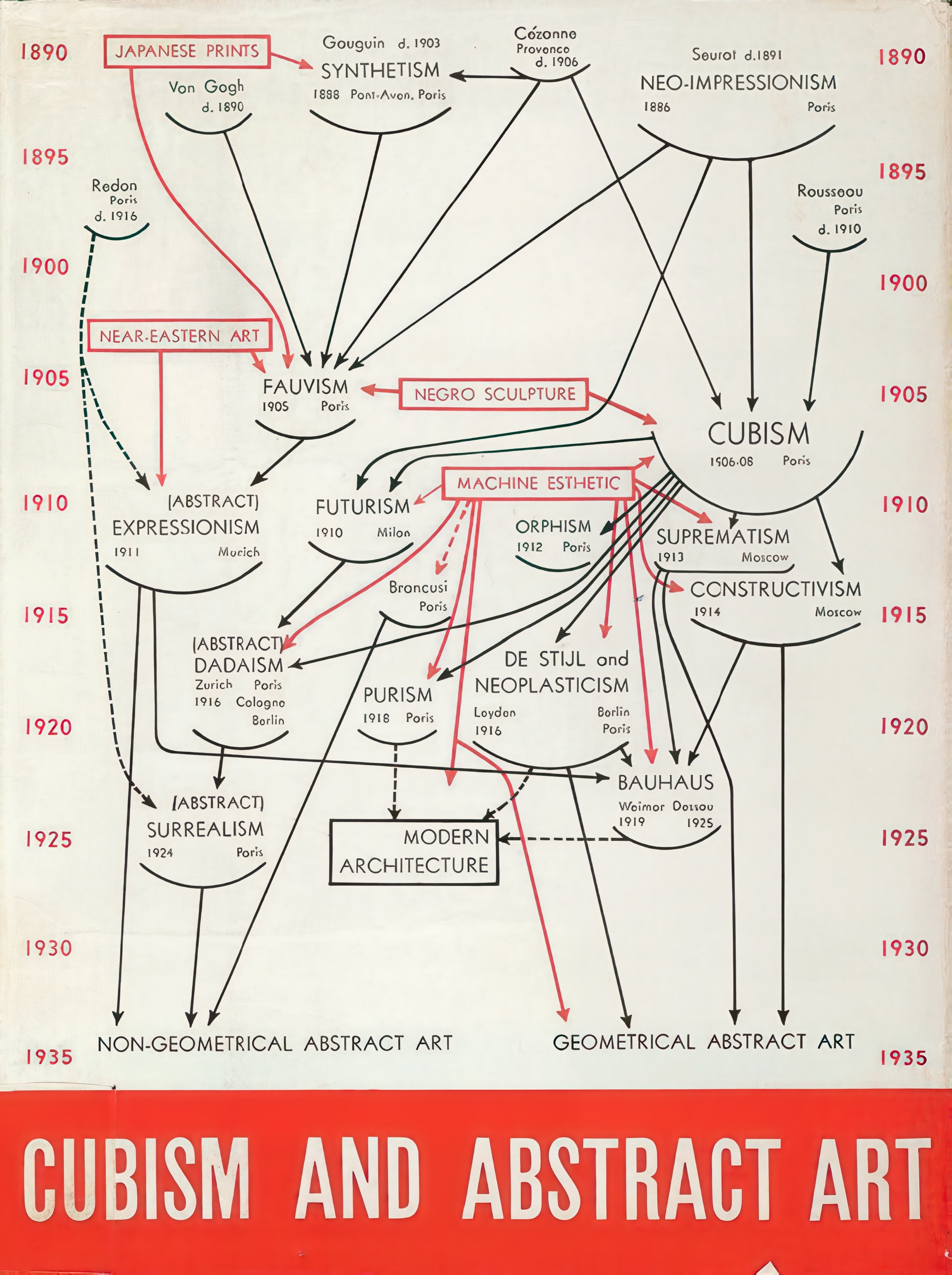
Alfred H. Barr, cover of the exhibition catalog Cubism and Abstract Art, Museum of Modern Art, New York, 1936.
The question of the colonial past and present of the museum is rather more fraught than passages of art history through time. As we see around us, decolonial thinking has produced a huge backlash. This comes not only from conservatives who want to preserve their colonial privileges but also from a left that seeks to defend the benefits of coloniality for the white working and middle classes, and in some cases defends new colonial genocides, as in Gaza. In response, I think it is vital that museums—which are holders of memories and are (hi)story-telling machines—come clean about their roots in colonial plunder and extraction, as well as research how those origins have not disappeared but continue in the form of coloniality today and are still present in their collection, programs, and patrons.
In the Van Abbemuseum, we tackled this in two ways. First, by making a strong exhibition statement that was called Hidden Connections and did not include many artworks but simply laid out the conditions for workers on the tobacco plantations that had generated the finances for the museum. Second, when I left, we had begun to work with artists and activists in Java and Sumatra to see what use the museum could be in support of their struggles and cultural activities. I saw this as a small step toward restitution, both in financial and epistemological terms. One concrete example would be an agreement to support a small museum in the Wates community of West Java by acquiring work from the BKP collective based nearby, and by offering our institutional knowledge to help develop the museum. Another concrete example was part of the last exhibition I made in the museum, which involved supporting the Congolese collective CATPC (Congolese Plantation Art Workers Circle), visiting the original tobacco fields in Sumatra, where they asked permission to show their work in Eindhoven and forged links that I hope the museum will develop after me.
HV: In your work at the Van Abbemuseum, you have included an extensive use of archives that reflected on the social history of the institution more than on the traditional art historical narratives. In your opinion, what does this epistemological shift from art history to social history mean for the discipline of art history at large? Does this redefine art history as an anachronistic discourse? And could one say that it is itself a product of its own history?
CE: Every discipline is a product of its own history, of course, and that history has ebbs and flows. However, I am not interested in defining art history, or discussing whether it is valid, but in using it as a tool to address art and art’s condition in the world. As such, art history is one of the tools a museum curator can use to reflect on the art that is being shown to their publics. For me, it remains valid but not particularly privileged when working in a museum. In making an exhibition like Hidden Connections about the colonial plantations that created the Van Abbemuseum, we needed economic and political knowledge first, and we worked with a social historian Reggie Baay to create a narrative that was partially erased by the colonizers. Later, the help and support of artists like CAPTC came in to develop relations with the people who now live and work on these plantations and whose conditions have not changed radically, though tobacco has given way to palm oil.
This exhibition is part of Delinking and Relinking as a whole; in other parts, such as Lam and Picasso or the room of two official modernisms, art history was essential. Then, in a room like “Proud Rebels,” with Sanja Iveković, Patricia Kaersenhout, Marlene Dumas, Gülsün Karamustafa, and Iris Kentsmil, the narrative relies less on art history and much more on feminist histories and theory, as well as a “boomerang” understanding of the Second World War in Europe to give the ensemble meaning. So, I would say that art museums are moving away from a close relation to art history, where they were even illustrators of art historical movements, and that they are adding other relationalities and theoretical constructions, including, of course, decolonizing. However, I don’t see them abandoning art history wholesale, but rather pluralizing the sources of the narratives that the museum seeks to share.
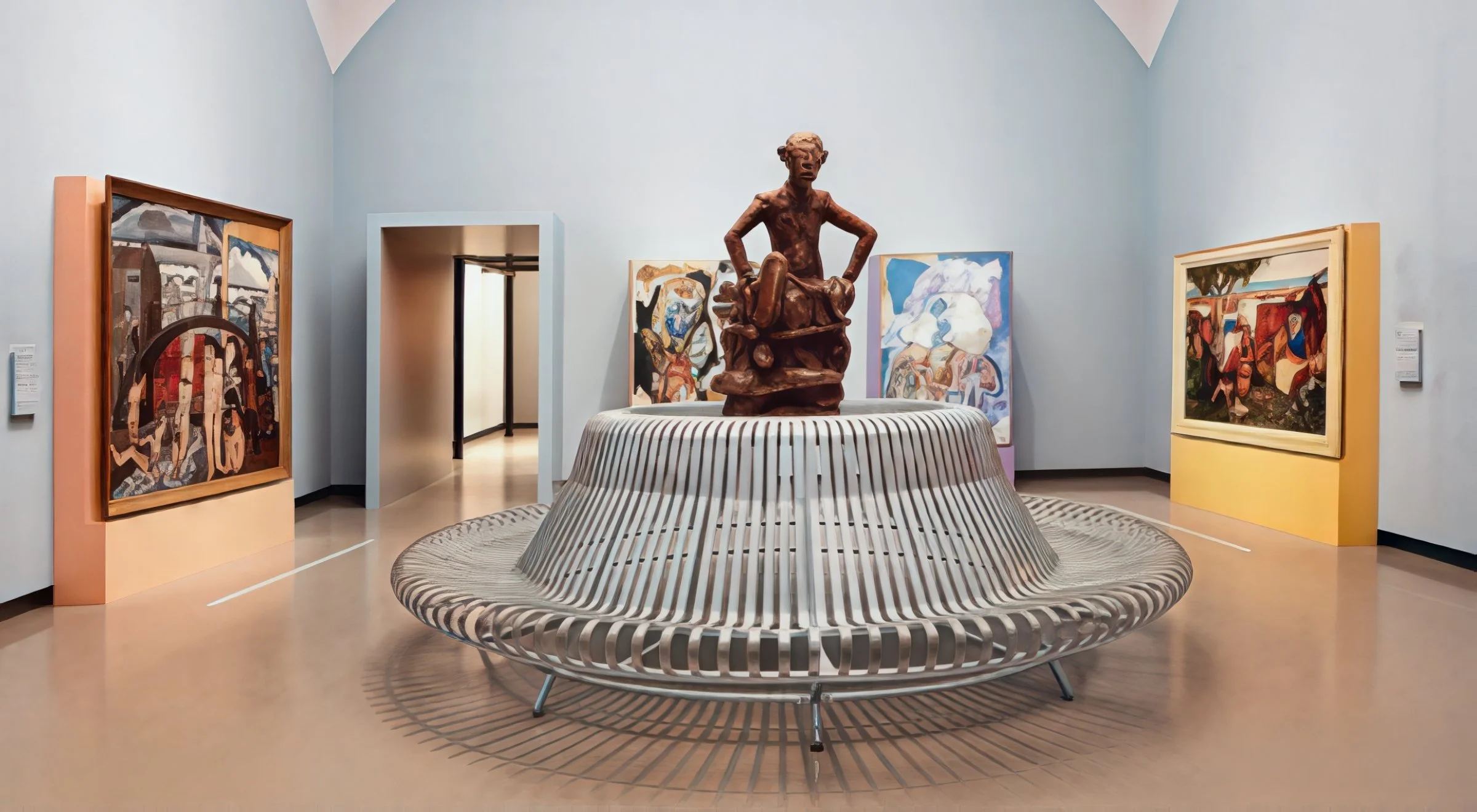
View of the CATPC exhibition, Two Sides of the Same Coin, Van Abbemuseum, Eindhoven, 2024. © CATPC/photo © Archives Van Abbemuseum, photographer: Nick Bookelaar.
HV: In a 2005 essay on contemporaneity, Giorgio Agamben explains that one needs to be out of step with one’s own time, to be anachronistic, to really be of one’s time. Yet at the same time, he explains being fully contemporary means “to show up on time at a rendezvous that one can only miss.” Our current political context forces many of us to sense a form of historical urgency and an increasing pressure on our definitions of history, and in looking for a “truth of the past.” What role do you see the museum playing here? What do you imagine the future of the museum to be in this context?
CE: I guess all philosophers are inconsistent, but maybe there is a way to reconcile being out of step and showing up on time. The most compelling part of Agamben’s thinking for me is in The Coming Community, which is a book that rejects identity for a whatever singularity (if I understand it well). Maybe this could be applied to the question of time, urgency, and anachronism. If the museum can be a place where whatever singularities, both animate and inanimate, can come together unburdened by the processes of claiming or rejecting identities, but in search of a relationship to art, to each other, and even to the divine, then this might help to define their future role. This would allow us to think about how a museum could be a place out of time and out of step and one that encourages reflection rather than mimicking the experience that the world anyway offers. At the same time, it is an embodied experience where it is necessary to be physically present in order to build relations. I see a connection here with our work in the museum on how different bodies and capacities can feel welcome, including touch, sound, and smell in the mediation support structures.
Maybe this is all a little too vague, but I would be interested to borrow from Agamben to develop an idea of a museum as a place that prefigures the coming community. I also see it as idealistic, but I think museums need to be in dialogue with idealism, even as they are constantly confronted by pragmatics. Museums are not profit-centers nor measured by popularity because they preserve something like collective cultural memory that is not limited to an exhibition or even a generation. That is their strength and uniqueness, and museums are there to cherish what is not instantly able to be financialized. It is partly the loss of a plurality of ideas next to capital accumulation that is the tragedy of the early twenty-first century, and museums could, if they understood themselves as such, bear part of the responsibility to resist the bitter logic of the bottom line.
HV: As a curator of contemporary art, does your experience in decolonizing the museum make you more attentive to the work of artists who address history and our relationship to it? Can you comment on the work of artists who do shed a creative light on the issues you have been working on at the museum?
CE: What decolonizing points to above all is the need to understand modernity and coloniality as two aspects of the same. A museum of modern art has, therefore, to bear the erasures and destruction of coloniality inside itself and in its foundations. Decolonizing is, therefore, not simply a rewriting of histories—though it includes it—but more a reorientation away from repeating the colonial-modern forms of politics, economy, and social control. When I think about artists working today who address these questions, my knowledge is also very partial and geographically limited. But artists and thinkers who are important to me in working through these questions include DAAR (Sandi Hilai and Alessandro Petti), Hira Nabi, Zena Cumpston, Catherine Walsh, Rolando Vazquez Melken, Jatiwangi Art Factory, ruangrupa, Patricia Kaersenhout, CATPC, Walter Mignolo, and Experimental Station for Art and Life, to name a few with whom I have worked recently.
What is important for me in all their work, if I can generalize for a moment, is that it has a fundamentally propositional character rather than a critical one. In my view, these artists and thinkers are working to free themselves of the inheritance of modernist criticality and to seek different possibilities and better values in the mire of the mid-twenty-first-century world. This minor optimism in the face of current conditions is hugely important, I think, no matter how bad the next wars will be. I find myself today often saying that we have to remember that there was a 1945—something that would have seemed unimaginable only five years before. We should really prepare ourselves not to miss that rendezvous when the world has again had enough of tyrants and bullies, and wants to revise its ideas of justice, extraction, and relation to the land. Artists have a way to understand and communicate all of this in ways that I still find extraordinary. That’s why I’m sticking with them.
NOTES
1. Barbara Adams, Time (Polity, 2004). Adams’s view resonates with postcolonial and anthropological critiques of temporal hegemonies, such as the works of anthropologist Johannes Fabian and historian Dipesh Chakrabarty. See also Johannes Fabian, Time and the Other How Anthropology Makes Its Object (Columbia University Press, 1983, 2014) and Dipesh Chakrabarty, Provincializing Europe: Postcolonial Thought and Historical Difference (Princeton University Press, 2008).
2. Fred Wilson, Mining the Museum: An Installation, Maryland Historical Society, April 4, 1992–February 28, 1993. See similar interventions, such as The Lost World, Oxford Museum of Archaeology and Anthropology and Contemporary Art Tasmania (CAT), Hobart. October 23—November 30, 2013, and the book inspired by the exhibition, The Importance of Being Anachronistic: Contemporary Aboriginal Art and Museum Reparations, ed. Khadija von Zinnenburg Carroll (Discipline and Third Text Publications, 2016).
3. Before Yesterday We Could Fly: An Afrofuturist Period Room, the Metropolitan Museum of Art, New York, ongoing since November 10, 2021.
4. “UNTIE TO TIE – On Colonial Legacies and Contemporary Societies,” ifa-Galerie, Berlin, March 30, 2017–March 30, 2018.
5. The Museum Is Multiple. Van Abbemuseum 2004–2024, eds. Charles Esche and Chương-Đài Võ (Van Abbemuseum, 2024).
6. Esche is currently working on a book on demodern thinking with Sandi Hilal and Alessandro Petti, forthcoming from Duke University Press this year.
7. Quijano, Aníbal, “Coloniality of Power, Eurocentrism, and Latin America,” Nepantla: Views from South 1 (3), 2000, 533–580.
8. Walter D. Mignolo, The Darker Side of Western Modernity: Global Futures, Decolonial Options. (Duke University Press, 2011).
9. Specifically, I am thinking of the work of Jorge González Santos or the Congolese Plantation Art Workers Circle here.
10. Walter Benjamin, “Theses on the Philosophy of History,” Thesis VI, Critical Theory and Society (Routledge, 2020), 255–263.
-
Charles Esche is a curator and writer. He served as Director of the Van Abbemuseum, Eindhoven (2004–2023), where he developed a program centered on decoloniality, institutional critique, and plural narratives of modern and contemporary art. He has curated numerous international exhibitions and biennials and writes widely on museums, politics, and artistic practice.
Hélène Valance is a scientific advisor responsible for the Histoire en Jeux research program at the InVisu laboratory (CNRS) at the National Institute of Art History. Her research focuses on representations of the past in the visual cultures of nineteenth-century France and the United States.