
The Curatorial: From Epistemic Capacities to Curatorial Research
How does the curatorial investigate and constitute the world around us? How is knowledge articulated differently from the inherited disciplines and protocols of academia?
By Carolina Rito
Carolina Rito • 2/1/25
-
Critical Curating is The Curatorial’s section devoted to more theoretically oriented considerations of curatorial research and practice. While of a specialized nature, we seek essays for this section that are written for a broadly engaged intellectual audience interested in curating’s philosophical, historical, aesthetic, political, and social tenets, as well as a labor-based activity and its ramifications.
This essay examines curatorial research as a critical epistemological practice intersecting artistic research, curatorial methodology, and critical theory. Drawing on the work of Irit Rogoff, Maria Lind, and others, it explores how curatorial research operates beyond traditional exhibition-making, emphasizing processes of exposure, relational assemblages, and speculative inquiry. The essay argues that curatorial research resists conclusive answers by prioritizing exploration, dynamic inquiry, and audience participation, offering a transformative approach to cultural knowledge production and critical engagement.
Much ink has been spilled over the last twenty years concerning the specific characteristics and relevance of artistic research. To cite just a few examples: the work of Tom Holert on conceptualizing artistic research as an agent of neoliberal politics, the editorial texts of the Journal of Artistic Research, the numerous events exploring the subject (including the annual conferences of the Society for Artistic Research and the European Artistic Research Network), and the many doctoral programs in artistic research that continue to proliferate around the world.1 However, much has been said, experts question the degree of novelty that seems to animate these conversations, seeing that some of the questions raised appear to ignore the fact that artistic research has been around at least since the 1990s, if we consider the first PhDs in the field. A much longer history could be traced back at least to the nineteenth-century debates about science and art in their particular forms of knowledge production.
I agree with the critique of the relentless sense of novelty in these discussions and the perpetual start-from-scratch tone of most conversations about artistic research. Still, I would like to argue that the same cannot be said about the bourgeoning field of curatorial research, which, like artistic research, is conducted through the means of practice, but this time curatorially. Often confused with the curation of research exhibitions, curatorial research is the process by which curatorial formats are used to articulate questions, advance investigations, and provide new insights into the subject matter to which they are applied. Although curatorial research is far from being the new kid on the block, it is fair to say that it has never attracted the same kind of attention as artistic research. This lack of attention is evident both in the nature of the debates and, most fundamentally, in the lack of resources devoted to supporting and enabling these investigative practices. In what follows, I will discuss some of the reasons that have led to the lack of resources for curatorial research, and I will trace some of the prominent references in this debate. Most importantly, I would like to suggest a few ideas to frame the epistemic qualities of curatorial research.
Before outlining some of the contributions and specifics of curatorial research, it is important to acknowledge that, for some of the scholars who have engaged in these debates, the curatorial is a field that benefits from being left without a clear definition so that its practice, together with its needs and urgencies, determines its behavior and how it manifests itself. And while I agree with the principle of letting practice determine the direction of the field, I am also wary of the lack of a clearer framework, which has arguably limited the development of curatorial research in both the cultural and academic fields. These drawbacks include, for example, the lack of recognition of the field in research funding, in doctoral programs in practice studies, and in curatorial programming in cultural institutions, where research is usually limited to the domain of exploring the museum’s collection.
As I have noted above, curatorial research has often been confused with the curation of exhibitions in which the results of a research process are displayed and shared with a wider audience. This is what I would call a research exhibition. Research exhibitions can be the result of an investigation in any field and discipline, from the arts and humanities to the sciences, and are organized to display and represent the results, interpretations, and findings. More than occasionally, this is taken to simply signify exhibitions that involve some degree of research in their preparation—which is arguably always the case, since a curatorial process typically involves the exploration of a wide range of ideas and artifacts toward the ultimate selection to present.
Another common misconception is that curatorial research is the result of a thematic exhibition, where a theme is represented by the objects/artifacts/documents on display. This is often the case in the arts, where artworks are brought together to represent an idea, concept, or argument. A simple example would be an exhibition exploring the impact of climate change on the planet, with the presentation of artworks representing natural disasters such as floods, droughts, and the displacement of peoples and species caused by CO2 emissions into the atmosphere.
What I want to explore is curatorial research, not as a representation of the given subject, but as a process of investigation in which the subject is set in motion through curatorial formats. These methods, such as exhibitions, talks, workshops, events, publications, and more, make public the questions, doubts, propositions, and ambiguities of the process of knowing. So, we can say that curatorial research is a methodology of knowledge production situated symbiotically with the field of artistic research—or, as it’s sometimes known, as practice research in the arts—where artistic research is conducted through the means of curatorial methods, formats, and modus operandi.
The Curatorial and the Production of Knowledge: The Debate
In the first decade of the 2000s, the intersection between knowledge production, research, and curating has led curators and researchers to claim that this new arena of practice was a place where knowledge was constituted differently. These claims go hand in hand with the expansion of curating, from the presentation of a set of objects to convey an idea and/or a narrative, to a much broader cultural activity from which questions, knowledge, and concerns are addressed by bringing together people, materials, and ideas in the larger field of the artwork and the exhibition. It is with these new ideas in mind that such scholars and curators as Irit Rogoff, Maria Lind, Beatrice von Bismarck, and Paul O'Neill and Mick Wilson, among others, have begun to explore the potential of curating as a forum for critical debate and knowledge production.2 Despite the differences in their arguments, there is a common denominator in the points they share: the field of curating has given way to a new kind of cultural engagement and conceptual formulation. In their writings, they called this new approach “the curatorial.”
As the curatorial began to emerge as a new concept, it was useful for these authors to explain the differences between curating and the curatorial. Although both terms are related to the practice of giving-something-to-be-experienced, the curatorial is seen as a departure from the professional activity of organizing exhibitions. Instead, the curatorial is located in the expanded field of curating, with a role that goes beyond displaying objects and points to the epistemic functions of cultural production. As Lind put it:
Seen this way, “curating” would be the technical modality—which we know from art institutions and independent projects alike—and “the curatorial” a more viral presence consisting of signification processes and relationships between objects, people, places, ideas, and so forth, that strives to create friction and push new ideas—to do something other than “business as usual” within and beyond contemporary art.3
In the wake of the second millennium, curating was enjoying its own success with the heyday of the never-ending proliferation of biennials, large-scale exhibitions, and the increasingly prominent stardom of curators that some felt was annoyingly overshadowing the space that once belonged exclusively to artists. While the glitter danced in the air, there were practitioners and thinkers who were intrigued by the new possibilities that curating was opening up beyond the spectacle and the spotlight. One could even say that other curatorial ambitions, which seemed to be set against the increasing neoliberalization of cultural production as a spectacle commodity, were ready to be apprehended. These debates were concerned with finding a space for a long-term, process-driven, collective forum to exchange ideas and energize contemporary debates among participants in the field. The idea was to promote the field’s radical interdependence with every discipline of knowledge production, getting rid of the long and monotonous discussion about the autonomy of the artwork, and the exhibition.
In 2006, Rogoff published “Smuggling—Embodied Criticality,” which has become one of the seminal texts on the curatorial. It explored the epistemic possibilities of the curatorial from a different standpoint. It started from the complex position of the curator/researcher and their socio-political conditions to generate new questions and methods of approach. Rogoff argues that the inherited disciplines in academia no longer "accommodate the complex realities we are trying to live, nor the ever more attenuated ways we have of thinking about them."4 In this way, Rogoff makes a clear distinction between curating and the curatorial. While curating stands for the professional skills of exhibition-making and the task of representing worlds, the curatorial is far removed from illustration, intention, and exemplification. The curatorial is critical thinking that does not rush to embody itself, does not rush to concretize itself, but allows us to stay with the questions until they point us in a direction we might not have been able to predict.5
A few years later, Lind took up the debate about the differences between curating and the curatorial to locate the latter in the tensions and frictions of the connections between things; in the “linking objects, images, processes, people, locations, histories, and discourses in physical space like an active catalyst, generating twists, turns, and tensions.”6 In this way, the curatorial is not the result of an intended message, but the generator of a new social and political situation. For Lind, following Chantal Mouffe's notion of “the political,” the curatorial performs something in the here and now, rather than merely mapping it from the there and then, or representing what is already known. This new space of signification is also where the potential for political resignification can take place, with new dynamics, roles, functions, meanings, and social relations becoming moving parts.7
These lively debates demonstrated that the space opened up by the curatorial allowed for the exploration of forms and concepts of practice that operate away from, alongside, or in addition to the main work of curating as exhibition-making, an approach considered from various perspectives in O’Neill and Wilson’s Curating Research.8 Further to this, Irit Rogoff notes:
[…] the curatorial makes it possible for us to affect a shift in emphasis to a very different place, to the trajectory of activity. So if in curating, the emphasis is on the end product—even if that end product is often very complicated and ends up performing differently than one might have assumed—in the curatorial, the emphasis is on the trajectory of ongoing, active work, not an isolated end product but a blip along the line of an ongoing project.9
This implies a process of signification that inevitably changes in the new assemblages of things, the performance of meaning in the making. Here the questions are: How does the curatorial investigate and constitute the world around us? How is knowledge articulated differently from the inherited disciplines and protocols of academia?
The Epistemic Capacities of Curatorial Research
Defining the epistemic qualities of the curatorial has implications for how knowledge is perceived outside the traditional institutions of knowledge production, such as the university and the museum, as well as for the continued belief in the hegemony of the inherited protocols of academic research based on rigor, originality, and objectivity. The impact of the debates about the characteristics and modes of the curatorial is as much an epistemic shift in perceptions of where and how research is conducted and valued as it is a political consideration—who has the power to validate it and who is it for. What I mean to present here is to present a few ideas for a possible framework for curatorial research that academia explore, enable and support.
The curatorial, as a situation or event of knowledge, emerges from the juxtaposition and relations between materials and ideas. And that these relationships are enacted and activated within and through the exhibitionary conditions present in the socio-political context. “Exhibitionary” here refers to the apparatus that incorporates and activates these materials and their meanings in their relation to one another, or in their exposure to one another. “Exposure” is central to my thinking in what follows, and I use the term in alignment with Jean-Luc Nancy’s notion of “touching,” which refers to how the meanings and perceptions of materials in relation to one another are established, as well as the relationships among more abstract forms, such as concepts and ideas.10 These relationships emerge from the materials that constitute the objects in any curatorial production—or even outside of it. They define those objects in their co-relations, modifying their meanings, how they are perceived, and actualizing them in time and space.
This is not only a matter of the physical arrangement of objects and their proximity to one another but also a matter of their remote correlation—the way that connections are established among objects even when they are not in proximity. Exposure also relates to the correlation (as it is with people and ideas) over geographic and temporal distances. This is like two people in different countries who remain “in touch,” mutually influencing each other over space and time. The exposures of the curatorial are aesthetic, as they are established as the forms of the historical, the social and the political in the instability and plasticity of meanings and affects. It is in the tensions between things that the singularity of the curatorial situation is generated, a unique situation that is provoked precisely thanks to and in the instability between (un)fixed meanings and affects.
In the curatorial, the subjects and objects of inquiry are set in conversation, mutually influencing one another, and neither subject nor object remains the same throughout the research process. This is in keeping with the fact that, arguably unlike traditional research, curatorial research does not aim to reach a conclusive outcome, providing a fixed answer or solving a problem. It is not about knowing more and better. The curatorial is not concerned with the idea of immanent knowledge or the meaning intrinsic to things in the world, but rather with historical systems of truth, genealogies, and the plasticity and performativity that these materials carry with them. In this way, the curatorial aims to critically engage with the material and immaterial formations that are exposed in a historically situated world, while critically perform within aesthetic and epistemic formations. In that way, we could say that the curatorial contribution to the subject matter to which it is applied is essayistic and exploratory rather than evidence-based.
The methods of the curatorial are the so-called formats of curating, which include, but can’t be reduced to, exhibitions, talks, publications, workshops, public programs, and essays, to name just a few. These events (or what I would like to call “operative exposures”) come into being when propositions are made public and meanings are challenged, resisted, and reimagined. Because of its public nature, the methods of the curatorial are simultaneously outputs, and means of dissemination of the investigation. The intersection of methods, outputs and dissemination in curatorial research raises new questions about audiences in their different formations as participants and recipients. The audience becomes one more exposure to what is being set in relation, and so is an active participant in the sensory experience and resignification of the work. The audiences’ co-engagement (whether profound, superficial, or tangential) continues beyond the temporal end of the curatorial event.
In conclusion, I believe that curating has a great deal to contribute to the ways in which we perceive the functions of cultural production as well as the potential of research in the arts to navigate the complexities of contemporaneity. If the epistemic and methodological dimensions of the curatorial are further developed, it holds the prospect of establishing a curatorial way of understanding the material world around us. This approach is critical, relational, and performative, grounded in the instability and interconnectedness of meanings, objects, and ideas. By prioritizing exposure, juxtaposition, and the dynamic interplay between materials, concepts, and audiences, curatorial research resists definitive answers and instead embraces essayistic inquiry, enabling critical engagement within the forms of the historical, social, and political. In this sense, the curatorial is not merely a medium for disseminating knowledge but a transformative space in which understanding is continually reimagined through collective participation and dialogue. For it to thrive, though, it is crucial that academia and the cultural sector avoid imposing rigid protocols on this kind of research, instead using it as an opportunity to expand their epistemic and practice-research horizons.
NOTES
Tom Holert, Knowledge Beside Itself: Contemporary Art’s Epistemic Politics (Cambridge, MA: Sternberg Press, 2020). Michael Schwab, "Editorial," Journal of Artistic Research, no. 24. https://jar-online.net/en/issues/24.
Irit Rogoff, “‘Smuggling’ – An Embodied Criticality,” Transversal - EIPCP Web Journal, no. 08 (2006). https://eipcp.net/dlfiles/rogoff-smuggling/attachment_download/rogoff-smuggling.pdf. Irit Rogoff, “The Expanded Field,” in The Curatorial: A Philosophy of Curating, ed. Jean-Paul Martinon and Irit Rogoff (New York: Bloomsbury Academic, 2013), 41–48. Maria Lind, “The Curatorial,” Artforum, October 2009. https://www.artforum.com/columns/the-curatorial-192127/. Maria Lind, Selected Maria Lind Writing, ed. Brian Kuan Wood (Berlin: Sternberg Press, 2010). Maria Lind, ed., Performing the Curatorial: Within and Beyond Art (Berlin: Sternberg Press, 2012). Beatrice von Bismarck, Jörn Schafaff, and Thomas Weski, eds., Cultures of the Curatorial (Berlin: Sternberg Press, 2012). Curating Research, eds. Paul O’Neill and Mick Wilson (Amsterdam: Open Editions/de Appel, 2014).
Lind, Performing the Curatorial, 20.
Rogoff, “‘Smuggling’ – An Embodied Criticality,” n.p.
Rogoff, “‘Smuggling’ – An Embodied Criticality.”
Lind, Selected Maria Lind Writing, 63.
Lind, Selected Maria Lind Writing.
O’Neill and Wilson, Curating Research.
Irit Rogoff and Beatrice von Bismarck, "Curating/Curatorial: A Conversation Between Irit Rogoff and Beatrice von Bismarck," in Cultures of the Curatorial, ed. Beatrice von Bismarck, Jörn Schafaff, and Thomas Weski (Berlin: Sternberg Press, 2012), 21–30, 23.
Jean-Luc Nancy, “Touching,” in The Sense of the World, (Minnesota: University of Minnesota Press, 1998), 59–63.
-
Carolina Rito is Professor of Creative Practice Research at the Research Centre for Arts, Memory, and Communities, Coventry University, UK. She is a researcher and curator whose work is situated at the intersection of knowledge production, the curatorial, and contested historical narratives. Rito is an Executive Board Member of the Midlands Higher Education & Culture Forum and a Research Fellow at the Institute of Contemporary History (IHC), Universidade Nova de Lisboa. She has served as the Executive Editor of The Contemporary Journal and has published in international journals such as King’s Review, Mousse Magazine, Wrong Wrong, and The Curatorial. From 2017 to 2019, Rito was Head of Public Programs and Research at Nottingham Contemporary, leading the partnership with Nottingham Trent University and the University of Nottingham. She holds a PhD in Curatorial/Knowledge from Goldsmiths, University of London, where she also taught from 2014 to 2016. She lectures internationally—in Europe, South America, and the Middle East—on her research and curatorial studies. She is a member of the Curatorial Studies Workshop, part of the Expanded Artistic Research Network (EARN).
At the Edge of Ailey
While the exhibition offers a dizzying spectacle and aims to transcend disciplinary borders, it remains rooted in largely static visual art forms—ironic for a show dedicated to a master of movement.
By Tom Koren
Tom Koren • 2/1/25
Edges of Ailey, Whitney Museum of American Art, New York, September 2024–February 2025
-
On Site is The Curatorial’s section in which writers review exhibitions from a curatorial perspective—not an art review, a curatorial review. This is also a showcase for master’s degree students in the MA Curatorial Practice program at the School of Visual Arts (the home of the journal) to publish as part of the program—though others are welcome to write for On Site as well.
In this review, Adrienne Edwards’s groundbreaking exhibition, concerned with the choreographer Alvin Ailey, is critiqued. The exhibition offers a variety of approaches to delve into Ailey’s work and cultural context. It is spectacular and challenging in ways that are both informative and problematic for our reviewer.
As the Whitney Museum elevator doors open onto the fifth-floor galleries, the Edges of Ailey audience is met with a dizzying spectacle. The vastness of the open space, the dramatically dimmed spotlights, the luscious burgundy walls, the abundance of artworks, and the multi-channel video panorama that envelops the gallery—its soulful and propulsive soundtrack reverberating throughout—combine into a glamorous theatricality, making it feel as though one has emerged directly onto an active stage.
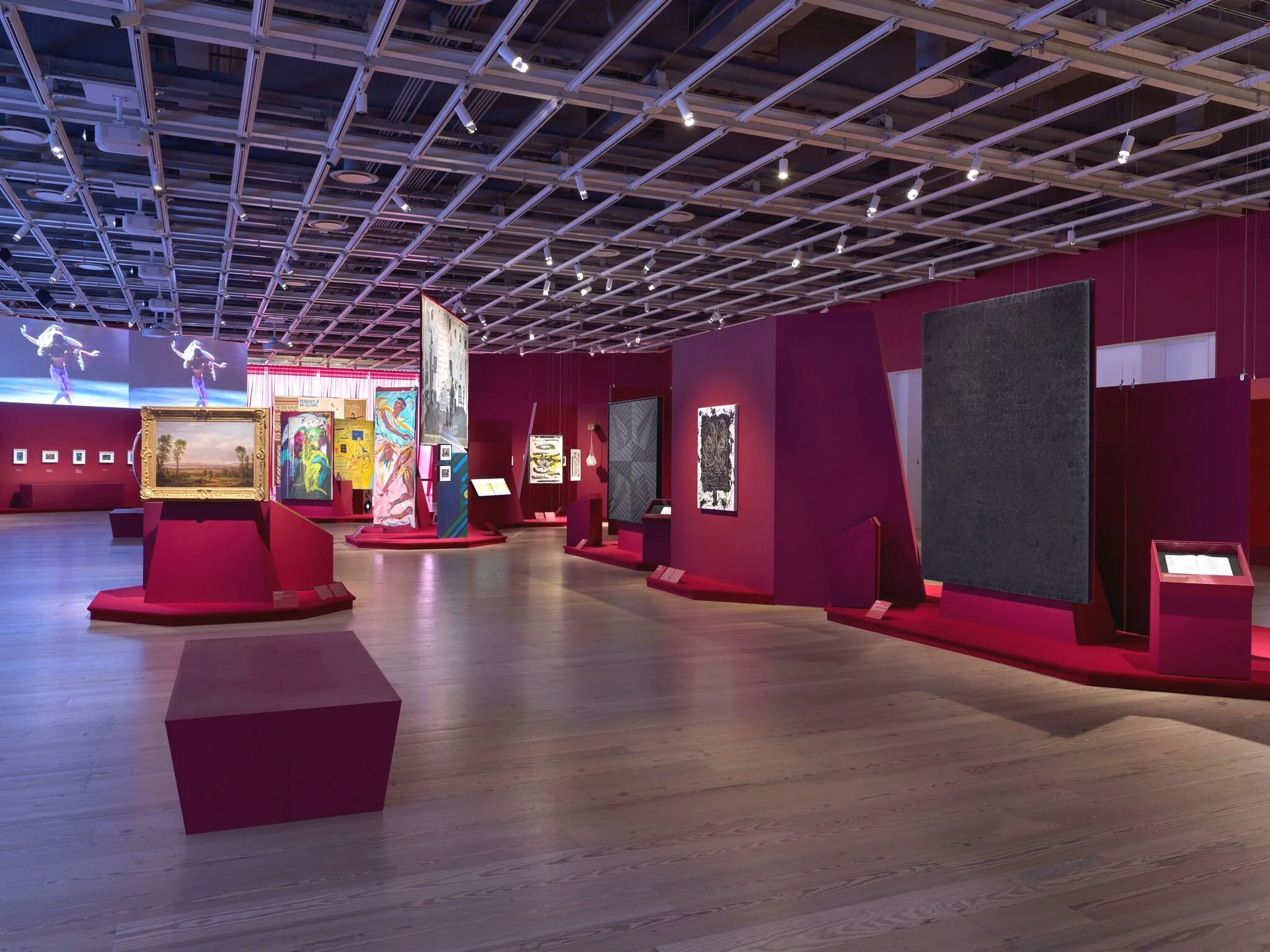
Installation view of Edges of Ailey (Whitney Museum of American Art, New York, September 25, 2024-February 9, 2025). From left to right: Romare Bearden, “The Father Comes Home” from the Bayou Fever series, 1979; Romare Bearden, “Wife and Child in Cabin” from the Bayou Fever series, 1979; Romare Bearden, “The Herb Woman” from the Bayou Fever series, 1979; Romare Bearden, “The Mother Hears the Train” from the Bayou Fever series, 1979; Robert Duncanson, View of Cincinnati, Ohio from Covington, Kentucky, c. 1851; Mary Lovelace O’Neal, Race Woman Series #7, c. 1990s; Jean-Michel Basquiat, Hollywood Africans, 1983; Emma Amos, Judith Jamison as Josephine Baker, 1985; Kerry James Marshall, Souvenir IV, 1998; Ellsworth Ausby, Untitled, 1970; Lorna Simpson, Momentum, 2011; Kandis Williams, Black Box, 4 points: Horton, Ailey, McKayle contractions and expansions of drama from vernacular –– arms outstretched and entangle, 2021; Jacob Lawrence, Figure Study, c. 1970; Terry Adkins, Other Bloods (from The Principalities), 2012; James Little, Stars and Stripes, 2021; Rashid Johnson, Untitled Anxious Men, 2016; Glenn Ligon, Stranger in the Village #12, 1998. Photograph by Ron Amstutz. All images courtesy the Whitney Museum of American Art.
Edges of Ailey, curated by Adrienne Edwards, the Engell Speyer Family Curator and Curator of Performance at the Whitney, honors the trailblazing choreographer Alvin Ailey (1931–1989) and the legacy of his eponymous dance company, founded in 1958 and active to this day. Drawing on Ailey’s innovative, cross-disciplinary, and tentacular approach to modern dance—with inspirations ranging from literature and poetry, music and art, theater and cinema, to history, politics, community, and spirituality—the exhibition seeks to explore and pay homage to the roots and impact of his practice through a unique presentation of visual art complemented by a live dance program in the museum’s theater.
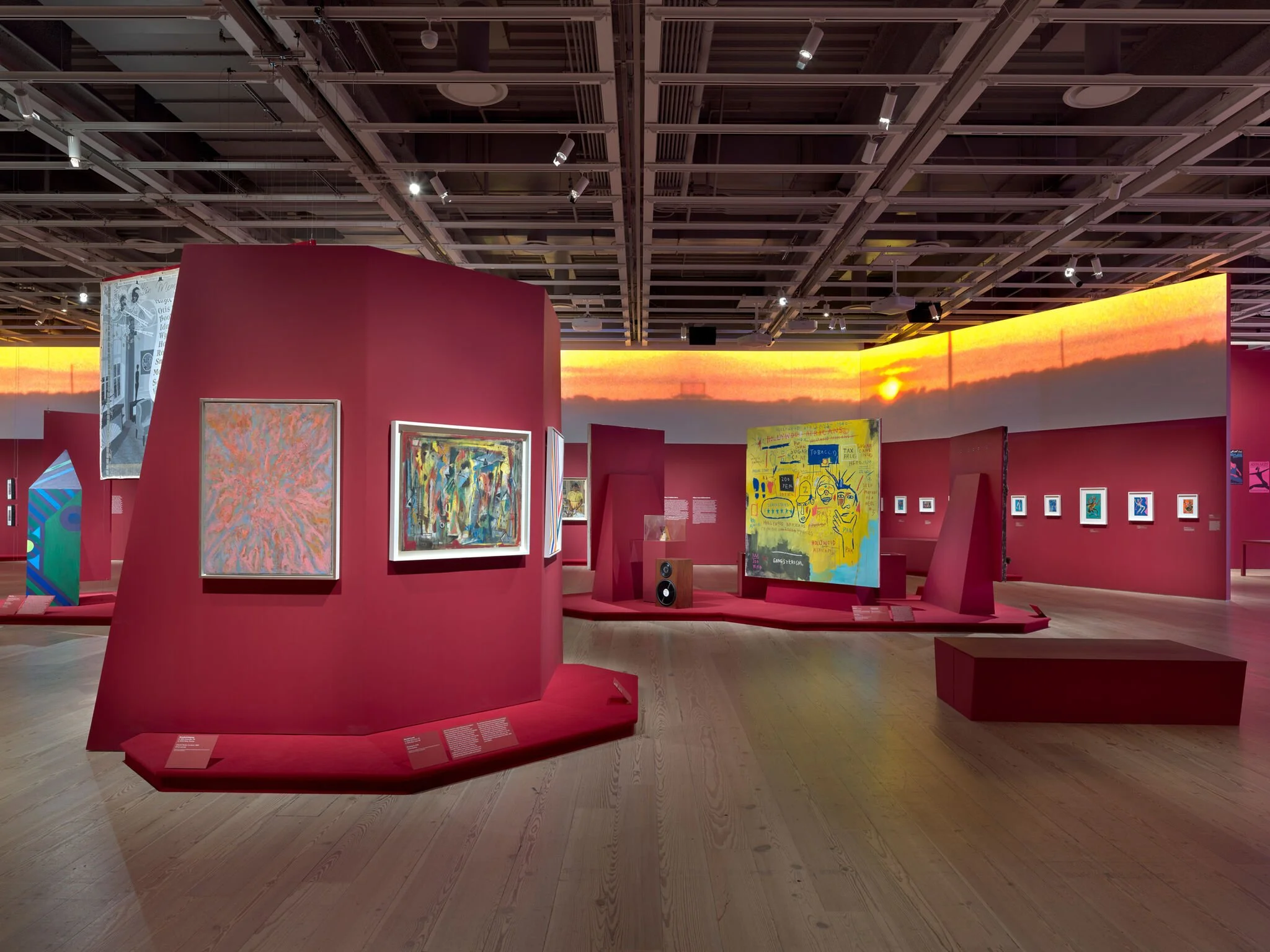
From left to right: Ellsworth Ausby, Untitled, 1970; Kerry James Marshall, Souvenir IV, 1998; Beauford Delaney, Charlie Parker Yardbird, 1958; Norman Lewis, Phantasy II, 1946; Sam Gilliam, Swing 64, 1964; Loïs Mailou Jones, Jennie, 1943; Betye Saar, I’ve Got Rhythm, 1972; Charles Gaines, Sound Box: Nina Simone and Billie Holiday, 2021; Jean-Michel Basquiat, Hollywood Africans, 1983; Romare Bearden, “The Father Comes Home” from the Bayou Fever series, 1979; Romare Bearden, “Wife and Child in Cabin” from the Bayou Fever series, 1979; Romare Bearden, ”The Swamp Witch” from the Bayou Fever series, 1979; Romare Bearden, “The Blue Demons” from the Bayou Fever series, 1979; Romare Bearden, “The Wart Hog” from the Bayou Fever series, 1979; Romare Bearden, “The Lizard” from the Bayou Fever series, 1979; Romare Bearden, “The Hatchet Man” from the Bayou Fever series, 1979. Photograph by Ron Amstutz.
Ailey’s visionary spirit is reflected mainly in the exhibition design. The decision to open up the entire gallery space is daring; there are hardly any separations, and the entirety of the show becomes visible at a glance. Paintings and sculptures are grouped in archipelagos in the center of the space, propped against dark red backings or suspended from the ceiling in a free-standing, Lina Bo Bardi fashion, while other sections of artworks hang on the surrounding walls beneath the video installation. The exhibition includes works from the Whitney’s collection alongside some loans and commissions, all intended to represent or respond to the elements that made up Ailey’s life and artistic persona, together forming one multilayered portrait of the choreographer and an encompassing visualization of Black dance. Interwoven throughout the artworks are personal notebooks, postcards, books, photographs, posters, and other Alvin Ailey American Dance Theater (AAADT) ephemera, densely aggregated inside vitrines. The curatorial strategy aims to form “constellations” that resist a linear or hierarchical narrative, blurring the boundaries between the disciplines and themes that shaped Ailey’s choreography. While this curatorial approach works well conceptually—successfully restaging the multidimensionality, richness, and breadth of Ailey’s influences and accurately capturing the spirit of the time inherent to his practice—there is a sense that the concept comes at the expense of the artworks. The floating islands and dense hanging of works create a slightly disorienting dramaturgy for the audience, resulting in a sight that is as aesthetically dazzling as it is overwhelming, leading to a somewhat superficial encounter with the art on display.
From left to right: Romare Bearden, “Star (Star from the Heavens)” from the Bayou Fever series, 1979; Archibald John Motley Jr., Gettin’ Religion, 1948; Roy DeCarava, Coltrane and Elvin, 1960; Roy DeCarava, Elvin Jones, 1961; Lyle Ashton Harris, Billie #21, 2002; Hale Aspacio Woodruff, Blind Musician, 1935/1998; Norman Lewis, Jazz, 1943–44; Gordon Parks, Music–That Lordly Power, 1993; Mary Lovelace O’Neal, Race Woman Series #7, c. 1990s; Terry Adkins, Other Bloods (from The Principalities), 2012; Bill Traylor, Untitled (Man in a Blue House), date unknown; Ralph Lemon, Bongos and Djembe, 1999; Ralph Lemon, Untitled (On Black music), 2001-07; Ralph Lemon, Untitled (Miles Davis), 2006; Mickalene Thomas, Katherine Dunham: Revelation, 2024. Photograph by Ron Amstutz.
The selection of artworks elegantly unpacks the era and situates Ailey’s oeuvre within a larger sociopolitical context, tying an important interdisciplinary link between his many realms of influence and the figures he was in dialogue with. The focus on his upbringing in the American South and the historical emphasis on Black migration and liberation work to elucidate just how groundbreaking and unprecedented his worldwide success was at the time. That being said, the sensory overload resulting from the large amount of works, their clustered, salon-style hanging, and the all-encompassing presence of the video installation limits a deeper engagement with each thematic section and with the individual pieces within it. The thematic groupings often feel loose or associative, with artworks serving as explicit visualizations of broad and abstract topics. For instance, the section dedicated to the influence of Black women on Ailey’s life includes paintings of Black women or mothers, while his struggle with mental health is illustrated by Rashid Johnson’s Untitled Anxious Men (2016), which depicts an abstracted and distraught figure, its features frenetically etched into thick black wax. While the porousness of the different sections is intended as part of the constellational curatorial vision, they are at times confusing to navigate through. This isn’t always made easier by the didactics, which are often too small or placed in strange, inconvenient locations such as the floor or in the middle of a section, surfacing only after you’ve spent a moment wondering what you are looking at and how it ties into the exhibition. To a viewer who isn’t well versed in Ailey’s world, this makes it difficult to distinguish which of the artworks have a direct connection to his life or practice, and which are included to illustrate abstract elements of his biography. The juxtapositions of the works rarely form illuminating conceptual connections that enhance their individual presence or enrich the internal logic of each section, resulting in a whole that may be greater than the sum of its parts, yet, on balance, offers a spectacle that is somewhat flattening.

From left to right: Sam Doyle, Frank Capers, 2023; Sam Doyle, LeBe, 1970s; Wadsworth Jarrell, Together We Will Win, 1973; Faith Ringgold, United States of Attica, 1971; Wadsworth Jarrell, Revolutionary (Angela Davis), 1972; James Van Der Zee, Marcus Garvey Rally, 1924; Jeff Donaldson, Soweto/So We Too, 1979. Photograph by Ron Amstutz.
To the left of the exhibition space is a section of archival ephemera, dominated by a double-sided row of old TV monitors that plays black-and-white videos. The source materials are dedicated to Ailey’s influences and collaborators, ranging from specific choreographers, artists, and musicians to broader themes like Hollywood or Broadway. These are also inadequately contextualized in the didactics. Their connection to his practice is often too unclear or too loose, and the lack of seating doesn’t aid viewers in the extended type of engagement that can illuminate the works or inspire the audience. In the absence of time-based media that actually depicts Ailey’s practice itself, the amount of videos dedicated to his influences is disproportionate, lacking anything substantial for viewers to tie it back to. This also applies to the archival documents presented in vitrines throughout the space, where Ailey’s personal notebooks and correspondences mainly function as material relics since they are usually too illegible to consume as content.
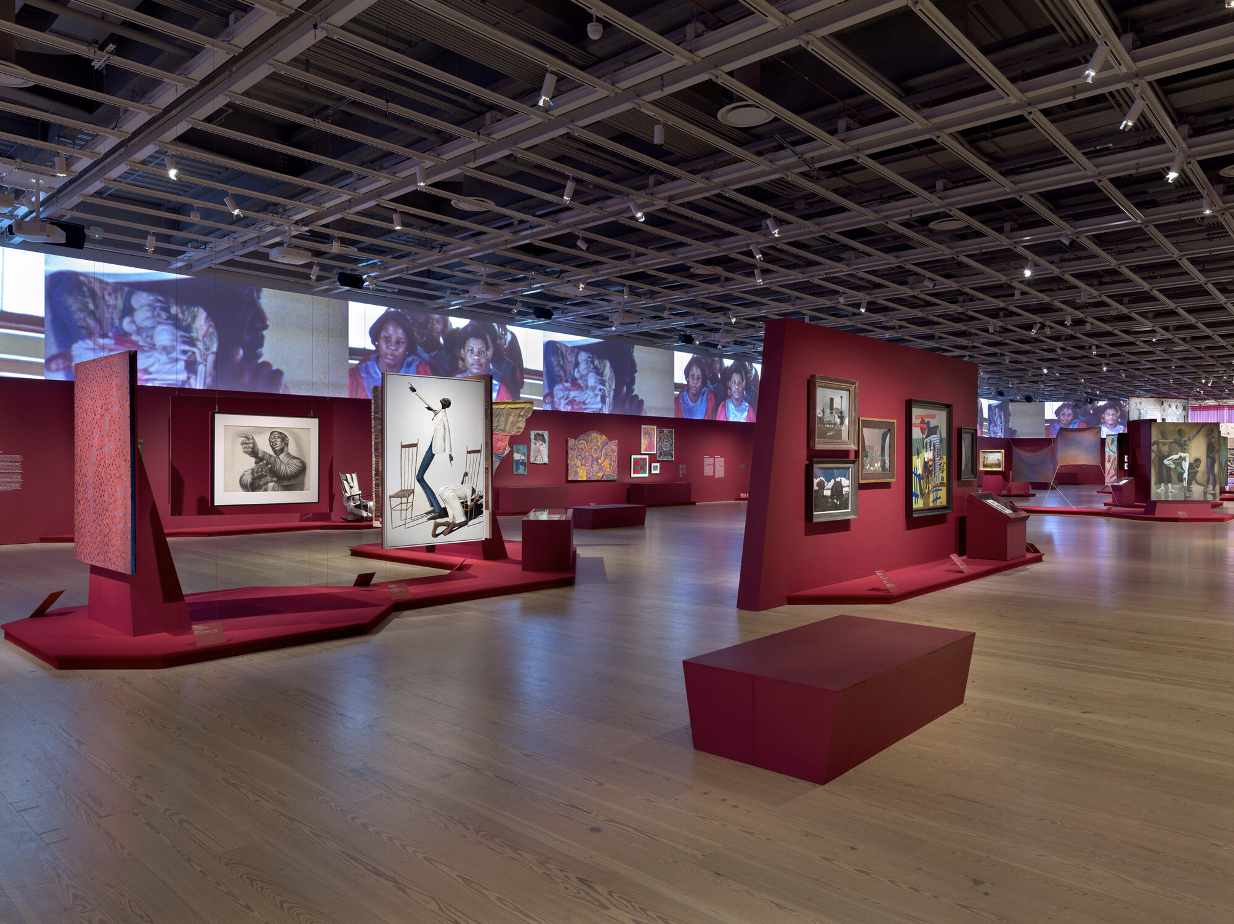
From left to right: Alma Thomas, Mars Dust, 1972; Charles White, Preacher, 1952; Lonnie Holley, Sharing the Struggle, 2018; Benny Andrews, The Way to the Promised Land, 1994; Sam Doyle, Frank Capers, 2023; Sam Doyle, LeBe, 1970s; Wadsworth Jarrell, Together We Will Win, 1973; Faith Ringgold, United States of Attica, 1971; Wadsworth Jarrell, Revolutionary (Angela Davis), 1972; James Van Der Zee, Marcus Garvey Rally, 1924; Jeff Donaldson, Soweto/So We Too, 1979; Horace Pippin, School Studies, 1944; Horace Pippin, Cabin in the Cotton, c. 1931–37; Horace Pippin, Knowledge of God, 1944; William H. Johnson, At Home in the Evening, c. 1940; John Biggers, Sharecropper, 1945; Robert Duncanson, View of Cincinnati, Ohio from Covington, Kentucky, c. 1851; Joe Overstreet, Purple Flight, 1971; Emma Amos, Judith Jamison as Josephine Baker, 1985; Kerry James Marshall, Souvenir IV, 1998; Lynette Yiadom-Boakye, A Knave Made Manifest, 2024; Lynette Yiadom-Boakye, Fly Trap, 2024; Missa Marmalstein and other makers unknown, Block 1871 of the AIDS Memorial Quilt, 1987. Photograph by Ron Amstutz.
It is important to note that the decision to represent dance through various mediums—showcasing not only Ailey's choreography but also his concerns, the art that interested him, and the art that bounds the experience of Blackness—is, of course, an important endeavor—and one that continues the correction of the historical imbalance of the representation of Black artists in American institutions, both in collections and exhibitions. But are paintings and objects really the best way to convey the history and legacy of dance? One thing that starkly stands out about the exhibition is that, despite its insertion of dance into the museum, Edges of Ailey upholds the traditional division of visual art and live performance. While the exhibition design and content do transcend disciplinary borders in various ways, the show is largely made up of conventional, two-dimensional, static visual art forms. Described as a “dynamic showcase” by the Whitney website, the exhibition is surprisingly dominated by a stillness of objects, despite the presence of scattered videos, as well as the video frieze atop one long wall of the space. The artworks remain divided from live performance, which is relegated to a separate black-box theater’s ticketed performances in allocated time slots. Considering that the show was initiated by a renowned curator of performance art, it would have been interesting to include a durational, unpredictable, or experimental live element within the gallery space.

From left to right: Maren Hassinger, River, 1972/2012; Melvin Edwards, Utonga (Lynch Fragment), 1988; Aaron Douglas, Bravado, 1926; Melvin Edwards, Chitungwiza from the Lynch Fragment series, 1989; Aaron Douglas, Flight, 1926; Melvin Edwards, Katura from the Lynch Fragment series, 1986; Aaron Douglas, Surrender, 1970; Melvin Edwards, Cup of? From the Lynch Fragment series, 1988. Photograph by Ron Amstutz
Even the musical aspects of Ailey’s practice are referenced illustratively and two-dimensionally, with paintings of instruments and a Billie Holiday photograph standing in for more creative auditory forms. The only music that is vibrantly present comes from that sprawling 18-channel video frieze, which is the one truly dynamic and innovative element in the show. The hour-long, looping montage features footage from the AAADT archive paired with a soundtrack of both timeless and contemporary music—ranging from Pharoah Sanders to Donny Hathaway to House music cuts—that is overlaid with interview clips. However, the video’s elevated placement causes it to function more decoratively as a backdrop to the still works, rather than as an artwork in its own right. This feeling is amplified by the fact that the video is uncredited and unexplained within the gallery space, with details about its creators—filmmakers Josh Begley, Kya Lou, and the curator—available only on the website. Were there additional time-based or performative media within the exhibition that referenced Ailey’s practice, this panoramic strip would have sufficed as a curatorial element alone.
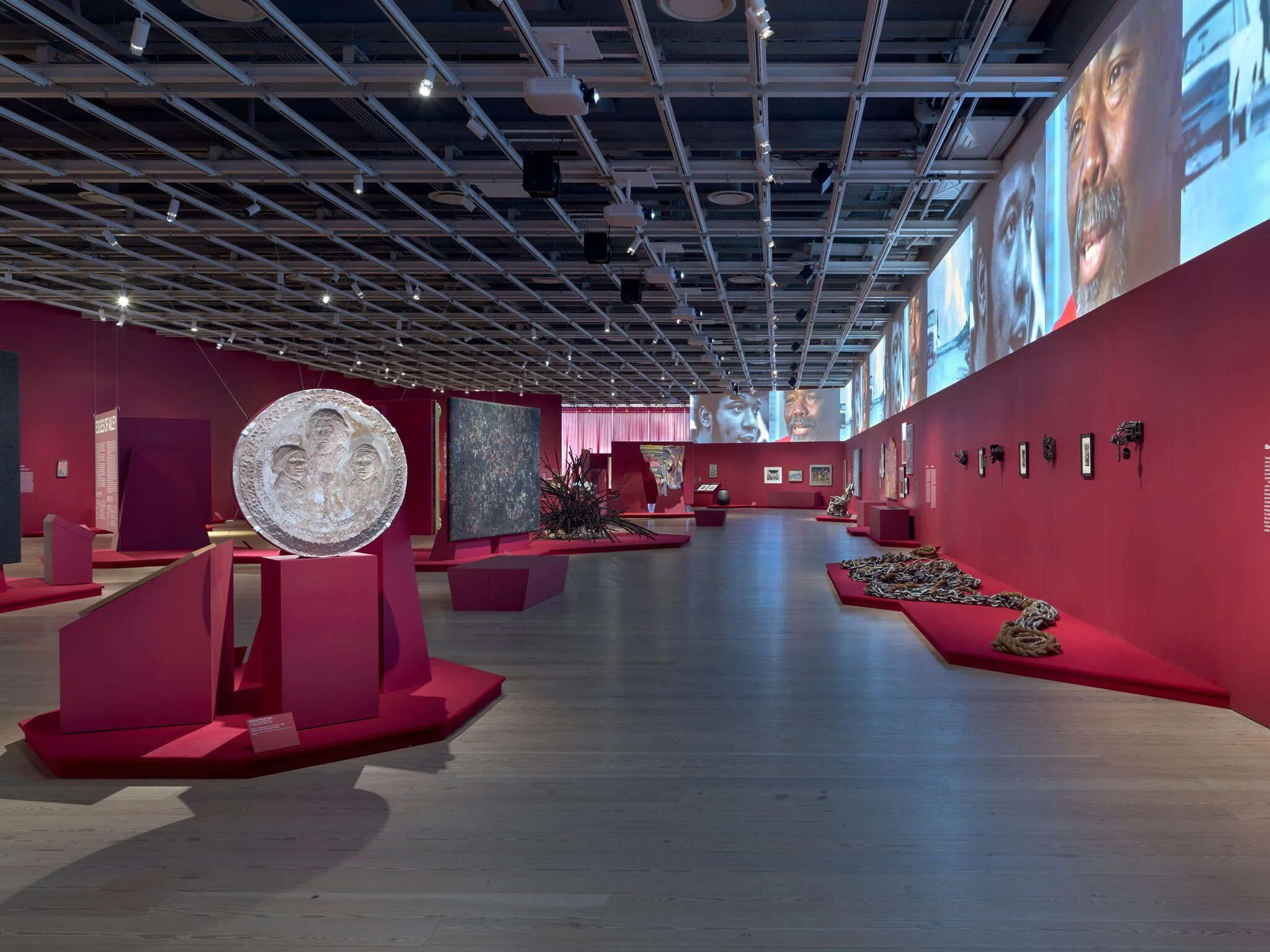
From left to right: Purvis Young, Ocean, 1975; Meta Vaux Warrick Fuller, Mold for Crusaders for Freedom, 1962; Sam Gilliam, Untitled (Black), 1978; David Hammons, Untitled, 1992; Al Loving, Untitled, c. 1975; Hale Aspacio Woodruff, By Parties Unknown, 1935, printed 1996; Hale Aspacio Woodruff, Giddap, 1935, printed 1996; Purvis Young, I Love Your America, late 1970s; Martin Puryear, The Rest, 2009-10; Samella Lewis, Migrants, 1968; Purvis Young, Black People Migrating West, late 1970s; William H. Johnson, Moon Over Harlem, 1943-44; Lonnie Holley, Sharing the Struggle, 2018; Theaster Gates, Minority Majority, 2012; Sam Doyle, Frank Capers, 2023; Sam Doyle, LeBe, 1970s; Wadsworth Jarrell, Together We Will Win, 1973; Faith Ringgold, United States of Attica, 1971; Wadsworth Jarrell, Revolutionary (Angela Davis), 1972; James Van Der Zee, Marcus Garvey Rally, 1924; Jeff Donaldson, Soweto/So We Too, 1979; Maren Hassinger, River, 1972/2012; Melvin Edwards, Utonga (Lynch Fragment), 1988; Aaron Douglas, Bravado, 1926; Melvin Edwards, Chitungwiza from the Lynch Fragment series, 1989; Aaron Douglas, Flight, 1926; Melvin Edwards, Katura from the Lynch Fragment series, 1986; Aaron Douglas, Surrender, 1970; Melvin Edwards, Cup of? From the Lynch Fragment series, 1988. Photograph by Ron Amstutz.
While this immersive video installation is mesmerizing and atmospheric, its fast-paced edits offer limited insight into the essence of Ailey’s choreography. Without prior familiarity with his work or access to the museum’s sold-out performances, I left the show without any clear sense of what Ailey’s choreography is actually like. Ultimately, while the exhibition aims to celebrate Ailey’s groundbreaking legacy and cross-disciplinary influence, it fails to foundationally destabilize disciplinary boundaries in practice, or to reimagine new ways of presenting an archive through performance. By relying on representations instead of recreations and pointing at ideas instead of performing them, Edges of Ailey looks backward, surveying the past more than it experiments with possibilities for the future.
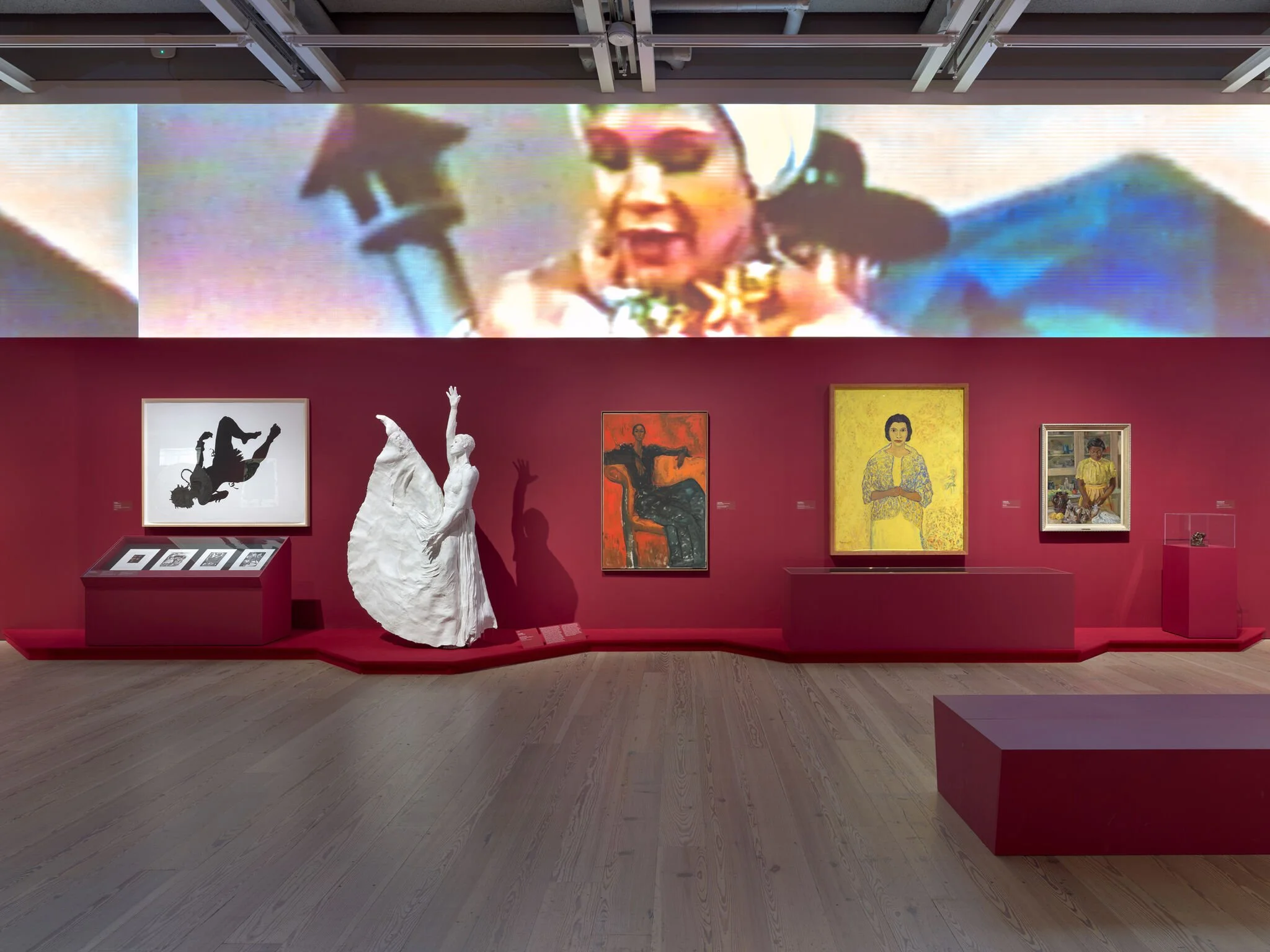
In vitrine, from left to right: Elizabeth Catlett, I am the Negro Woman, 1947, printed 1989; Elizabeth Catlett, In Harriet Tubman I helped hundreds to freedom, 1946, printed 1989; Elizabeth Catlett, In Sojourner Truth I fought for the rights of women as well as Negroes, 1947, printed 1989; Elizabeth Catlett, In Phillis Wheatley I proved intellectual equality in the midst of slavery, 1946, printed 1989; From left to right: Kara Walker, African/American, 1998; Karon Davis, Dear Mama, 2024; Geoffrey Holder, Portrait of Carmen de Lavallade, 1976; Beauford Delaney, Marian Anderson, 1965; Loïs Mailou Jones, Jennie, 1943; Meta Vaux Warrick Fuller, Mother and Child (Secret Sorrow), c. 1914. Photograph by Ron Amstutz.
-
Tom Koren is currently a student in the MA Curatorial Practice program at the School of Visual Arts, New York. She received her B.A in Art History and English Literature at the Tel Aviv University. Her professional experience is rooted in the music field, working as a curator, DJ, marketing manager and creative director for leading alternative cultural institutions and events in Tel Aviv. She has recently been awarded a Fulbright fellowship in the Public Humanities program, with which she aims to merge her academic and professional backgrounds by crossing over to the visual art field, experimenting with the curation of interdisciplinary events and further exploring her interest in participatory and live art practices.
Changing Concepts of Curatorial Enquiry: Care, Ethics, and Research
In today’s epistemic regime, we are no longer autonomous producers of knowledge but are forced to cede our sovereignty to processes of abstraction, quantification, and algorithmic regulation.
By Henk Slager
Henk Slager • 2/1/25
-
Critical Curating is The Curatorial’s section devoted to more theoretically oriented considerations of curatorial research and practice. While of a specialized nature, we seek essays for this section that are written for a broadly engaged intellectual audience interested in curating’s philosophical, historical, aesthetic, political, and social tenets, as well as a labor-based activity and its ramifications.
In this essay, the current debate about paradigm formation in artistic research is chosen as a starting point. The way in which artistic research operates as a convergence of creative practice, artistic thinking, and curatorial strategies shows strong similarities with the definition of care proposed by Maria Puig de la Bellacasa: a dynamic, triangulated interaction between labor, affect, and politics. This proposition will be briefly elaborated on the basis of three research projects. Starting from the statement “Research is another word for Care” (Marion von Osten), a further reflection on the significance of this perspective for the topical discussion about curatorial research will be developed.
Today, there is an encroaching sense that our relationship with the world is more and more disturbed. As a result of omnipresent technological acceleration, we are now running up against psychological, political, and planetary limits. This escalation manifests itself in topical forms of precarization (self-exhaustion), the crisis of democracy (politics that are no longer responsive to citizens), and the environmental crisis (treating nature only as a resource for extraction). It seems that we have lost the very pathways and rhythmic relationships to the world as such.1
This awareness is reinforced by the contemporary technological compulsion to transform everything into data. Through this new epistemic regime, we are no longer autonomous producers of knowledge but are forced, because of the imperative of transparency, to cede our sovereignty to processes of abstraction, quantification, digitization, calculation, and algorithmic regulation.
This whole constellation leads to alienation, which has affected many of us in various intensities as an inability to feel, sense, or hear ourselves. In addition, a large part of mankind has lost the common understanding of what a better society might look like. It even seems that our utopian energies are fully exhausted. Philosopher Boris Groys, for example, describes this current state of mind as follows: “Today no one has any idea what will happen in the future. The only hope people have is that the future doesn’t bring anything terrible. The hope is that everything remains as it is—that is the best hope that we can have.”2
Is it feasible to escape this rationalistic, instrumental, calculated, and disengaged relation to the world? Is it conceivable to overcome the current orientation toward the logic of unbridled growth and its cost to our humanity? In other words: Can we achieve a “way out” that resonates with the world and draws attention to other forms of knowledge, agency, solidarity, and community?3 Can we foster shifts in awareness that, as Marina Garces argues in her essay, “Conditio Posthuma,” could lead to a new revolution of “looking after ourselves”?4
In what follows, I’d like to put forward a series of artistic and/or curatorial propositions that might put us on the path to this transformation. For that purpose, the urgent question to be asked is what should be done to “maintain, continue, and repair our world so that we can live in it as well as possible.”5
Political scientist Joan Tronto introduces the concept of care as a tool to repair the connections between world, existence, and life. She does so by deploying this concept strategically: an understanding of care that goes beyond neoliberal capitalism’s calibration of individualist perspectives and preferences that emphasize self-care (a reductive appropriation of the ethical ideologies of care, focusing on lifestyle, fitness, and family). To free care from this hegemonic machine—or better to reclaim care—the concept will have to be recalibrated in its full complexity and ecology: “care shapes what we pay attention to, how we think about responsibility, what we do, how responsive we are to the world around us, and what we think of as important in life. That world includes our bodies, ourselves, and our environment, all of which we seek to interweave in a complex, life-sustaining web.”6 From Tronto's perspective, care is not something an inherently isolated and selfish individual needs to be forced to engage in through considerations of self-interest or duty. On the contrary, it comes naturally to us because we are all involved in and dependent on the ecology of this life-sustaining web. And with that, care is also a critical practice and concept. Starting from collective and multivocal enactments, it stands for strategies of survival, resilience, and resistance in a more-than-human world that is characterized by global inequality, climate crisis, and loss of biodiversity.
Precisely this disruptive understanding of care resonates with the field of artistic research that has played a significant role in art discourse from the beginning of this century. This relatively new form of research is characterized by intertwining creative practice, critical epistemologies, and engaged strategies of dissemination. This specific mode of inquiry enables artistic research to rehearse topical issues concerning planetary urgencies—such as the ecological crisis and social injustice—in a completely different way, namely from the transformative potential to imagine, initiate, or negotiate other ways of living together.
A striking example of this modus operandi is Gustafsson & Haapoja’s research project, “Becoming. Manual for Earthly Living.”7 This project departs from how the capitalist dictate of chronopolitics—that is, using time as a tool for social control in every precinct of life from work, production, and school schedules to health care to transportation—affects our Earth’s ecosystems by asking: Is it possible to live as a human being in a world that is dominated by Western models of progress that are exhausting our planet?
To find a possible answer, Gustafsson & Haapoja conducted thirty-seven video interviews to identify ways of relating to ourselves, others, and the world. They contemplated phenomena that are budding at this very moment and that should be nurtured. In these video conversations, the specific question arises: How can art contribute to forms of subjecthood and citizenship that are no longer determined by anthropocentric frameworks that use the rhetoric of exclusivity or human exceptionalism? In this way, a future world could be built where care forms the basis of coexistence and communality; a world based on another biopolitics where the dominant perspective of the homo economicus is replaced by homo ecologicus, i.e. substituted with a perspective characterized by a polyphonic imaginary, a collective empowerment, a sustainable existence, and a more-than-human community.
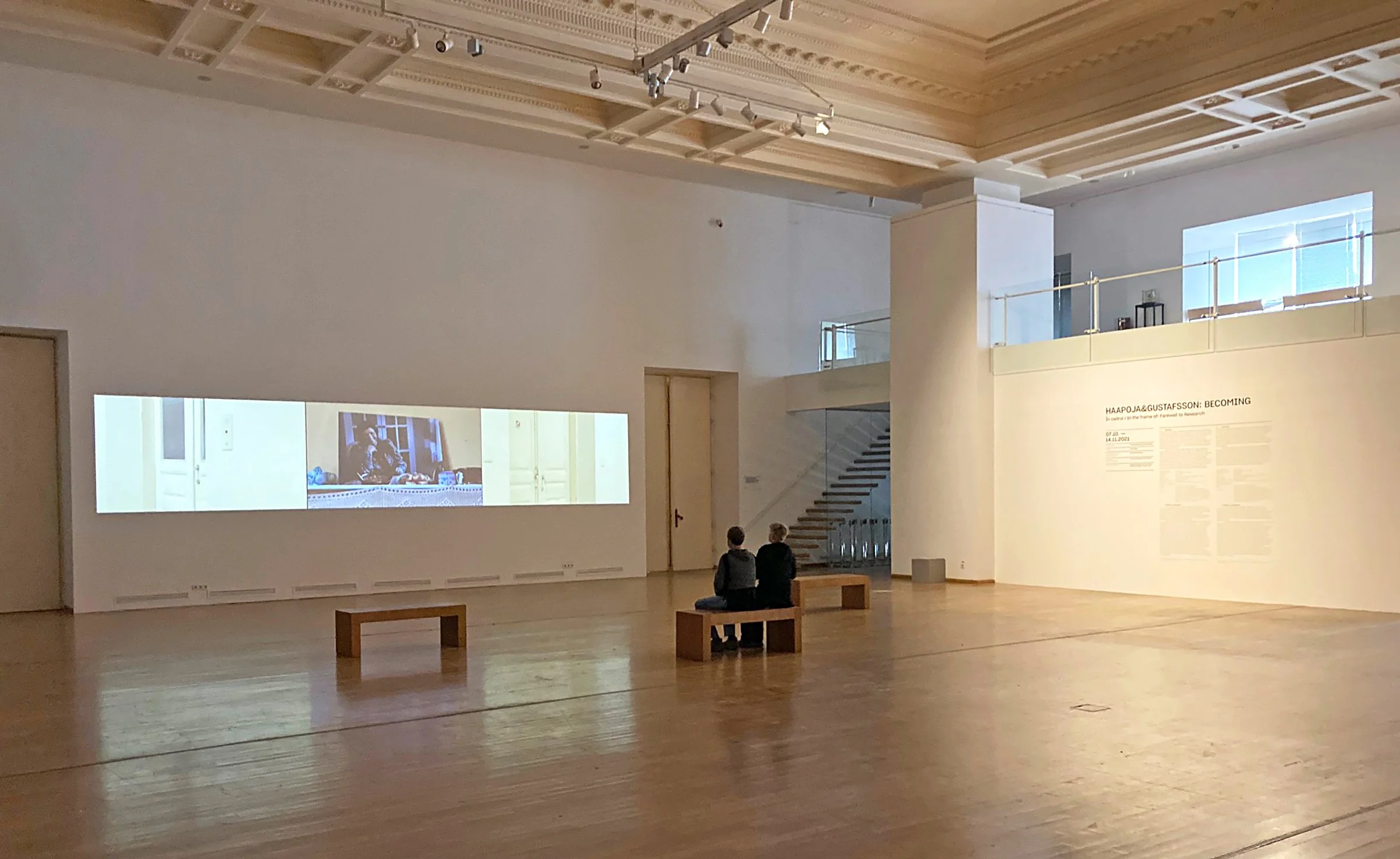
Gustafsson & Haapoja, Becoming. Manual for Earthly Living, installation view of Farewell to Research, MNAC, Bucharest, 2021.
Ursula Biemann’s research offers us another excellent example of this approach. Her practice emphasizes the speedy course of climate change into unknown futures that is forcing us to fundamentally rethink the relationship between humans and the Earth. For instance, the video essay Subatlantic juxtaposes the science of geology and climatology with human history, proposing that the fully imaginary globe that has been constructed in the disciplinary field of humanities fails to resonate with the mighty planetary grammar.8 Therefore, if we think from the perspective of a posthuman future, it is extremely important to develop a mode of contemporary art that brings the Earth on stage, so to speak, so that we see it as it is: an unstable living environment reconnecting us to infinite, untameable forces that animate extra-historical dimensions. “Perhaps from there, we can envision a less divided future that can harbor a post-human way of being in the world.”9
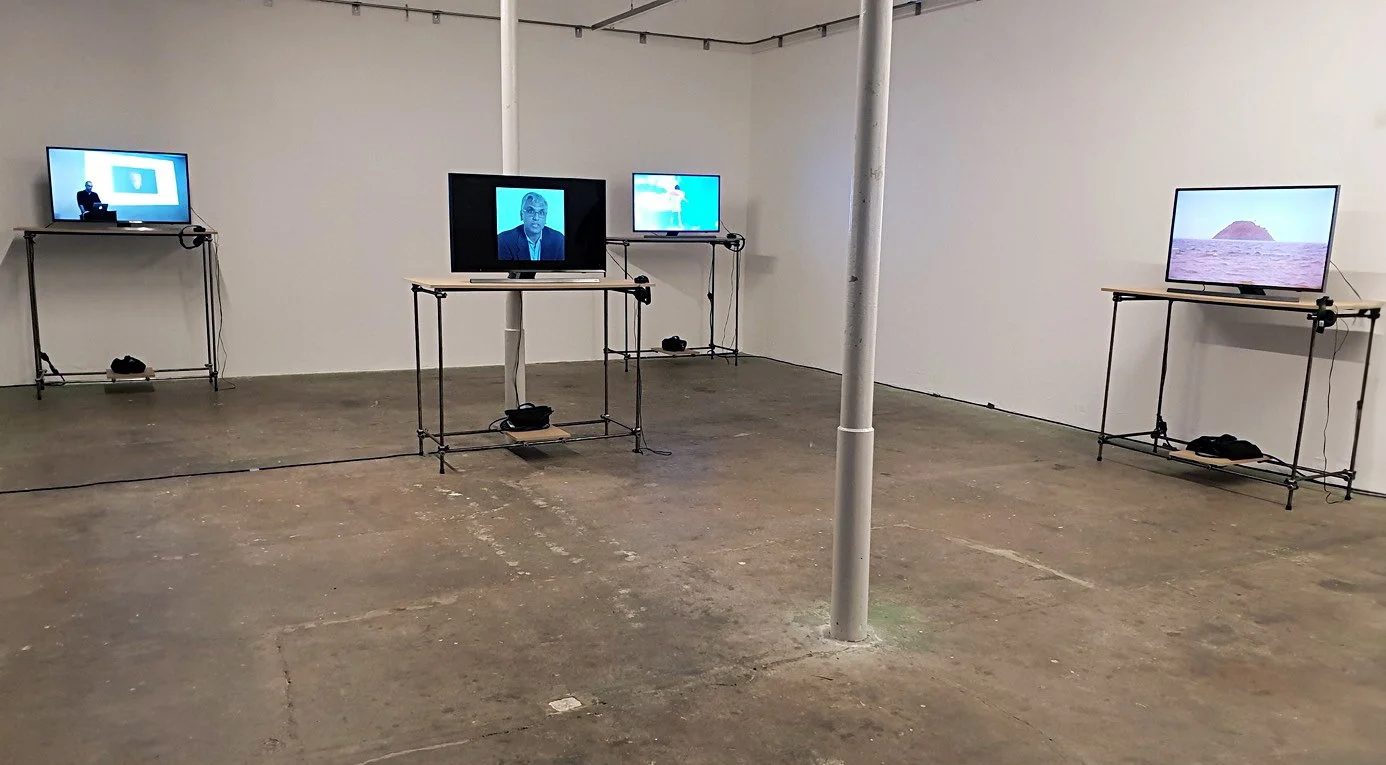
Ursula Biemann, Subatlantic, installation view (right side), Re-Imagining Futures, OnCurating, Zurich, 2019.
A similar postcapitalist perspective is articulated in the research project “Stones Have Laws” by Lonnie van Brummelen & Siebren de Haan.10 The film portrays how the Western model of linear time has played an important role in processes of colonization and exploitation, as well as in the loss of self-determination for a wide range of cultures and creatures. “Stones Have Laws” attends to the current situation of the Maroon community in the interior of Surinam and to another aspect of capitalist chronopolitics: a process that exchanges ecological time for a growth-oriented, measurable time. As a consequence, a system came into being in which nature became commodified, i.e., understood as an object for consumption. Meanwhile—and this is central to Van Brummelen & De Haan’s research project—a social protest is developing in Latin America that demands another ecology of care: a living world that requires different ways of organizing knowledge, time, and ontology that trouble the traditional direction of progress and the speed of technoscientific, productionist, future-driven interventions.

Lonnie van Brummelen & Siebren de Haan, Stones Have Laws, installation view, Any
Speculation Whatever, Museo Nacional de Bellas Artes de La Habana, 14th Havana
Biennale, 2022.
These projects emphasize that the urgencies of care ethics and the imagining of potential “ways out” are also high on the agenda of artistic research. María Puig de la Bellacasa's book, Matters of Care: Speculative Ethics in More than Human Worlds resonates with this.11 She describes care as a dynamic triangulated relationship of labor, affect, and politics; and it should always have these three ontological dimensions actively present: the practical (work), the affective (engagement), and the ethico-political (involvement). Only then can care present itself as both a speculative and existential domain: open-ended, with room for possible reconfigurations.
With Puig de Bellacasa’s characterization of care, we see clear similarities with a possible definition of the practice of artistic research.12 This mode of inquiry can also be described as a dynamic triangulated relationship: between creative practice (experimentality, art-making, the potential of the sensible); artistic thinking (open-ended, speculative, associative, nonlinear, haunting, thinking differently); and dissemination strategies (curatorial formats, topical modes of political imagination, performative perspectives, transformational spaces for encounters), comprehending these different kinds of conceptual space in their mutually vibrant and coherent interrelationships.
From whatever conceptual space one departs, an artistic research practice should always signify a transversal constellation—as a creative proposition for thought in action. Yet, that mode of research should never be reduced to a method of one of the three constituents. Artistic research cannot be exactly equated with creative innovation or disciplinary knowledge production or political activism. Consequently, it seems urgent now to profoundly challenge and question the issue of how to articulate and present the condition of the intersection between creative practice, artistic thinking, and the ways they are made manifest.
What does this triangulated connectivity mean for thinking about the curatorial dimension? In the symposium, Going to the Limits of Your Longing, Research as Another Name for Care, organized by the Basel Academy in 2021 to honor the late curator and artist Marion von Osten, a constructive and inspiring perspective was presented.13 The point of departure for the symposium was Von Osten’s empathetic curatorial approach to the medium of exhibition-making. This revolved around artistic research devoted to collective issues and modes of meaning-making, putting forward ideas on community, access, agency, gender, and ecology. And here we see a topical interpretation of curatorial care and responsibility: to work against repression, exclusion, and marginalization. Or to put it differently, curatorial care requires attention to other modes of being and thinking that are sensitive to difference. In this way, the curatorial also shows its political potential, i.e., making an ethics of care public in a strategic manner based on an understanding of the politics of display: how care is disseminated, how care is performed, how care is propagated, and how care ultimately resists categorical modes of thinking.
Beatrice von Bismarck also describes how curating involves modifying and generating meaning in acts of assembling in public. It constitutes a coming-together for processes of negotiation, but also for proclamation, demonstration, or argumentation. In this approach, curatorial processes are essentially performative. Exhibits find themselves in new juxtapositions, entering into relations with altered spaces and social, economic, and discursive contexts. Attention focuses on the interplay of all factors, and in particular on “the transformative, but also self-transforming relational fabric of the curatorial situation, its conditions and preconditions, and the options for actions they offer.”14
In this moment of making things public, we notice a challenging task for both thinking and practicing curatorial care and artistic research. This includes investigating the disruptive potential, the triangulated condition, the topical role of speculation, the perspective of change vectors, and different modes of agency, focusing on other ways of living together as a performative exploration of possible ways out. All of this could lead to the mutual enrichment and reassessment of the concepts and ecologies of research and care, and consequently afford a more profound thinking about matters concerning all of us and imagining future scenarios.
NOTES
1. In his book Resonance, A Sociology of our Relationship to the World (Cambridge: Polity Press, 2018), Hartmut Rosa looks for possibilities to restore our relationship with the world. Can we recover the phenomenological condition that makes it possible again to resonate with the world and hear its polyphony?
2. Boris Groys, Philosophy of Care (London/New York: Verso, 2022). See also “Philosophy of Care: A Conversation.” https://www.e-flux.com/notes/499836/philosophy-of-care-a-conversation.
3. The curatorial project “The Way Out” (Steirischer Herbst, Graz 2021, curators: Ekaterina Degot, David Riff) contrasts the disappointment of self-regulatory markets with a different, confrontational model of care. https://2021.steirischerherbst.at/en/program/2293/the-way-out-of.
4. Marina Garces, “Conditio Posthumana,” in The Great Regression (Cambridge: John Wiley & Sons, 2017), 7.
5. Joan Tronto, Who Cares, How to Reshape a Democratic Politics, (Ithaca: Cornell University Press, 2015), 3.
6. Tronto, Who Cares, How to Reshape a Democratic Politics, 8.
7. Presentation of “How to Become Human” in the context of the 9th Bucharest Biennale publication MaHKUscript, Journal of Fine Art Research, 5, After the Research Turn, 2020. See also Terike Haapoja’s presentation “Vulnerability, Animality, Community,” EARN Conference, The Postresearch Condition, BAK, basis voor actuele kunst, Utrecht, 2021. MaHKUscript: https://mahkuscript.com/5/volume/4/issue/1. https://www.hku.nl/en/study-at-hku/creative-transformation/pre-phd-programme/the-postresearch-condition.
8. This work by Ursula Biemann was shown in the research presentation “Re-Imagining Futures,” OnCurating, Zurich, 2019. “Re-Imagining Futures,” https://oncurating-space.org/re-imagining-futures/.
9. Quote from Ursula Biemann, Subatlantic, 2015. https://vimeo.com/123399928.
10. The research project Stones Have Laws was part of the second iteration of Re-Imagining Futures, titled Any Speculation Whatever, Futuro Y Contemporaneidad, 14th Havana Biennial. Stones Have Laws: https://www.youtube.com/watch?v=McQjpqbRjj0.
11. Maria Puig de la Bellacasa, Matters of Care (Minneapolis: University of Minnesota Press, 2017).
12. First steps toward this paradigm formation were given in “Farewell to Research” (9th Bucharest Biennale, 2020-2021) and the publication The Postresearch Condition (Metropolis M Books: Utrecht, 2021). Farewell to Research: https://www.e-flux.com/announcements/410540/farewell-to-research/. Postresearch Condition: https://www.e-flux.com/announcements/410536/metropolis-m-books-publishes-the-postresearch-condition/.
13. Symposium Going to the Limits of Your Longing, Research as Another Name for Care. In Memory of Marion von Osten, Basel Academy of Art and Design FHNW, March 17-18, 2021. https://www.e-flux.com/announcements/381063/going-to-the-limits-of-your-longing-research-as-another-name-for-care-in-memory-of-marion-von-osten/.
14. Beatrice von Bismarck, The Curatorial Condition (London: Sternberg Press, 2022), 9. In her description of the curatorial, von Bismarck also uses the model of dynamic triangulated relationships, consisting of the following constituents: constellation, transposition, and hospitality. “The curatorial is characterized by transpositional processes generating constellations that are determined by curatoriality and that are situatively, temporally, and dynamically shaped on the basis of the dispositif of hospitality.”(28)
-
Henk Slager’s focus has been on research and visual art for the last twenty years. He was a Lecturer at De Appel Curatorial Program (1995-2020), Visiting Professor of Artistic Research (Uniarts Helsinki 2010-2015, 2024-), and Dean of MaHKU Utrecht Graduate School of Visual Art and Design (HKU Utrecht 2003-2018). He is currently working for the same school on the development of a practice-based doctoral program. Henk Slager co-initiated the European Artistic Research Network (EARN), a network investigating the consequences of artistic research for current art education through symposia, expert meetings, and presentations. Departing from a similar focus on artistic research he published The Pleasure of Research, an overview of curatorial research projects (a.o. Shanghai Biennale, 2008; Tbilisi Triennial, 2012; Aesthetic Jam Taipei Biennial, 2014; 5th Guangzhou Triennial, 2015; Research Pavilion Venice, 2015-2019; and 9th Bucharest Biennale, 2020). A follow-up publication will be presented in 2025. Henk Slager is currently co-convening the 6th Asia Triennial Manchester (2025).
Digital Art as Intangible Heritage: A Shifting Cultural Landscape
Over the years, museums and institutions across the globe have set up protocols and experimented with how to engage with digital culture, from presentation to preservation and collecting. Here are some thoughts on the potential future directions of digital culture.
By Amira Gad
Amira Gad • 2/1/25
-
This section of The Curatorial, The Algorithmic State, considers visual culture, forms of intelligence, imaginative and critical faculties, and the revision of art historical notions in the digital sphere. For example, contrary to early utopian claims for the liberatory potential of artificial intelligence, AI has proven to be a technology of extraction. The resources required to run it, the downward pressure it places on wages, and the data harvested from every action and expression of its users all require an increase in socially and ecologically damaging practices. So, what are the costs, on a planetary scale, of a network that is increasingly the cause and the tool of undemocratic governance and inequity? Can we salvage the liberatory potential of AI? These and other questions related to technological advancements, as they pertain to artistic and curatorial practices, will be addressed in this section.
In “Digital Art as Intangible Heritage,” Amira Gad examines the evolving relationship between digital art in its various forms and cultural institutions. The essay addresses the reasons for digital art’s importance in culture today and gives a brief history of the medium and early institutional support in the West. Gad then discusses essential characteristics of this art and speaks about the tension between entertainment and critical engagement, considering the benefits of digital artistic production as a lever for the democratization of art in general while also speaking to the problems emerging from technodiversity, including digital colonialism. In this light, Gad calls for cultural institutions to redress power imbalances between the Global North and South through the auspices of museums prioritizing diverse voices and perspectives while being mindful of how digital infrastructures often perpetuate existing inequalities. She advocates for a more nuanced and critically engaged approach to digital art curation that goes beyond simple experiential presentations of spectacle to foster meaningful cultural discourse and inclusive representation.
Artists in our pervasively digital culture have naturally engaged with its technologies. They have used it as a medium in the making of a work (such as internet art, interactive installations, or Mixed Reality (MR) works), as subject matter for reflection, and as a way of challenging the way we engage with it and society at large. Technology continues to transform how art is created and experienced, as well as its dissemination. And so, the question of how to engage with digital culture within the contemporary art sector is all the more relevant. The need to reflect this dynamic and evolving digital culture within institutions was accelerated by the 2020 global pandemic. The cultural sector had to rapidly move real-life engagement online, kicking off a feverish search for “digital strategies.” For some, this search put a spotlight on existing work. For others, it was the start of exploring what it meant to work with digital culture in their respective contexts. Without a doubt, the pandemic marked a paradigm shift in attention to digital culture across the cultural sector.
The platform on which so much of this work takes place is the internet. Internet art, or net art, first emerged in the 1990s and used the platform as a medium and subject. Curating these works within the physical space of a museum brings layered complexities. Institutions need to bridge the gap between online and offline worlds. Now, more than 30 years later, it is worth questioning whether the definitions of digital art still stand—particularly within an intrinsically evolving genre.1 Post-internet art, for instance, came about at the beginning of this millennium. It refers to art created in a world in which the internet is ubiquitous. Post-internet work does not necessarily have to be online or digital, but it’s shaped by the conditions of a networked world. It reflects how artists engage with digital culture and the omnipresence of online platforms. I’d like to return to this perspective on digital culture as I believe it should guide institutional thinking toward focusing on culture, rather than technological tools. It mirrors the fact that the digital per se is not separate from us but is well-embedded in every aspect of our lives, even to the point that it is a challenge for us to dissociate ourselves from it.

Ian Cheng: Life After BOB, 9 September - 6 November 2022 at Halle am Berghain, Berlin © 2022 Ian Cheng. Presented by LAS Art Foundation © Dario Laganá
Digital Strategies in Museums
Over the years, museums and institutions across the globe have set up protocols and experimented with how to engage with digital culture, from exhibition to preservation and collecting. A non-exhaustive selection from the Western institutional landscape includes Rhizome (founded in 1996), New Inc. (established in 2014), and in Europe, there is ZKM | Center for Art and Media in Karlsruhe (founded in 1989), HEK (Haus der Elektronischen Künste) in Basel (established in 2011), and across the pond in London is my former employer, the Serpentine Galleries, to name a few. Since the 1980s, these various institutions have continued to lead the conversation in digital culture, highlighting the range of approaches to curating new media in the contemporary art context, whether it’s an open-ended and exploratory laboratory that allows for projects to redefine the role of technology in contemporary art or an interdisciplinary residency that enables the exchange of ideas to ensure a fluid and forward-thinking conversation. While the institutions cited here dominate a Western-centric discourse, digital culture is an international phenomenon that transcends geographical boundaries and speaks to the shared experience of living in a networked society.
Consequently, museums across the globe are picking up the pace. The Solomon R. Guggenheim Museum in New York was the first to commission net art and holds the United States’ leading conservation lab in the field. The most common approach adopted by museums is similar to Tate Modern’s digital strategy that aims to “embed digital thinking across the organization” by developing online platforms.2 The Tate Digital Studio, for example, offers digital art commissions, virtual exhibitions, and interactive projects to extend the museum’s reach beyond its physical walls. On the other end of the spectrum, another type of initiative has emerged to zoom in and bank on the assumed entertainment quality that digital art can enable, such as Pace Gallery’s commercial initiative Superblue that was launched in 2020 to create a space for experiential art. This is where definitions start to get a bit blurry.

Hito Steyerl: Power Plants. Installation view, 11 April – 6 May 2019, Serpentine Galleries. AR Application Design by Ayham Ghraowi, Developed by Ivaylo Getov, Luxloop, 3D data visualisation by United Futures. Courtesy of the artist, Andrew Kreps Gallery (New York) and Esther Schipper Gallery (Berlin). Photograph: © 2019 readsreads.info
The Hallmarks of Digital Art
One of the hallmarks of digital art is its potential to provide immersive and interactive experiences. The cultural sector strives for this kind of audience engagement. The recent article “Immersive Art is Exploding, and Museums have a Choice to Make,” by Felix Barber and András Szántó, addresses the hurdles, dilemmas, and market value of this art and its venues within today’s experience economy.3 Frequently cited examples include immersive and interactive installations by teamLab, United Visual Artists, Refik Anadol, and Random International, each of which has shown us how “new and younger” audiences can be targeted through the experiential nature of their works, often qualified as (and sometimes reduced to being) Instagram-friendly. This might involve participatory elements, real-time interaction, or using social media to extend the experience beyond the physical space. Their large-scale, immersive installations promise a theatrical experience that can transcend the ordinary, evoking awe and wonder while blurring the boundaries between the art object and the audience’s role as active participants. In this idealized vision, technology holds the potential to reach new audiences and reshape how we experience art in a way that feels transformative.
This is the essence of what the promise of digital art is for the cultural sector: the possibilities of expanding our understanding of art and making it accessible to new and younger audiences through engagement and interactivity, while also enhancing art’s publicity through online exposure. Unsurprisingly, this essence is at the core of the institutional struggle wherein digital art is utilized more often as a marketing tool to increase visitor numbers and ticketing revenue. The consequence of this is that the initial (curatorial and artistic) objective to reflect on the role of and relationship between technology and society, and to engage with contemporary art discourse, is sidetracked. Most significantly, the radical experiments and thinking that technologists and artists seek to engage with are too often overshadowed. The intersection of technology, art, and commerce reflects a growing trend in which the line between cultural experience and marketing is simply becoming far too blurred—and as such, definitions of digital culture are becoming more ambiguous. This raises concerns and cynicism about institutions’ ability to present digital art without risking turning it into a commodity—an experience designed for consumption rather than critical engagement.
Essentially, what I’m proposing here is not to ignore the entertainment quality of digital artistic practice, but to veer away from exhibiting “pure” experiential presentations. In other words, without an added or follow-up layer of critical reflection, these works are just another dot among the infinite productions that will not stand the test of time within cultural infrastructures. As a curator who has increasingly worked with digital artistic practices over the last few years, I’m often asked to hit those targets: the immersive presentation that will bring new kinds of audiences in with the ambition to renew people’s interest in the museum altogether. And for this, I always exercise caution and steer the focus to make sure that the presentation is doing more than creating immersive experiences, which returns me to the definition I started this essay with: art that is created in a world where the internet is ubiquitous and where works don’t have to be digital but that are shaped by the conditions of our networked world.
It should be noted that the idealism of digital culture is inherent and, in fact, inherited from the technology sector as a whole: techno-utopianism is the belief that technology can revolutionize society, solve problems, and create a more equitable world. These ideals, of course, have historically permeated the arts, too. Certainly, technology is often seen in the arts as a tool for liberation, providing new modes of expression, breaking down barriers to entry, and democratizing access to culture. The often-participatory nature of digital art embodies this hope that technology can foster a more connected, engaged, and inclusive society. However, while this vision captures the imagination, it also risks oversimplification. The belief that technology can solve complex societal problems too frequently overlooks the broader systemic issues and ethical dilemmas that come with it. There’s a tendency to view technology through rose-tinted glasses, assuming it will naturally lead to positive change without critically considering who controls it, who benefits from it, and who may be left out.

Simon Denny: Products for Organising. Installation view: Serpentine Galleries, 25 November 2015 – 14 February 2016. Photograph © 2015 readsreads.info. Courtesy of the artist
Democratizing the Arts
This potential to break down boundaries between audiences and museums and disrupt the structures of traditional art institutions is at the core of the promise of digital art. As technologies do offer the means to decentralize art production and distribution, this is largely true. Social media platforms, online marketplaces, and decentralized blockchain networks allow artists to reach global audiences directly, bypassing the traditional gatekeepers of the art world such as galleries, auction houses, and museums. The NFT (Non-Fungible Token) boom (which was also intensified by the global pandemic) exemplifies this decentralization, offering artists new ways to monetize their work and establish ownership over their digital creations without intermediaries, challenging traditional models of art valuation and distribution. They also expanded the notion of art collecting, making it accessible to anyone (with a crypto wallet). This created a supposedly more democratic system where artists can gain visibility without needing to conform to the standards of the institutional art world. The hierarchies within traditional institutions are then flattened, and the protocols that often limit accessibility are bypassed. In theory, this opens the door to a more inclusive and diverse art scene.
Still, the NFT space is not without its issues. While digital platforms expand access, we shouldn’t neglect factors such as digital literacy, internet access, and representation. Access can be questionable as it assumes a certain technical know-how from the user on how to open a crypto wallet, for instance.4 Questions of authenticity, value, and sustainability have also plagued the NFT market. The environmental impact of blockchain technology, particularly the energy-intensive process of minting NFTs, raises concerns about the broader ecological implications of digital art (just as crypto mining and powering AI are posing increasingly serious energy concerns). While NFTs democratize access in some ways, they also reflect the speculative nature of the art market, where hype and scarcity can inflate prices, sometimes at the expense of artistic merit or cultural significance, leaving yet another challenge for the cultural sector to siphon out the myriad productions and evaluating what is meaningful in that realm.
These ideas around democratizing access to the arts can sometimes feel reductive. One could argue that among the pitfalls of a so-called global outreach facilitated by digital culture are the crucial issues of inclusivity and accessibility. That’s to say that if we set aside the importance of digital literacy and equality of resources for a moment, we immediately find ourselves facing questions concerning technodiversity and digital colonialism. When I speak of digital colonialism, I’m specifically referring to the phenomenon of dominant entities exercising control over digital spaces, resources, and platforms—typically companies in technologically advanced and economically powerful regions. Economist and writer Yanis Varoufakis takes it further and coined the concept of “technofeudalism” where he likens the owners of big tech with the world’s feudal overlords, replacing capitalism with a new system and calling for us to escape our digital prison.5 When this troubling subject comes up, it’s often reduced to Big Tech’s use of data. Yet this is too simplistic. Digital colonialism runs deeper. It is manifested in the dominance of Western-centric narratives and perspectives in online content. It imposes technological standards and norms that marginalize diverse voices and cultures. And not only does it extract data and resources from developing countries, but it does so also without equitable compensation. All of this raises critical questions about ownership, representation, and the ethics of technological innovation in the context of cultural production. We need to re-evaluate digital practices in our commitment to decolonizing digital spaces in the pursuit of equity, diversity, and inclusion in the arts.
In this pursuit, technodiversity is key to promoting digital pluralism and the development of alternative, sustainable practices that highlight diversity. And as we do this, whether we are speaking, say, about democratizing access or the potential of blockchain technologies, it’s crucial to consider what is buried in these colonial legacies and ask: Whose access? To whose benefit? Should the cultural sector be an agent in these power dynamics? As museums engage in decolonial practices of their collection and programs, it is precisely these questions (and no doubt others) that have to be taken hand-in-hand with the curating we do, with collecting, preserving, and engaging digital culture in the widest sense.
When it comes to my curatorial engagement with digital artistic practices in the Western cultural sector, particular attention is paid to how we could flip the balance or how we could monopolize the Global North in favor of the Global South. How can ideas of technodiversity be applied to the museum context, to be inclusive and not have art museums and institutions contribute to increasing power gaps and inequalities? There are two ways in which this could be done: on the one hand prioritizing working with artistic practices or thinkers who raise awareness that the digital infrastructures as we know them today are built at the expense of the Global South.6 And the other lies in the importance of integrating diverse voices in the Global North narratives and stepping out from the echo chambers often illustrated by the same group of artists representing the voice of digital art today and who are exhibited widely. To do this, and to give legitimacy to new entries, the museum institutions need to become the platform that enables and essentially shapes these voices from the Global South by giving them access to the very technologies that contribute to their suppression. To be successful in this, I think a combination of both strategies is necessary and it is a long-term game of slow infiltration. When we talk about reframing narratives and decolonial practices within the museum, we eventually end up in thinking about the preservation of those narratives and the inclusion of those voices within museum practices, and this is epitomized by a museum’s collection.

Refik Anadol, Echoes of the Earth: Living Archive, 2024. Installation view, Serpentine Galleries, London, 2024. Photo: Hugo Glendinning. Courtesy Refik Anadol Studio and Serpentine.
Shifting Cultural Landscapes
As previously touched upon in this essay, one of the tenets of digital culture today, brought on by blockchain technologies among others, is shifting our thinking about ownership and authorship because of its advocacy of horizontal and collective ownership, and transparency. So, how do we reconcile traditional models of collecting with the advent of the digital age and its ethos? How do we tackle collecting (in other words, centralizing) artworks that are decentralized and distributed? This inadequacy prompts a need for a new ecosystem, with new protocols and alternative frameworks.
One way of looking at this is to approach engaging with (and so presenting, collecting and preserving) digital culture as we do intangible heritage. By approaching digital culture as we do intangible heritage, we acknowledge its fluid, evolving, and non-tangible nature, focusing on the preservation of the knowledge systems, practices, and contexts that give rise to digital works, rather than just the outputs or artifacts themselves. This method places emphasis on the cultural and social values embedded in digital practices, allowing for a deeper understanding of the communities, narratives, and innovations behind these works. Like intangible heritage, digital culture requires active participation and transmission across generations, ensuring its continued relevance and adaptability. This approach would help cultural institutions create frameworks that not only archive and exhibit digital art but also foster a living, breathing dialogue with it, continually adapting to technological advancements while safeguarding the context and meaning behind the work.
Artists are pioneers of (technological and) cultural discourse. So perhaps we should model our strategies to their thinking in addition to presenting, exposing, and exhibiting their work. And so, should our new collecting strategies (of digital artworks) also be distributed and decentralized? The museum sector could, for instance, consider a strategy whereby a network of organizations could leverage their respective strengths (distribution of (financial) resources) in collectively managing a truly global and international heritage of our digital culture (decentralized collecting) that illustrates the techno-utopian promise of digital art discussed earlier: to be free of transnational boundaries. The challenge is to define such protocols of authorship and ownership that reflect the collaborative and dynamic nature of digital culture.
Envisioning this new model opens the possibilities to learn from the horizontal hierarchies of blockchain technologies. By fostering greater collaboration, institutions can create more inclusive and representative collections. This approach not only democratizes access but also ensures that collections remain relevant to current artistic practices. As the boundaries between institutions, artists, and audiences blur, the need to balance the preservation of digital culture with innovation and accessibility is all the more important. The future of collecting digital art depends on how well institutions can adapt to this new paradigm and how it can restructure its programmatic budgets to prioritize such a global network.
Digital culture is challenging the cultural sector to be future-proof and relevant today through considering more radical, experimental, and innovative approaches to their structures that mirror changing society. From incubation and experimentation to preservation and critical discourse, organizations reflect how digital works of art are created, exhibited, understood, and remembered. The overlap between art, technology, and society necessitates an interdisciplinary approach to understand the artistic and technological dimensions of digital culture. These cross-pollinations might keep institutions and their audiences from falling into the trap of either spectacle or obsession with technological tools, each of which steer away from the multilayered dimensions of digital culture—and so an understanding of the world we live in. This calls for evolving the thinking and operational modes of the cultural ecosystem to embrace the ever-changing nature of digital culture.
As custodians of culture, this is an invitation for us to imagine a new cultural ecosystem that aligns with the ethos of digital culture. The utopian ideals that surround digital art stem from a belief that technology has the potential to solve the world’s problems and usher in a more equitable future. But let’s consider the ideal where curatorial practices can be decentralized and collaborative, that collecting can be a globalized and shared practice and where the art sector can empower voices and blur the lines of transnational boundaries. As with any tool, technology as much as culture is shaped by the hands that wield it.
NOTES
1. The digital culture field has a rich history that is not being elaborated here for scope. See, for instance, Art in the Age of the Internet: 1989 to Today, ed. Eva Respini (New Haven: Yale University Press, 2018); Christiane Paul, Digital Art (London: Thames & Hudson, 2023); and Curating Digital Art: From Presenting and Collecting Digital Art to Networked Co-Curation, ed. Annet Dekker (Amsterdam: Valiz, 2021).
2. Digital transformation | Tate Digital Transformation, Tate website, accessed August 28, 2024, https://www.tate.org.uk/about-us/projects/digital-transformation.
3. Felix Barber and András Szántó, “Immersive Art is Exploding, and Museums have a Choice to Make,” ARTnews, accessed August 22, 2024, https://www.artnews.com/art-news/opinion/immersive-art-industry-and-museums-1234715051/.
4. A crypto wallet is typically an application downloaded on a smartphone that allows for the safekeeping and storage of cryptocurrency.
5. Varoufakis, Yanis. Technofeudalism: What killed capitalism. New York: Melville House, 2024.
6. For example, architect and researcher Marina Otero Verzier’s work explores how built environments intersect with global systems of power and control. She often examines the impact of technological advancements on social structures and public spaces, critiquing issues like surveillance, labor, and ecological degradation. Another reference is writer Arthur Steiner's book The Digital Atlas: an exploration of the social, cultural, and political impact of digital technologies around the world. The book emphasizes the importance of "digital geographies," showing how technological infrastructures affect human experiences, identities, and power structures. Steiner's work is significant for promoting a more nuanced understanding of digital spaces, highlighting both the potential and pitfalls of technological advancements.
-
Amira Gad, an Egyptian-French curator, is Conservator of Modern and Contemporary Art at Museum Boijmans Van Beuningen in Rotterdam. Previously, she served as a curator at the Serpentine Galleries in London and as Curator at Large (Arts Technologies) at KANAL – Centre Pompidou in Brussels, where she developed the museum’s strategy for engaging with digital artistic practices. Over the years, Gad has curated exhibitions by Ian Cheng, Sondra Perry, Arthur Jafa, Hito Steyerl, Zaha Hadid, Simon Denny, Lynette Yiadom-Boakye, among others. Gad has been part of a number of juries and is a regular contributor to artists’ catalogues.