
Our New Teacher
Our agency is parodied and mourned by the artist’s chattering, oneiric devil as the division between human and machine continues to collapse.
Steven Henry Madoff • 7/20/26
Li Yi-Fan, Screen Melanchol, curated by Raphael Fonseca, Taiwan Collateral Event, Palazzo delle Prigione, 61st Venice Biennale, May 9—November 22, 2026
-
On Site is The Curatorial's section for curatorial reviews and a venue for MA Curatorial Practice students at the School of Visual Arts to publish as part of their program, though it is open to all writers.
In this text, Steven Henry Madoff reviews Screen Melancholy by Li Yi-Fan, curated by Raphael Fonseca as Taiwan's collateral event at the Palazzo delle Prigioni. The presentation is a sixty-minute AI-generated video installation in which a cheerful golem delivers an endless, dissociated monologue spanning self-help, tech instruction, and existential dread. Madoff argues that Li deploys AI as both medium and subject, using machinic intelligence tools to lampoon and mourn the very agency it displaces. The work's surreal humor, he contends, is not relief from its darkness but its vehicle, a hyperactive voice that, through ironic juxtaposition, teaches us what it means to be human.
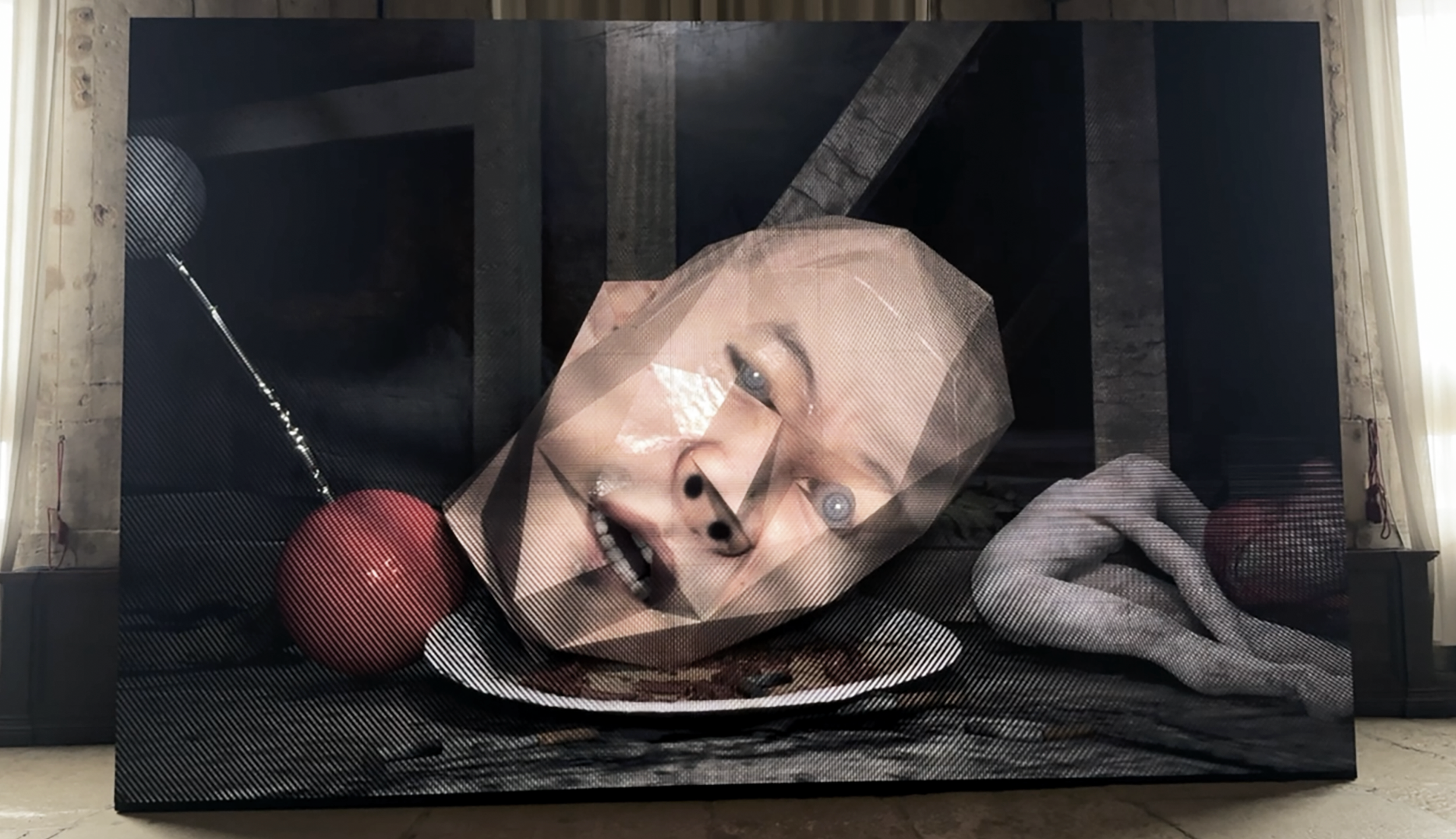
Li Yi-Fan, Screen Melancholy, 2026, installation view, Taiwan Collateral Event, 61st Venice Biennale. Image courtesy MACP.
I remember coming down the stairs in my parents’ house, I was 13, and I had a book in my hand. My mother had just come in from the garden, so it must have been a late spring weekend or early summer. I said something to the effect that I’d found a poetry anthology upstairs and a particular poem was amazing, and I read it aloud to her. I didn’t know it then, that it would change the whole direction of my life. You likely know the beginning of the poem well: “Let us go then, you and I,/When the evening is spread out against the sky/Like a patient etherized upon a table.” Time as a cloud of administered sleep, like a body infused with chemicals, morbid and remarkable. The insertion of the technological word “etherized” is a sudden shift in the poem’s tone, a little leap of ideational contrast into a pleasure I hadn’t known, dipping me down into the under-ness of understanding, the suddenness of it erupting.
I think of this now, back from Venice, where there was a work like that. Well, not so strangely elevated as T. S. Eliot’s “The Love Song of J. Alfred Prufrock,” but still revelatory in our age of rapidly unsettling intelligent machines: something immersed in the fluidity of life transmogrified through the sleight-of-hand of a technological unveiling. In Eliot, we may find the rediscovery of the sensations of life, but in this new work, those sensations are replaced by an artificiality zoomed in on from the horizon of what’s to come.
The work is Li Yi-Fan’s sixty-minute software-generated video installation, Screen Melancholy (2026), featured as Taiwan’s collateral event and organized by the dexterously talented curator Raphael Fonseca, in which the lubricity of AI-generated speech is given the chameleon logic of dreams—a language that already awaits us in the virtual passageways of customer support, of bureaucracy sped up, alien, and inescapable. I came once to see Li’s video, then after seeing everything else there was time for in the Biennale, I came back to see it again. What is it about Screen Melancholy that’s so haunting and macabre, and won’t leave my mind?
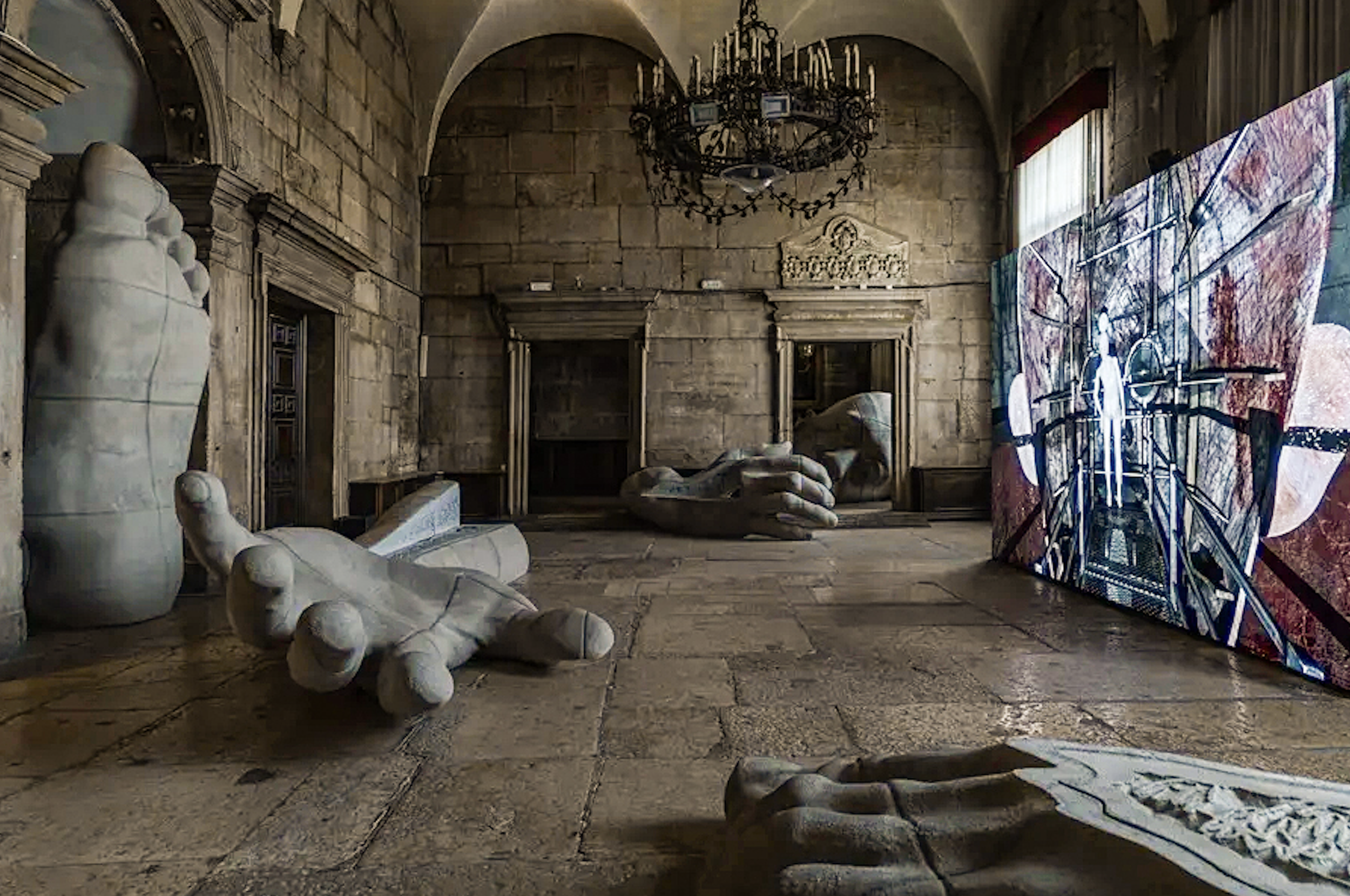
Li Yi-Fan, Screen Melancholy, 2026, installation in Palazzo delle Prigione, Taiwan Collateral Event, 61st Venice Biennale. Image courtesy the artist and TFAM.
The first thing that struck me wasn’t the content of this remarkable work, but the look of it. Li’s palette ranges over a continuum of sepulchral grays. Scenes have objects done in acid reds, blues, and greens, but his world-building largely conjures the dimly lit half-life of the undead. The heavy atmosphere is set askew still more by the jarring, almost avuncular, cheeriness of its protagonist, who has the comic gait of Charlie Chaplin, though more robotic, and is wrapped in the sallow skin of Gollum from Lord of the Rings, with whom he has a passing resemblance. Amid these tints and shadows, his manic talk rushes toward us in an endless, AI-fueled monologue of self-help, tech instructions, and hyperventilated storytelling about his own organs—heart, lungs, intestines, prostate, eyes—which are presented as mini-me puppets he manipulates, and keeps repeating, “I don’t want your gift. I don’t want your gift. I don’t want your gift.” Is that gift human sentience and subjectivity, or just meat instead of electrons, with the expiration date of organic life?
He talks about how to make the video he’s in, about AI and frame generation, jump-cutting from oracular commentary to the technological and an approximation of emotion: “One day you will also become a low-poly model. […] What is your relationship to all the images you’ve seen? […] How do you project a 2D plane onto a spherical geometry? […] Are you lost? Are you lost?” And, with an artificially sweetened dose of sentimentality, “You must follow the heart.” A golem is an anthropomorphic figure created from inanimate matter—mud or clay—and here, Li has created his golem from the inanimate material of code, seeming to stand in as an exculpatory being who somehow absolves us of the guilt implicit in the very creation of beings who are altering our lives. In this way, the giddy weirdness of his talk and bendy movements offer a kind of ventilating humor, relieving us of the claustrophobia of the space and the estranging aura of AI that he personifies, as he slips between English and Mandarin and pierces himself with arrows. That suffering unto the lord of digital advancement, which undergirds Screen Melancholy’s surreal narrative and scenes, is as ecstatic and fearsome as St. Sebastian while it floats in the hollowed-out feeling of the totally prefab, all synth and hall of mirrors.
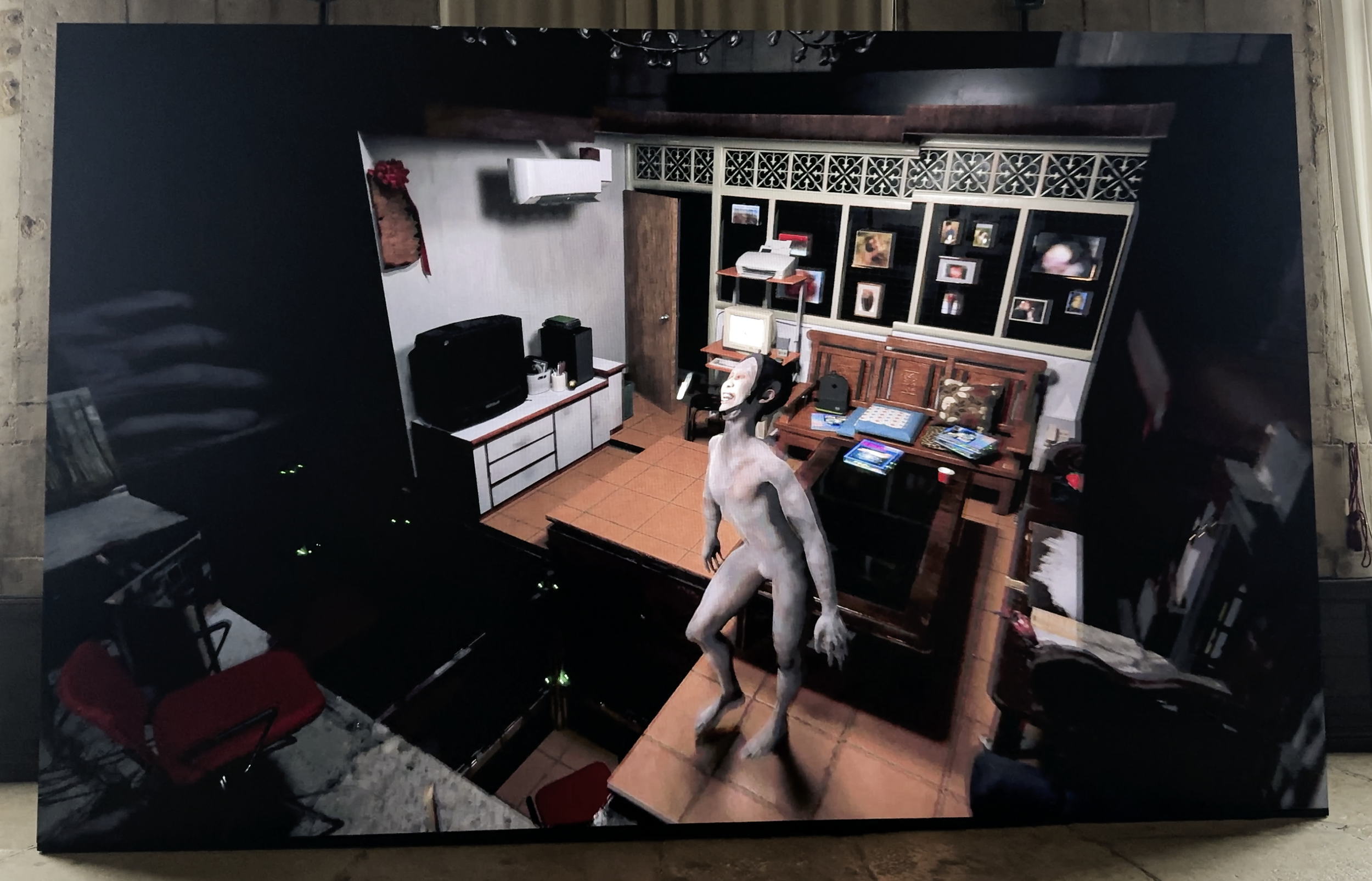
Li Yi-Fan, Screen Melancholy, 2026, installation view, Taiwan Collateral Event, 61st Venice Biennale. Image courtesy MACP.
In the video, our mongrel narrator crisscrosses a room that reflects the one we’re sitting in (a seventeenth-century palazzo interior of gray Istrian stone, once part of a prison, fitted out with monolithically scaled sculptures of body parts, some of which we sit on as benches) and a hallucinatory warren of rooms on two floors that magically rise and fall like stage sets, the spaces cluttered with technical equipment, military equipment, cooking gear, and junk. Sitting in that room simultaneously simulated on the screen somehow twists our physical presence, doubling and cleaving our sense of here-ness, dipping us in disorientation—a sort of quantum spookiness we inhabit on the other side of the work’s “melancholy screen,” which evokes all the screens through which we experience so much of contemporary life, at once endlessly deep and flattened.
To use the tools of AI to critique and lampoon its fleet-footedness as well as its potentially devastating weight is, of course, the point of Li’s off-kilter tension, to which we’re all captive now. The paradox of machinic life haunting—or is it taunting—the human in its own dissociated voice is vivid as a bruise. In Critique of Pure Reason, Kant wrote, “What can I know? What should I do? What can I hope for?” Here, the artist seems to be saying, with soul-searching melancholy pulsing under his humor, that the darker realities of AI plumb the first two of these questions for itself, while immiserating the last for humankind.
So it was that I stepped from the brilliant morning light of the Piazza San Marco, with its clouds of pigeons and the scintillations of the Grand Canal, into a technological den of humanly made inhuman artifice, whose ultimate message, I think, is about being human and our particular trait of tool-making, taught back to us here by our own ironic creation. Tool-making has always been an act of invention on whatever scale with the goal of improvement or, most basically, of survival. Now, as Li’s golem shows and tells us, it’s an apparatus of onanism whose prospect exists within a bubble of artificial self-determination; an echo chamber in which the call for improvement is replaced by the algorithmic desire to only reproduce its own environment and its own organs in a technological hothouse. At one point, he remarks, “Are you scared? Don’t be scared. It’s just a computer graphic.” His reassurance is hardly reassuring. It feels as if our own agency is parodied and mourned by this chattering, oneiric devil as we cruise at ballistic speed not only toward the conjugation of democracy’s collapse but toward the collapse, too, of the division between human and machine, as abstract and visceral as Eliot’s etherized evening, enveloping us as we watch.
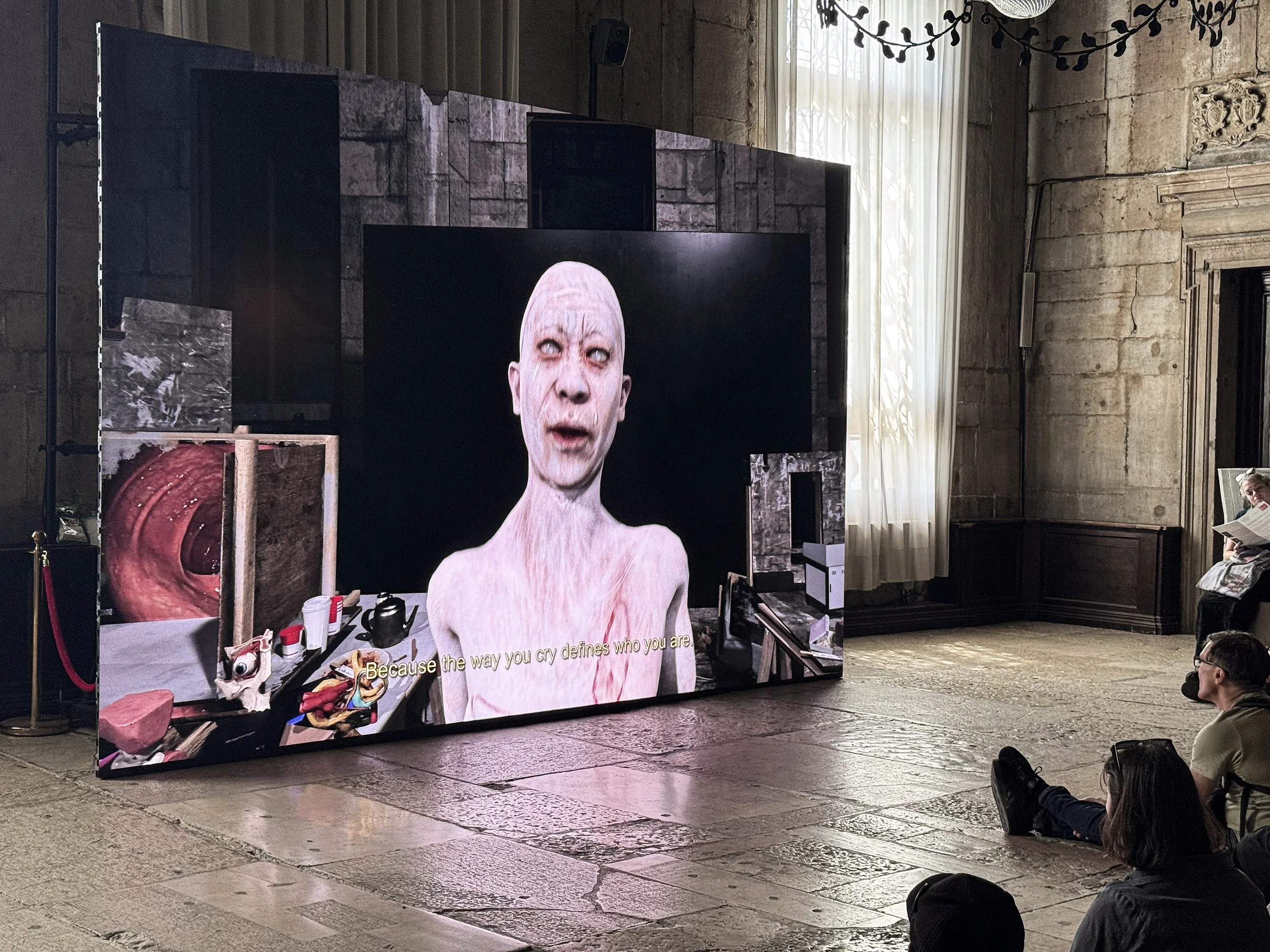
Li Yi-Fan, Screen Melancholy, 2026, installation view, Taiwan Collateral Event, 61st Venice Biennale. Image courtesy MACP.
-
Steven Henry Madoff is the founding chair of the MA Curatorial Practice program at the School of Visual Arts in New York and editor in chief of The Curatorial. Previously, he served as senior critic at Yale University’s School of Art. He lectures internationally on such subjects as the history of interdisciplinary art, contemporary art, curatorial practice, and art pedagogy. He has served as executive editor of ARTnews magazine and as president and editorial director of AltaCultura, a project of the Museum of Modern Art in New York. His books include Unseparate: Modernism, Interdisciplinary Art, and Network Aesthetics from Stanford University Press; Thoughts on Curating from Sternberg Press (series editor); Turning Points: Responsive Pedagogies in Studio Art Education (contributor) from Teachers College Press; Learning by Curating: Current Trajectories in Critical Curatorial Education (contributor) from Vector; Fabricating Publics (contributor) from Open Humanities Press; What about Activism? (editor) from Sternberg Press; Handbook for Artistic Research Education (contributor) from SHARE; Art School (Propositions for the 21st Century) (editor) from MIT Press; Pop Art: A Critical History (editor) from University of California Press; Christopher Wilmarth: Light and Gravity from Princeton University; To Seminar (contributor) from Metropolis M Books; and After the Educational Turn: Critical Art Pedagogies and Decolonialism (contributor) from Black Dog Press. Essays concerning pedagogy and philosophy have appeared in volumes associated with conferences at art academies in Beijing, Paris, Utrecht, and Gothenburg. He has written monographic essays on various artists, such as Marina Abramović, Georg Baselitz, Ann Hamilton, Rebecca Horn, Y. Z. Kami, Shirin Neshat, and Kimsooja, for museums and art institutions around the world. His criticism and journalism have been translated into many languages and appeared regularly in such publications as the New York Times, Time magazine, Artforum, Art in America, Tate Etc., as well as in ARTnews and Modern Painters, where he has also served as a contributing editor. He has curated exhibitions internationally over the last 35 years in the United States, Europe, and the Middle East. Most recently, Y.Z. Kami: In a Silent Way at MUSAC, León, Spain, June 2022-January 2023. Madoff is the recipient of numerous awards, including from the National Endowment for the Arts and the Academy of American Poets. He is a member of the Curatorial Studies Workshop, part of the Expanded Artistic Research Network (EARN).