
Liquid Tongues: Expanding Language, Limiting Experience
There is a difference between making deaf people the topic of an exhibition and actually being inclusive of them in making the exhibition.
Chaieun Lee • 7/20/26
Liquid Tongues, Bogna Burska and Daniel Kotowski, curated by Ewa Chomicka and Jolanta Woszczenko, Pavilion of Poland, 61st Venice Biennale, May 9–November 22, 2026
-
On Site is The Curatorial's section for curatorial reviews and a venue for MA Curatorial Practice students at the School of Visual Arts to publish as part of their program, though it is open to all writers.
In this review, Chaieun Lee examines Liquid Tongues by Bogna Burska and Daniel Kotowski at the Polish Pavilion, curated by Ewa Chomicka and Jolanta Woszczenko, an audiovisual installation that draws on sign language, whale song, and underwater space to challenge the primacy of spoken language and foreground deaf experience. Lee argues that while the work succeeds in proposing spoken language, sign language, and other communicative forms as parallel rather than hierarchical, its curatorial execution falls short of its own ambitions, guiding hearing visitors through sound while leaving deaf visitors at a momentary disadvantage, and missing opportunities, particularly in the sculptural seating structure, to communicate through vibration and bodily sensation. The review ultimately distinguishes between representing deaf people and designing for them, asking whether the exhibition's inclusivity was fully realized or only partially imagined.
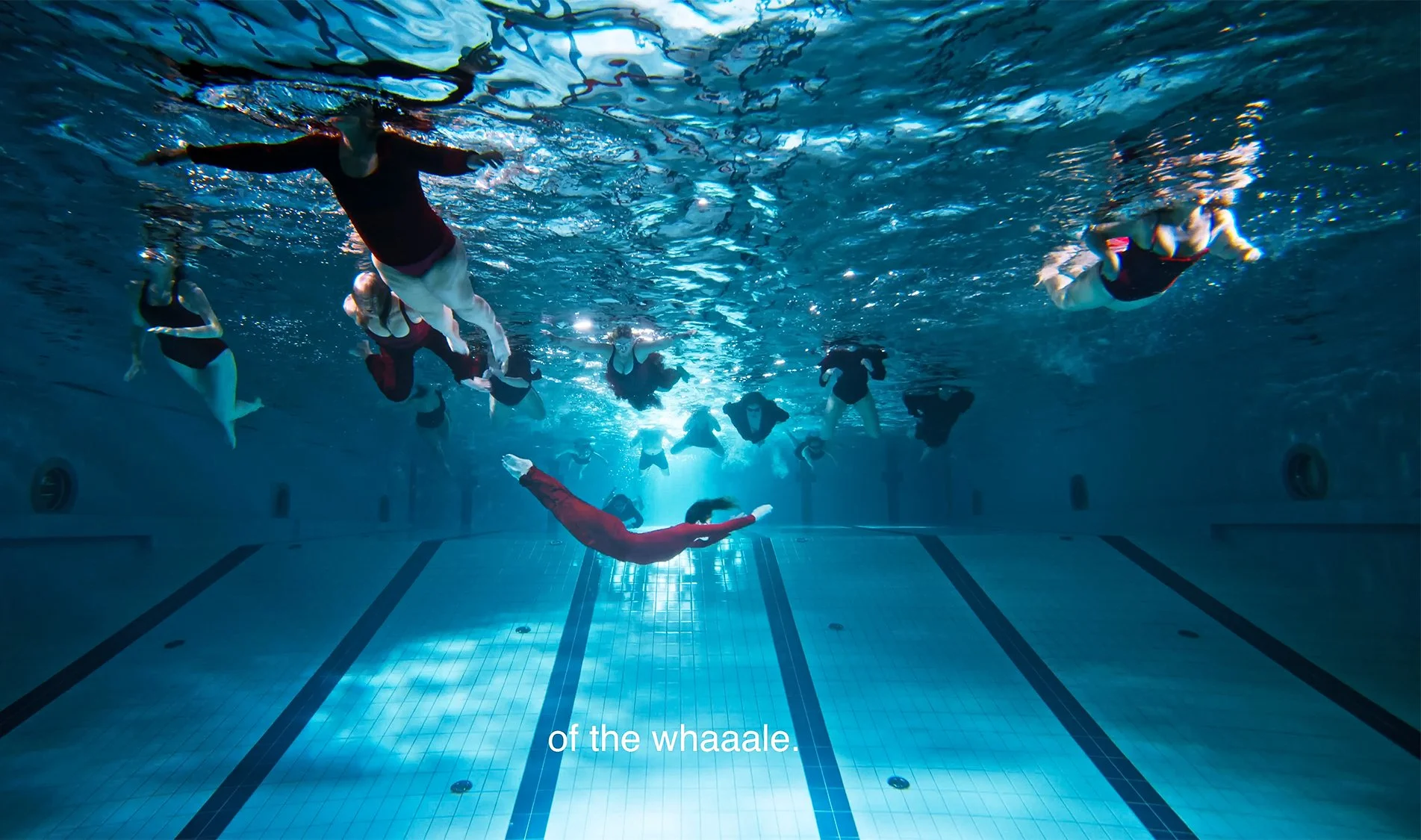
Bologna Burska and Daniel Kotowski, Liquid Tongues, 2026, still from video, Pavilion of Poland, 61st Venice Biennale. Image courtesy Zacheta Archive.
What first overwhelms visitors on entering the Polish Pavilion is the surround-sound chorus. Sequences of spoken letters, harmonies reminiscent of whale song, and fragments of text drift through the space, drawing visitors toward the exhibition’s two large screens, one mounted on the wall and the other suspended overhead. As they watch the performers’ gestures and movements, they soon realize that what they are seeing is a form of sign language and that the exhibition seeks to address, at least in part, the marginalization of the deaf. Yet, a surprising question almost instantly came to mind as I moved through the space and sat there: Who was this exhibition for?
Liquid Tongues, an audiovisual installation by hearing artist Bogna Burska and deaf artist Daniel Kotowski, presents two screens that only come fully into view after entering the space and turning one’s head or body. Hearing visitors are naturally guided toward the screen on the wall to the left by sounds resembling water or whale song. It seems an irony that deaf visitors, not able to share that same auditory invitation into the work, are left at a momentary disadvantage, and the question emerges of how this might have been curatorially resolved.
Still, the images ultimately draw everyone in, and they are striking. In the videos, against cool-toned backgrounds, groups dressed in vivid red move their hands and mouths as they submerge themselves underwater in a swimming pool and stand in a snowy winter landscape, communicating through language and gesture. This visual intensity resembles the way many deaf people navigate the hearing world, where communication often begins with the need to capture another person’s attention. The videos’ stark contrasts seem to reflect that condition, where visibility becomes a prerequisite for language itself.
The address of Liquid Tongues to auditory otherness also resonates with “minor keys,” the late Koyo Kouoh’s theme for the Biennale’s central exhibition. Kouoh described “minor keys” as an invitation to revisit, listen to, and sense the margins of society and daily experience. Yet the notion of hearing and listening carries its own implicit limitations and risks of marginalization. For all the good intentions carried in the musical allusion of Kouoh’s title, the auditory remains exclusionary for some. And so, for the Polish Pavilion, curators Ewa Chomicka and Jolanta Woszczenko, who seek with the artists to highlight the agency of deaf people living within a hearing world, it might be said that they signal the “minor” to redress exclusion and celebrate difference without calling aloud for its keys. Kotowski spoke in a recent interview about this as “Deaf Gain,” saying that “hearing people usually perceive deaf people through a strongly medicalized perspective and notice only the deficits that deaf people may have. But Deaf Gain completely reverses this and shows how much deaf people are capable of and how much they can offer the world.”1

Bologna Burska and Daniel Kotowski, Liquid Tongues, 2026, installation view, Pavilion of Poland, 61st Venice Biennale. Image courtesy Jacopo Salvi (altomare)/Zachęta Archive.
Liquid Tongues explores this condition most strikingly through underwater space. The performers who appear throughout the videos, Chór w Ruchu (Choir in Motion), are composed of both deaf and hearing members. They sing in spoken and sign languages, attempting communication through their bodies as much as through their words. In the videos, water, which covers most of the planet yet remains outside the principal living and communication space for humans, becomes a primary space for the way meaning is signaled. In this submerged environment, spoken language becomes distorted and difficult to understand, while sign language takes on authority and centrality, and the evocation of whale song offers another instance of alternative communicative authority, identity, and sovereign wholeness. As Burska said about the work, “I had this idea that together we could create a kind of super-language, expressed through sound, the way hearing people speak, and through image and space, the way deaf people communicate, so that together they could create this super-language. Maybe we could try to imagine how whales communicate and interpret the world, or to put it more accurately, in whale language.”2
Here, a reversal of this hierarchy is powerfully presented. The assumption that spoken language holds primacy originates in the history of the word “language” itself. The English word derives from the Latin lingua, meaning “tongue.” If language itself is etymologically tied to the tongue, it is easy to understand why speech and the ability to hear it are intrinsic to the way language is valorized in its auditory form. Liquid Tongues proposes a profound reconsideration, in which spoken language, sign language, whale song, and written language in the form of the videos’ subtitles are presented not as hierarchical forms of communication, but as parallel ones.
Significantly, the curators chose the plural form, tongues—languages—rather than the singular. And we can see this attentiveness in the work’s soundscape itself. Certain words, phrases, and refrains drawn from distinct sources and contexts recur throughout the work, from the repeated “whup whup,” an interpretation of humpback whale calls disrupted by human-generated ocean noise, to “hand talk,” recalling Indigenous sign languages displaced by spoken-language systems. While they spark curiosity, their meaning isn’t always immediately clear.
The zine distributed in the pavilion provides crucial context, including explanations of specific phrases, their sources, and information about Kotowski’s collaboration with a hearing interpreter in translating whale communication into spoken and sign languages. It also clarifies why whale communication occupies such a significant place in the project. Reading these explanations, visitors gradually begin to trace connections between the historical marginalization of sign language and the difficulties whales face communicating in increasingly noisy oceans. Still, much of this important information is difficult to find in the project’s materials online. Of course, providing additional context on-site is an important curatorial practice. Yet the reliance on a single physical format still feels at odds with the exhibition’s broader concern for accessibility.
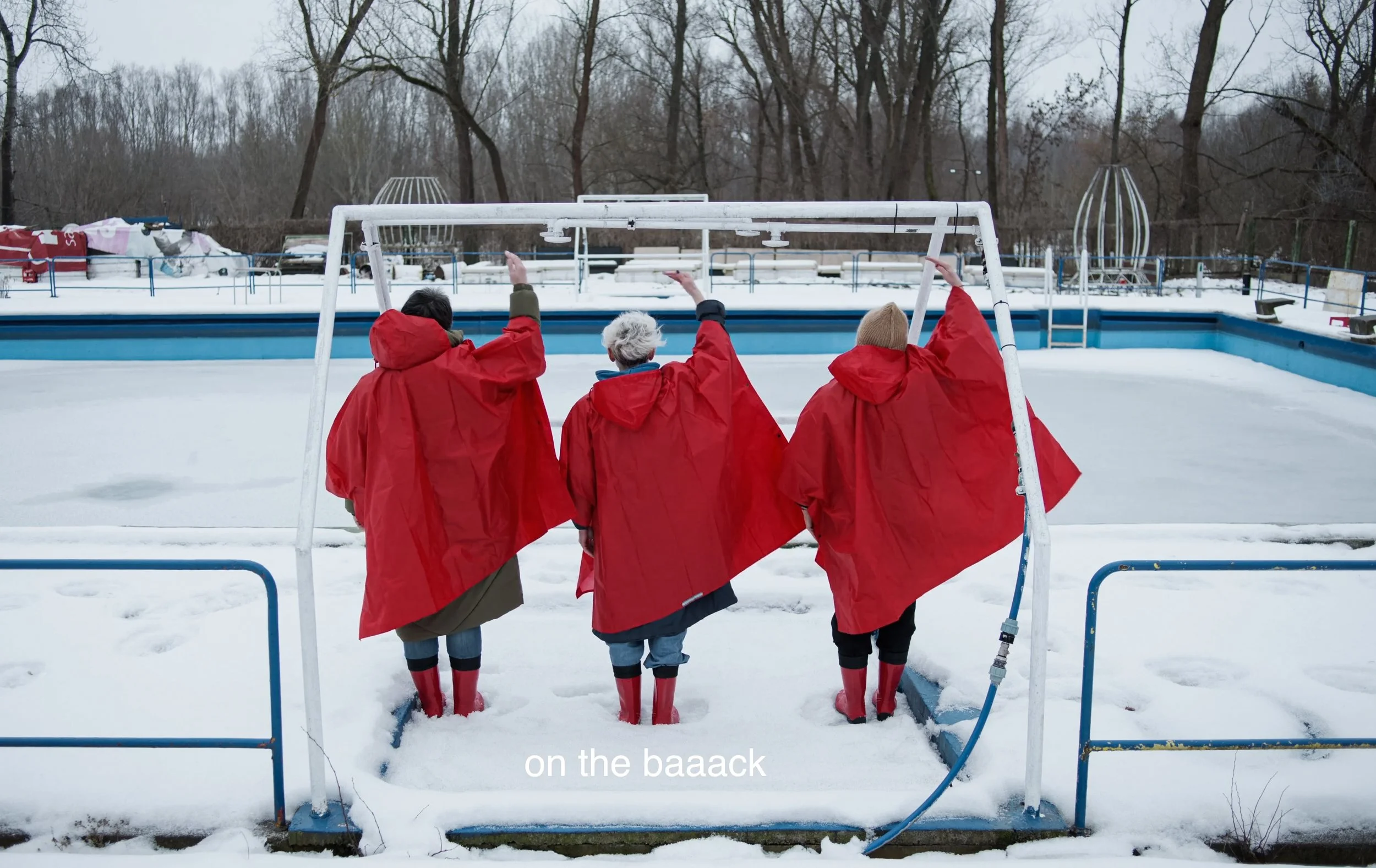
Bologna Burska and Daniel Kotowski, Liquid Tongues, 2026, still from video, Pavilion of Poland, 61st Venice Biennale. Image courtesy Zacheta Archive.
There is another aspect of communication that seems not fully aligned with the exhibition’s ambitions. At the center of the pavilion, a sculptural seating structure by Marcin Kwietowicz is installed, positioned like an island between the wall and ceiling screens. Visitors can recline against its streamlined form, reminiscent of a whale's spine, while watching the videos. Because of its primary position within the installation, and because it invites direct physical contact, I expected the structure to function as an organ of resonance, that is to say, as another channel of communication, connecting the audience to the work through the body as well as through sight and sound. Yet the structure remains primarily a seat, and the exhibition remains more conventional than it could have been as an audio-visual installation—a missed opportunity. Even more so because vibration, lip movement, and bodily movement all play a role in the communicative practices of the deaf. Had vibration traveled through Kwietowicz’s work, it would have brought this communicatory form to life for visitors as a way to more fully apprehend deaf experience in its breadth.
And so, let me return to my initial question: Would a deaf visitor encounter this exhibition in the same way as a hearing audience?
Liquid Tongues succeeds in challenging the hierarchy that has long privileged spoken language over other forms of communication. Yet it has to be asked if deaf people in this exhibition were imagined solely as a subject of representation or as members of its audience and, by extension, more fully understood members of society. There is a difference between making deaf people the topic of an exhibition and making them the point of reference through which the exhibition is designed to create that greater inclusivity. It would be unfair to do anything less than praise the exhibition’s significant engagement with deaf experience and the compelling artistic work it has produced. Still, if spoken and sign languages were more fully embodied in the presentation of Liquid Tongues,the ambitions of the artists and curators would have been truly met.
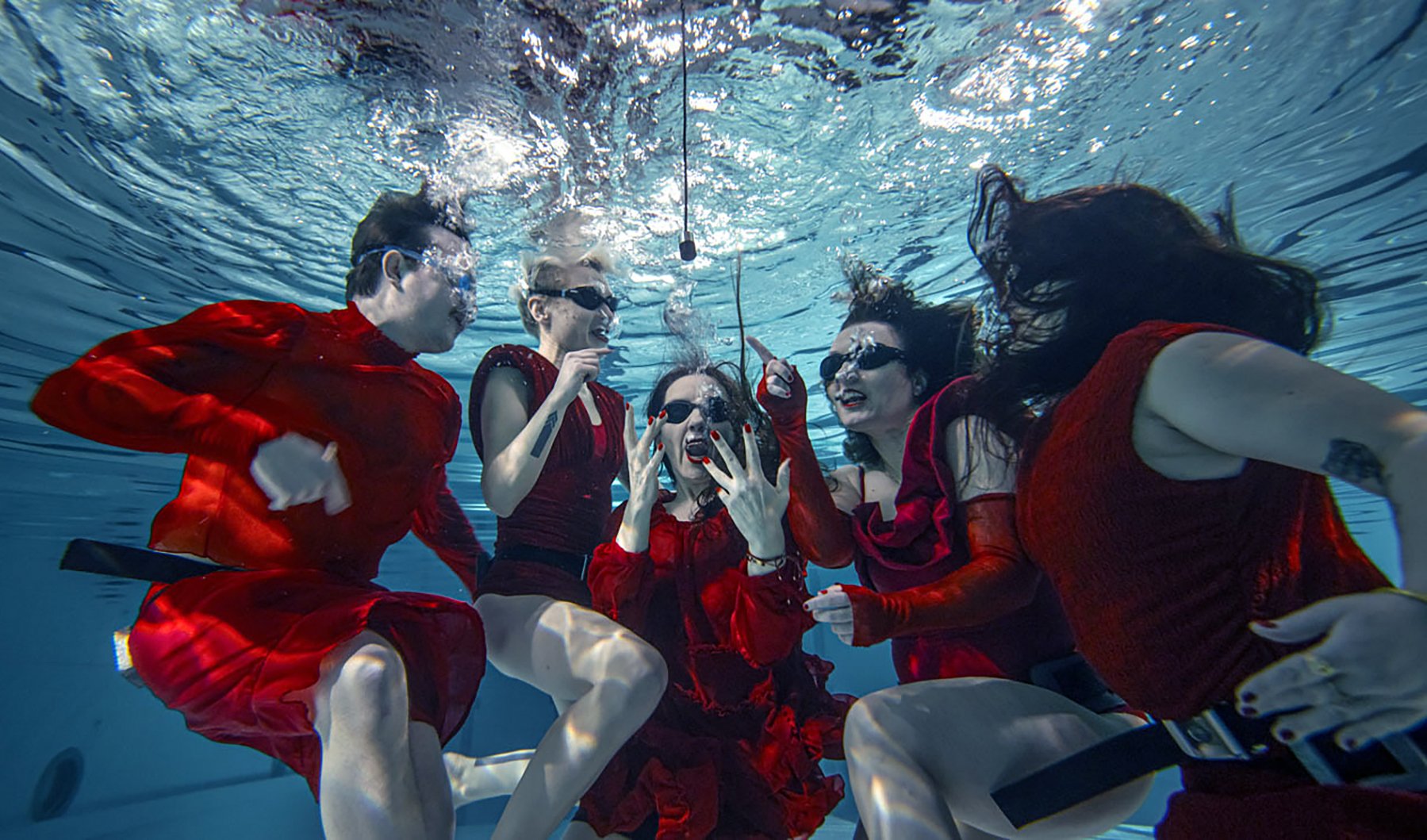
Bologna Burska and Daniel Kotowski, Liquid Tongues, 2026, still from video, Pavilion of Poland, 61st Venice Bienale. Image courtesy Zacheta Archive.
NOTES
1. Artim, “Polish Pavilion at the Venice Biennale 2026,” YouTube, https://www.youtube.com/watch?v=TsDCyVc8EqU.
2. Artim, “Polish Pavilion,” https://www.youtube.com/watch?v=TsDCyVc8EqU.
-
Chaieun Lee is an independent curator and artist from Seoul, South Korea. Drawing on her background as an artist, she approaches each exhibition as a work in its own right. Her practice focuses on accessibility and marginalized voices, exploring how exhibitions can create spaces for empathy and dialogue. She is currently a student in the MA Curatorial Practice program at the School of Visual Arts in New York. Alongside her independent curatorial practice, she has curated exhibitions in Seoul and New York and worked at DIA Contemporary, New York, and Casco Art Institute: Working for the Commons, Utrecht, the Netherlands.