
Rehearsals for Possible Futures
Through smirks, dry delivery, and the revelation of constructed stagecraft, the Danish Pavilion places small cracks in the fantasies and realities of performance and desire.
Naomi Moser • 7/20/26
Maja Malou Lyse, Things to Come, curated by Chus Martinez, Pavilion of Denmark, 61st Venice Biennale, May 9–November 22, 2026
-
On Site is The Curatorial's section for curatorial reviews and a venue for MA Curatorial Practice students at the School of Visual Arts to publish as part of their program, though it is open to all writers.
In this review, Naomi Moser takes a closer look at Things to Come by Maja Malou Lyse at the Danish Pavilion of the 2026 Venice Biennale, curated by Chus Martinez, focusing on its use of immersive spectacle to interrogate gender performance and affective labor. Taking as its premise a fertility study finding that VR porn dramatically improves sperm motility, the exhibition deploys campy, self-reflexive vignettes in which the mechanics of fantasy are exposed mid-performance. Moser critically evaluates how this approach engages theories of performativity from Goffman, Tolentino, and Legacy Russell, asking whether revealing the artifice underlying femininity and desire might ease the social burden of sustaining them, and arguing that Lyse's work places productive cracks in the structures of gender performance without fully dismantling them.
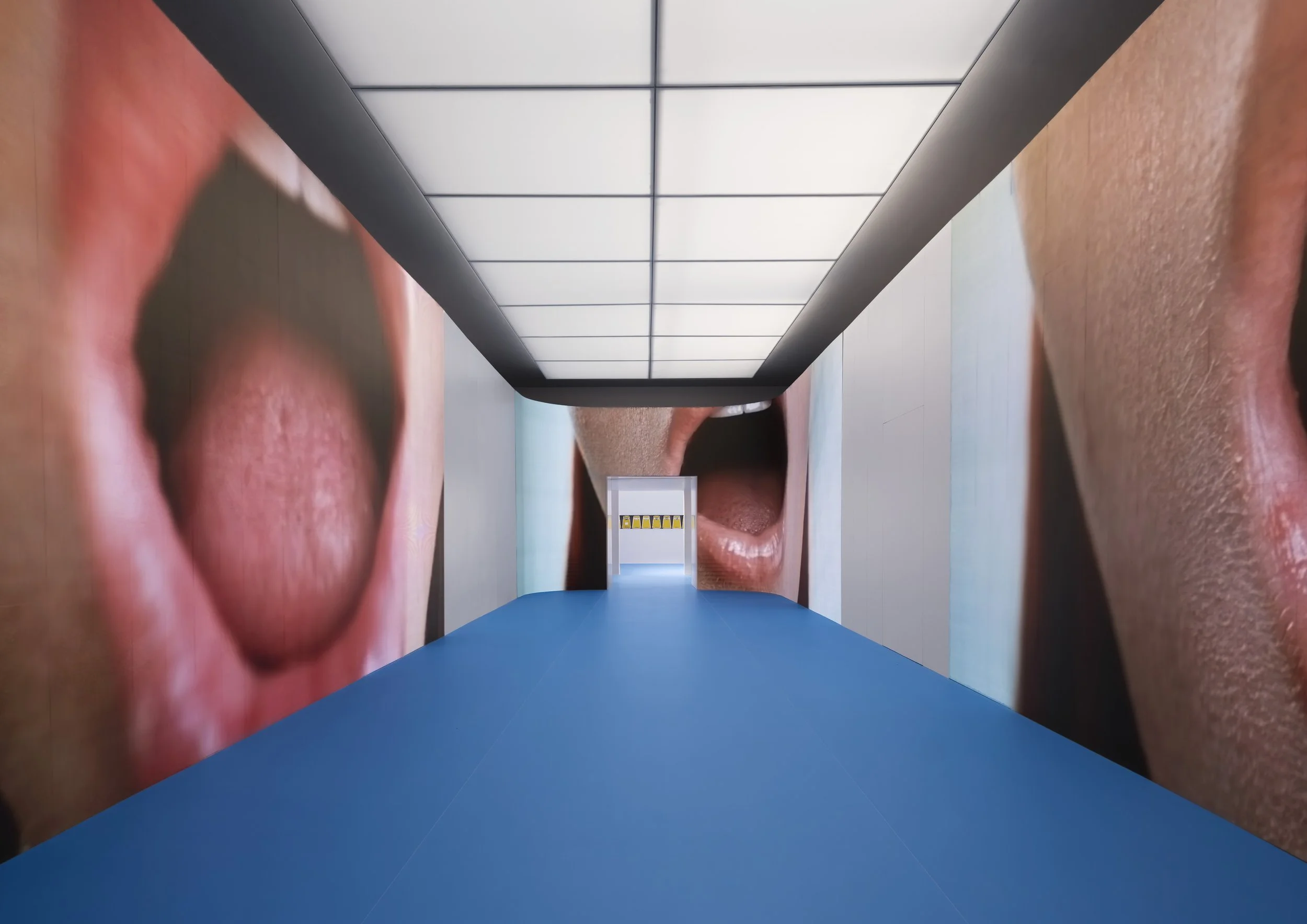
Maja Malou Lyse, DIS, Things to Come, 2026, installation view, Pavilion of Denmark, 61st Venice Biennale. Photo by Ugo Carmeni.
On entering the Danish Pavilion, viewers are confronted with an intriguing solution to the contemporary fertility crisis: VR porn. Maja Malou Lyse’s sculptural video installations that fill the pavilion, curated by Chus Martinez, are inspired by a Cryos International study that found sperm motility (i.e., speed and aliveness), which has declined dramatically in the last decade, went up by fifty percent for those watching porn on VR devices vs. other screens. Even with the POV (point of view) perspective in VR porn, the viewer knows that the performance isn’t personalized for them, and yet, these findings indicate that this disconnect, or artificiality, is not a barrier to dramatically improved corporeal results. Just the opposite. As I watched Lyse’s work, which Martinez has referred to as “rehearsals for possible futures,” I wondered whether these outcomes might be meaningful, not only for fertility but also for the study of performance.1 If audiences respond physically, despite recognizing a performance’s artificial nature, then how does Lyse’s work address the role of sincerity and artificiality in performance art, gender performance, and porn acting? Can exposing artifice in these performances lessen the affective labor required to sustain genuine-seeming presentations of femininity, desire, and care?
The first of the two installations, Stars in My Pocket, is a series of yellow cryogenic sperm bank tanks with embedded palm-sized screens that play “sperm races,” a recent internet phenomenon. Fears of declining fertility have been transformed into entertaining online sporting events, where men have their sperm race along microscopic tracks. Sperm races, like the study that inspired the work, connect staged performance and physiological output.
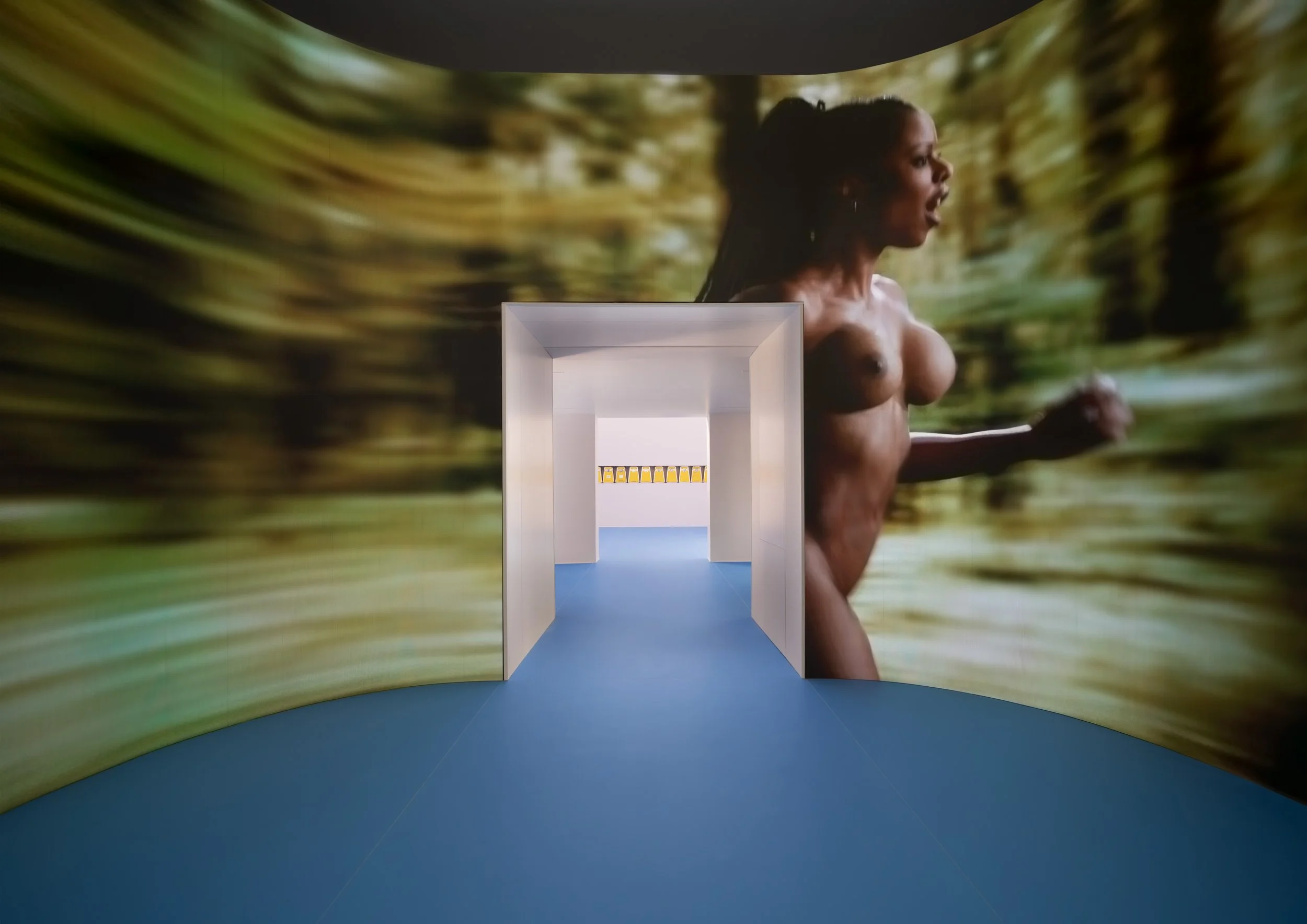
Maja Malou Lyse, DIS, Things to Come, 2026, installation view, Pavilion of Denmark, 61st Venice Biennale. Photo by Ugo Carmeni.
If Stars in My Pocket is the raw data, then the second installation, Things to Come, is the scientific method. Created by Lyse and art collective DIS, the piece is comprised of a series of amusing vignettes set at a fertility clinic in a not-so-distant future. Here, campy, godly porn stars run the sperm bank that’s facilitating the fate of humanity through fertility optimization. Lyse, DIS, design studio Common Accounts, and Martinez successfully took VR—a single-person activity viewed through an individual headset—and adapted it into an immersive, communal POV experience. The porn stars’ exaggerated, meme-able scenes surround the audience on huge, curved LED walls. And, as with VR, the screen-walled room engulfed every corner of my eyes as lip-filler-filled lips parted and a cast member took the audience’s POV down her throat into darkness.
In another scene, a series of (what I interpret to be) future Eves with huge, augmented breasts run Baywatch-style through a forest. Legendary porn actress Nicolette Shea, with platinum blonde hair and a little goatee to match, catwalks the halls of the fertility center. Her lab coat trails behind her, revealing a bikini so scant that one of the sperm she later observes through a microscope could wear it on its race to optimization.
Next, a performer, in a sultry, automated-like voice, says, “Hey, I have something really important to say, so I’m going to take my clothes off while I say it, okay?” She then recites frightening side effects as she strips naked, both instructing the viewer on the risks of an unspecified procedure and providing them with inspiration for their sample. Her performance makes explicit the notion that the most effective way to hold the viewer’s attention is to arouse them. Instead of performing “sexy” from a place of genuine lust, her performance can be read as self-reflexive burlesque, calling attention to the tease and its problematic implications while still titillating the audience. However, I also recognized resignation and emptiness in her delivery. Is it the weight of knowing she's only worth listening to if she’s turning someone on? And even then, is anyone actually listening? I don’t remember the side effects.
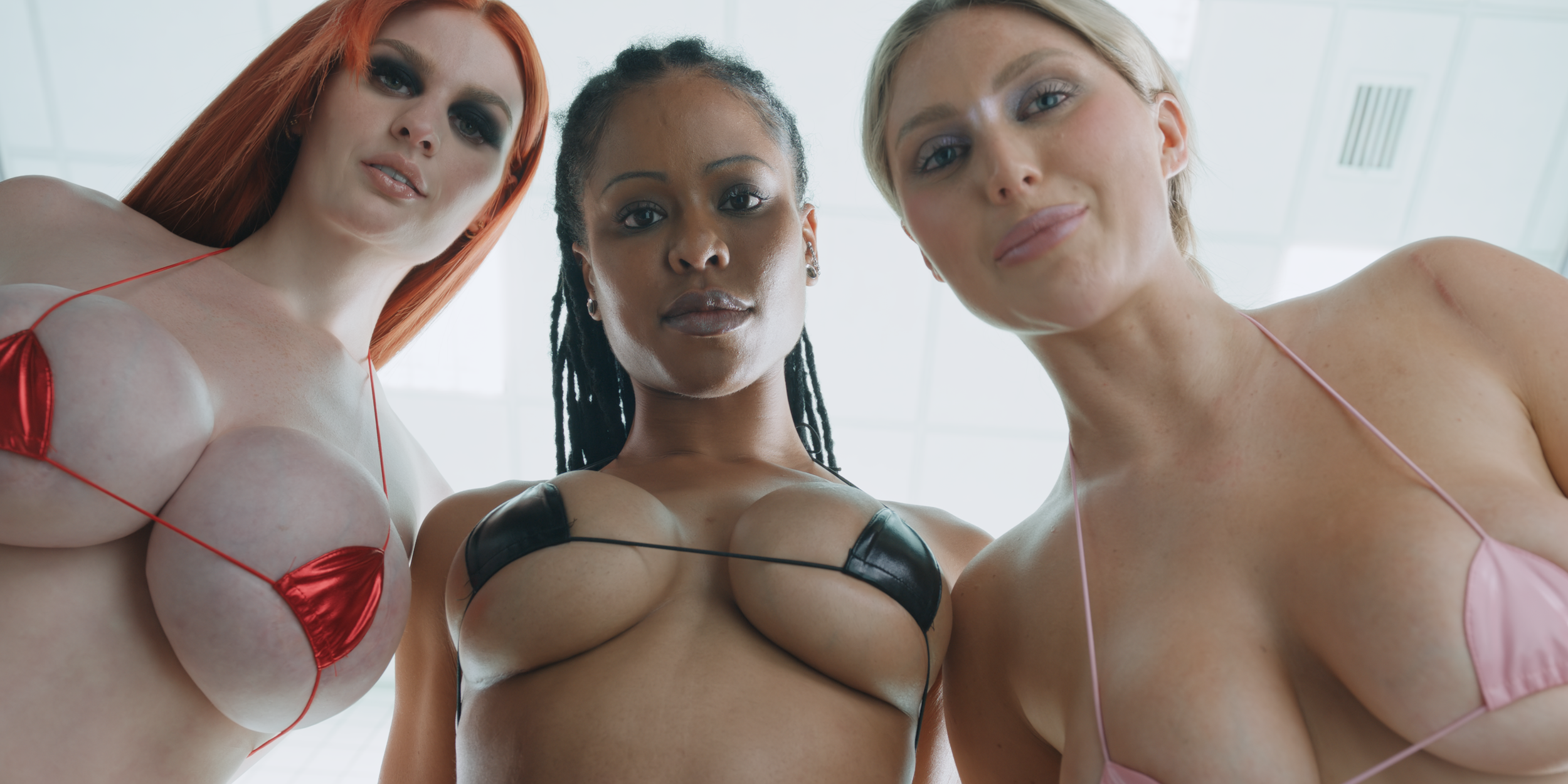
Maja Malou Lyse, DIS, Things to Come, 2026, still from video, Pavilion of Denmark, 61st Venice Biennale. Image courtesy DIS.
In a standout vignette, a performer’s breasts miraculously bounce independently from the rest of her body. She smirks at the audience as the camera pans up a ladder behind her. Fishing wires are revealed, and Lyse herself is shown pulling the set of strings that bounce the performer's breasts. The audience is invited to enjoy a fantasy while seeing how it’s made. Perhaps the 360-degree POV makes the act feel more urgent, as if Things to Come is pleading with its viewers to see the constructed, artificial aspects of the fantasy it is creating. Could unveiling the mechanics of this illusion lessen the burden of maintaining it?
Society continues to expect that women be nurturing, highly considerate, sexy, and enthusiastic (among a billion other things)—and, importantly, that they be one-hundred-percent genuine. In The Presentation of Self in Everyday Life, performance theorist Erving Goffman writes that the backstage is where “the performer can relax; he can drop his front, forgo speaking his lines, and step out of character.”2 And, like in Lyse’s work, “it is here that illusions and impressions are openly constructed.”3 Gia Tollentino brings Goffman’s theory to the present in her book Trick Mirror, observing that with digital identity performance, “the backstage” no longer exists. She writes that “where the offline audience necessarily empties out and changes over, the online audience never has to leave.”4 In the internet era, society demands that gender performance not only be genuine but also continuous. Curator and author Legacy Russell writes in Glitch Feminism that a “calculated failure” to perform gender as expected “creates a fissure within which new possibilities of being and becoming manifest. This failure to function within the confines of a society that fails us is a pointed and necessary refusal.”5
Through smirks, dry delivery, and the revelation of constructed stagecraft, Lyse and her performers do just this, placing small cracks in the fantasy, suggesting that there can be a backstage onstage, even as the show goes on, looping in the Danish Pavilion. They play with matches, teasing the flammable structures of gender performance and affective labor, while still inside the smoldering building.
The work begs the question: If VR technology continues to improve, and artificial, constructed interactions have even greater, positive effects on the human body, will people increasingly choose them over genuine ones? And could this, in fact, increase the labor of everyday gender performance? Would people be expected to perform even more impossibly, like characters who live in VR headsets, available 24/7, who are made of pixels, and don’t need to eat or sleep? Or could this free up the flesh-and-bone individuals who aren’t actually trapped on these screens? Maybe Lyse and her cast flicked the match from a safe distance and are watching the building burn with only their avatars left inside.
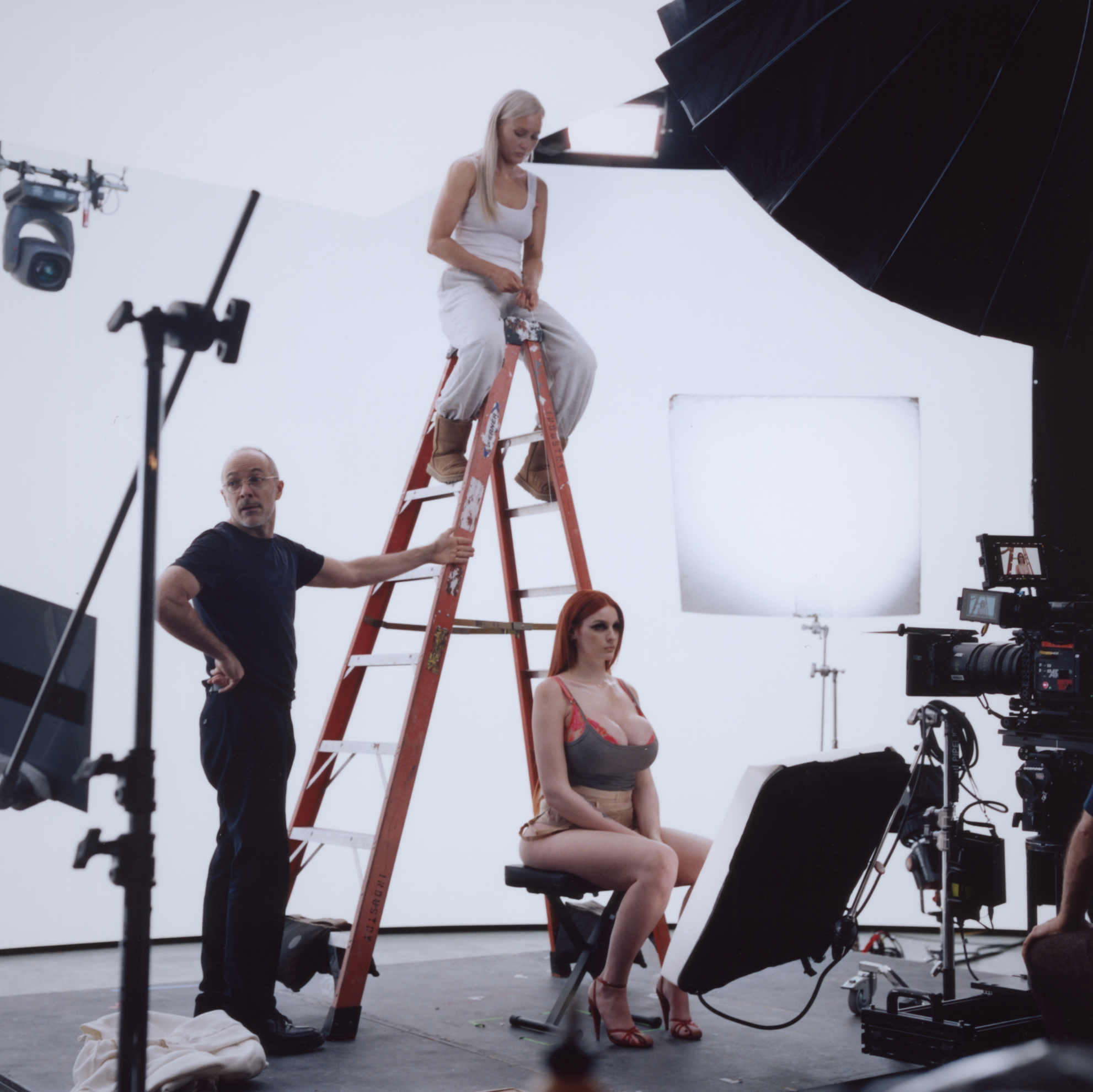
Maja Malou Lyse, DIS, Things to Come, 2026, behind the scenes, Pavilion of Denmark, 61st Venice Biennale. Photo by Zoe Chait.
NOTES
1. Danish Arts Foundation, “Maja Malou Lyse’s Things to Come at La Biennale di Venezia,” https://www.kunst.dk/english/art-forms/visual-arts/maja-malou-lyses-things-to-come-at-la-biennale-di-venezia?utm_source=chatgpt.com.
2. Erving Goffman, The Presentation of Self in Everyday Life (Doubleday Anchor Books, 1959), 112.
3. Ibid.
4. Jia Tolentino, Trick Mirror: Reflections on Self-Delusion (Random House, 2019), 15.
5. Legacy Russell, Glitch Feminism: A Manifesto (Verso, 2020), 11.
-
Naomi Moser is an independent curator and visual artist based in New York. In 2020, she completed a Fulbright grant in Romania, researching Yiddish Theater. She is currently working toward her MA in Curatorial Practice at the School of Visual Arts. Most recently, she curated a series of group shows/art parties in Los Angeles and New York that explore performance from live to screened, theatrical to everyday, and organic to machinic. As a video, animation, and performance artist, she has participated in residencies at BANFF, Atlantic Center for the Arts, and Beirut Art Residency. Her work has been featured in group and solo shows, including Feminine Urge at TRIBECA GALLERY; Give Me a Tension!, a two-person show at Space Gallery in Portland, ME; and Broken Character, a solo exhibition at EXTRA SPECIAL WITH CHEESE in Burlington, VT.