
A Shift in the Air
Venice was unexpectedly hopeful, not because it offered solutions, but because it reminded us that there are other stories, other histories, other ways to understand the world.
Diana Sardaryan • 7/20/26
In Minor Keys, curated by Koyo Kouoh, with Gabe Beckhurst Feijoo, Marie Hélène Pereira, and Rasha Salti, and Siddhartha Mitter, 61st Venice Biennale, May 9–November 22, 2026
-
On Site is The Curatorial's section for curatorial reviews and a venue for MA Curatorial Practice students at the School of Visual Arts to publish as part of their program, though it is open to all writers.
Diana Sardaryan surveys the 2026 Venice Biennale, In Minor Keys, curated by the late Koyo Kouoh and carried out by her assembled team. Framing it as a symptom of a broader shift in the global order, Sardaryan argues that where previous landmark curatorships by Okwui Enwezor and Adriano Pedrosa confronted or rewrote the Western canon, Kouoh's exhibition opted out of opposition altogether, allowing other histories and cosmologies to exist on their own terms. Formally uneven and at odds with conventional exhibition-making, In Minor Keys is assessed here not by professional criteria it was never designed to meet, but by its emotional register: dense, dissonant, and ultimately humble. Drawing on observations across multiple national pavilions, she argues that the Biennale's most honest gesture was its willingness to begin from uncertainty, proposing not solutions, but a pause, and the possibility of other stories.
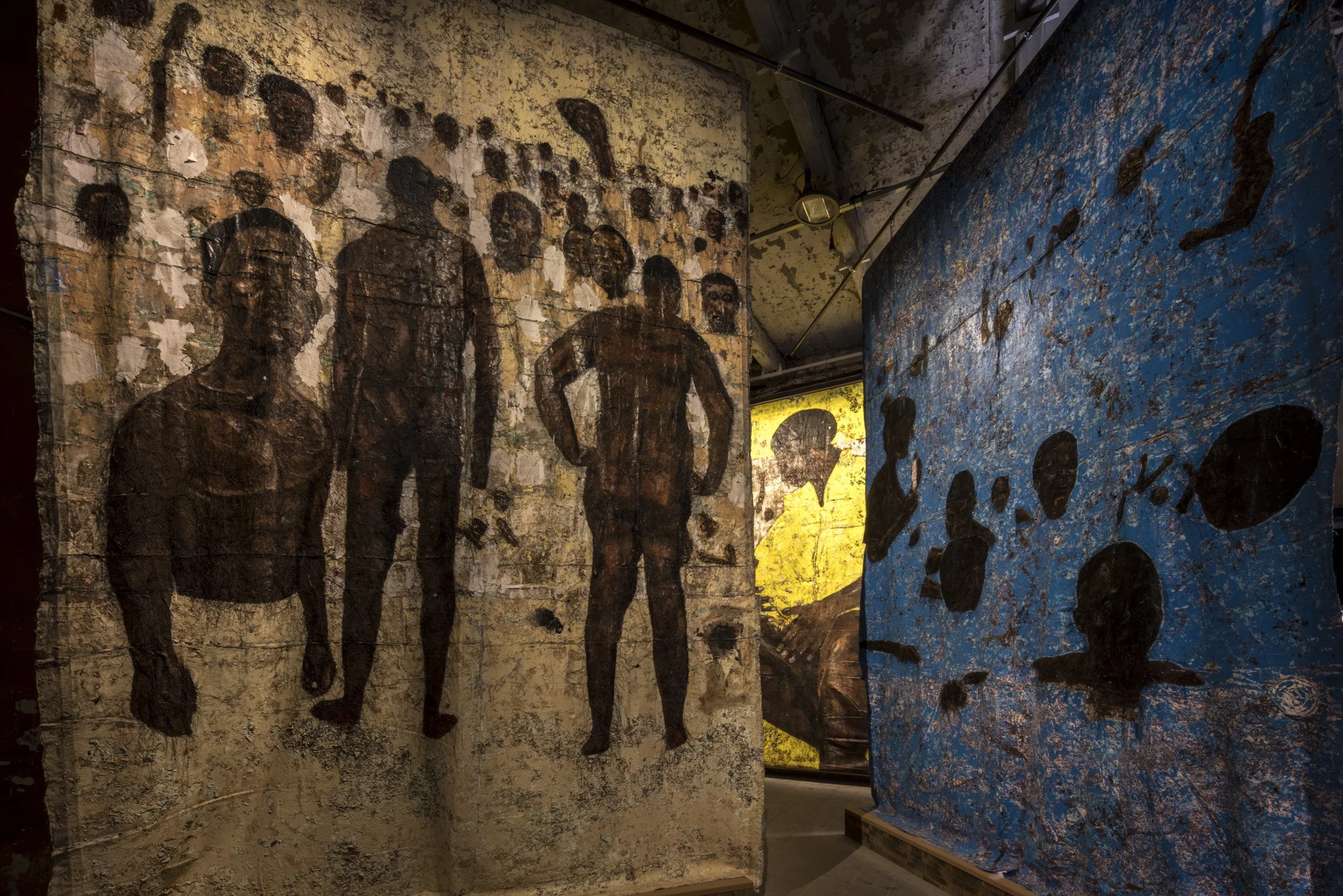
Kaloki Nyamai, Kwata kau, Ithyonze nitwavika vaa, and Ithyonze nitwavika vaaII, 2025, installation view, Arsenale, 61st Venice Biennale. Photo by Marco Zorzanello.
Before coming to Venice for the first time, I thought of the Biennale primarily as a spectacle of cultural capital: an expensive global event seemingly disconnected from the suffering, violence, and instability shaping much of the world. But once I found myself there, surrounded by its contradictions, I realized that critique alone was insufficient. The 2026 Venice Biennale was not simply a reflection of the world we live in, but a symptom of it, which revealed far more about the historical moment we are living through.
As always, this edition of the Biennale brought together countries, institutions, and cultural positions from across the world, creating a snapshot of the present—in this case, I think, a peculiar one. Looking at this landscape, I had the impression that something fundamental is shifting. For decades, certain countries and institutions have occupied the position of the world’s grand narrators, defining the dominant ideas of universality, progress, coexistence, democracy, and the global order itself. Yet the consequences of that order have made this position increasingly difficult to uphold, and the 2026 Biennale stands as a testament to that condition.
Of course, this process has been unfolding for some time. Thinkers such as Adorno and Lyotard had already diagnosed the contradictions of modernity and the exhaustion of its universal narratives. But in an age of instantaneous communication, those contradictions have become impossible to ignore. The distance between proclaimed commitments to peace, love, and freedom, and the realities they produce has become apparent.
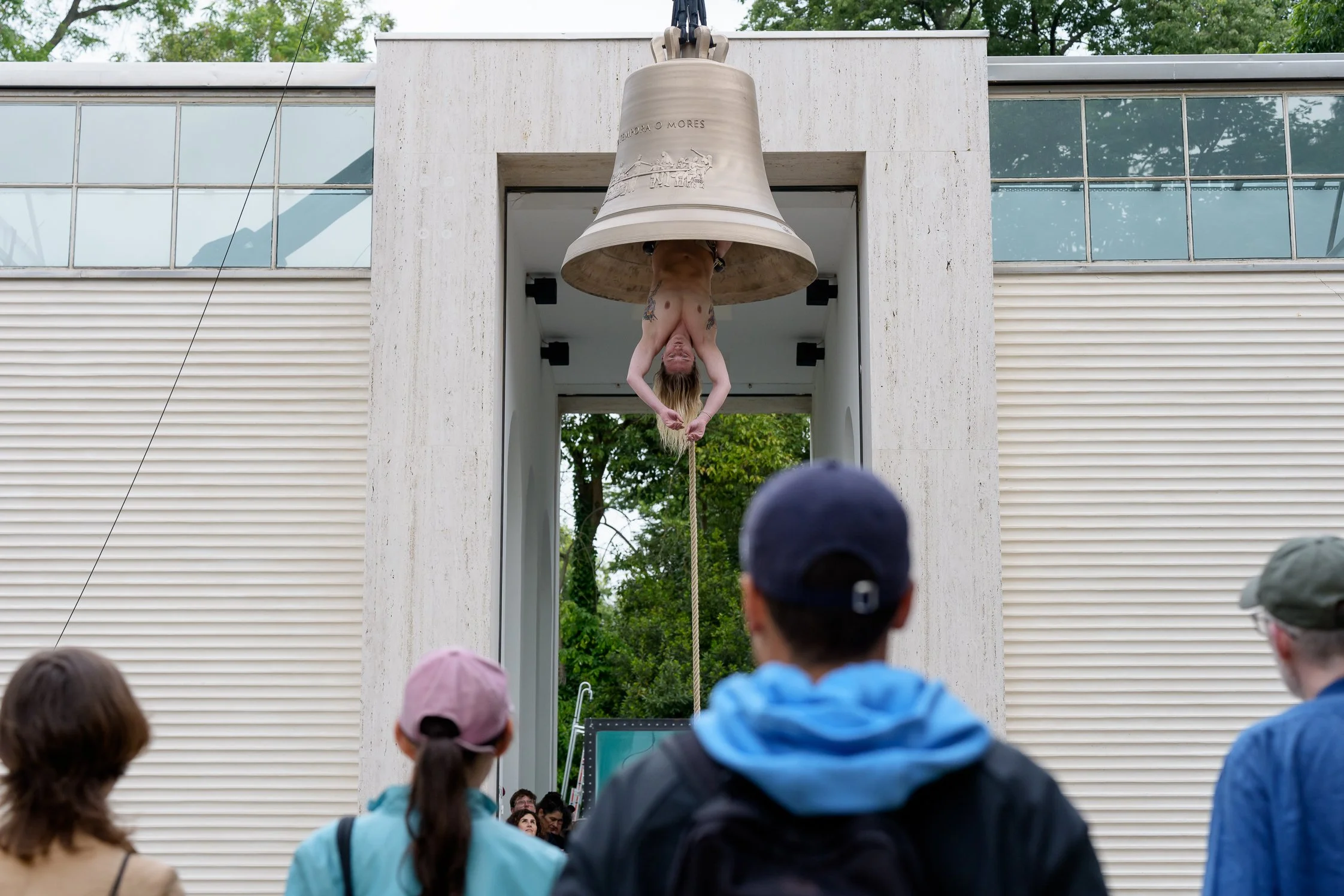
Florentina Holzinger, Seaworld Venice, 2026, installation view, Pavilion of Austria, 61st Venice Biennale. Photo by Andrea Avezzù.
This shift was perhaps most visible in the decision to place the central exhibition in the hands of the late Koyo Kouoh, the Cameroonian-born curator and former executive director of Zeitz MOCAA in Cape Town, who passed away shortly before the opening of the exhibition. Subsequently, the team she assembled—curators Gabe Beckhurst Feijoo, Marie Hélène Pereira, and Rasha Salti, together with researcher Rory Tsapayi and editor-in-chief Siddhartha Mitter—attempted to realize her vision. Historically, Kouoh’s appointment was not unprecedented. Okwui Enwezor was the first African-born curator of the Venice Biennale’s central exhibition in 2015, and Adriano Pedrosa’s Foreigners Everywhere in 2024 further challenged the boundaries of the Western canon. Yet In Minor Keys seemed to operate differently. Where Enwezor’s exhibition confronted the political and economic structures of the Western-designed world, and Pedrosa’s sought to rewrite art history from the perspective of those excluded from it, Kouoh’s exhibition seemed less interested in opposition altogether. It was not about who was permitted to speak, but instead about the nature of the conversation itself. Operating in a different register that did not seek to establish hierarchical legitimacy, it allowed other histories, cosmologies, and ways of being to exist on their own terms, without requiring translation or obligatory relation to the dominant cultural framework.
Kouoh’s exhibition looked bad, yet it didn’t feel bad.
According to almost every professional criterion a typical Western-educated curator or critic might use to evaluate an exhibition (and Western criteria are largely the only criteria most of us are taught), the show didn’t seem to work. The number of artworks, the selection, the coherence, the placement, the lighting, the navigation, the rhythm: everything seemed wrong at first. Yet looked at less formally, In Minor Keys was a dense, messy exhibition that remained intimate, informal, emotional, and open. Sometimes too much. Sometimes unclear. Often not entirely certain of what it wanted to say, while completely certain in its urge to be heard. As Kouoh suggested in her curatorial text, she wanted her exhibition to sound like free jazz: dissonant at first—full of stray sounds, missed notes, and moments that seemed almost out of place—yet capable of reaching the heart if given patience.
The organizers of the Biennale entrusted the central exhibition to a different curatorial perspective from the typical kind of authorial uber-statement, and in doing so, a productive tension was present. The art exhibition is itself a European invention, shaped by its own assumptions and hierarchical universalism. What happens when forms of expression rooted elsewhere are asked to inhabit that format? Perhaps something like In Minor Keys. It can even be said that the exhibition’s evident unevenness was a sign of the challenge to translate this very different curatorial vision—and especially without the curator who conceived it. Throughout her career, Kouoh’s work was often at odds with the European exhibitionary model exemplified by the Venice Biennale, and here it was equally so. The exhibition took a humble position. She and her team did not attempt to offer a new truth or replace one universal narrative with another. Instead, they invited viewers to “shift to a slower gear and tune in to the frequencies of the minor keys” because, “though often lost in the anxious cacophony of the present chaos raging through the world, the music continues...”1
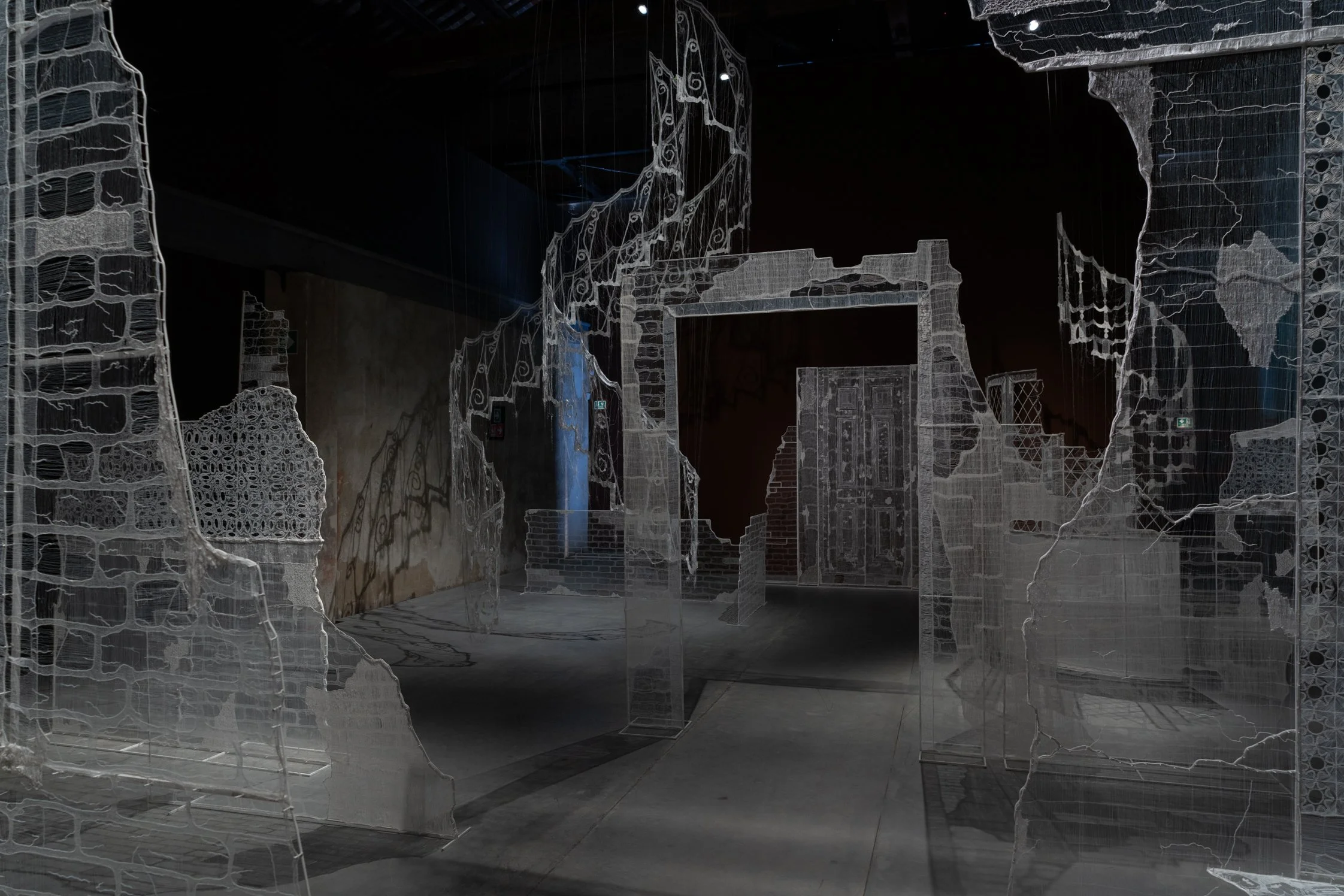
Sumakshi Singh, Permanent Address, 2026, installation view, Pavilion of India, 61st Venice Biennale. Photo by Luca Zambelli Bais.
Rather than claiming certainty, they seemed willing to begin from the uncertainty of becoming. Perhaps that was the most honest position to take. Nobody possesses a complete map of history or a framework capable of explaining everything. Yet In Minor Keys did not leave the viewer in a state of paralysis. Instead, it proposed a pause, a space to breathe, to remain together, and to search for ways of creating meaning and beauty. As Kouoh quotes Toni Morrison in her curatorial text, “In our myths, in our songs, that’s where the seeds are. It is not possible to constantly hone on the crisis. You have to have the love, and you have to have the magic, that’s also life.”2
The transitional condition of our world, where the old world is dying and a new one struggles to be born, extended beyond the central exhibition, taking various forms. Many of the pavilions at the center of the old global order felt like exhibitions of mourning for their own death. France’s Comme Saturne (Like Saturn) revolved around erosion, devouring, self-consumption, and burnout. Germany’s In Ruins revisited historical fractures and unresolved debts. Austria, with SEAWORLD VENICE, presented multiple dystopian performances, in one of which a suspended body functioned as the clapper of a church bell, ringing it hourly with their own body, and recalling an image from Bosch’s The Last Judgment.
Other pavilions, while equally grounded in their geographies, histories, and lived realities, were less extreme, less confrontational in front of an international audience. Their reflections on the present were more measured, whether in formal material terms or traditional modes of telling. In the Indian Pavilion, Sumakshi Singh’s Permanent Address reconstructed a demolished childhood home through delicate thread and embroidery, grounding the work in memory, place, and generations of collective making by women. Morocco’s pavilion, centered on Amina Agueznay’s installation Asǝṭṭa, drew on traditions of ritual weaving and collective knowledge, transforming the space into an intimate environment where visitors could sit, lie down, and move freely. The Uzbekistan Pavilion, The Aural Sea, approached the ecological catastrophe of the Aral Sea through sound and storytelling. Arriving during Josef Tumari’s live performance, Äwlep, I found myself less drawn to individual works than to the pavilion’s atmosphere. There was air between the works, which was part of the exhibition, echoing the vast emptiness left behind by the disappearing sea.
I came to Venice with a great deal of despair. Immersed in the artistic and intellectual life of New York, I often find myself trapped inside a self-referential conversation, speaking constantly about the world while rarely acknowledging how partial its view might be. Venice was unexpectedly hopeful, not because it offered solutions, but because it reminded me that there are other stories. Other histories. Other ways of understanding the world. The dominant narrative has become so self-contained that it leaves little room for other realities. Many countries no longer seemed interested in fitting themselves into a single global narrative or defining themselves in relation to it. Instead, they were trying to understand themselves on their own terms. This may look fragmented, uncertain, or unfinished. Yet perhaps that is simply the honest condition of our moment.
Perhaps this is a moment of turning toward ourselves, our histories, our traditions, and our conditions. A moment of knowing ourselves and maybe feeling embarrassed or appreciating who we are. A moment of an inevitable need to be honest with ourselves.
And perhaps only then can we begin to understand our relationships with each other.
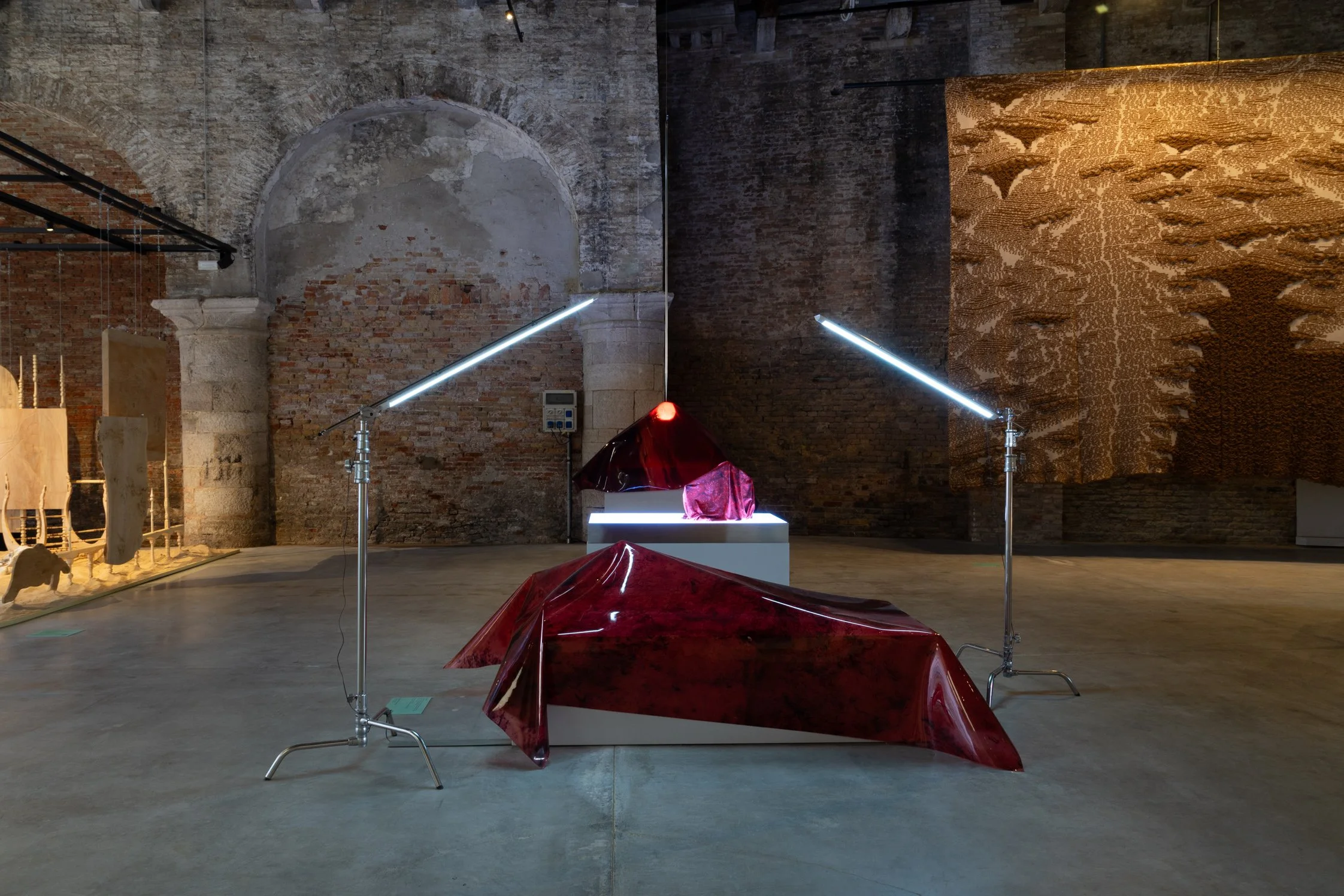
The Aural Sea, 2026, installation view, Pavilion of Uzbekistan, 61st Venice Biennale. Photo by Luca Zambelli Bais.
NOTES
1. Koyo Kouoh, In Minor Keys, exhibition text, 61st Venice Biennale, 2026.
2. Ibid.
-
Diana Sardaryan is a curator from Yerevan, Armenia, with over five years of experience in independent art contexts, working locally and internationally. With a background in film direction, she engages with a wide range of mediums in contemporary and historical art, as well as archives, spanning traditional forms, non-traditional practices, and creative technologies. Her curatorial work is dedicated to amplifying under-represented cultures, engaging with post-colonial narratives, and exploring situated cultural knowledge and plural practices within today’s global context. She is currently based in New York, pursuing an MA in Curatorial Practice at the School of Visual Arts.