
The Interstitial Stitch: Goen Choi’s Meridian in Venice
The arced movements of Choi’s work raise questions about how borders shift across national lines, and how such artistic activity can expose and unsettle the invisible infrastructures underpinning a nation's governance.
Hyun Sung • 7/20/26
Goen Choi, Liberation Space: Fortress/Nest, and Hyeree Ro, Mourning Station, curated by Binna Choi, Pavilion of Republic of Korea, 61st Venice Biennale, May 9–November 22, 2026
-
On Site is The Curatorial's section for curatorial reviews and a venue for MA Curatorial Practice students at the School of Visual Arts to publish as part of their program, though it is open to all writers.
In this review, Hyun Sung examines Liberation Space: Fortress/Nest at the Korean Pavilion of the 2026 Venice Biennale, curated by Binna Choi, focusing on Goen Choi's commission Meridian, an expansive network of burst copper pipes that threads through and beyond the pavilion's architecture to physically map the spatial politics of national representation. Sung argues that Choi's installation does not refuse nationhood so much as expose and destabilize the discursive infrastructure that produces it, tracing punctures and splices in Korea's representative image while crossing territorial boundaries, most pointedly in a pipe that arcs through the bush dividing the Korean and Japanese pavilions. Read alongside Hyeree Ro's durational sculptural stations and the contributions of the pavilion's inaugural fellows, Meridian emerges as a system that simultaneously questions and fractures the nation-state, ultimately reframing the exhibition's central question, "How Can I Ever Possibly Love This Country?", as an embrace of friction rather than a flat refusal of it.
iPhone photograph of Lang Lee & Goen Choi: SCULPTURE, SONG, SHOWING UP: A DIALOGUE, published in LIBERATION SPACE: READER (1). Image courtesy the author.
The subtext for Liberation Space: Fortress/Nest at the Korean Pavilion for the 61st Venice Biennale, poses the question: “How Can I Ever Possibly Love This Country?” Within this global constellation of art, the exhibition allegorically questions the very capacity of the Korean Pavilion to represent the nation-state as a living monument. Inspiriting a nuanced occupation of the Pavilion, curator Binna Choi has gathered an intimately collaborative exhibition of liberatory praxis, staging commissioned works by artist Goen Choi and Hyeree Ro, while enfolding various forms of contributions from the inaugural fellows: writer and singer Lang Lee, Nobel Prize-winning novelist Han Kang, photographer Yezoi Hwang, activist-farmer Huju Kim, and artist Christian Nyampeta.
Goen Choi’s commission for the Pavilion, Meridian (2026)—an expansive infrastructure of burst copper pipes spanning varied lengths and undulating arcs within and beyond the pavilion building—lays bare a paradoxical transparency in the site's physical and ideological structure. Symbiotically counterweighting the airiness of Choi’s lines, Hyeree Ro’s Bearing assembles stationary wooden and clay structures as “stations” for somatic activities and durational movements of care. These rituals transpire behind a monumental wall of wax-coated organza circles, activated daily by a cohort of “Bearers” whose repetitive bodily labor continuously reinforces the partition with the material residues of their processes. While varying in their approaches to the pavilion’s architectural constraints, if the hard edges of Choi’s liminal gestures throw the building’s territorial function into flux, Ro’s opaque wall functions as a protective second skin against the building’s transparent glass facade, embracing these sites of collective place-making like internal organs. As the shifting, durational contributions of the fellows further upend the static constants of the Biennale, any reduction of these practices to a singular national identity is most directly pierced by the stillness of Meridian. Working from within this state-sanctioned simulacrum of sovereign territory, Goen Choi expounds upon and implodes the institutional networks that uphold this spectacular national illusion—tracing the outlines, punctures, and splices inherent in the discursive fabrication of Korea’s representative image.
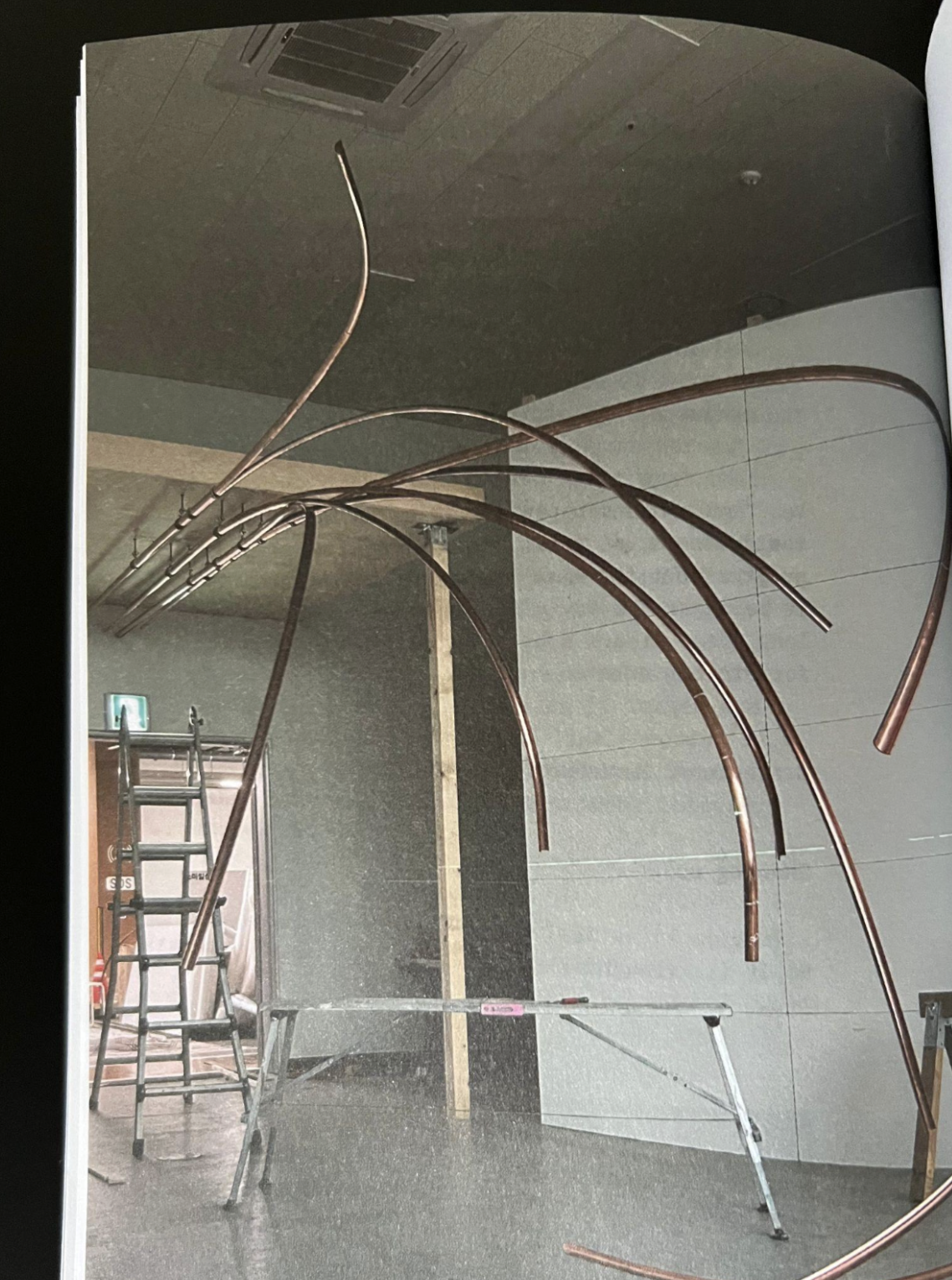
Walking between the German and Japanese Pavilions, visitors approaching the Korean Pavilion encounter Corea Pavilion-Bush-Giappone Pavilion (2026)—one element of Meridian—from a distance, experiencing its architecture phenomenologically before entering the building. The sunlight glimmers off the metallic skin of an elongated copper pipe, split perfectly in half across its length. Emerging from the dirt, it arcs through the bush that divides the territories of the Korean and Japanese pavilions. Immediately following the announcement of the Korean Pavilion’s establishment in 1994, the Japanese team had planted this bush, erecting a physical partition to delineate one sovereign territory from another. The opening and closing “stitch of this weave,” as the artist refers to the allegorical function of Meridian, bodily transcends this territorial boundary, a spatial placement made possible through close collaborations between the Korean and Japanese curatorial teams (mirroring this, parts of artworks presented at the Japanese Pavilion are also placed across the Korean Pavilion). Plunging back into the earth on Japan’s side of the bush, this opening act leaves the viewers to wonder: Where does Meridian truly end?
iPhone photograph of Lang Lee & Goen Choi: SCULPTURE, SONG, SHOWING UP: A DIALOGUE, published in LIBERATION SPACE: READER (1). Image courtesy the author.
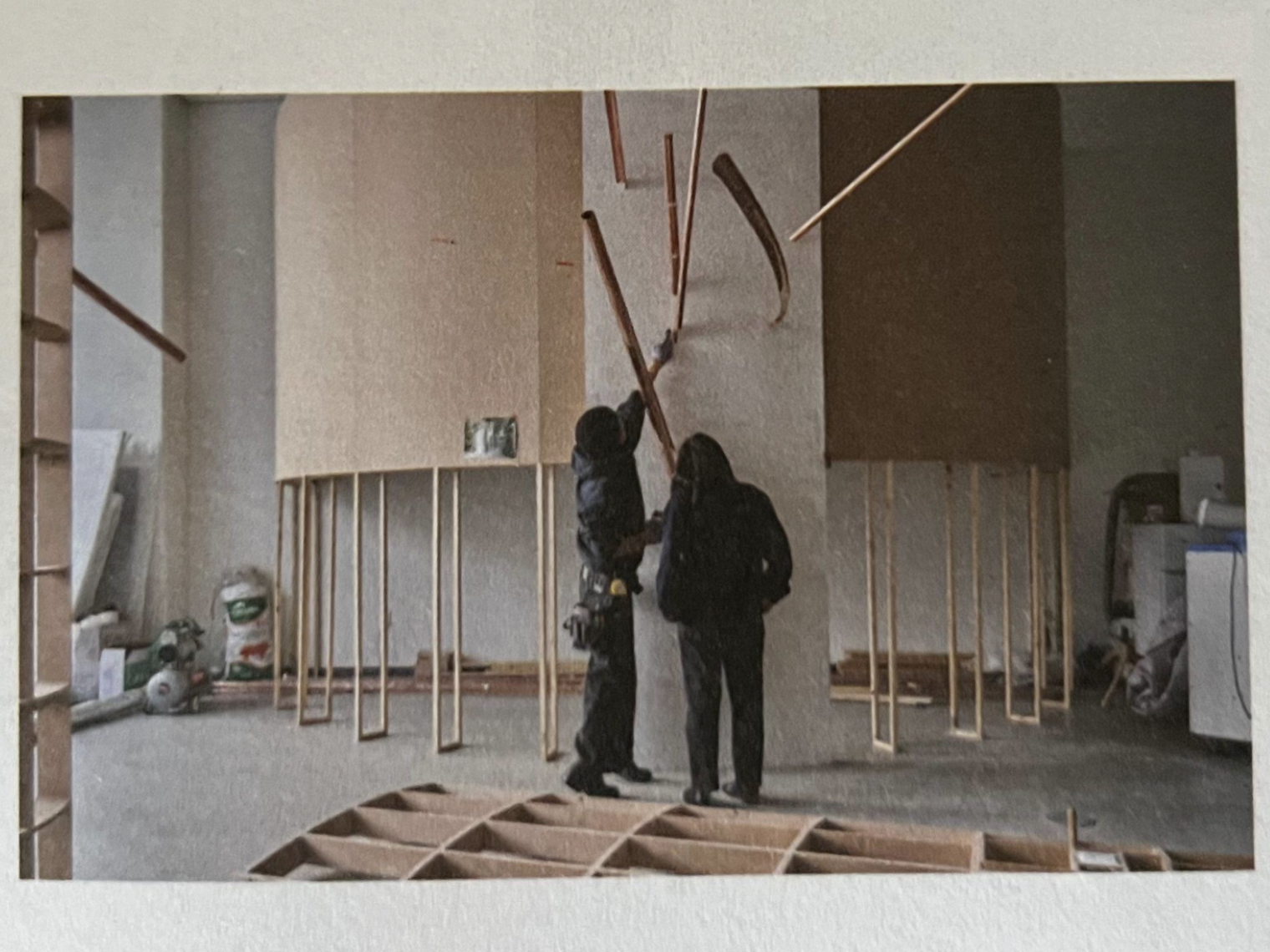
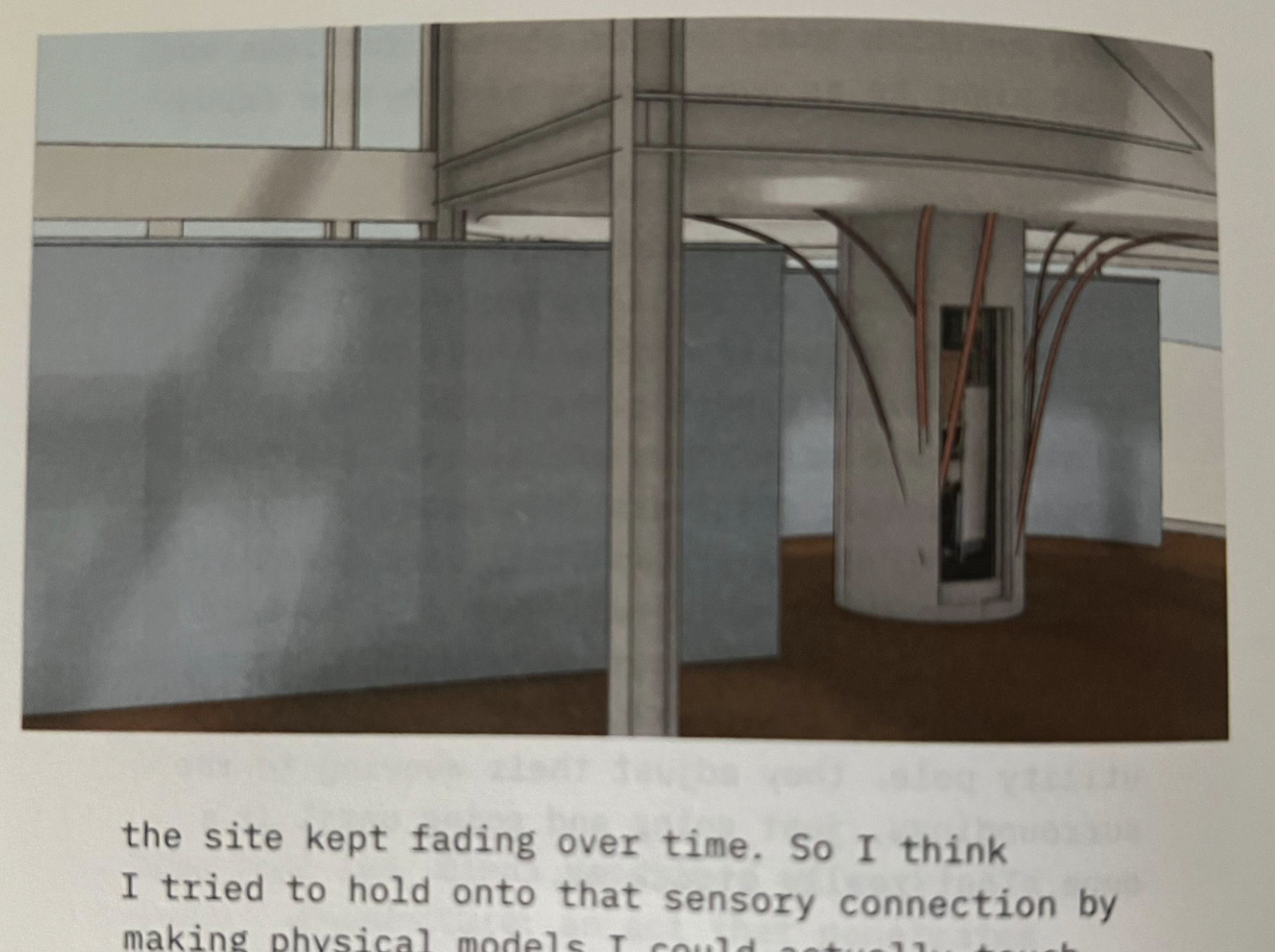
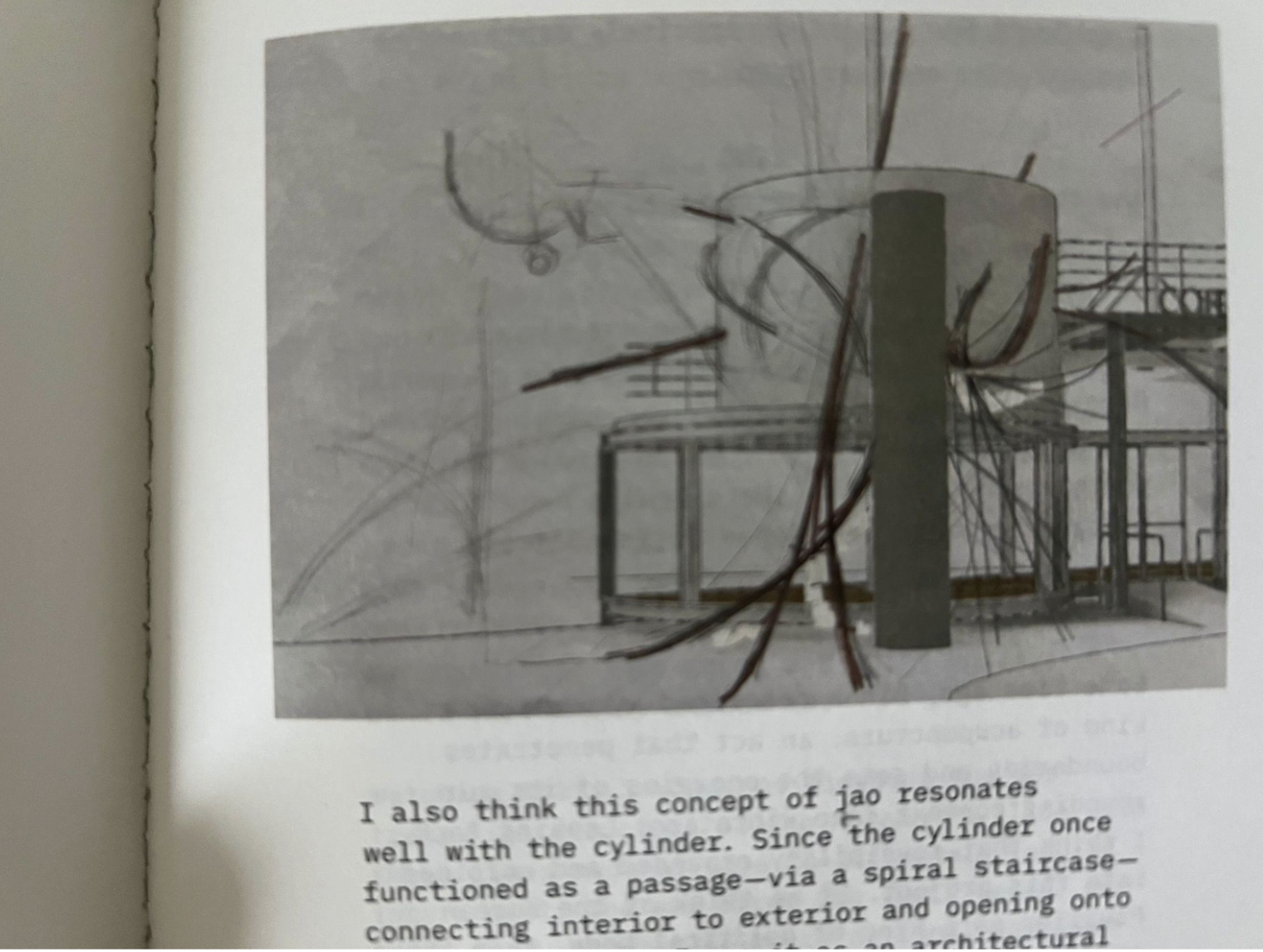
A sprawling constellation of curved linear forms, Meridian weaves across the grounds, physically charting the spatial politics of its ecosystem. Threading into the building’s interior and protruding outward through the pavilion walls, elements of Meridian-pillar (2025-2026) have been inserted into its sole structural column. On one side of the pillar, a rectangular slab has been removed to make the hidden electrical panel and archival wiring visible. Investigating the operational gravity of this structural foundation, as well as the encircling emptiness where a spiral staircase once allowed for direct access to the rooftop terrace, Choi makes these invisible nuances of space, history, and somatic movement palpable. Exposing the core operations of the building’s technological network, the infrastructure is laid bare. This architectural exposure directly informs the dynamics of the half-copper pipes that, from this gravitational point, seemingly burst out into the gallery space, through the glass windows, and onto the entering path. Though void of kinetic capabilities, these sculptures register as a durational performance in limbo, extending beyond the pavilion’s walls to burst outward while drawing the external environment into the interior.
iPhone photograph of Lang Lee & Goen Choi: SCULPTURE, SONG, SHOWING UP: A DIALOGUE, published in LIBERATION SPACE: READER (1). Image courtesy the author.
On the way out of the pavilion, one recognizes how all components of Meridian interconnect, their material resonance and linear positioning reconstellating into a new kind of map. This map becomes emphatic in its relationship to the surrounding collaborative works and texts within the pavilion's ecosystem. Diagramming both the outermost and innermost layers of the pavilion’s architecture, Meridian embraces, weaves, and expands the resonances between its artistic counterparts. It achieves this through a simple gesture of lines that do not merely connect one point to another but oscillate in the spaces between them. These arced movements spark the imagination, raising questions about how borders shift across national lines, and how such artistic activity can expose and unsettle the invisible infrastructures underpinning a nation’s governance. The installation operates as a system of parts that simultaneously questions, deconstructs, stabilizes, and fractures—not the state itself, but the discursive framework of its ecosystem, inciting the viewer to envision alternative structural realities.
It is a phenomenal paradox that the transnational framework of the Biennale’s exhibitionary economics and politics provided the very possibility for Meridian to exist. For reasons that are complex and tied tobureaucratic histories, the Korean Pavilion is a long-term concession with Venice and the Biennale, as opposed to having been purchased outright and claiming ownership, highlighting the comparatively tenuous nature of its territorial claim. Meridian emerged from Choi’s inquiry into Korea’s industrial production facilities and close collaboration with factory workers, yet these resulting objects have been transposed to a foreign land. Do they rebound across the Giardini, where most of the pavilions are situated, and beyond? Is there a point at which the copper wiring in the pavilion’s electrical panel becomes entirely disconnected from the electrical grids of South Korea?
iPhone photograph of Lang Lee & Goen Choi: SCULPTURE, SONG, SHOWING UP: A DIALOGUE, published in LIBERATION SPACE: READER (1). Image courtesy the author.
What happens when participants refuse to straightforwardly claim the country they represent? An argument could certainly be made positioning these works as a development of modern Korean aesthetics, noting the clear dialogue between Choi’s material sensibilities and the sprawling installation forms of older generations of Korean artists, such as Lee Bul or Lee Ufan. Yet, the specific structural operations within the pavilion directly tie historical referents of Korea’s resistant past to the core, material and conceptual development of the artworks, charging the very space Meridian dissects. Within Hyeree Ro’s Mourning Station, the enfolding of Han Kang’s text-sculpture The Funeral (2018) commemorates the Jeju 4.3 Uprising and Massacre (1947–1954). Nearby, at the Remembering Station, Christian Nyampeta’s lino plates from the post-uprising Gwangju People’s Art School (1983–1986), ritually altered daily by a Bearer, sit alongside Yezoi Hwang’s transferred photographs documenting the citizen protests spanning the recent December 2024 martial law declaration to the April 2025 presidential impeachment. On the rooftop, the ensemble of ceramic vessels that comprise the Sharing Station house Lang Lee’s commissioned song Our ㅁ (mieum) and Huju Kim’s clay-molded indigenous seeds. Anchored by these historical traumas and revolutionary acts, the exhibition’s subtextual question becomes less a flat refusal of nationhood and more a deep embrace of the friction, turbulence, and ambivalence characteristic of the nation’s identity.
-
Hyun Sung is the nom de plume of a student in the MA Curatorial Practice program at the School of Visual Arts.