
Collective Respiration: Embodied Knowledge in Minor Keys
Despite little evidence to support the harboring of hope, these works allow us to imagine that through collective care and action, repair and renewal are possible.
Romy Cohen • 7/20/26
Gabrielle Goliath, Elegy, Chiesa di Sant’Antonin, May 4–July 31, 2026, and Yo-E Ryou, Breath Orchestra: Act 9: Ellipsis, 61st Venice Biennale, May 9–November 22, 2026
-
On Site is The Curatorial's section for curatorial reviews and a venue for MA Curatorial Practice students at the School of Visual Arts to publish as part of their program, though it is open to all writers.
In this text, Romy Cohen pairs two works from the 2026 Venice Biennale: Gabrielle Goliath's Elegy, relocated to the Chiesa di Sant'Antonin after the South African government refused to sponsor it, and Yo-E Ryou's Breath Orchestra: Act 9: Ellipsis in the Arsenale. They are both read in relation to Koyo Kouoh's curatorial invitation to breathe as an act of agency. Cohen argues that the two installations position respiration as a communal practice through which bodies negotiate grief and repair: Goliath deploying the sustained collective voice as a form of infinite mourning and resistance; Ryou drawing on the ritual breathing traditions of Jeju Island's haenyeo divers to connect visitors to embodied, intergenerational knowledge.
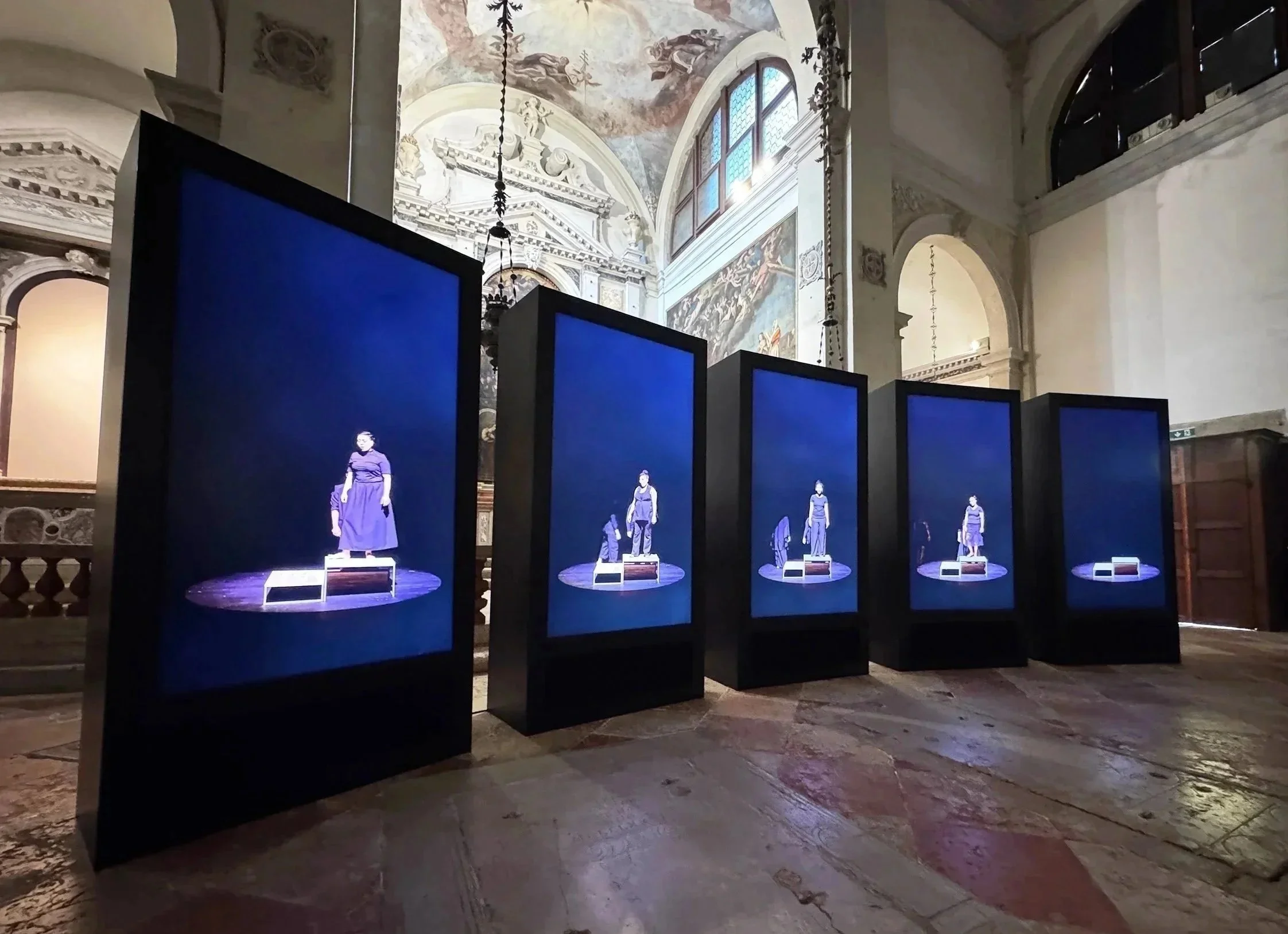
Gabrielle Goliath, Elegy, 2015–ongoing. Presented independently at the Chiesa di Sant'Antonin, Venice. Realized with the support of the Bertha Foundation, Ibraaz, and Galleria Raffaella Cortese. Image courtesy MACP.
[Take a deep breath]
[Exhale]
[Drop your shoulders]
[Close your eyes]
— Koyo Kouoh’s introduction to In Minor Keys
The ability to control one’s own breath is, perhaps, the most primal expression of personal agency. In the 61st Venice Biennale, the late curator Koyo Kouoh’s invocation at the Central Pavillion’s entry to In Minor Keys asks visitors to pause and give consciousness to that freedom. Seen through this curatorial invitation, Breath Orchestra: Act 9: Ellipsis (2024-26) by Yo-E Ryou and Elegy (2015-ongoing) by Gabrielle Goliath, both position respiration as a communal practice through which bodies negotiate the interdependence of grief and repair. In these two installations, practices of collective breathing connect to a vision of embodied knowledge that challenges detached observation as the site of comprehension. Within Kouoh’s exhibition, embodied knowledge, and specifically breath, emerges as a critical site to inhabit “the persistent signals of earth and life,” as she notes. Breath, usually a silent partner, becomes active as it binds individual bodies to collective histories and a shared environment. Visitors are implicated not as witnesses, but as participants in collective ritual, proposing physical experience as a vital source of understanding.
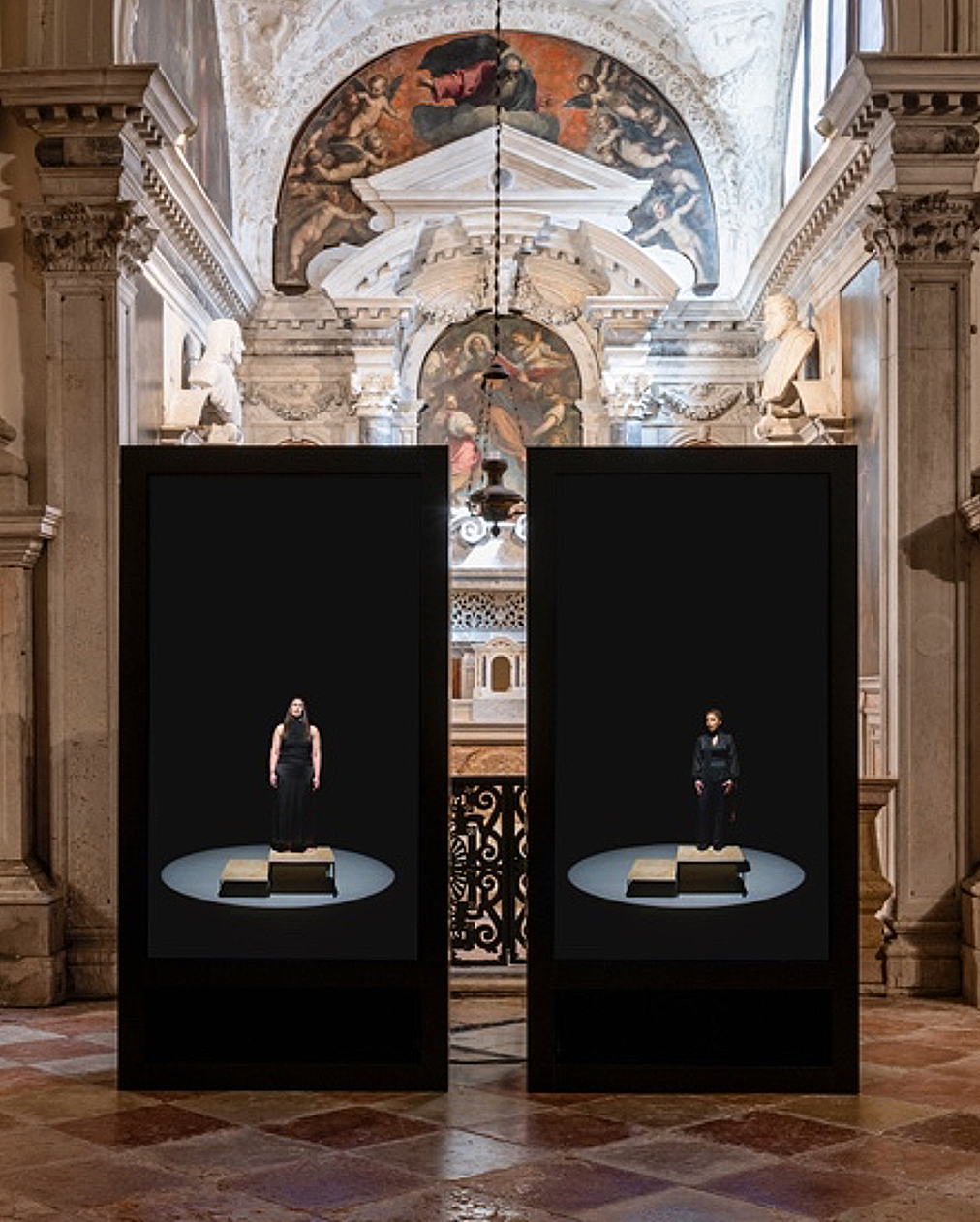
Gabrielle Goliath, Elegy, 2015–ongoing. Presented independently at the Chiesa di Sant'Antonin, Venice. Realized with the support of the Bertha Foundation, Ibraaz, and Galleria Raffaella Cortese. Image courtesy the artist.
Entering Breath Orchestra: Act 9: Ellipsis, which includes drawing, two video works, a multi-channel sound installation and performance, we are invited into a collectiveexperience of breathing grounded not in observation but participation. Korean artist Yo-E Ryou reflects on her time with the haenyeo women of Jeju Island. Feeling suffocated in New York City during the pandemic, Yo-E relocated to Hado-ri, a small village on South Korea’s Jeju Island, where she embedded herself in the community of haenyeo deep-sea divers. The haenyeo practice an ancient harvesting ritual, diving as deep as sixteen meters without breathing apparatus to gather sea life from the ocean’s floor. On any given day, they can spend up to six hours under the frigid water collecting their livelihood. Over centuries, the divers have developed ritual breathing practices that allow them to accomplish this extraordinary feat.
In her installation, Yo-E creates a seating circle that mirrors the shape of the open-air enclosures where the haenyeo gather. Two video screens each show a group of women. In one, girls variously standing or sitting on the rocky edge of the sea, the wind gently tousling their hair, are practicing the ancient breathing, learning how to achieve the skill that will bring them to the state of unity with nature. They do not learn their craft through detached instruction. Instead, understanding is produced through evolving engagement with each other and the sea. The second screen shows the masters, older women, sleeping together in a display of comfortable intimacy developed over years of mutual survival; close bonds formed through a lifetime of shared practice. Sitting between the two screens, we are placed in the arc of the generations, invited into the cycle of life, reminded of the lineage of women who have practiced this for hundreds of years. A series of drawings gives a poetic overview of the interconnected networks of bonds between people and nature, voices of the sea and of the divers, and the water with which the women become a part when they submerge themselves.
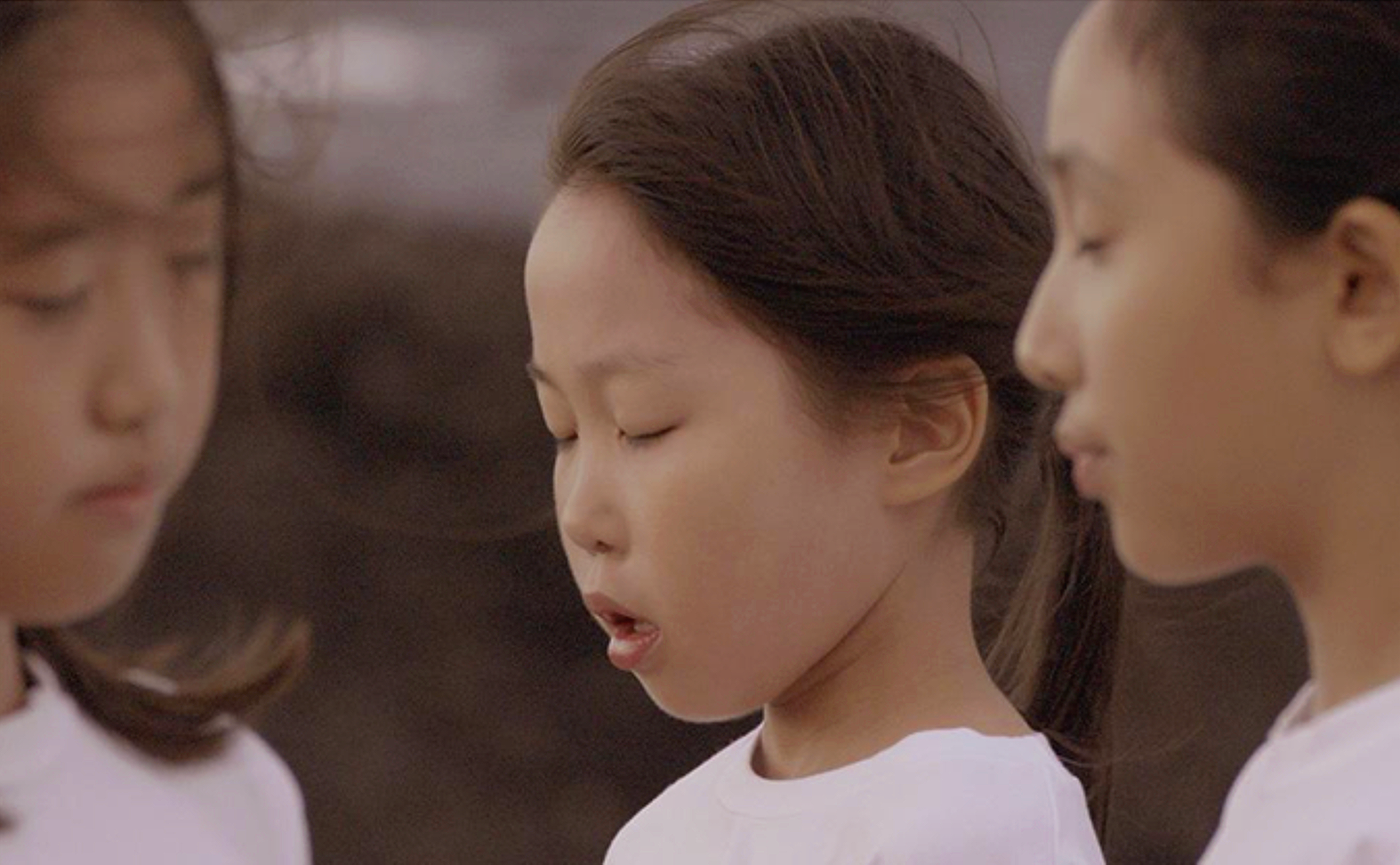
Yo-E Ryou, Breath Orchestra, 2026, still from video, Arsenale, 61st Venice Biennale. Image courtesy the artist.
In the circle, we experience Breath Orchestra’s multichannel audio recording of a composition made from the sounds of the various breaths of the haenyeo women masters. The haenyeo’s breathing cycle alternates between four phases, transforming breath into a disciplined practice of bodily control rooted in attuning oneself to the natural world. Preparation, characterized by slow, measured, regulating breaths that calm the body for the descent are followed by powerful energy producing breath. Once prepared, withholding breath through the dive becomes a conscientious labor of endurance and discipline. In this phase the divers’ experience an almost transcendent state of being at one with the sea. Finally, there is the recovery breath, the sumbisori, when the divers’ surface and transition back to the land.
The longest phase of breath is holding it, and so much of the audio we hear is nearly silent. There are the gentle sounds of the seaside heard in the video of the young women, along with an occasional dramatic sumbisori breath and the gentler breaths of preparation breaking the silence. These moments provide an unpredictable effect, giving an emotional shape to the to the quiet. John Cage and his sense of the powerful presence of silence come to mind, with the breaths that bracket the silence in Yo-E’s work gaining particular impact. Here, the layered sounds of the sea, the wind, and breathing draw us into the bodily experience of the haenyeo, connecting us to them and the natural world with which they are so closely connected.
While Yo-E approaches breath as a means of connecting people to one another and to nature, Gabriel Goliath’s Elegy similarly invokes breath, but not as a means of connecting to nature, rather as mechanism of ritualized mourning and renewal. Like Breath Orchestra, Elegy is deceptively simple. Comprised of three different project suites, each documents a series of performances dedicated to a particular victim of imperial, colonial, or patriarchal violence. Very like each other in format, each of the screens presents a theatrically lit singer, dressed in black, standing on a podium, holding a single note until her voice starts to fail. She then steps down and another singer steps onto the podium, continuing the note. Eight separate videos, each with its own continuous voice, create a soundscape that is a meditative and mournful lamentation, revealing the possibility of infinite resistance through continuity not as individuals, but as a collective community. Addressing layers of injustice and marginalization, each of these projects acknowledges a specific loss; in this installation, South African student Ipeleng Christine Moholane, two Nama women ancestors, and the Palestinian poet Heba Abunada. Goliath has made dozens of such performances since 2015. While the beauty of a seemingly infinite collective voice of resistance inspires, it also gives us the overwhelming realization that there are a seemingly infinite number of victims to mourn.
Although the work was originally intended to be shown in the South African Pavilion, because one of the performances laments a Palestinian poet, the conservative South African government deemed the work too controversial and refused an official national presence for this Biennale. Goliath then found alternate sponsors and relocated her exhibition to the Chiesa di Sant’Antonin, within walking distance of the main grounds of the Giardini. In this space, the voices are beautifully amplified acoustics that evoke centuries of worship and rites of passage. The collective cry is not simply heard; it is absorbed into the body, resonating through time and place as echoes of grief, memory, and resilience. For the run of the Biennale, the South African Pavilion stands empty, its own vacancy a symbol of repression, censorship, and continued efforts of a hierarchical society to silence marginalized voices.
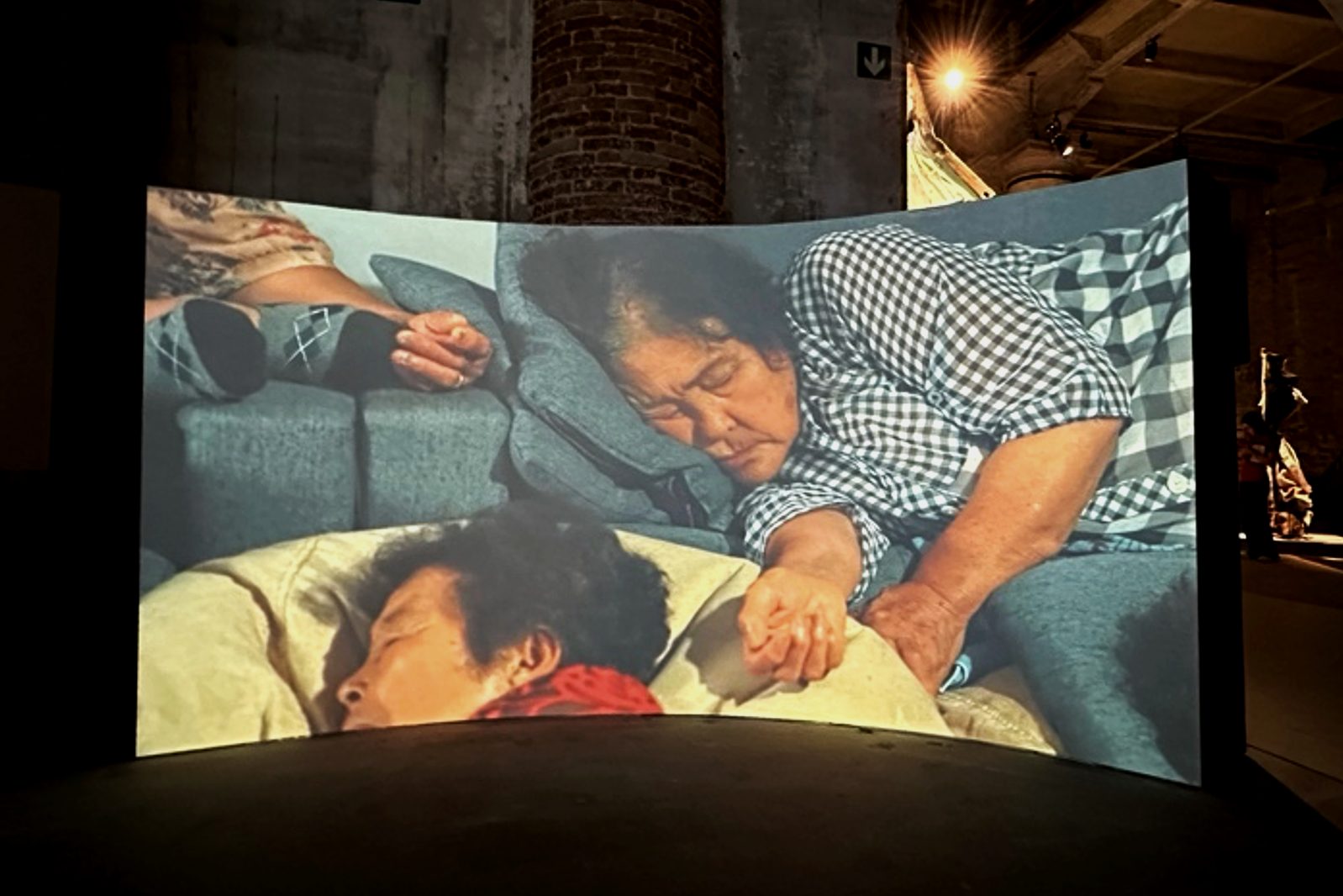
Yo-E Ryou, Breath Orchestra, 2026, installation view, Arsenale, 61st Venice Biennale. Image courtesy the author.
Over ten years ago, Eric Garner died at the hands of police, his final words, “I can’t breathe,” initiating civil rights protests around the United States and the world. In the years since, we’ve experienced a conservative backlash and backslide, rendering even the freest among us inert. In concert with the theme of Kouoh’s In Minor Keys, these works investigate breath as a refuge, a lamentation, a meditation, a connecting medium, and most importantly, a site of personal agency. Despite little evidence to support the harboring of hope, these works allow us to imagine that through collective care and action, renewal and repair are possible.
-
Romy Cohen is an independent curator, writer, and master’s degree candidate in Curatorial Practice at the School of Visual Arts. Her practice explores the intersections of art, architecture, and the body, with a particular interest in materiality, spatial perception, and the ways contemporary art reshapes our understanding of embodied experience. As a docent at the Whitney Museum of American Art, she leads tours that situate works of art within broader social and cultural contexts, encouraging close looking and dialogue. Her curatorial research examines how artists mobilize architecture, landscape, and the built environment as sites of memory, movement, and embodied experience. She is interested in exhibitions that foreground the body as a site of knowledge, perception, and social encounter.