
Still Joy?
In the face of the ongoing, catastrophic war, the Ukrainian exhibition proposes that joy, despite everything, is a sign of strength and resistance.
Justin Apice • 7/20/26
Still Joy—From Ukraine Into the World, curated by Björn Geldhof and Oleksandra Pogrebnyak, Ukraine Collateral Event, Palazzo Contarini Polignac, 61st Venice Biennale, May 9—November 22, 2026
-
On Site is The Curatorial's section for curatorial reviews and a venue for MA Curatorial Practice students at the School of Visual Arts to publish as part of their program, though it is open to all writers.
In this piece, Justin Apice reviews Still Joy—From Ukraine Into the World, Ukraine's collateral event curated by Björn Geldhof and Oleksandra Pogrebnyak, which frames joy as radical resistance under conditions of ongoing war. Apice posits that the exhibition's most compelling works, particularly Khimei and Malashchuk's Open World and Nikita Kadan's closing painting After All, reveal joy and grief as inseparable, undercutting the curatorial premise in a way that deepens it. Apice further notes that the Biennale's accommodation of the United States, Russia, and Israel compromises the very theme it set out to champion.
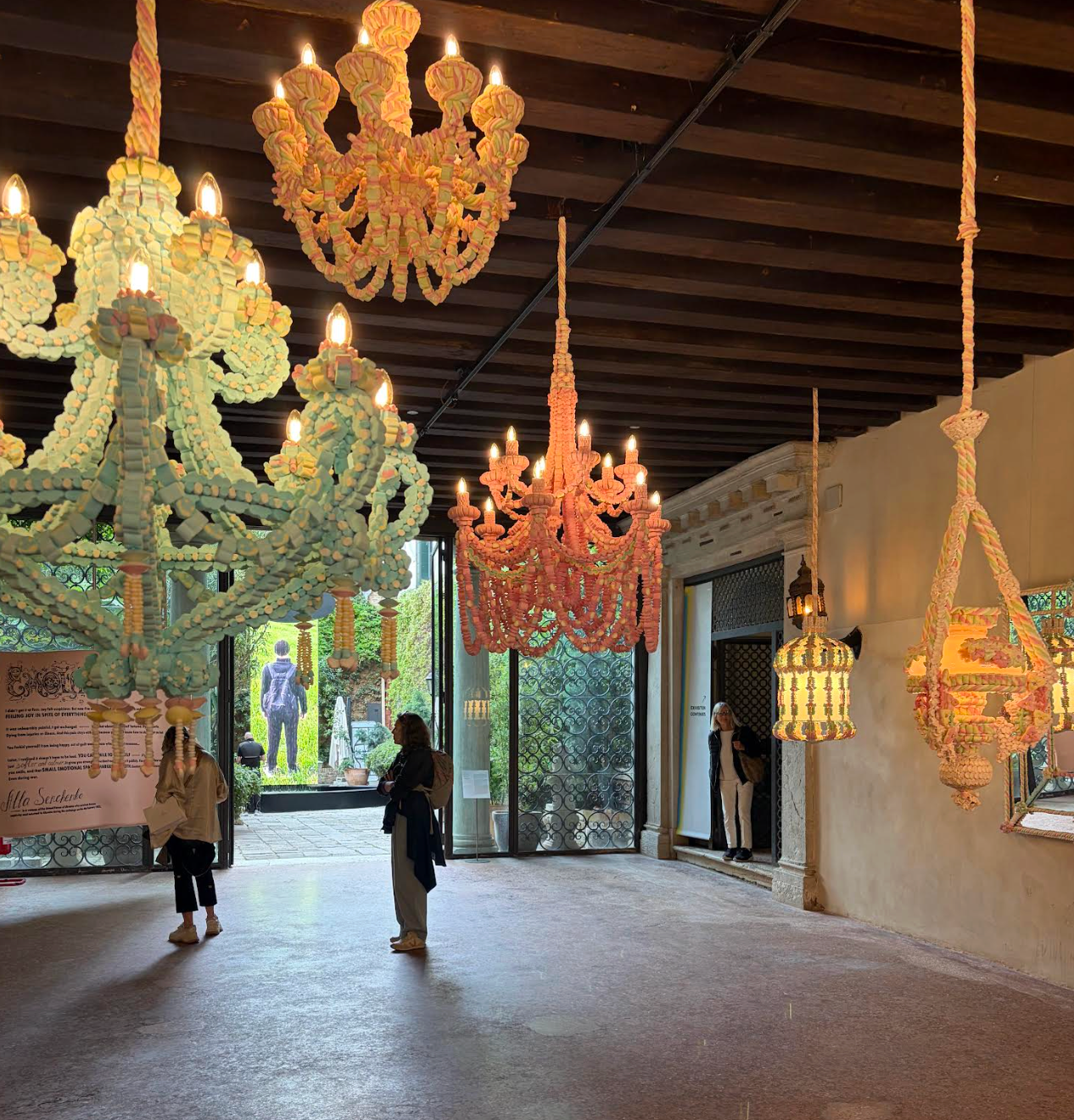
Simone Post, She Knew She/It/They Would Melt, 2026, installation view, Ukraine Collateral Event, 61st Venice Biennale. Image courtesy the author.
As the 2026 edition of the Venice Biennale continues into the fall, there is still much that feels unsettled and unsettling about the show. What was meant to be the celebratory spirit of In Minor Keys—the late Koyo Kouoh’s curatorial vision of the “quieter,” Indigenous, and marginalized art communities being exhibited for international audiences—has so far resulted in mixed reviews, controversies, and numerous protests over the participation of the United States, Russia, and Israel. Given the current geopolitical crises unfolding around the world, the choice to include these countries has left many disheartened by the blindness to the violence these nations perpetrate and the decision, nonetheless, to allow them to be represented here in Venice. Despite the restlessness and gloom of so much of the content of this Biennale, Ukraine’s collateral event, Still Joy—From Ukraine Into the World, situated in the Palazzo Contarini Polignac, instills a much-needed sense of euphoria and the power of love as an act of resistance amid global systemic collapse.
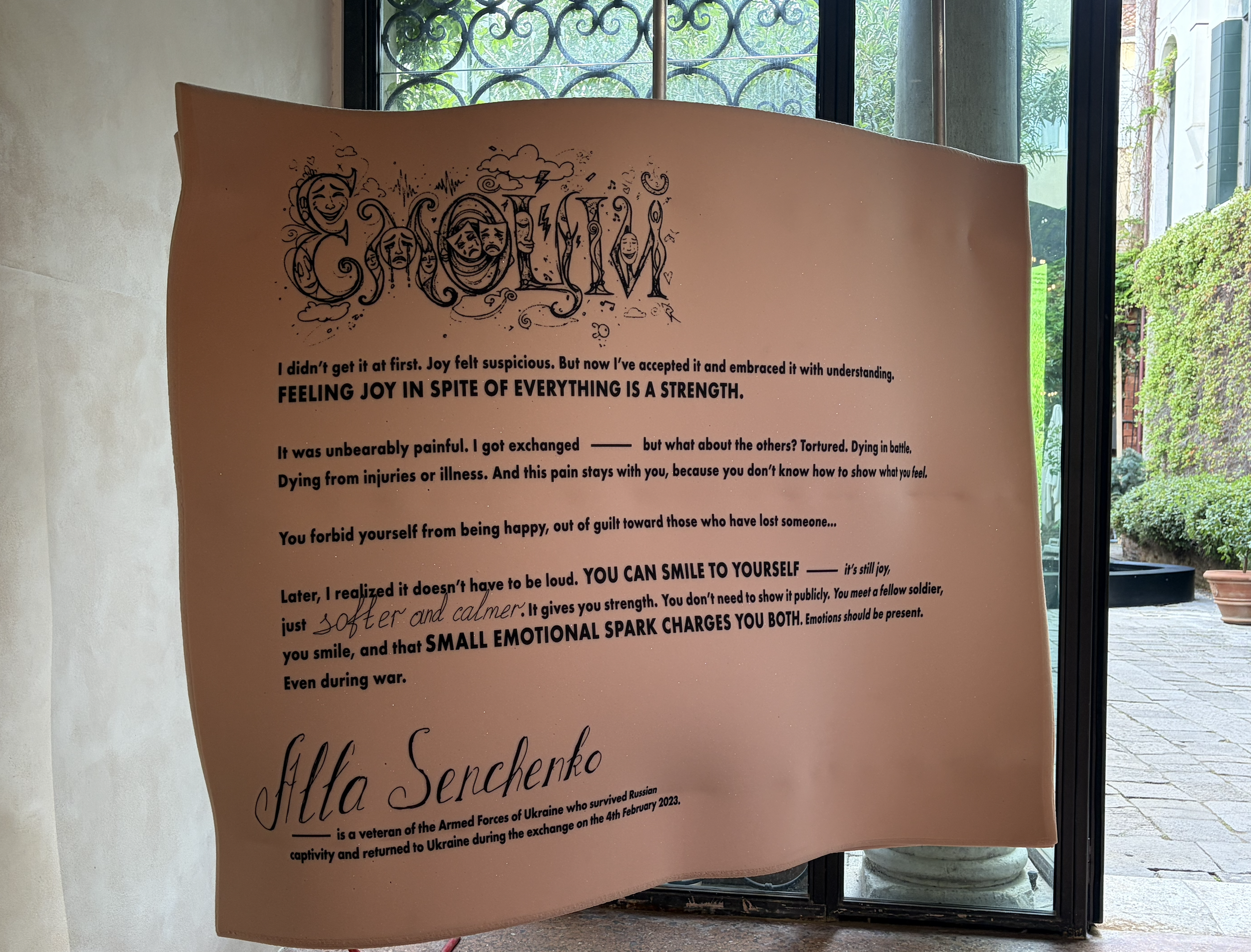
Alla Senchenko, Testimony to Joy, 2026, installation view, Ukraine Collateral Event, 61st Venice Biennale. Image courtesy the author.
Curated by Björn Geldhof and Oleksandra Pogrebnyak, the exhibition brings together international and Ukrainian artists to reflect on the concept of joy as a radical act of humanity. Under the context of war and the reduction of a great deal of Ukraine’s sovereign territory to rubble, the exhibition highlights testimonies collected by the Pinchuk Art Center from Ukrainian soldiers, such as Alla Senchenko, who believes that “allowing yourself to feel joy despite everything is a sign of strength.”1 This elevation of feelings is brought to the viewer throughout the three-story exhibition. As I entered, I was immediately presented with a rave featured on a two-channel video, the work of Ukrainian artists Yarema Malashchuk and Roman Khimei. Titled Dedicated to the Youth of the World II (2019) and Dedicated to the Youth of the World III (2023), the videos show youth engaging in rave culture, which remains popular in Eastern Europe. Both videos feature different temporal realities, one before and one after the full-scale invasion. With a pulsating score, viewers become part of the movement, where—within the confines of the dance floor—pleasure prevails over the terror that exists outside a club.2
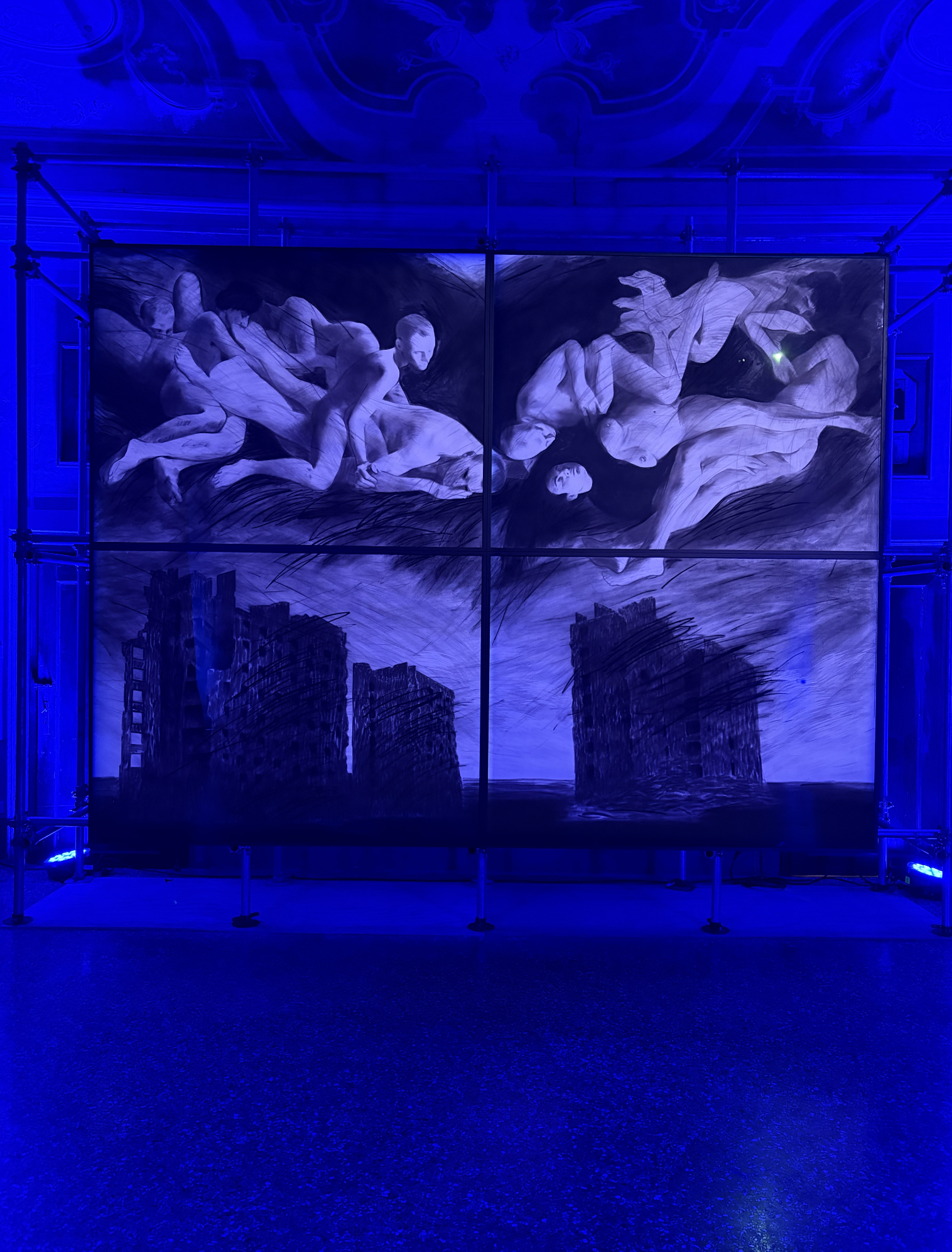
Nikita Kadan, After All, 2026, installation view, Ukraine Collateral Event, 61st Venice Biennale. Image courtesy the author.
The theme continues, consistent throughout the whole of the exhibition. On the second floor, viewers are thrust into a candy wonderland, with Simone Post’s She Knew She/It/They Would Melt (2026). Referencing the Palazzo’s chandeliers and grand decoration, Post created copies of the decor made entirely of candy, altering the gray monotone of the room with the bright colors of hard candies. The work filled the space, a cornucopia of childlike delight, though its sweetness had the tinge of longing for an innocence lost in adulthood—all the more present with the wages of war. Still, it felt like an escape from everything outside of the centuries-old palazzo, and its wistfulness, however Instagrammable-inducing, spoke to the melancholy and bite underlying the curators’ advocacy of overarching joy, though, of course, that is what makes the exhibition poignant.
Consider the current reality for Ukrainian art production through the lens of resistance: Throughout the rubble of its war-torn cities, artists put their lives on the line, facing death by artillery, to create murals alongside half-standing buildings, instilling hope and morale in Ukrainian soldiers and the populace who face constant threat.3 To that extent, Still Joy effectively presents the spirit of resistance, to a degree. While many of the works in the show rely on happiness as a sign of rebellion, the note of sadness haunts the exhibition as a gross reminder that the violence is unremitting, with no prospect of resolution on the horizon. The two sides of the coin, how to continue living in the shadow of the war, turn Post’s work bittersweet.
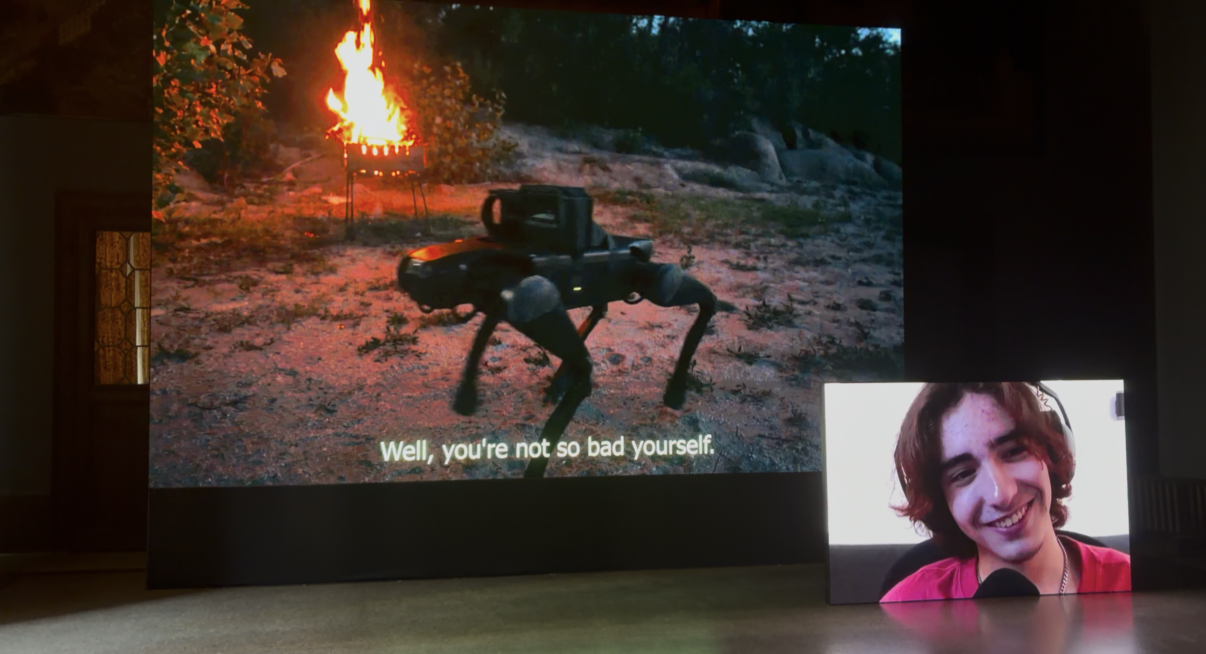
Yarena Malashchuk and Roman Khimei, Open World, 2025, installation view, Ukraine Collateral Event, 61st Venice Biennale. Image courtesy the author.
Khimei and Malashchuk’s Open World (2025) illuminates this paradox, showing the journey of Yaroslav, a teenager who fled Zaporizhzhia, Ukraine, and now lives in Poland. With the help of a robotic dog, Yaroslav navigates his once-beloved city remotely, finding himself in his half-destroyed school, chatting with his mother, who still lives in the city, at least some of the time. The commentary from Yaroslav appears to be lighthearted, with a humorous moment in the conversation he has with her captured onscreen, until he’s then reminded that he won’t be able to return home—a moment of silence followed by Yaroslav’s tears. Open World mediates grief during war. Remaining joyful is a way to think beyond the current despair, but what the exhibition shows, whether intentionally or not, is that this kind of resistance has its limits.
The end of the exhibition is a dark blue room with a large painting by Nikita Kadan, After All (2026), that explicates the jubilations of lived experiences as they intertwine with violence. Where the show begins with a rave scene, offering feelings of ecstasy to forget about the world, After All carries the weight of the world. A tense dialogue between the orgy scene above and the dismay of a dark, destroyed land below, the painting proposes how thin the line can be between happiness and despair. Rather than merely concluding the exhibition, Kadan’s work is in productive friction with the central theme of the Biennale. It suggests that celebration and destruction are not opposites but coexist within every life in the global system, all affected by uneven distributions of power, visibility, and suffering. As the rave can be seen to represent the Biennale’s curators’ intentions to celebrate the small moments in life overlooked by spectacles of power, the rubble below concisely represents the unending continuance of those spectacles, and that not only Ukraine but every country has suffered and continues to suffer from the monolithic force of dominating actors on the world stage. With Russia, Israel, and the United States’ participation in the Biennale, the poetic strength of this year’s theme is compromised by its accommodation to the agents of violence, whose crimes against humanity allow them to prosper and, ironically, fulfill their own joys.
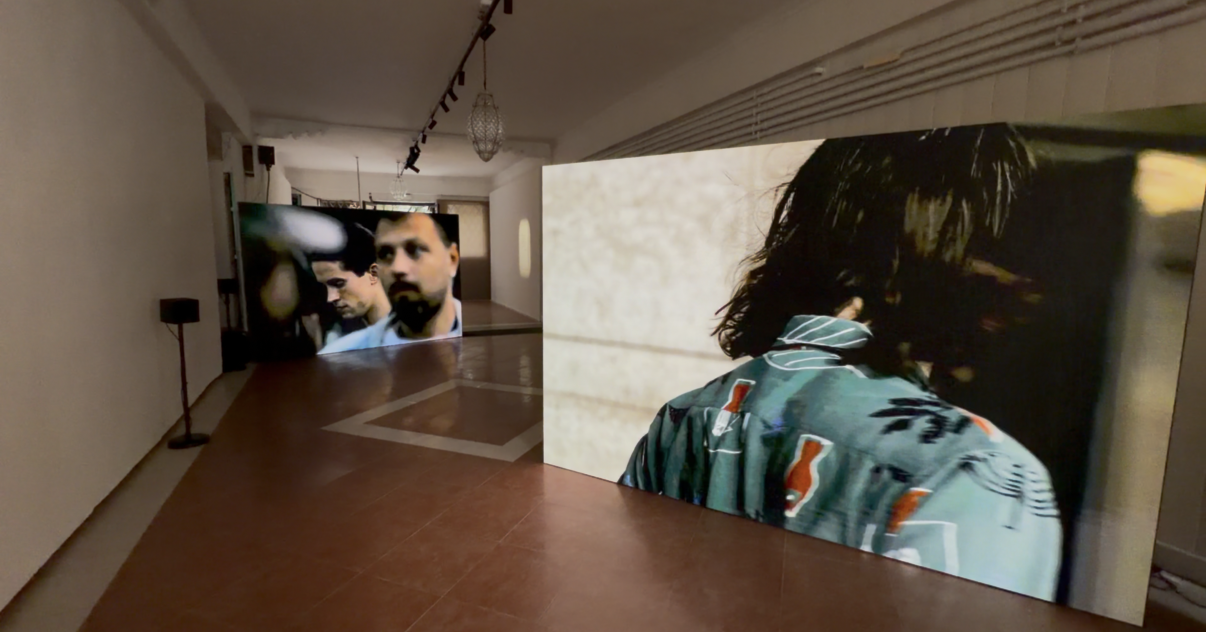
Yarena Malashchuk and Roman Khimei, Dedicated to Youth of the World II, 2019 (right) and Dedicated to the Youth of the World III, 2023 (left), installation view, Ukraine Collateral Event, 61st Venice Biennale. Image courtesy the author.
NOTES
1. Alla Senchenko, “Alla Senchenko,” PinchukArtCentre, April 29, 2026.
2. Annalise Kamegawa, “In Venice, Ukrainian Artists Reclaim Joy with Tender Force,” Designboom, May 15, 2026.
3. Anastasia Khudiakova, “Anti-War Murals in Ukraine and the World During the Russian-Ukrainian War,” The Ukrainian Art and Design Journal (Hudprom) 25, no. 1 (2023), 200.
-
Justin Apice is an independent curator and art historian. He is a graduate student in the MA Curatorial Practice program at the School of Visual Arts. He has curated numerous exhibitions at the United Nations, worked at the Jewish Museum as a curatorial researcher, and currently works as a gallery associate in New York. His curatorial work is particularly concerned with the ways that artists uncover the human condition in times of suffering and political dissonance. His interpretation of contemporary art is predicated on his interests in social justice and the practice of active listening to diverse voices.