
Paradise Must Not Last Forever
The Latvian Pavilion does a far better job of embodying intimate and convivial universes created by artists compared to the Biennale’s overstuffed and incohesive main exhibitions in the Giardini and Arsenale.
Colleen Dalusong • 7/20/26
MAREUNROL’S and Bruno Birmanis, Untamed Assembly: Backstage of Utopia, curated by Inga Lāce and Adomas Narkevičius, Pavilion of Latvia, 61st Venice Biennale, May 9—November 22, 2026
-
On Site is The Curatorial's section for curatorial reviews and a venue for MA Curatorial Practice students at the School of Visual Arts to publish as part of their program, though it is open to all writers.
In this review, Colleen Dalusong examines Untamed Assembly: Backstage of Utopia, the Latvian Pavilion at the 2026 Venice Biennale, arguing that its reconstruction of the Untamed Fashion Assembly (UFA)—an experimental fashion festival held in Riga during the 1990s—offers a compelling model for thinking about artistic communities as temporary yet generative utopias. Through an installation that foregrounds backstage labor, archival memory, and material improvisation, MAREUNROL, Bruno Birmanis, and curators Inga Lāce and Adomas Narkevičius shift attention from spectacle to the social infrastructures that make creative experimentation possible. Situating the project against the broader context of the Biennale, the review argues that the pavilion demonstrates how ephemeral artistic spaces can endure as cultural imaginaries, suggesting that the value of utopia lies not in permanence but in its capacity to inspire future forms of collective creativity.
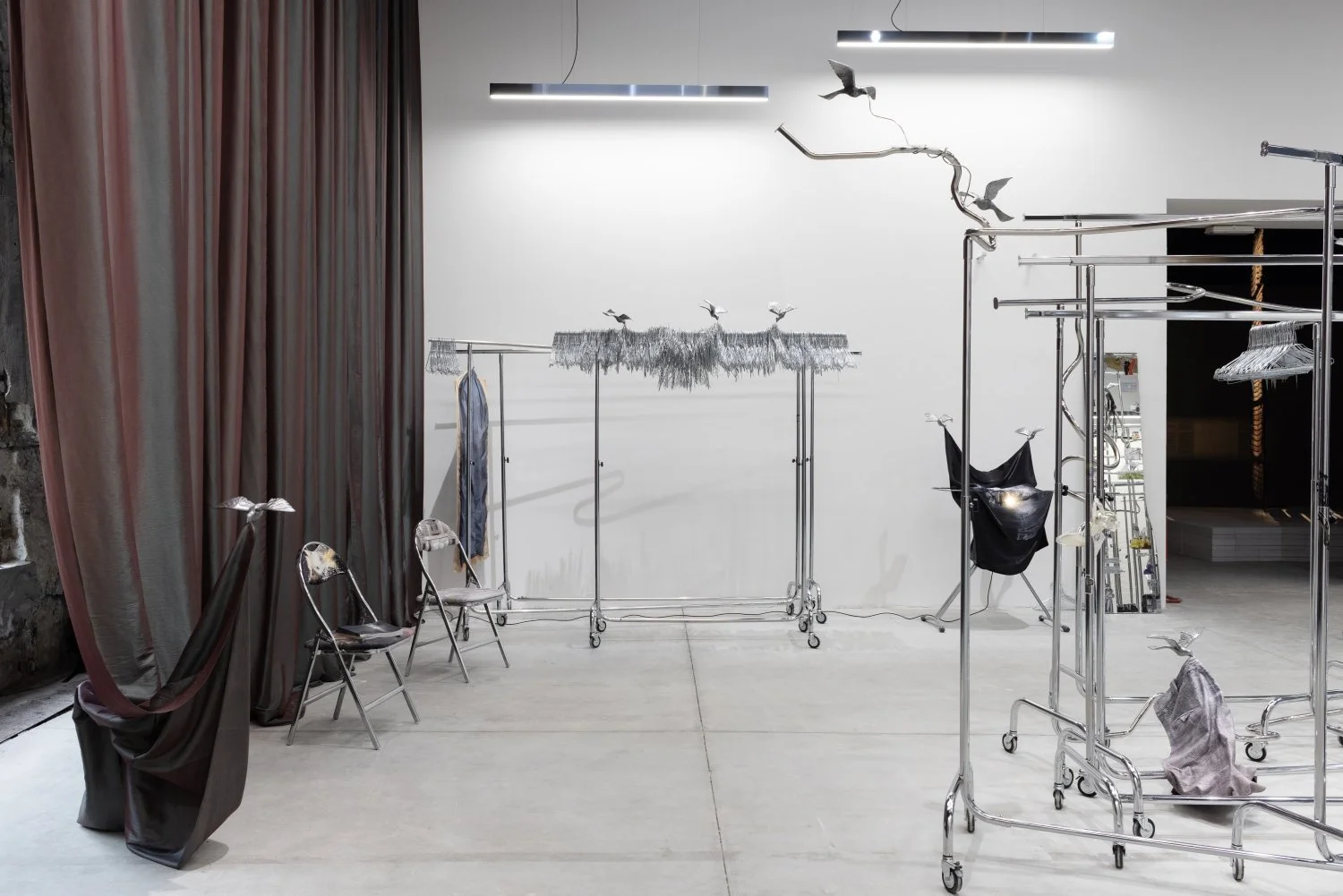
MAREUNROL’S, Untamed Assembly: Backstage Utopia, 2026, installation view, Pavilion of Latvia, 61st Venice Biennale. Photo by Kristine Madjare.
On entering the Latvian pavilion, I had the impression of entering the backstage of a fashion show after everybody has already left. At the center is a towering, almost palatial structure of gleaming chrome clothing racks, its metal rods twisting and bending to intertwine with one another. There are barely any clothes left hanging on the racks (the models must have chosen to wear the designs to the afterparty), a few chairs are scattered haphazardly around the perimeter, a forgotten pair of monstrously tall platform shoes are there, as if just taken off, and a slouching backpack emanates a mysterious golden glow. Along with these lingering traces of backstage frenzy, metal birds scattered around the structure hold aloft panels of fabric printed with scenes from archival footage from the Untamed Fashion Assembly (UFA), an annual fashion festival held in Riga between 1990 and 1999.
For the Latvian pavilion at the 2026 Venice Biennale, curators Inga Lāce and Adomas Narkevičius worked with the artist duo MAREUNROL’S (Mārīte Mastiņa-Pēterkopa and Rolands Pēterkops) and the fashion designer Bruno Birmanis to reimagine a backstage utopia inspired by the UFA. The festival’s carnivalesque and avant-garde shows were a direct antithesis of the mainstream fashion trends at the time, namely the minimalism popularized by designers such as Calvin Klein, Jil Sander, and Helmut Lang. Designers, models, photographers, musicians, and artists from all over the world would descend on Riga to take part in the UFA, which was legendary not only for its non-commercial and DIY spirit but also for the sense of freedom and joy to be found at the festival.
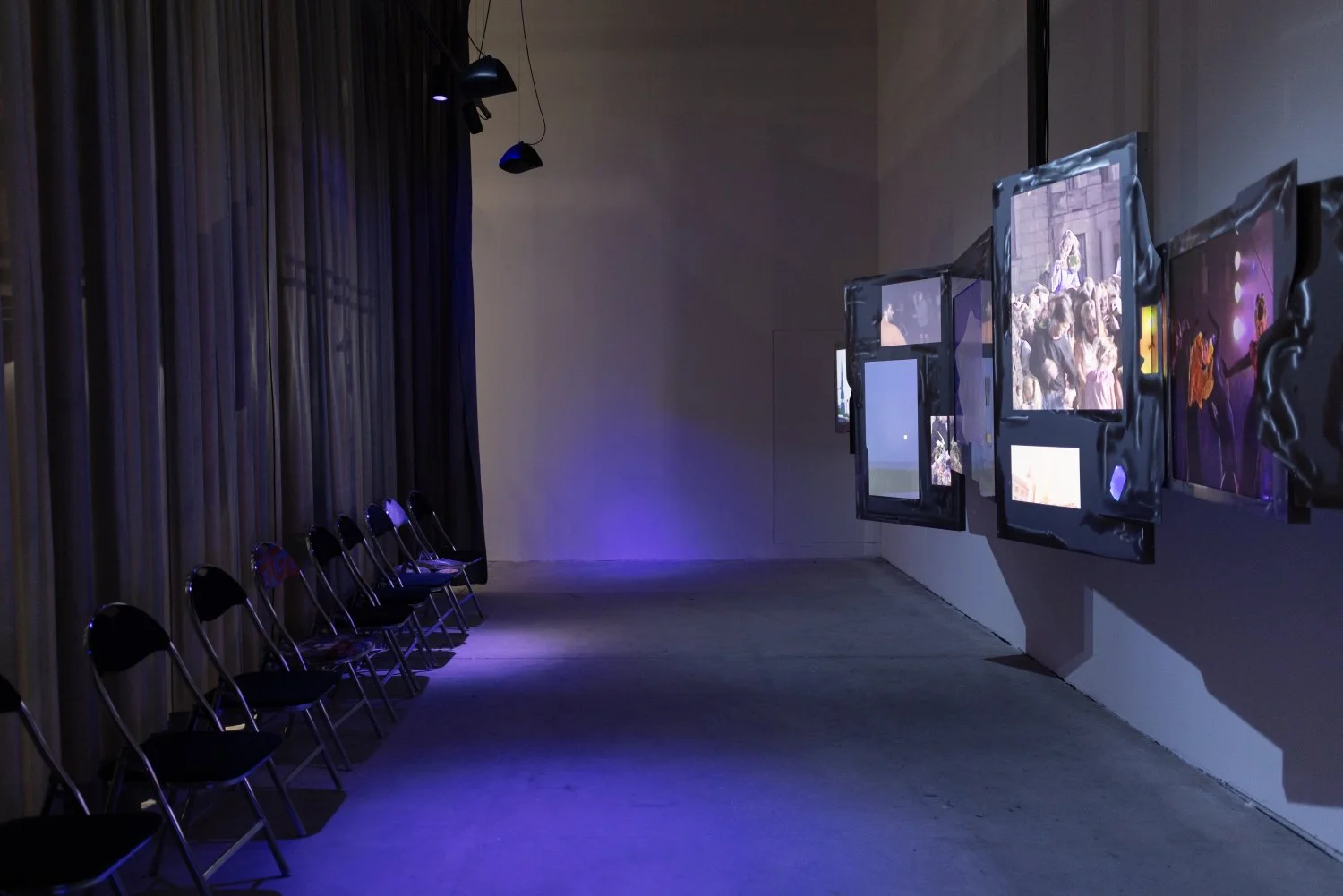
MAREUNROL’S, Untamed Assembly: Backstage Utopia, 2026, installation view, Pavilion of Latvia, 61st Venice Biennale. Photo by Kristine Madjare.
The UFA’s archival footage takes on many forms in the exhibition: in its most straightforward incarnation, the original videos are visible only to those who are curious enough to peek behind the curtain that separates the central sculpture from the makeshift viewing room, essentially flipping the expectations of what takes the centerstage versus the backstage. Here, the catwalk is relegated to the periphery while the invisible labor of those who toiled out of sight becomes the main attraction. The once-forgotten faces and voices of those who made the UFA possible become all the more visible when viewers glance in the mirrors resting against the wall. Each person’s reflection is literally framed by cut-out stickers of models and assistants from archival footage, occasionally punctuated by stickers immortalizing quotes, such as “WHEN YOU HAVE NOTHING, YOU FIND SOMETHING POWERFUL,” or “THE OPENINGS BECAME NIGHTCLUBS BECAME THE BEACH BECAME THE CLUB.”
The juxtaposition of the viewers’ reflections with these stickers is wholly inviting, almost encouraging each visitor to imagine themselves as one of the visionary artists who took part in the UFA’s utopian atmosphere of creative experimentation. This invitation is taken a step further in the incorporation of still images from the archival footage printed onto the clothing and the chairs that populate the almost-empty room. Rather than plain fabric, the folding chairs are upholstered with images taken on bus rides to Riga, hands performing last-minute tailoring, and public plazas repurposed for fashion shows. The fabric panels held aloft by the birds depict similar scenes from the archival footage, suggesting that the history of the UFA is one that we can bring into our own lives—whether it is an idealized reflection to strive toward, a comforting legacy that we can find relief in, or a committed lifestyle choice, such as the clothes we choose to wear on our bodies every day.
The clothing shown at the UFA was outrageous yet inventive. According to Bruno Birmanis, a number of participating designers incorporated furniture fabric into their designs simply because it was cheap and readily available. Models would strut onto the runway, wearing minidresses adorned with bedazzled hammers and sickles, hats resembling traffic cones, or duvets and pillows reimagined as sumptuous ballgowns. As Birmanis fondly recalls, nothing was off limits, and designers were more than happy to search, improvise, and invent new ways to bring their visions to life in the face of shortages and economic collapse.
Although it isn’t part of the Biennale’s main exhibition, the pavilion reminds me of the following passage from the late Koyo Kouoh’s curatorial text: “Minor tones are also minor islands: worlds in the middle of oceans, with distinct and infinitely rich ecosystems, social lives articulated—for better or worse—within much larger political structures, and ecological stakes of great significance. In this context, the evocation of tones and islands extends to an archipelago of oases: gardens, courtyards, residences, lofts, dance floors—the other worlds created by artists, intimate and convivial universes that regenerate and sustain even in the darkest moments; indeed, especially in the darkest moments.”
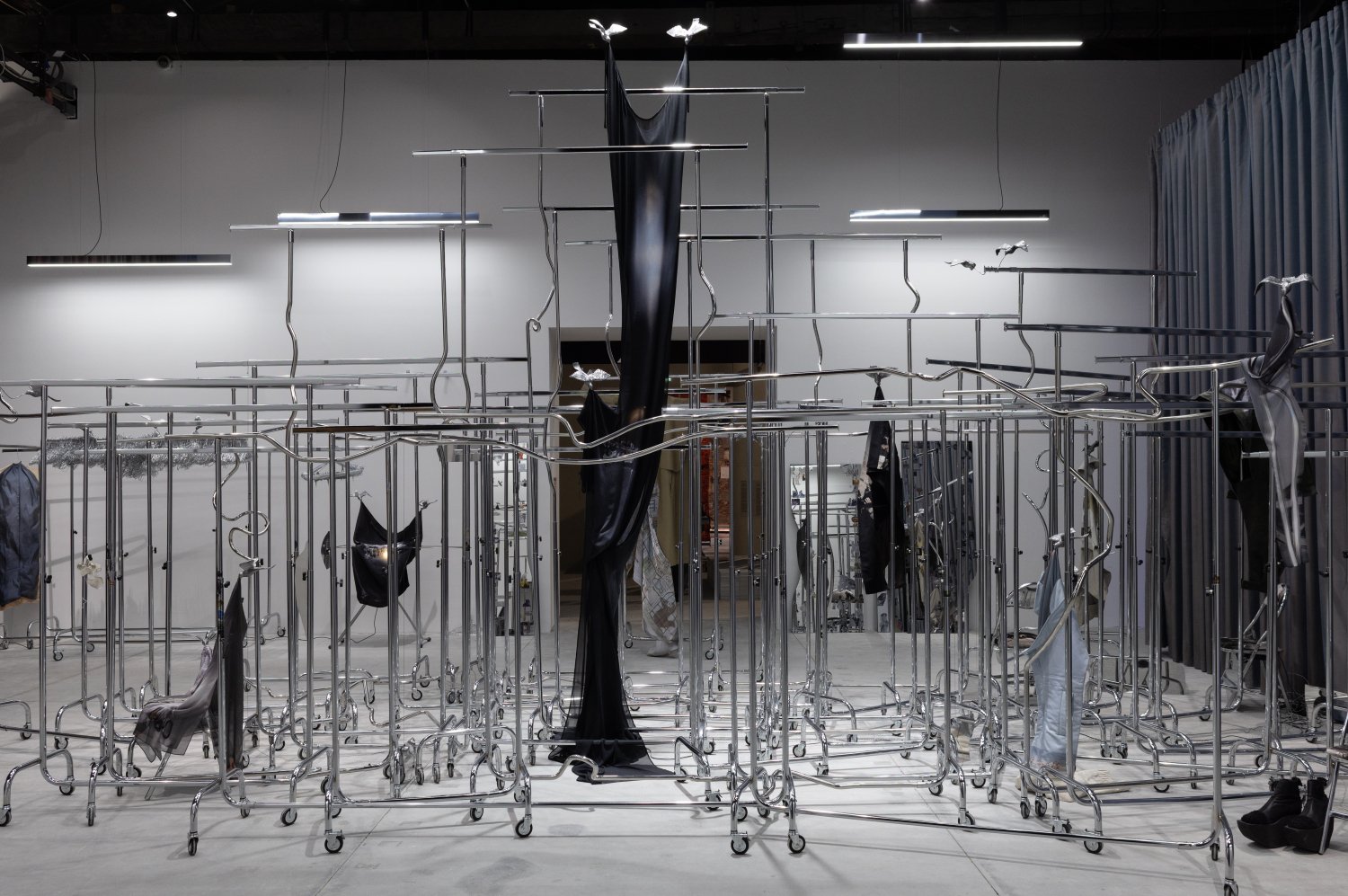
MAREUNROL’S, Untamed Assembly: Backstage Utopia, 2026, installation view, Pavilion of Latvia, 61st Venice Biennale. Photo by Kristine Madjare.
Ironically, the Latvian Pavilion does a far better job of embodying this idea compared to the Biennale’s overstuffed and incohesive main exhibitions in the Giardini and Arsenale. Perhaps this is because Lāce and Narkevičius are at an advantage compared to Kouoh’s curatorial team—it is much easier to make sense of the past than it is to wade through the muddled chaos of the present. For this reason, the Latvian project accomplishes what the vast majority of the Biennale does not: its focus on the UFA, an oasis created by artists during bygone times of darkness, illuminates a possible pathway for those of us in the present moment.
To say that the UFA took place during tumultuous times would be an understatement. It existed in a strange in-between state in the shadow of the collapsed Soviet Union, somewhere between Western and Eastern Europe, no longer communist but not yet fully capitalist either. Nonetheless, it was a utopia precisely because Latvia’s role wasn’t defined yet, so people felt free to experiment. In the same way that childhood is idyllic because it lacks the crushing weight of being defined by a job or a social responsibility, the UFA was able to operate as a short-lived paradise that many people look back on fondly.
Some people would say it’s a shame that the UFA couldn’t last forever, yet there’s really no need for a paradise to do that. If such a thing were possible, then nothing would ever change, and there would be no craving or desire for the experimentation that created paradise in the first place. It’s enough that it existed at one point in time, during the long and endless stretch of human history. The fact that it could ever exist in the first place—however short-lived it may have been—already provides the foundation for future dreamers to build the next utopia.
-
Colleen Dalusong is an independent curator and writer based in New York City and is currently a master’s degree student in Curatorial Practice at the School of Visual Arts. She has previously curated exhibitions at Accent Sisters, CP Projects Space, Uncool Gallery, A Space Gallery, and nuun gallery. Her writing has been featured on Whitehot Magazine, Cultbytes, Impulse Magazine, sabukaru.online, Hot Coffee Conversations, and Mercer Street Reader. She has held positions at Alternative Space LOOP, the International Studio & Curatorial Program, and the Asian American Arts Centre.