
Whose Wet Dream Is This?
The body becomes its own archive of the show's demands, and this visibility raises the very question it might intend to foreground: Who is this visibility for?
Kiera McIntosh • 7/20/26
Florentina Holzinger, Seaworld Venice, curated by Nora-Swantje Almes, Pavilion of Austria, 61st Venice Biennale, May 9—November 22, 2026
-
On Site is The Curatorial's section for curatorial reviews and a venue for MA Curatorial Practice students at the School of Visual Arts to publish as part of their program, though it is open to all writers.
In this review, Kiera McIntosh examines Seaworld Venice by Florentina Holzinger at the Austrian Pavilion, curated by Nora-Swantje Almes, in which a rotating cast of female performers spend extended periods submerged, spinning, and suspended across a series of aquatic stations for the full seven-month run of the Biennale. McIntosh argues that while Holzinger achieves something genuinely radical, making the labor of performance legible on the surface of the body itself, the work cannot fully resolve the tension between feminist critique and the spectacle it stages. Naming the gaze, she contends, does not disrupt it; and asking female bodies to absorb, endure, and display the marks of that endurance for an audience risks restaging the very extraction the ecological frame sets out to critique.

Florentina Holzinger, Seaworld Venice, 2026, performance view, Pavilion of Austria, 61st Venice Biennale. Image courtesy Nicole Marianna Wutyczak.
Walking through Florentina Holzinger’s Seaworld Venice at the Austrian Pavilion, past the well-calculated aesthetics, the audiences openly filming despite signage demanding otherwise, and the portable toilets on either side of the central tank whose contents, provided by the public, quite literally fed the exhibition (the body’s waste becoming the water, the water becoming the work, rising levels of human excess made literal), I couldn’t help but stop and notice the bruises.
Before entering the pavilion, just outside every hour on the hour, a naked woman in a harness climbs a rope up to a large brass bell suspended from a blue crane, and rings it by hanging upside down from inside, her body becoming the bell’s clapper as she swings side-to-side with slow, rhythmic momentum. Inside, the pavilion unfolds as a hallway leading to a single open atrium: to the left, a large open tank in which a naked woman on a jet ski circles with building force; to the right, a towering spinning ladder on which golden sculptures of women frozen at various stages of ascent share the structure with real, naked women moving slowly among them, mirroring the cast figures’ poses. At the end, anchoring the center atrium, a large viewing tank in which a naked woman stood immersed, scuba mask on, staring back through the glass, the two portable toilets connected on either side. Pale blue-yellow blooms spreading across a thigh, a forearm, and a shoulder blade; skin that has puckered and whitened from three hours in the water, and fingertips wrinkling into soft, collapsed ridges. The women in the tank, climbing the spinning ladder, operating a jet ski, or hanging upside down in a brass bell, are not enacting exhaustion; they are actually very much exhausted, while the audience, dry and clothed and temporally passing through, looks on.

Florentina Holzinger, Seaworld Venice, 2026, peformance view, Pavilion of Austria, 61st Venice Biennale. Image courtesy Nicole Marianna Wutyczak.
This is the central friction of Seaworld Venice, and it is one that the work's ambitious conceptual scaffolding (water as ecological crisis, the body as machinic organism, purity and pollution as co-constitutive) does not fully resolve. Holzinger, an Austrian choreographer and director who has built her practice around the radical possibilities of the female body, staging works in which nudity, danger, and physical extremity are not provocations for their own sake but the very grammar of the work, has long been drawn to extreme durational embodiment, to bodies pushed past the decorative and into the frankly material: bleeding, straining, and enduring. Here, the aquatic installation demands that a rotating cast of female performers spend extended periods submerged in tanks that double as both amusement park spectacle and sewage treatment. The press release tells us the performers inhabit an ecosystem out of control. What it does not quite tell us is what that inhabitation costs the body over not an afternoon, but seven months of a Biennale run.
The bruises and the waterlogged skin are not prosthetics or theatrical effects, but the legible record of what sustained immersion and immense physical labor do to human tissue. In this sense, Holzinger achieves something genuinely radical: she makes the labor of performance visible on the surface of the body itself. The body becomes its own archive of the show’s demands, and this visibility raises the very question it might intend to foreground: Who is this visibility for?
The gaze is not a neutral instrument here either. When we look at women’s bodies in states of physical duress, whether it's bruised, bloated with water, or stripped of the armor of composed presentation, we are operating within a long history of looking that has rarely been to women's benefit. Holzinger is clearly aware of this as she directly engages the mechanics of spectacle, refusing to let the audience sit comfortably in voyeurism by implicating them in what they consume. The press release’s closing provocation—“whose wet dream is this?”—names it directly. But naming the gaze does not automatically disrupt it. An audience can hold both the critique and the pleasure simultaneously, and often does. I mean, I literally saw an older man take out his DSLR camera, walk right up to the tank, and take a close-up shot of his “wet dreams.” Apart from that, the bruises become aestheticized, whether or not that is the intention, and the exhausted face becomes a kind of sublime. This is not a failure unique to Holzinger; it haunts durational work involving female bodies almost constitutively, but it is a tension the work does not resolve so much as stage.
What is also being staged, whether consciously or not, is the transformation of emotional labor into physical labor. The history of demanding that women perform endurance for an audience, like sustaining discomfort, remaining present, and continuing despite the cost, is not separate from the history of domestic and affective service. The female body in the tank is also, in some register, the female body doing what female bodies have always been asked to do: maintain composure while placed under uncomfortable situations. This is not a new artistic gesture when thinking about artists such as Marina Abramović, who built an entire practice on the proposition that the body under duress becomes a site of meaning, and Valie Export, whose early actions made the female body’s suffering and endurance specifically political, refusing to let that labor remain invisible. Holzinger’s work within this lineage and the feminist force of making physical labor legible is real and significant. The argument here is not that this work is spectacle rather than art, or that endurance is exploitation rather than expression. It is rather that the performance of endurance by women, for an audience, carries a weight that no amount of feminist framing entirely neutralizes, and the work is most honest when it holds that tension rather than resolving it. When we ask whose endurance is being consumed and toward what end, it is not to undermine the work but to hold it to a high enough regard to ask.
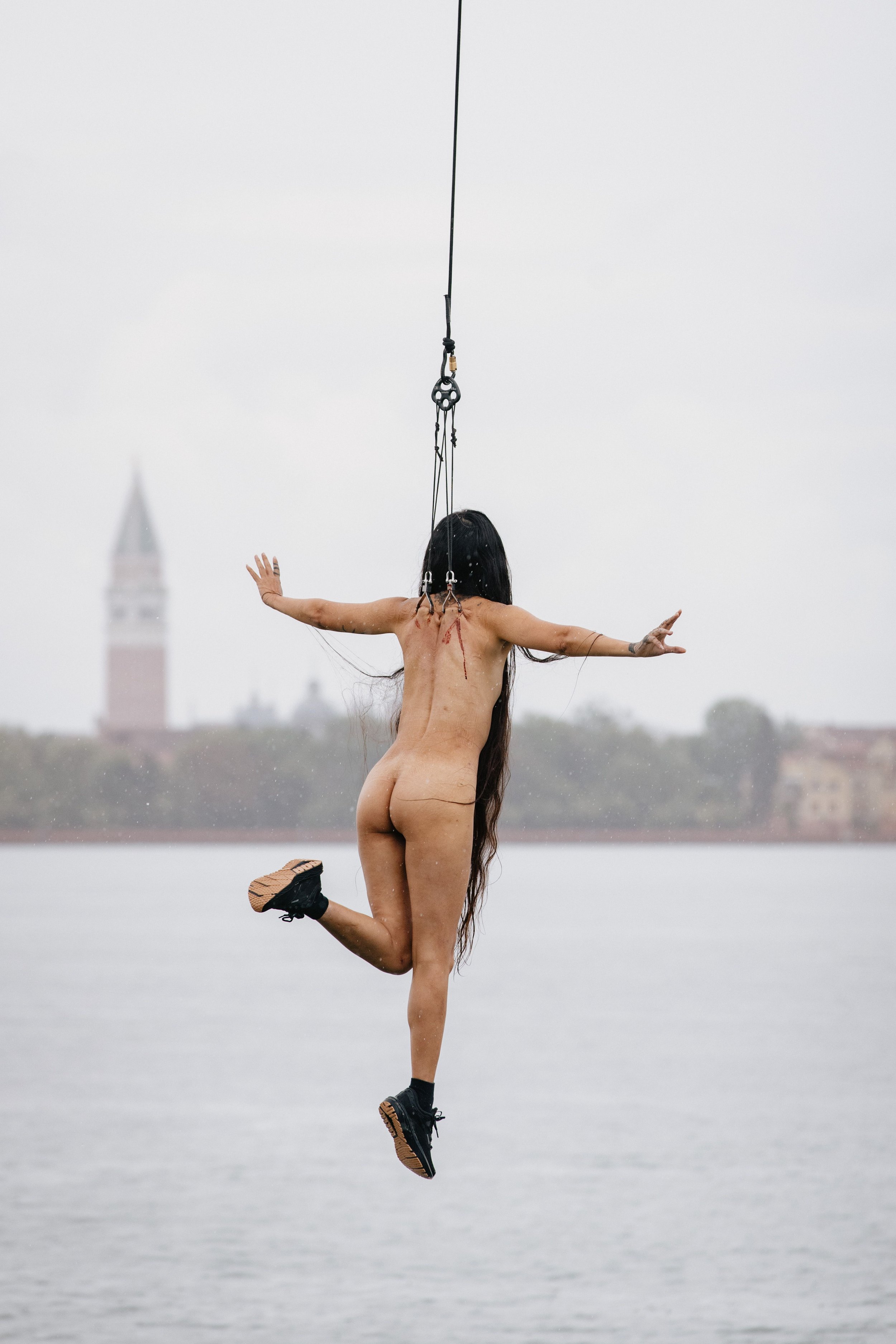
Florentina Holzinger, Seaworld Venice, 2026, performance view, Pavilion of Austria, 61st Venice Biennale. Image courtesy Nicole Marianna Wutyczak.
Then there is the durational question that the institution of the Biennale itself poses. Seven months is not a performance but seems more like a condition. The body can sustain extraordinary things for a single afternoon, a single week, but the cumulative effect of repeated immersion over a Biennale season, the repeated bruising, and the skin that never quite recovers is a different ethical proposition. What does it mean to ask this of bodies? What does it mean for the performers who say yes? There is, presumably, genuine consent and a genuine desire to participate, and yet consent is not the end of the ethical inquiry. The question of what we are willing to let art do to human bodies, and which bodies, and over what duration, is not answered by pointing to contracts or voluntary participation. There is no simple answer to these questions, but it’s important to raise them.
This is especially pointed given Seaworld Venice’s ecological ambitions. Holzinger connects the body’s fluids (urine, sweat, etc.) to water as a planetary resource and crisis. Rising sea levels are not an abstract backdrop but the conceptual ground of the work. The body submerged in water is the body living inside the consequence of human excess, as the earth is submerged in the waste of its own civilization. There is something genuinely moving in this alignment: the individual body as a microcosm of planetary crisis, the female body as a figure for a nature that is exploited, overworked, and required to absorb damage it did not produce. Mother Earth (the cliché goes) and Holzinger are asking what it actually looks like to live in that saturated, waterlogged condition, and to have the consequences of others’ waste written on your skin. The bell will always take its toll and time will always be up. Ding, ding!
But here, the ecological frame and the endurance frame collapse into each other in ways that are worth pressing. If the female body is made to stand in for an exhausted, over-extracted earth, then the performance of that exhaustion risks becoming not a critique of extraction but a restaging of it. The work makes the women’s bodies do what industrial capitalism makes the planet do: absorb, endure, and display the marks of that absorption for an audience that leaves intact.
Can it last seven months? Probably, with rotation and care. Should it? That is a question the work itself seems to be asking, even if it cannot answer—and perhaps that is precisely the point. It must install an unanswerable question in the body of the show, to make the audience sit with the discomfort of what they are watching and what they are complicit in, long after they have stepped back into the opulence of Venice.

Florentina Holzinger, Seaworld Venice, 2026, performance view, Pavilion of Austria, 61st Venice Biennale. Image courtesy Nicole Marianna Wutyczak.
-
Kiera McIntosh is an independent curator from Denver, Colorado, whose practice explores the intersection of desire and storytelling through poetics, feminist theory, and communicative practice. Her exhibitions investigate intimacy, embodiment, and voice, pairing exhibition-making with live public programming that positions desire not simply as a subject, but as a curatorial methodology. Her practice is informed by sustained experience across artist-led, commercial, and institutional contexts. She has supported exhibitions and public programming at Camden Arts Centre in London, managed large-scale public events as Program Manager for The Dinner Party in Denver, and held curatorial and gallery roles at Pardon Arts and Dateline Gallery, where she contributed to artist selection, exhibition development, installation, and interpretive texts. Across these positions, she has developed a practice grounded equally in conceptual research and the practical realities of producing exhibitions. McIntosh is currently an MA candidate in Curatorial Practice at the School of Visual Arts in New York, where she continues to develop a feminist approach to exhibition-making rooted in poetic inquiry, critical research, and collaborative forms of knowledge production.