
Special Section: 61st Venice Biennale
If art and its exhibition are a kind of gnomon to guide us to the right time of reckoning, quite a few pavilions showed us the length of the shadows and the nuanced complexities (sometimes as amusing as they were alarming) that illuminate the world at this moment.
Steven Henry Madoff • 7/20/26
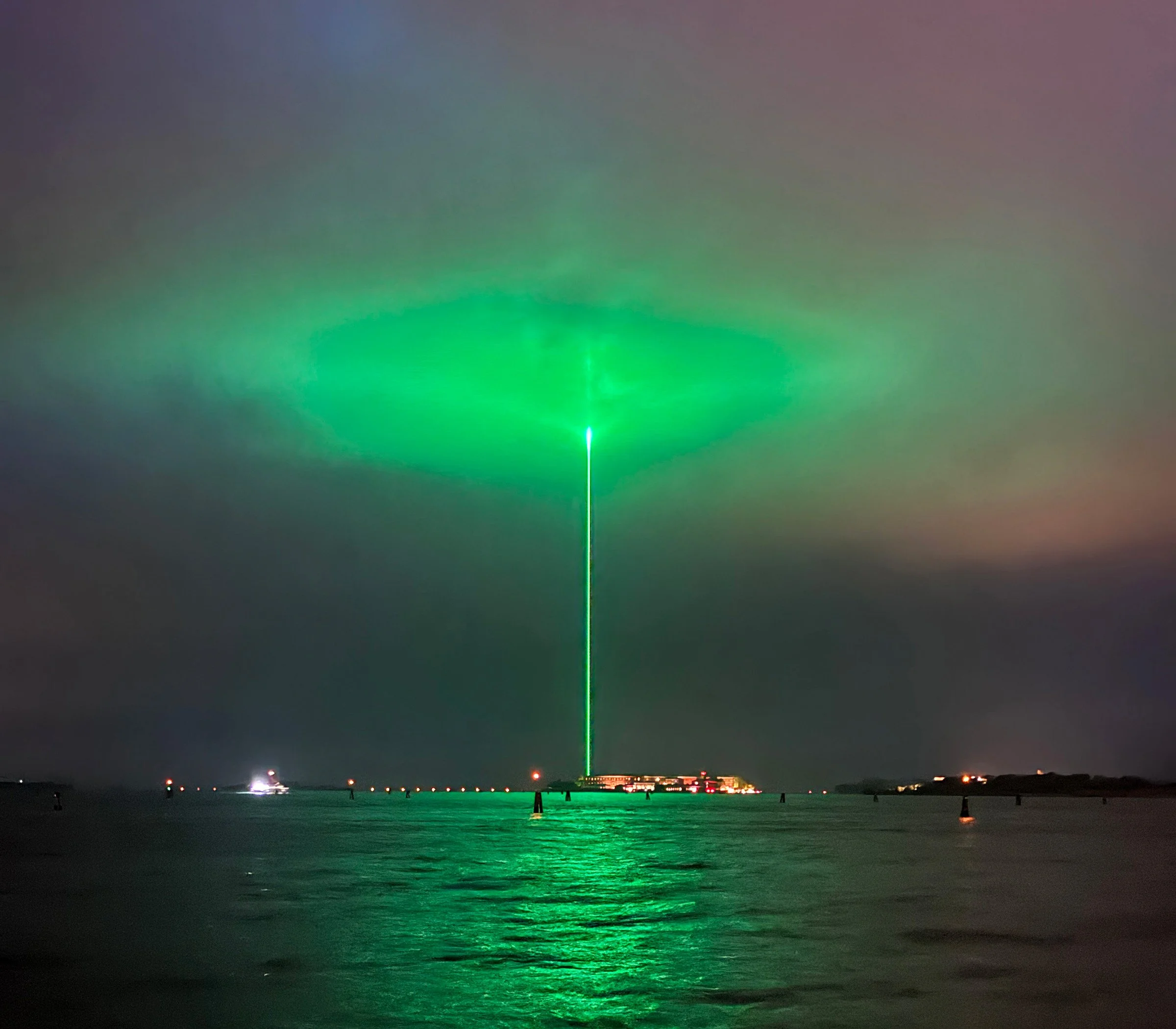
Chris Levine, Higher Power, 2026, laser projected from the San Clemente Palace Hotel adjacent to the 61st Venice Biennale. Image courtesy MACP.
For the 61st edition of the Venice Biennale, I invited graduate students in the MA Curatorial Practice program at the School of Visual Arts in New York to go to Venice and select an exhibition within the biennial to review. This Biennale has been burdened by the sudden death of its artistic director, Koyo Kouoh; strikes concerning Palestine and workers’ rights; protests over the inclusion of Russia, Israel, and the United States; and the subsequent resignation of the prize jury. The European Union punished the Biennale for allowing the Russian Pavilion to open (which it did for just the week of the professional opening) by withdrawing $2.3 million in funding. Whatever the validity of the criticisms and tumult of this Biennale, the fact of Kouoh’s passing left her vision for the exhibition in the Central Pavilion and the Arsenale in the hands of her small curatorial team, who were without that single guiding hand to make it all cohere.
With 110 artists from scores of countries within what Kouoh called “the relational geography of encounters,” her theme, “In Minor Keys,” wanted to ramp down the contemporary condition of spectacularized focus on trauma of one stripe or another. Instead, she proposed an exhibition foregrounding the amelioration of duress that comes with localized joy, daily consummations of the good, the caring, the wanted touch, the opening of social vistas in place of clenched turmoil.
The national pavilions that reside in tree-lined lanes alongside the Central Pavilion—a colonialist habit of empire-saturated ownership literally built into the Biennale’s grounds—are under no compulsion to follow the artistic director’s theme. It turned out, as many of the writers note in this special section, that the pavilions largely resounded with the same sensitivity to the world’s woes that undergirded Kouoh’s counter-position of retrenched human fealty, though her curatorial approach, at least as it was executed by her team, was read by some critics as diffuse and ungainly. Instead, the reviews here suggest that the curators of various pavilions offered responses more incisive and piercing. Their incisions in the skin of social injustice and global ruin were more vivid, with a greater hold on viewers’ attentions, both critical and sympathetic. If art and its exhibition are a kind of gnomon to guide us to the right time of reckoning, quite a few pavilions showed us the length of the shadows and the nuanced complexities (sometimes as amusing as they were alarming) that illuminate the world at this moment. Read on.
Table of Contents
Justin Apice, Still Joy?
Romy Cohen, Collective Respiration: Embodied Knowledge in Minor Keys
Colleen Dalusong, Paradise Must Not Last Forever
Chaieun Lee, Liquid Tongues: Expanding Language, Limiting Experience
Steven Henry Madoff, Our New New Teacher
Kiera McIntosh, Whose Wet Dream Is This?
Naomi Moser, Rehearsals for Possible Futures
Diana Sardaryan, A Shift in the Air
Hyun Sung, The Interstitial Stitch: Goen Choi’s Meridian in Venice
Hongjin Zhou, Minor Life in the Embrace
-
Steven Henry Madoff is the founding chair of the MA Curatorial Practice program at the School of Visual Arts in New York and editor in chief of The Curatorial. Previously, he served as senior critic at Yale University’s School of Art. He lectures internationally on such subjects as the history of interdisciplinary art, contemporary art, curatorial practice, and art pedagogy. He has served as executive editor of ARTnews magazine and as president and editorial director of AltaCultura, a project of the Museum of Modern Art in New York. His books include Unseparate: Modernism, Interdisciplinary Art, and Network Aesthetics from Stanford University Press; Thoughts on Curating from Sternberg Press (series editor); Turning Points: Responsive Pedagogies in Studio Art Education (contributor) from Teachers College Press; Learning by Curating: Current Trajectories in Critical Curatorial Education (contributor) from Vector; Fabricating Publics (contributor) from Open Humanities Press; What about Activism? (editor) from Sternberg Press; Handbook for Artistic Research Education (contributor) from SHARE; Art School (Propositions for the 21st Century) (editor) from MIT Press; Pop Art: A Critical History (editor) from University of California Press; Christopher Wilmarth: Light and Gravity from Princeton University; To Seminar (contributor) from Metropolis M Books; and After the Educational Turn: Critical Art Pedagogies and Decolonialism (contributor) from Black Dog Press. Essays concerning pedagogy and philosophy have appeared in volumes associated with conferences at art academies in Beijing, Paris, Utrecht, and Gothenburg. He has written monographic essays on various artists, such as Marina Abramović, Georg Baselitz, Ann Hamilton, Rebecca Horn, Y. Z. Kami, Shirin Neshat, and Kimsooja, for museums and art institutions around the world. His criticism and journalism have been translated into many languages and appeared regularly in such publications as the New York Times, Time magazine, Artforum, Art in America, Tate Etc., as well as in ARTnews and Modern Painters, where he has also served as a contributing editor. He has curated exhibitions internationally over the last 35 years in the United States, Europe, and the Middle East. Most recently, Y.Z. Kami: In a Silent Way at MUSAC, León, Spain, June 2022-January 2023. Madoff is the recipient of numerous awards, including from the National Endowment for the Arts and the Academy of American Poets. He is a member of the Curatorial Studies Workshop, part of the Expanded Artistic Research Network (EARN).