
Special Section: 61st Venice Biennale
If art and its exhibition are a kind of gnomon to guide us to the right time of reckoning, quite a few pavilions showed us the length of the shadows and the nuanced complexities (sometimes as amusing as they were alarming) that illuminate the world at this moment.
By Steven Henry Madoff
If art and its exhibition are a kind of gnomon to guide us to the right time of reckoning, quite a few pavilions showed us the length of the shadows and the nuanced complexities (sometimes as amusing as they were alarming) that illuminate the world at this moment.
Steven Henry Madoff • 7/20/26
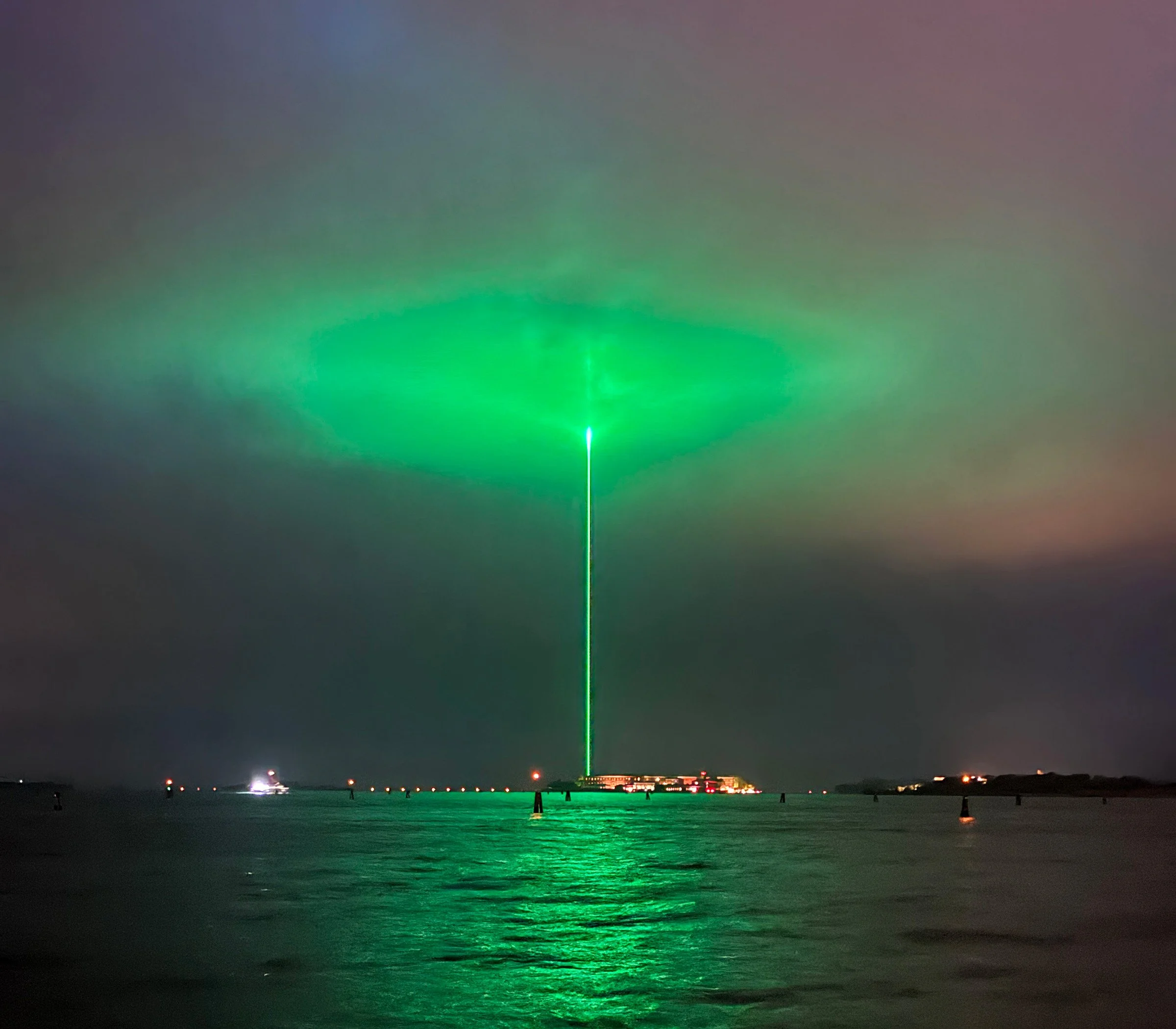
Chris Levine, Higher Power, 2026, laser projected from the San Clemente Palace Hotel adjacent to the 61st Venice Biennale. Image courtesy MACP.
For the 61st edition of the Venice Biennale, I invited graduate students in the MA Curatorial Practice program at the School of Visual Arts in New York to go to Venice and select an exhibition within the biennial to review. This Biennale has been burdened by the sudden death of its artistic director, Koyo Kouoh; strikes concerning Palestine and workers’ rights; protests over the inclusion of Russia, Israel, and the United States; and the subsequent resignation of the prize jury. The European Union punished the Biennale for allowing the Russian Pavilion to open (which it did for just the week of the professional opening) by withdrawing $2.3 million in funding. Whatever the validity of the criticisms and tumult of this Biennale, the fact of Kouoh’s passing left her vision for the exhibition in the Central Pavilion and the Arsenale in the hands of her small curatorial team, who were without that single guiding hand to make it all cohere.
With 110 artists from scores of countries within what Kouoh called “the relational geography of encounters,” her theme, “In Minor Keys,” wanted to ramp down the contemporary condition of spectacularized focus on trauma of one stripe or another. Instead, she proposed an exhibition foregrounding the amelioration of duress that comes with localized joy, daily consummations of the good, the caring, the wanted touch, the opening of social vistas in place of clenched turmoil.
The national pavilions that reside in tree-lined lanes alongside the Central Pavilion—a colonialist habit of empire-saturated ownership literally built into the Biennale’s grounds—are under no compulsion to follow the artistic director’s theme. It turned out, as many of the writers note in this special section, that the pavilions largely resounded with the same sensitivity to the world’s woes that undergirded Kouoh’s counter-position of retrenched human fealty, though her curatorial approach, at least as it was executed by her team, was read by some critics as diffuse and ungainly. Instead, the reviews here suggest that the curators of various pavilions offered responses more incisive and piercing. Their incisions in the skin of social injustice and global ruin were more vivid, with a greater hold on viewers’ attentions, both critical and sympathetic. If art and its exhibition are a kind of gnomon to guide us to the right time of reckoning, quite a few pavilions showed us the length of the shadows and the nuanced complexities (sometimes as amusing as they were alarming) that illuminate the world at this moment. Read on.
Table of Contents
Justin Apice, Still Joy?
Romy Cohen, Collective Respiration: Embodied Knowledge in Minor Keys
Colleen Dalusong, Paradise Must Not Last Forever
Chaieun Lee, Liquid Tongues: Expanding Language, Limiting Experience
Steven Henry Madoff, Our New New Teacher
Kiera McIntosh, Whose Wet Dream Is This?
Naomi Moser, Rehearsals for Possible Futures
Diana Sardaryan, A Shift in the Air
Hyun Sung, The Interstitial Stitch: Goen Choi’s Meridian in Venice
Hongjin Zhou, Minor Life in the Embrace
-
Steven Henry Madoff is the founding chair of the MA Curatorial Practice program at the School of Visual Arts in New York and editor in chief of The Curatorial. Previously, he served as senior critic at Yale University’s School of Art. He lectures internationally on such subjects as the history of interdisciplinary art, contemporary art, curatorial practice, and art pedagogy. He has served as executive editor of ARTnews magazine and as president and editorial director of AltaCultura, a project of the Museum of Modern Art in New York. His books include Unseparate: Modernism, Interdisciplinary Art, and Network Aesthetics from Stanford University Press; Thoughts on Curating from Sternberg Press (series editor); Turning Points: Responsive Pedagogies in Studio Art Education (contributor) from Teachers College Press; Learning by Curating: Current Trajectories in Critical Curatorial Education (contributor) from Vector; Fabricating Publics (contributor) from Open Humanities Press; What about Activism? (editor) from Sternberg Press; Handbook for Artistic Research Education (contributor) from SHARE; Art School (Propositions for the 21st Century) (editor) from MIT Press; Pop Art: A Critical History (editor) from University of California Press; Christopher Wilmarth: Light and Gravity from Princeton University; To Seminar (contributor) from Metropolis M Books; and After the Educational Turn: Critical Art Pedagogies and Decolonialism (contributor) from Black Dog Press. Essays concerning pedagogy and philosophy have appeared in volumes associated with conferences at art academies in Beijing, Paris, Utrecht, and Gothenburg. He has written monographic essays on various artists, such as Marina Abramović, Georg Baselitz, Ann Hamilton, Rebecca Horn, Y. Z. Kami, Shirin Neshat, and Kimsooja, for museums and art institutions around the world. His criticism and journalism have been translated into many languages and appeared regularly in such publications as the New York Times, Time magazine, Artforum, Art in America, Tate Etc., as well as in ARTnews and Modern Painters, where he has also served as a contributing editor. He has curated exhibitions internationally over the last 35 years in the United States, Europe, and the Middle East. Most recently, Y.Z. Kami: In a Silent Way at MUSAC, León, Spain, June 2022-January 2023. Madoff is the recipient of numerous awards, including from the National Endowment for the Arts and the Academy of American Poets. He is a member of the Curatorial Studies Workshop, part of the Expanded Artistic Research Network (EARN).
Still Joy?
In the face of the ongoing, catastrophic war, the Ukrainian exhibition proposes that joy, despite everything, is a sign of strength and resistance.
By Justin Apice
In the face of the ongoing, catastrophic war, the Ukrainian exhibition proposes that joy, despite everything, is a sign of strength and resistance.
Justin Apice • 7/20/26
Still Joy—From Ukraine Into the World, curated by Björn Geldhof and Oleksandra Pogrebnyak, Ukraine Collateral Event, Palazzo Contarini Polignac, 61st Venice Biennale, May 9—November 22, 2026
-
On Site is The Curatorial's section for curatorial reviews and a venue for MA Curatorial Practice students at the School of Visual Arts to publish as part of their program, though it is open to all writers.
In this piece, Justin Apice reviews Still Joy—From Ukraine Into the World, Ukraine's collateral event curated by Björn Geldhof and Oleksandra Pogrebnyak, which frames joy as radical resistance under conditions of ongoing war. Apice posits that the exhibition's most compelling works, particularly Khimei and Malashchuk's Open World and Nikita Kadan's closing painting After All, reveal joy and grief as inseparable, undercutting the curatorial premise in a way that deepens it. Apice further notes that the Biennale's accommodation of the United States, Russia, and Israel compromises the very theme it set out to champion.
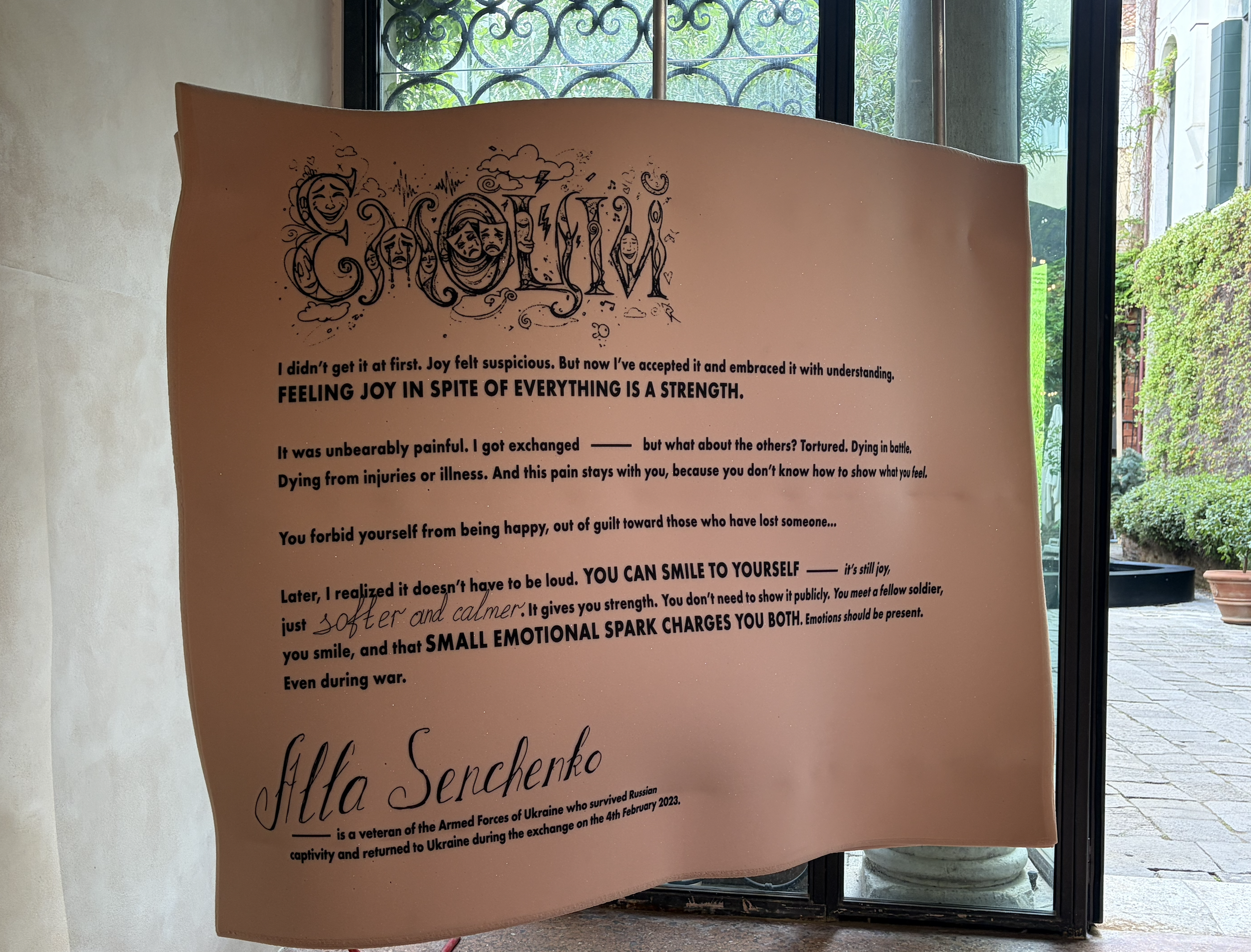
Simone Post, She Knew She/It/They Would Melt, 2026, installation view, Ukraine Collateral Event, 61st Venice Biennale. Image courtesy the author.
As the 2026 edition of the Venice Biennale continues into the fall, there is still much that feels unsettled and unsettling about the show. What was meant to be the celebratory spirit of In Minor Keys—the late Koyo Kouoh’s curatorial vision of the “quieter,” Indigenous, and marginalized art communities being exhibited for international audiences—has so far resulted in mixed reviews, controversies, and numerous protests over the participation of the United States, Russia, and Israel. Given the current geopolitical crises unfolding around the world, the choice to include these countries has left many disheartened by the blindness to the violence these nations perpetrate and the decision, nonetheless, to allow them to be represented here in Venice. Despite the restlessness and gloom of so much of the content of this Biennale, Ukraine’s collateral event, Still Joy—From Ukraine Into the World, situated in the Palazzo Contarini Polignac, instills a much-needed sense of euphoria and the power of love as an act of resistance amid global systemic collapse.
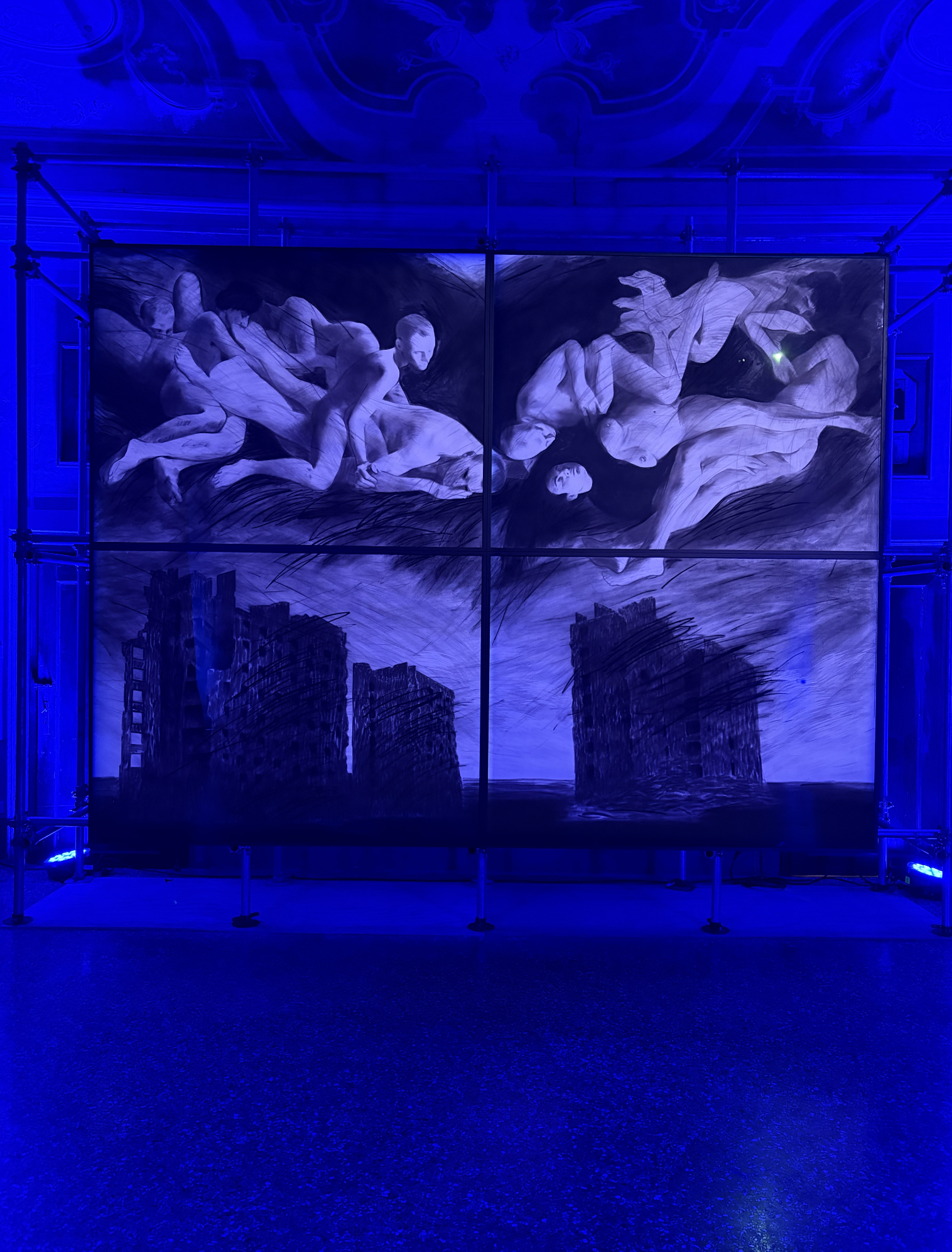
Alla Senchenko, Testimony to Joy, 2026, installation view, Ukraine Collateral Event, 61st Venice Biennale. Image courtesy the author.
Curated by Björn Geldhof and Oleksandra Pogrebnyak, the exhibition brings together international and Ukrainian artists to reflect on the concept of joy as a radical act of humanity. Under the context of war and the reduction of a great deal of Ukraine’s sovereign territory to rubble, the exhibition highlights testimonies collected by the Pinchuk Art Center from Ukrainian soldiers, such as Alla Senchenko, who believes that “allowing yourself to feel joy despite everything is a sign of strength.”1 This elevation of feelings is brought to the viewer throughout the three-story exhibition. As I entered, I was immediately presented with a rave featured on a two-channel video, the work of Ukrainian artists Yarema Malashchuk and Roman Khimei. Titled Dedicated to the Youth of the World II (2019) and Dedicated to the Youth of the World III (2023), the videos show youth engaging in rave culture, which remains popular in Eastern Europe. Both videos feature different temporal realities, one before and one after the full-scale invasion. With a pulsating score, viewers become part of the movement, where—within the confines of the dance floor—pleasure prevails over the terror that exists outside a club.2
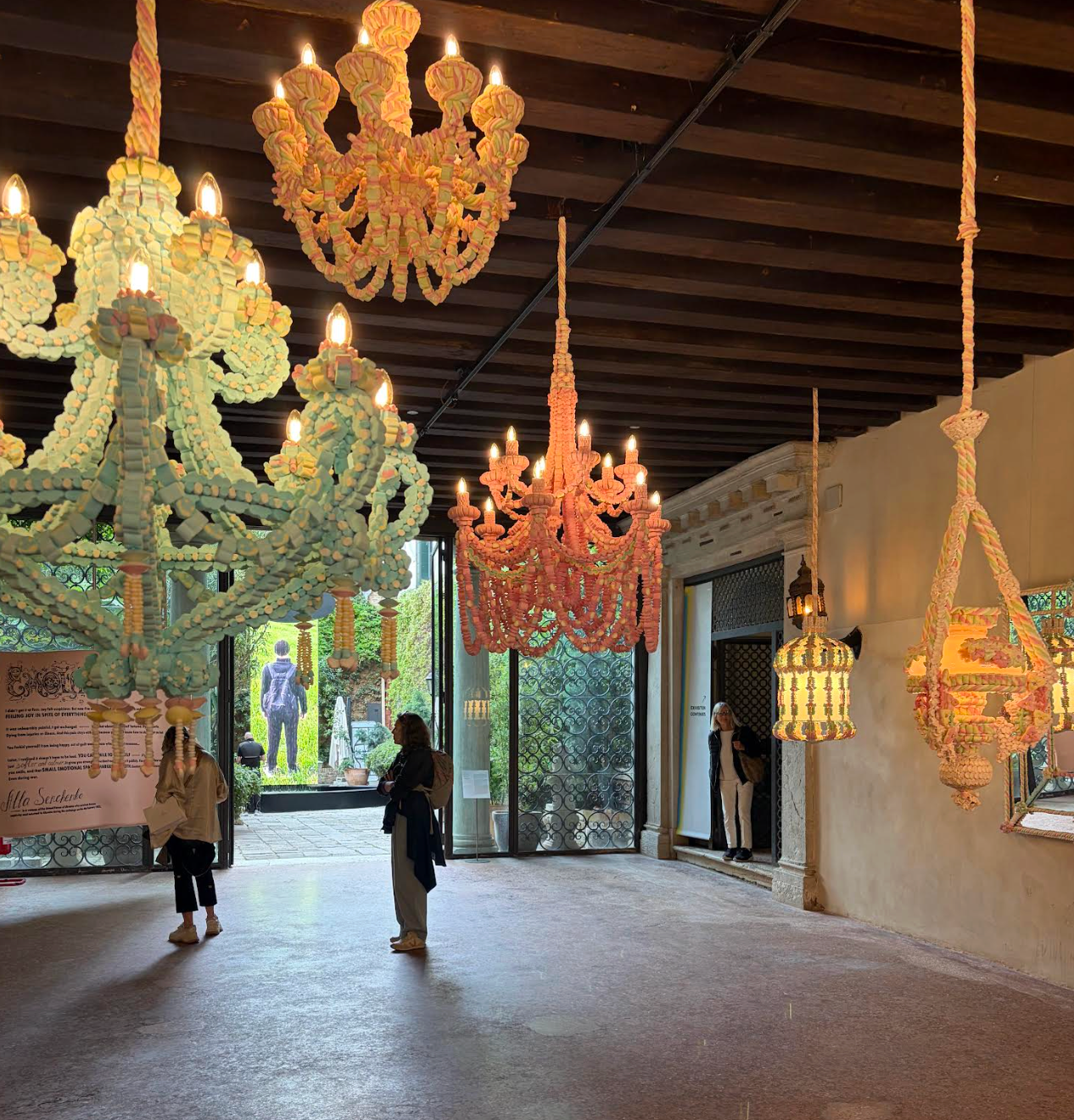
Nikita Kadan, After All, 2026, installation view, Ukraine Collateral Event, 61st Venice Biennale. Image courtesy the author.
The theme continues, consistent throughout the whole of the exhibition. On the second floor, viewers are thrust into a candy wonderland, with Simone Post’s She Knew She/It/They Would Melt (2026). Referencing the Palazzo’s chandeliers and grand decoration, Post created copies of the decor made entirely of candy, altering the gray monotone of the room with the bright colors of hard candies. The work filled the space, a cornucopia of childlike delight, though its sweetness had the tinge of longing for an innocence lost in adulthood—all the more present with the wages of war. Still, it felt like an escape from everything outside of the centuries-old palazzo, and its wistfulness, however Instagrammable-inducing, spoke to the melancholy and bite underlying the curators’ advocacy of overarching joy, though, of course, that is what makes the exhibition poignant.
Consider the current reality for Ukrainian art production through the lens of resistance: Throughout the rubble of its war-torn cities, artists put their lives on the line, facing death by artillery, to create murals alongside half-standing buildings, instilling hope and morale in Ukrainian soldiers and the populace who face constant threat.3 To that extent, Still Joy effectively presents the spirit of resistance, to a degree. While many of the works in the show rely on happiness as a sign of rebellion, the note of sadness haunts the exhibition as a gross reminder that the violence is unremitting, with no prospect of resolution on the horizon. The two sides of the coin, how to continue living in the shadow of the war, turn Post’s work bittersweet.
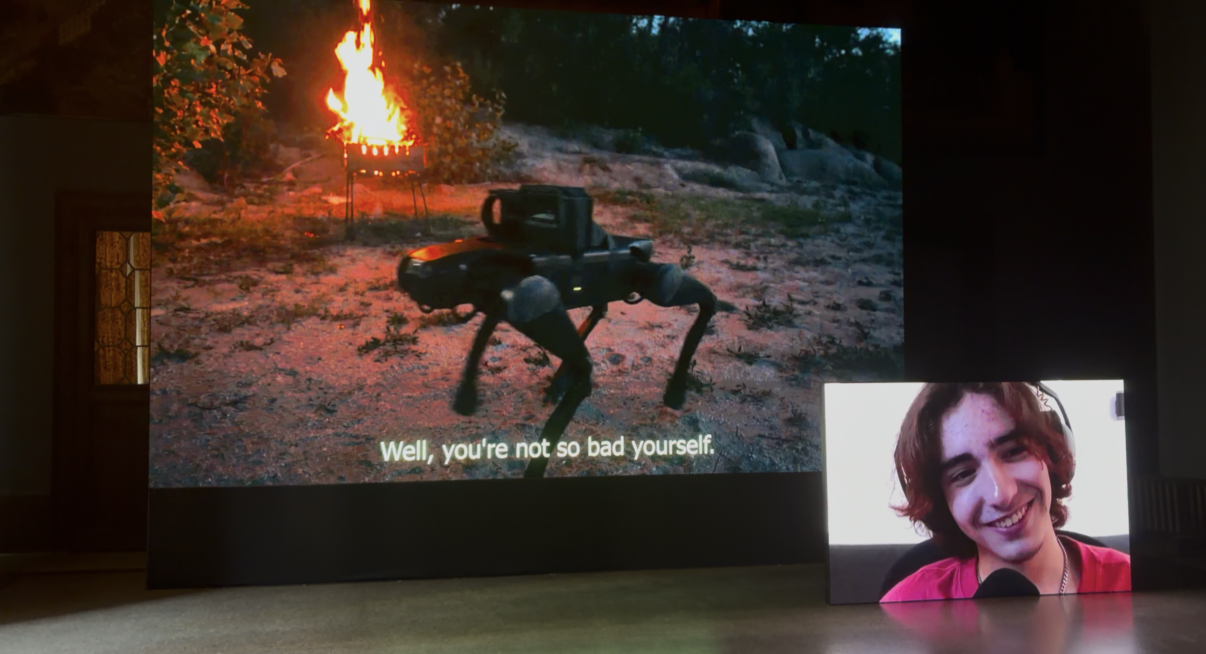
Yarena Malashchuk and Roman Khimei, Open World, 2025, installation view, Ukraine Collateral Event, 61st Venice Biennale. Image courtesy the author.
Khimei and Malashchuk’s Open World (2025) illuminates this paradox, showing the journey of Yaroslav, a teenager who fled Zaporizhzhia, Ukraine, and now lives in Poland. With the help of a robotic dog, Yaroslav navigates his once-beloved city remotely, finding himself in his half-destroyed school, chatting with his mother, who still lives in the city, at least some of the time. The commentary from Yaroslav appears to be lighthearted, with a humorous moment in the conversation he has with her captured onscreen, until he’s then reminded that he won’t be able to return home—a moment of silence followed by Yaroslav’s tears. Open World mediates grief during war. Remaining joyful is a way to think beyond the current despair, but what the exhibition shows, whether intentionally or not, is that this kind of resistance has its limits.
The end of the exhibition is a dark blue room with a large painting by Nikita Kadan, After All (2026), that explicates the jubilations of lived experiences as they intertwine with violence. Where the show begins with a rave scene, offering feelings of ecstasy to forget about the world, After All carries the weight of the world. A tense dialogue between the orgy scene above and the dismay of a dark, destroyed land below, the painting proposes how thin the line can be between happiness and despair. Rather than merely concluding the exhibition, Kadan’s work is in productive friction with the central theme of the Biennale. It suggests that celebration and destruction are not opposites but coexist within every life in the global system, all affected by uneven distributions of power, visibility, and suffering. As the rave can be seen to represent the Biennale’s curators’ intentions to celebrate the small moments in life overlooked by spectacles of power, the rubble below concisely represents the unending continuance of those spectacles, and that not only Ukraine but every country has suffered and continues to suffer from the monolithic force of dominating actors on the world stage. With Russia, Israel, and the United States’ participation in the Biennale, the poetic strength of this year’s theme is compromised by its accommodation to the agents of violence, whose crimes against humanity allow them to prosper and, ironically, fulfill their own joys.
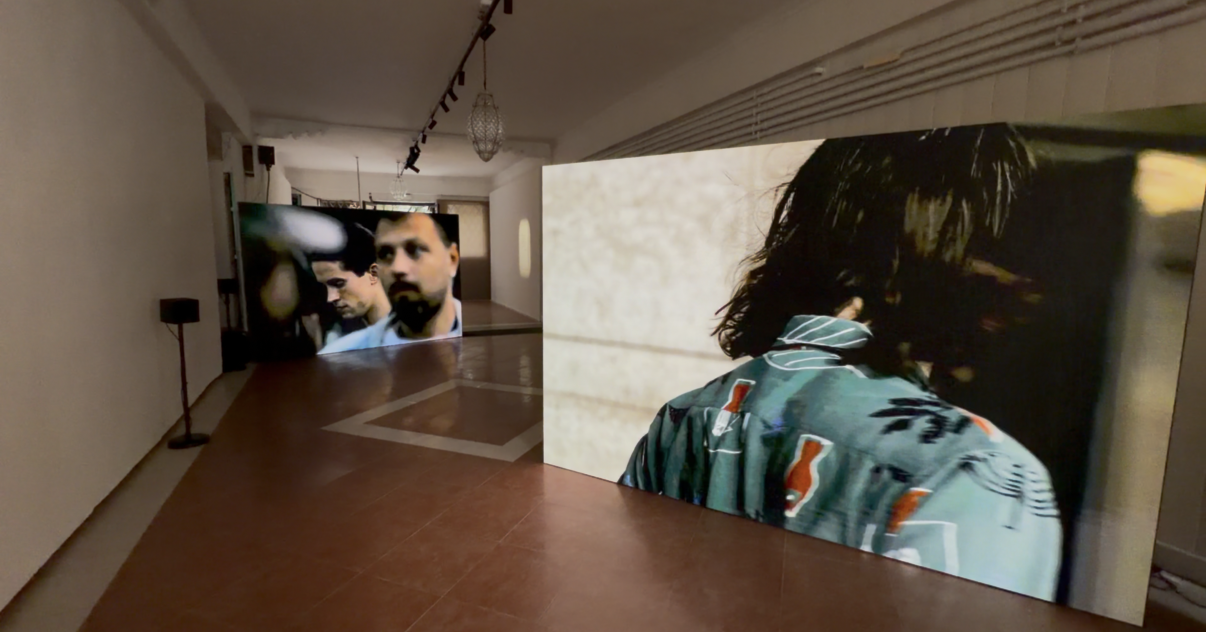
Yarena Malashchuk and Roman Khimei, Dedicated to Youth of the World II, 2019 (right) and Dedicated to the Youth of the World III, 2023 (left), installation view, Ukraine Collateral Event, 61st Venice Biennale. Image courtesy the author.
NOTES
1. Alla Senchenko, “Alla Senchenko,” PinchukArtCentre, April 29, 2026.
2. Annalise Kamegawa, “In Venice, Ukrainian Artists Reclaim Joy with Tender Force,” Designboom, May 15, 2026.
3. Anastasia Khudiakova, “Anti-War Murals in Ukraine and the World During the Russian-Ukrainian War,” The Ukrainian Art and Design Journal (Hudprom) 25, no. 1 (2023), 200.
-
Justin Apice is an independent curator and art historian. He is a graduate student in the MA Curatorial Practice program at the School of Visual Arts. He has curated numerous exhibitions at the United Nations, worked at the Jewish Museum as a curatorial researcher, and currently works as a gallery associate in New York. His curatorial work is particularly concerned with the ways that artists uncover the human condition in times of suffering and political dissonance. His interpretation of contemporary art is predicated on his interests in social justice and the practice of active listening to diverse voices.
Collective Respiration: Embodied Knowledge in Minor Keys
Despite little evidence to support the harboring of hope, these works allow us to imagine that through collective care and action, renewal and repair are possible.
By Romy Cohen
Despite little evidence to support the harboring of hope, these works allow us to imagine that through collective care and action, repair and renewal are possible.
Romy Cohen • 7/20/26
Gabrielle Goliath, Elegy, Chiesa di Sant’Antonin, May 4–July 31, 2026, and Yo-E Ryou, Breath Orchestra: Act 9: Ellipsis, 61st Venice Biennale, May 9–November 22, 2026
-
On Site is The Curatorial's section for curatorial reviews and a venue for MA Curatorial Practice students at the School of Visual Arts to publish as part of their program, though it is open to all writers.
In this text, Romy Cohen pairs two works from the 2026 Venice Biennale: Gabrielle Goliath's Elegy, relocated to the Chiesa di Sant'Antonin after the South African government refused to sponsor it, and Yo-E Ryou's Breath Orchestra: Act 9: Ellipsis in the Arsenale. They are both read in relation to Koyo Kouoh's curatorial invitation to breathe as an act of agency. Cohen argues that the two installations position respiration as a communal practice through which bodies negotiate grief and repair: Goliath deploying the sustained collective voice as a form of infinite mourning and resistance; Ryou drawing on the ritual breathing traditions of Jeju Island's haenyeo divers to connect visitors to embodied, intergenerational knowledge.
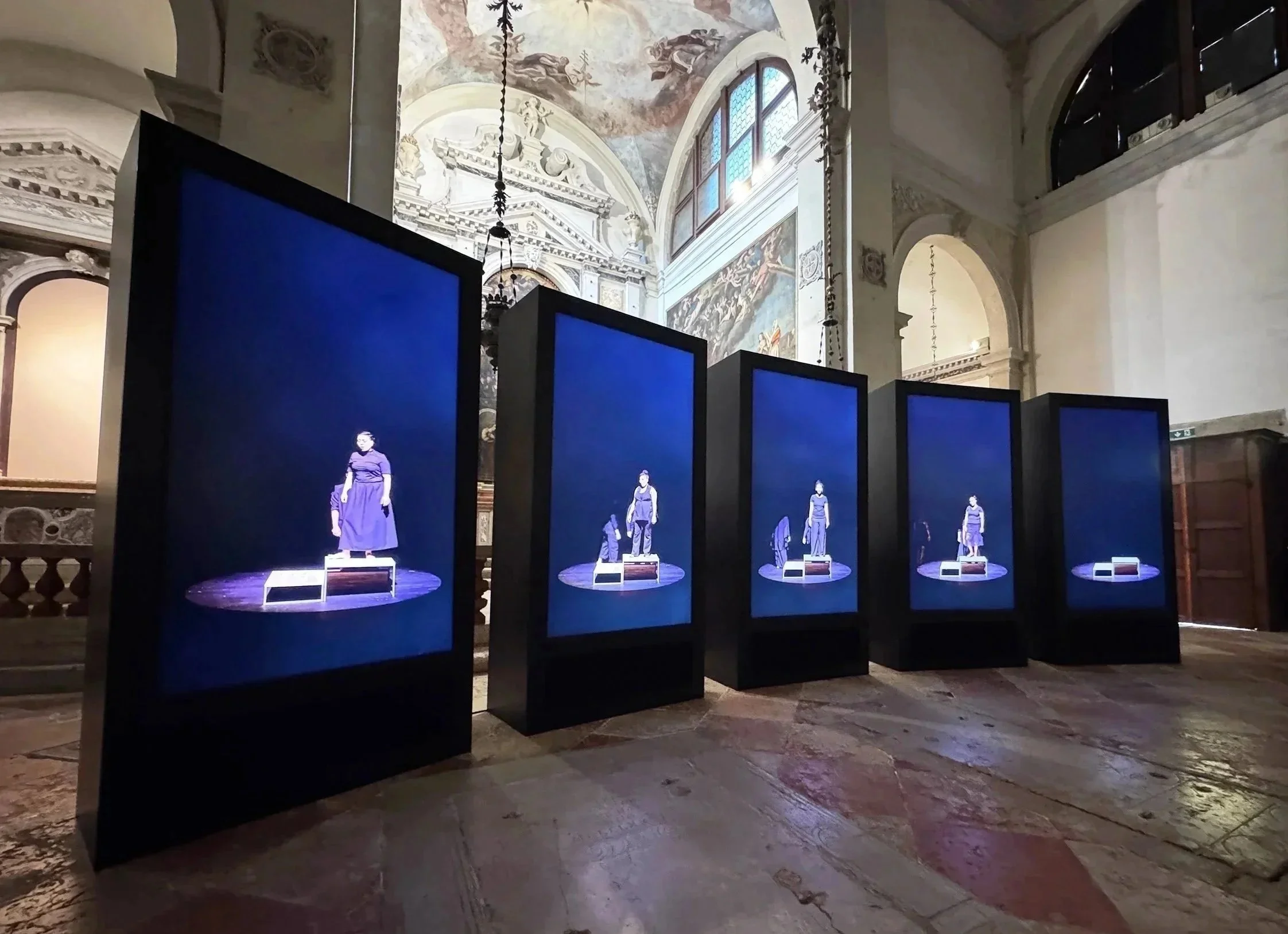
Gabrielle Goliath, Elegy, 2015–ongoing. Presented independently at the Chiesa di Sant'Antonin, Venice. Realized with the support of the Bertha Foundation, Ibraaz, and Galleria Raffaella Cortese. Image courtesy MACP.
[Take a deep breath]
[Exhale]
[Drop your shoulders]
[Close your eyes]
— Koyo Kouoh’s introduction to In Minor Keys
The ability to control one’s own breath is, perhaps, the most primal expression of personal agency. In the 61st Venice Biennale, the late curator Koyo Kouoh’s invocation at the Central Pavillion’s entry to In Minor Keys asks visitors to pause and give consciousness to that freedom. Seen through this curatorial invitation, Breath Orchestra: Act 9: Ellipsis (2024-26) by Yo-E Ryou and Elegy (2015-ongoing) by Gabrielle Goliath, both position respiration as a communal practice through which bodies negotiate the interdependence of grief and repair. In these two installations, practices of collective breathing connect to a vision of embodied knowledge that challenges detached observation as the site of comprehension. Within Kouoh’s exhibition, embodied knowledge, and specifically breath, emerges as a critical site to inhabit “the persistent signals of earth and life,” as she notes. Breath, usually a silent partner, becomes active as it binds individual bodies to collective histories and a shared environment. Visitors are implicated not as witnesses, but as participants in collective ritual, proposing physical experience as a vital source of understanding.
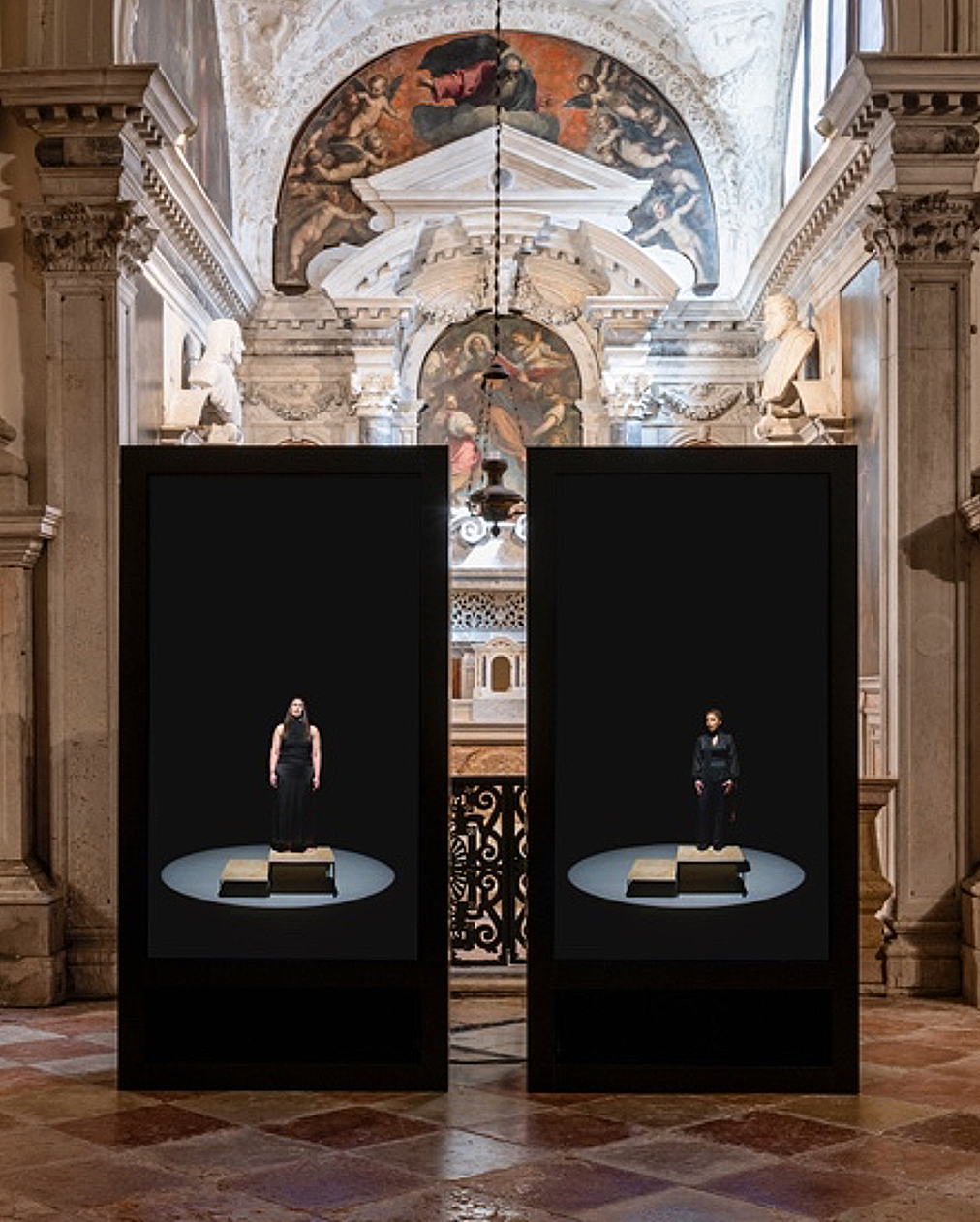
Gabrielle Goliath, Elegy, 2015–ongoing. Presented independently at the Chiesa di Sant'Antonin, Venice. Realized with the support of the Bertha Foundation, Ibraaz, and Galleria Raffaella Cortese. Image courtesy the artist.
Entering Breath Orchestra: Act 9: Ellipsis, which includes drawing, two video works, a multi-channel sound installation and performance, we are invited into a collectiveexperience of breathing grounded not in observation but participation. Korean artist Yo-E Ryou reflects on her time with the haenyeo women of Jeju Island. Feeling suffocated in New York City during the pandemic, Yo-E relocated to Hado-ri, a small village on South Korea’s Jeju Island, where she embedded herself in the community of haenyeo deep-sea divers. The haenyeo practice an ancient harvesting ritual, diving as deep as sixteen meters without breathing apparatus to gather sea life from the ocean’s floor. On any given day, they can spend up to six hours under the frigid water collecting their livelihood. Over centuries, the divers have developed ritual breathing practices that allow them to accomplish this extraordinary feat.
In her installation, Yo-E creates a seating circle that mirrors the shape of the open-air enclosures where the haenyeo gather. Two video screens each show a group of women. In one, girls variously standing or sitting on the rocky edge of the sea, the wind gently tousling their hair, are practicing the ancient breathing, learning how to achieve the skill that will bring them to the state of unity with nature. They do not learn their craft through detached instruction. Instead, understanding is produced through evolving engagement with each other and the sea. The second screen shows the masters, older women, sleeping together in a display of comfortable intimacy developed over years of mutual survival; close bonds formed through a lifetime of shared practice. Sitting between the two screens, we are placed in the arc of the generations, invited into the cycle of life, reminded of the lineage of women who have practiced this for hundreds of years. A series of drawings gives a poetic overview of the interconnected networks of bonds between people and nature, voices of the sea and of the divers, and the water with which the women become a part when they submerge themselves.
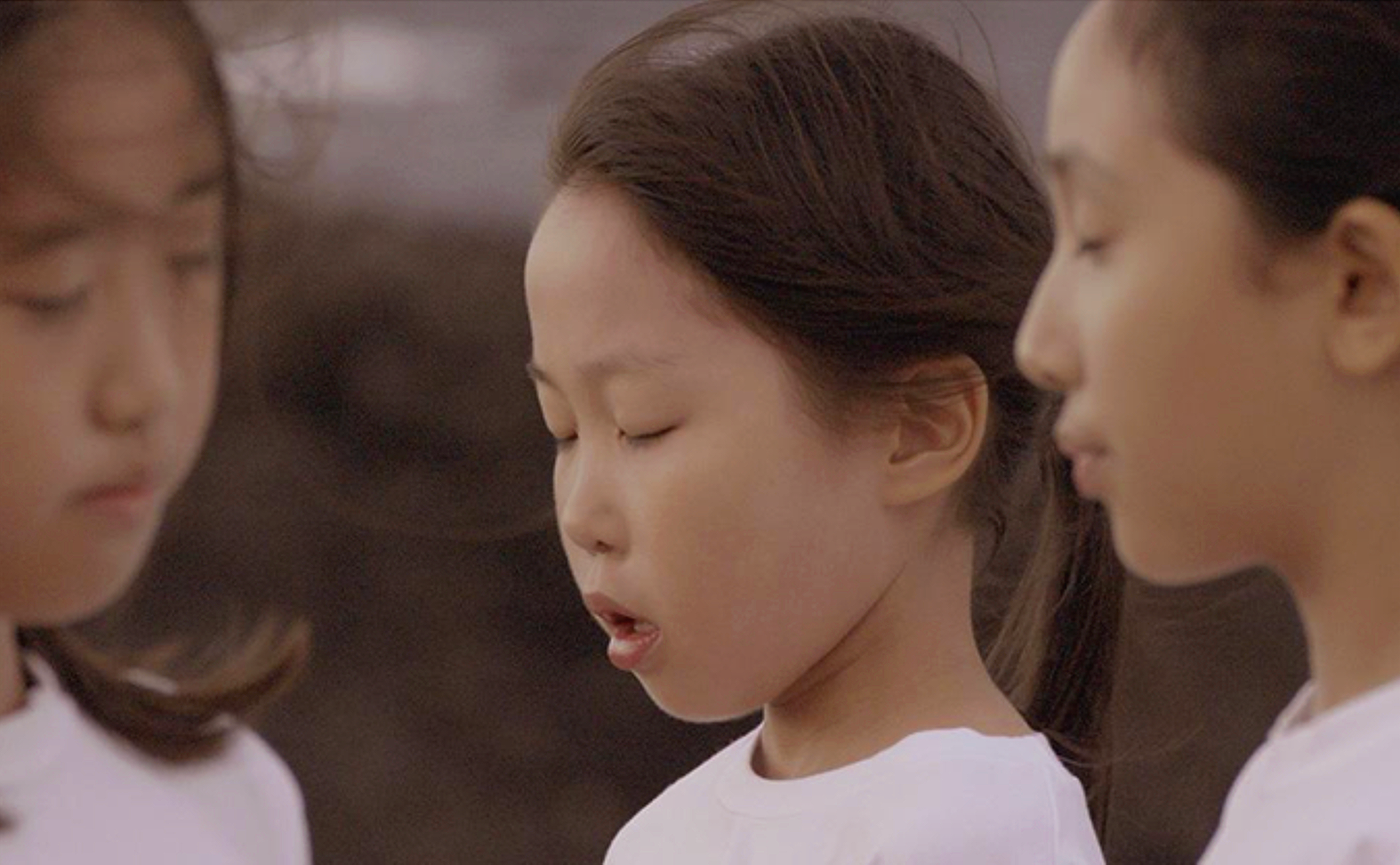
Yo-E Ryou, Breath Orchestra, 2026, still from video, Arsenale, 61st Venice Biennale. Image courtesy the artist.
In the circle, we experience Breath Orchestra’s multichannel audio recording of a composition made from the sounds of the various breaths of the haenyeo women masters. The haenyeo’s breathing cycle alternates between four phases, transforming breath into a disciplined practice of bodily control rooted in attuning oneself to the natural world. Preparation, characterized by slow, measured, regulating breaths that calm the body for the descent are followed by powerful energy producing breath. Once prepared, withholding breath through the dive becomes a conscientious labor of endurance and discipline. In this phase the divers’ experience an almost transcendent state of being at one with the sea. Finally, there is the recovery breath, the sumbisori, when the divers’ surface and transition back to the land.
The longest phase of breath is holding it, and so much of the audio we hear is nearly silent. There are the gentle sounds of the seaside heard in the video of the young women, along with an occasional dramatic sumbisori breath and the gentler breaths of preparation breaking the silence. These moments provide an unpredictable effect, giving an emotional shape to the to the quiet. John Cage and his sense of the powerful presence of silence come to mind, with the breaths that bracket the silence in Yo-E’s work gaining particular impact. Here, the layered sounds of the sea, the wind, and breathing draw us into the bodily experience of the haenyeo, connecting us to them and the natural world with which they are so closely connected.
While Yo-E approaches breath as a means of connecting people to one another and to nature, Gabriel Goliath’s Elegy similarly invokes breath, but not as a means of connecting to nature, rather as mechanism of ritualized mourning and renewal. Like Breath Orchestra, Elegy is deceptively simple. Comprised of three different project suites, each documents a series of performances dedicated to a particular victim of imperial, colonial, or patriarchal violence. Very like each other in format, each of the screens presents a theatrically lit singer, dressed in black, standing on a podium, holding a single note until her voice starts to fail. She then steps down and another singer steps onto the podium, continuing the note. Eight separate videos, each with its own continuous voice, create a soundscape that is a meditative and mournful lamentation, revealing the possibility of infinite resistance through continuity not as individuals, but as a collective community. Addressing layers of injustice and marginalization, each of these projects acknowledges a specific loss; in this installation, South African student Ipeleng Christine Moholane, two Nama women ancestors, and the Palestinian poet Heba Abunada. Goliath has made dozens of such performances since 2015. While the beauty of a seemingly infinite collective voice of resistance inspires, it also gives us the overwhelming realization that there are a seemingly infinite number of victims to mourn.
Although the work was originally intended to be shown in the South African Pavilion, because one of the performances laments a Palestinian poet, the conservative South African government deemed the work too controversial and refused an official national presence for this Biennale. Goliath then found alternate sponsors and relocated her exhibition to the Chiesa di Sant’Antonin, within walking distance of the main grounds of the Giardini. In this space, the voices are beautifully amplified acoustics that evoke centuries of worship and rites of passage. The collective cry is not simply heard; it is absorbed into the body, resonating through time and place as echoes of grief, memory, and resilience. For the run of the Biennale, the South African Pavilion stands empty, its own vacancy a symbol of repression, censorship, and continued efforts of a hierarchical society to silence marginalized voices.
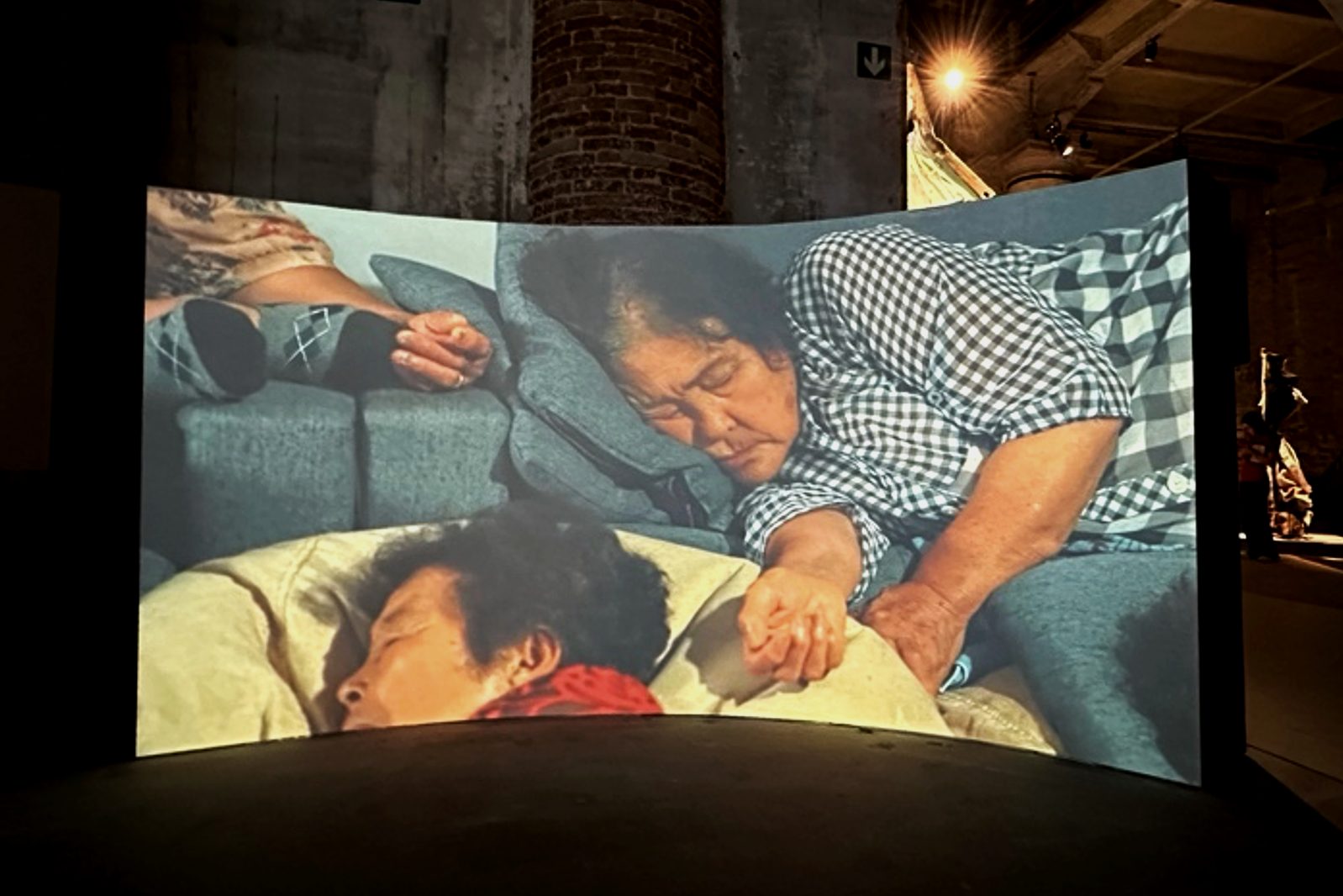
Yo-E Ryou, Breath Orchestra, 2026, installation view, Arsenale, 61st Venice Biennale. Image courtesy the author.
Over ten years ago, Eric Garner died at the hands of police, his final words, “I can’t breathe,” initiating civil rights protests around the United States and the world. In the years since, we’ve experienced a conservative backlash and backslide, rendering even the freest among us inert. In concert with the theme of Kouoh’s In Minor Keys, these works investigate breath as a refuge, a lamentation, a meditation, a connecting medium, and most importantly, a site of personal agency. Despite little evidence to support the harboring of hope, these works allow us to imagine that through collective care and action, renewal and repair are possible.
-
Romy Cohen is an independent curator, writer, and master’s degree candidate in Curatorial Practice at the School of Visual Arts. Her practice explores the intersections of art, architecture, and the body, with a particular interest in materiality, spatial perception, and the ways contemporary art reshapes our understanding of embodied experience. As a docent at the Whitney Museum of American Art, she leads tours that situate works of art within broader social and cultural contexts, encouraging close looking and dialogue. Her curatorial research examines how artists mobilize architecture, landscape, and the built environment as sites of memory, movement, and embodied experience. She is interested in exhibitions that foreground the body as a site of knowledge, perception, and social encounter.
Paradise Must Not Last Forever
The Latvian Pavilion does a far better job of embodying intimate and convivial universes created by artists compared to the Biennale’s overstuffed and incohesive main exhibitions in the Giardini and Arsenale.
By Colleen Dalusong
The Latvian Pavilion does a far better job of embodying intimate and convivial universes created by artists compared to the Biennale’s overstuffed and incohesive main exhibitions in the Giardini and Arsenale.
Colleen Dalusong • 7/20/26
MAREUNROL’S and Bruno Birmanis, Untamed Assembly: Backstage of Utopia, curated by Inga Lāce and Adomas Narkevičius, Pavilion of Latvia, 61st Venice Biennale, May 9—November 22, 2026
-
On Site is The Curatorial's section for curatorial reviews and a venue for MA Curatorial Practice students at the School of Visual Arts to publish as part of their program, though it is open to all writers.
In this review, Colleen Dalusong examines Untamed Assembly: Backstage of Utopia, the Latvian Pavilion at the 2026 Venice Biennale, arguing that its reconstruction of the Untamed Fashion Assembly (UFA)—an experimental fashion festival held in Riga during the 1990s—offers a compelling model for thinking about artistic communities as temporary yet generative utopias. Through an installation that foregrounds backstage labor, archival memory, and material improvisation, MAREUNROL, Bruno Birmanis, and curators Inga Lāce and Adomas Narkevičius shift attention from spectacle to the social infrastructures that make creative experimentation possible. Situating the project against the broader context of the Biennale, the review argues that the pavilion demonstrates how ephemeral artistic spaces can endure as cultural imaginaries, suggesting that the value of utopia lies not in permanence but in its capacity to inspire future forms of collective creativity.
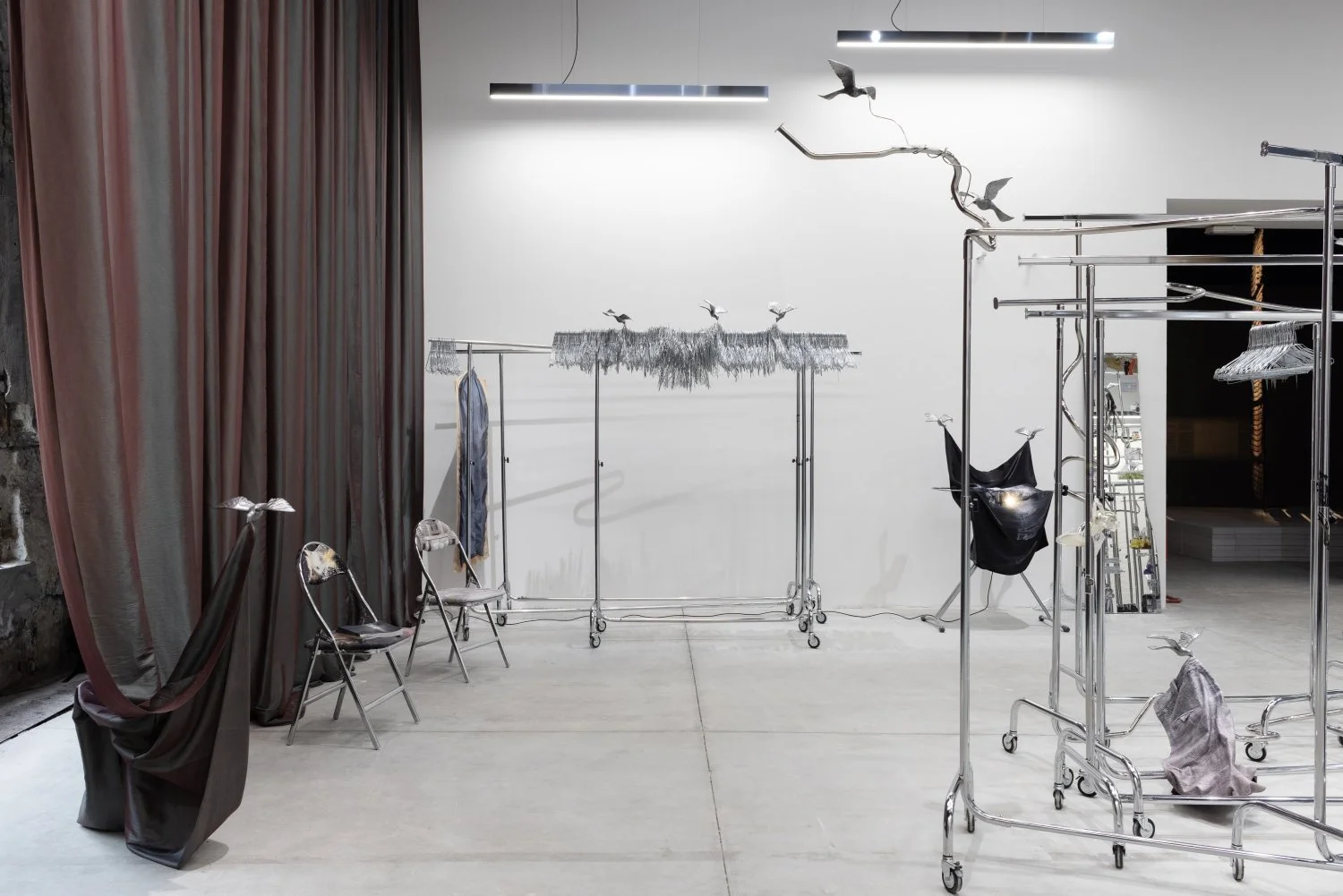
MAREUNROL’S, Untamed Assembly: Backstage Utopia, 2026, installation view, Pavilion of Latvia, 61st Venice Biennale. Photo by Kristine Madjare.
On entering the Latvian pavilion, I had the impression of entering the backstage of a fashion show after everybody has already left. At the center is a towering, almost palatial structure of gleaming chrome clothing racks, its metal rods twisting and bending to intertwine with one another. There are barely any clothes left hanging on the racks (the models must have chosen to wear the designs to the afterparty), a few chairs are scattered haphazardly around the perimeter, a forgotten pair of monstrously tall platform shoes are there, as if just taken off, and a slouching backpack emanates a mysterious golden glow. Along with these lingering traces of backstage frenzy, metal birds scattered around the structure hold aloft panels of fabric printed with scenes from archival footage from the Untamed Fashion Assembly (UFA), an annual fashion festival held in Riga between 1990 and 1999.
For the Latvian pavilion at the 2026 Venice Biennale, curators Inga Lāce and Adomas Narkevičius worked with the artist duo MAREUNROL’S (Mārīte Mastiņa-Pēterkopa and Rolands Pēterkops) and the fashion designer Bruno Birmanis to reimagine a backstage utopia inspired by the UFA. The festival’s carnivalesque and avant-garde shows were a direct antithesis of the mainstream fashion trends at the time, namely the minimalism popularized by designers such as Calvin Klein, Jil Sander, and Helmut Lang. Designers, models, photographers, musicians, and artists from all over the world would descend on Riga to take part in the UFA, which was legendary not only for its non-commercial and DIY spirit but also for the sense of freedom and joy to be found at the festival.
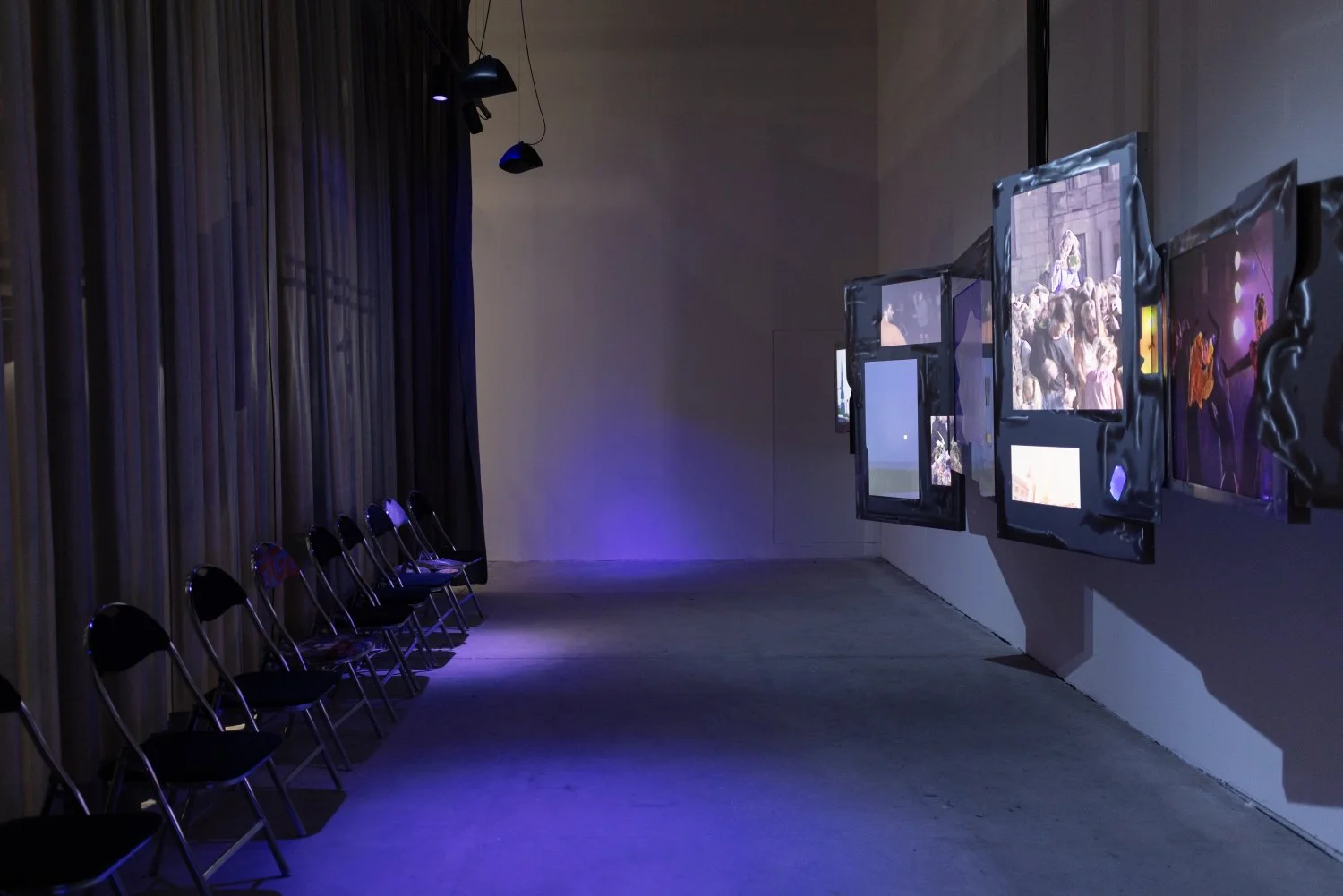
MAREUNROL’S, Untamed Assembly: Backstage Utopia, 2026, installation view, Pavilion of Latvia, 61st Venice Biennale. Photo by Kristine Madjare.
The UFA’s archival footage takes on many forms in the exhibition: in its most straightforward incarnation, the original videos are visible only to those who are curious enough to peek behind the curtain that separates the central sculpture from the makeshift viewing room, essentially flipping the expectations of what takes the centerstage versus the backstage. Here, the catwalk is relegated to the periphery while the invisible labor of those who toiled out of sight becomes the main attraction. The once-forgotten faces and voices of those who made the UFA possible become all the more visible when viewers glance in the mirrors resting against the wall. Each person’s reflection is literally framed by cut-out stickers of models and assistants from archival footage, occasionally punctuated by stickers immortalizing quotes, such as “WHEN YOU HAVE NOTHING, YOU FIND SOMETHING POWERFUL,” or “THE OPENINGS BECAME NIGHTCLUBS BECAME THE BEACH BECAME THE CLUB.”
The juxtaposition of the viewers’ reflections with these stickers is wholly inviting, almost encouraging each visitor to imagine themselves as one of the visionary artists who took part in the UFA’s utopian atmosphere of creative experimentation. This invitation is taken a step further in the incorporation of still images from the archival footage printed onto the clothing and the chairs that populate the almost-empty room. Rather than plain fabric, the folding chairs are upholstered with images taken on bus rides to Riga, hands performing last-minute tailoring, and public plazas repurposed for fashion shows. The fabric panels held aloft by the birds depict similar scenes from the archival footage, suggesting that the history of the UFA is one that we can bring into our own lives—whether it is an idealized reflection to strive toward, a comforting legacy that we can find relief in, or a committed lifestyle choice, such as the clothes we choose to wear on our bodies every day.
The clothing shown at the UFA was outrageous yet inventive. According to Bruno Birmanis, a number of participating designers incorporated furniture fabric into their designs simply because it was cheap and readily available. Models would strut onto the runway, wearing minidresses adorned with bedazzled hammers and sickles, hats resembling traffic cones, or duvets and pillows reimagined as sumptuous ballgowns. As Birmanis fondly recalls, nothing was off limits, and designers were more than happy to search, improvise, and invent new ways to bring their visions to life in the face of shortages and economic collapse.
Although it isn’t part of the Biennale’s main exhibition, the pavilion reminds me of the following passage from the late Koyo Kouoh’s curatorial text: “Minor tones are also minor islands: worlds in the middle of oceans, with distinct and infinitely rich ecosystems, social lives articulated—for better or worse—within much larger political structures, and ecological stakes of great significance. In this context, the evocation of tones and islands extends to an archipelago of oases: gardens, courtyards, residences, lofts, dance floors—the other worlds created by artists, intimate and convivial universes that regenerate and sustain even in the darkest moments; indeed, especially in the darkest moments.”
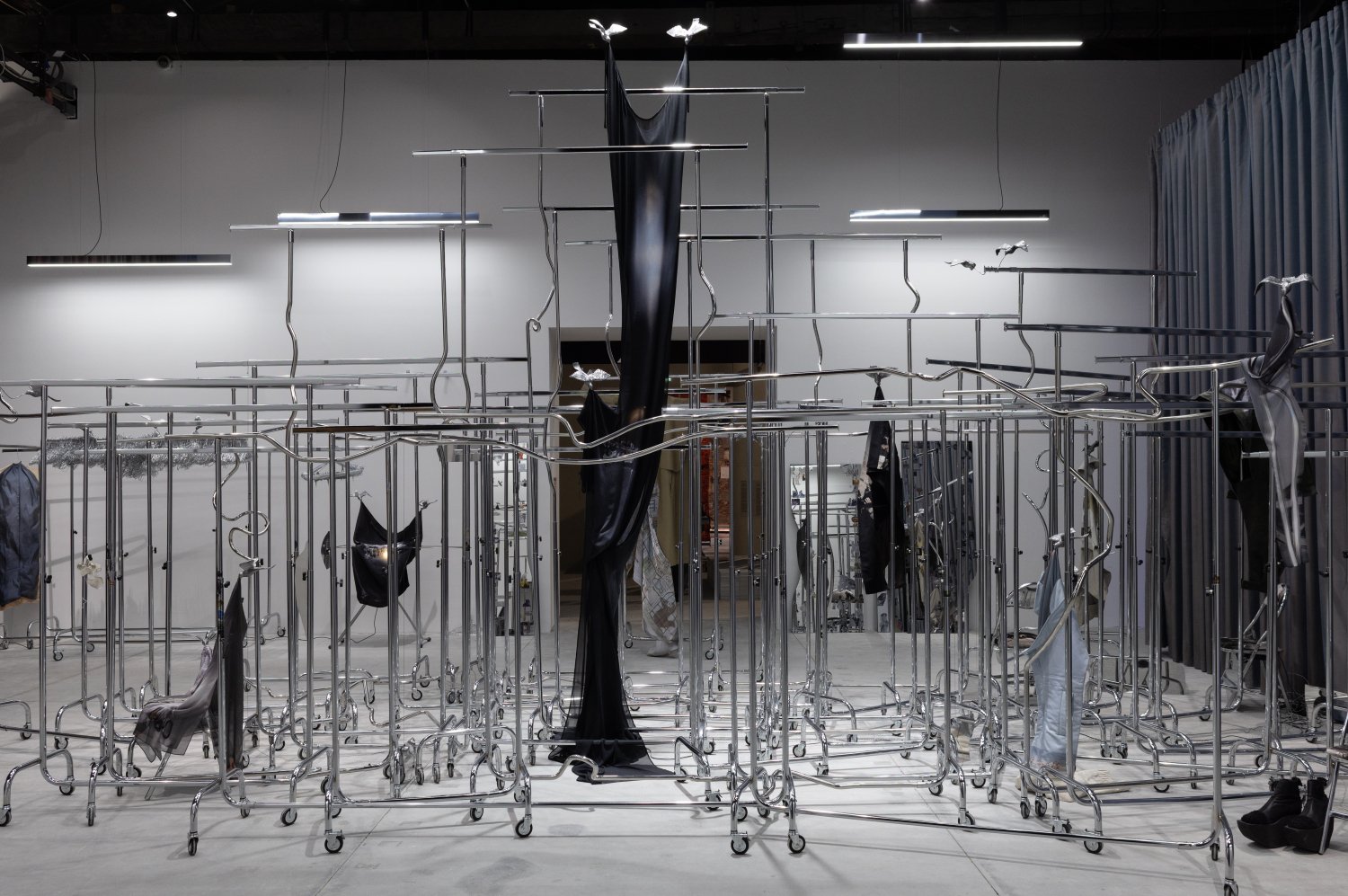
MAREUNROL’S, Untamed Assembly: Backstage Utopia, 2026, installation view, Pavilion of Latvia, 61st Venice Biennale. Photo by Kristine Madjare.
Ironically, the Latvian Pavilion does a far better job of embodying this idea compared to the Biennale’s overstuffed and incohesive main exhibitions in the Giardini and Arsenale. Perhaps this is because Lāce and Narkevičius are at an advantage compared to Kouoh’s curatorial team—it is much easier to make sense of the past than it is to wade through the muddled chaos of the present. For this reason, the Latvian project accomplishes what the vast majority of the Biennale does not: its focus on the UFA, an oasis created by artists during bygone times of darkness, illuminates a possible pathway for those of us in the present moment.
To say that the UFA took place during tumultuous times would be an understatement. It existed in a strange in-between state in the shadow of the collapsed Soviet Union, somewhere between Western and Eastern Europe, no longer communist but not yet fully capitalist either. Nonetheless, it was a utopia precisely because Latvia’s role wasn’t defined yet, so people felt free to experiment. In the same way that childhood is idyllic because it lacks the crushing weight of being defined by a job or a social responsibility, the UFA was able to operate as a short-lived paradise that many people look back on fondly.
Some people would say it’s a shame that the UFA couldn’t last forever, yet there’s really no need for a paradise to do that. If such a thing were possible, then nothing would ever change, and there would be no craving or desire for the experimentation that created paradise in the first place. It’s enough that it existed at one point in time, during the long and endless stretch of human history. The fact that it could ever exist in the first place—however short-lived it may have been—already provides the foundation for future dreamers to build the next utopia.
-
Colleen Dalusong is an independent curator and writer based in New York City and is currently a master’s degree student in Curatorial Practice at the School of Visual Arts. She has previously curated exhibitions at Accent Sisters, CP Projects Space, Uncool Gallery, A Space Gallery, and nuun gallery. Her writing has been featured on Whitehot Magazine, Cultbytes, Impulse Magazine, sabukaru.online, Hot Coffee Conversations, and Mercer Street Reader. She has held positions at Alternative Space LOOP, the International Studio & Curatorial Program, and the Asian American Arts Centre.
Liquid Tongues: Expanding Language, Limiting Experience
There is a difference between making deaf people the topic of an exhibition and actually being inclusive of them in making the exhibition.
By Chaieun Lee
There is a difference between making deaf people the topic of an exhibition and actually being inclusive of them in making the exhibition.
Chaieun Lee • 7/20/26
Liquid Tongues, Bogna Burska and Daniel Kotowski, curated by Ewa Chomicka and Jolanta Woszczenko, Pavilion of Poland, 61st Venice Biennale, May 9–November 22, 2026
-
On Site is The Curatorial's section for curatorial reviews and a venue for MA Curatorial Practice students at the School of Visual Arts to publish as part of their program, though it is open to all writers.
In this review, Chaieun Lee examines Liquid Tongues by Bogna Burska and Daniel Kotowski at the Polish Pavilion, curated by Ewa Chomicka and Jolanta Woszczenko, an audiovisual installation that draws on sign language, whale song, and underwater space to challenge the primacy of spoken language and foreground deaf experience. Lee argues that while the work succeeds in proposing spoken language, sign language, and other communicative forms as parallel rather than hierarchical, its curatorial execution falls short of its own ambitions, guiding hearing visitors through sound while leaving deaf visitors at a momentary disadvantage, and missing opportunities, particularly in the sculptural seating structure, to communicate through vibration and bodily sensation. The review ultimately distinguishes between representing deaf people and designing for them, asking whether the exhibition's inclusivity was fully realized or only partially imagined.
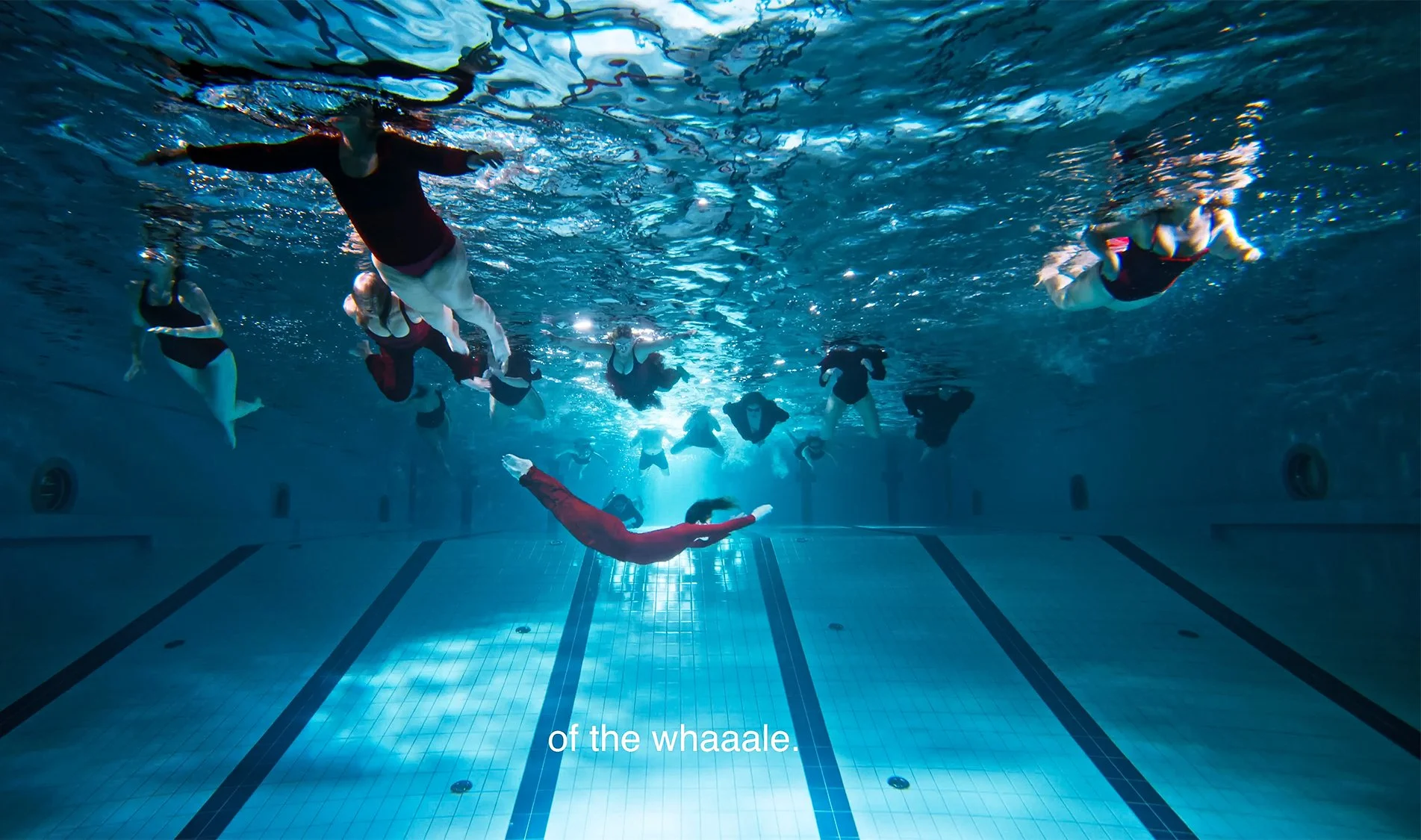
Bologna Burska and Daniel Kotowski, Liquid Tongues, 2026, still from video, Pavilion of Poland, 61st Venice Biennale. Image courtesy Zacheta Archive.
What first overwhelms visitors on entering the Polish Pavilion is the surround-sound chorus. Sequences of spoken letters, harmonies reminiscent of whale song, and fragments of text drift through the space, drawing visitors toward the exhibition’s two large screens, one mounted on the wall and the other suspended overhead. As they watch the performers’ gestures and movements, they soon realize that what they are seeing is a form of sign language and that the exhibition seeks to address, at least in part, the marginalization of the deaf. Yet, a surprising question almost instantly came to mind as I moved through the space and sat there: Who was this exhibition for?
Liquid Tongues, an audiovisual installation by hearing artist Bogna Burska and deaf artist Daniel Kotowski, presents two screens that only come fully into view after entering the space and turning one’s head or body. Hearing visitors are naturally guided toward the screen on the wall to the left by sounds resembling water or whale song. It seems an irony that deaf visitors, not able to share that same auditory invitation into the work, are left at a momentary disadvantage, and the question emerges of how this might have been curatorially resolved.
Still, the images ultimately draw everyone in, and they are striking. In the videos, against cool-toned backgrounds, groups dressed in vivid red move their hands and mouths as they submerge themselves underwater in a swimming pool and stand in a snowy winter landscape, communicating through language and gesture. This visual intensity resembles the way many deaf people navigate the hearing world, where communication often begins with the need to capture another person’s attention. The videos’ stark contrasts seem to reflect that condition, where visibility becomes a prerequisite for language itself.
The address of Liquid Tongues to auditory otherness also resonates with “minor keys,” the late Koyo Kouoh’s theme for the Biennale’s central exhibition. Kouoh described “minor keys” as an invitation to revisit, listen to, and sense the margins of society and daily experience. Yet the notion of hearing and listening carries its own implicit limitations and risks of marginalization. For all the good intentions carried in the musical allusion of Kouoh’s title, the auditory remains exclusionary for some. And so, for the Polish Pavilion, curators Ewa Chomicka and Jolanta Woszczenko, who seek with the artists to highlight the agency of deaf people living within a hearing world, it might be said that they signal the “minor” to redress exclusion and celebrate difference without calling aloud for its keys. Kotowski spoke in a recent interview about this as “Deaf Gain,” saying that “hearing people usually perceive deaf people through a strongly medicalized perspective and notice only the deficits that deaf people may have. But Deaf Gain completely reverses this and shows how much deaf people are capable of and how much they can offer the world.”1

Bologna Burska and Daniel Kotowski, Liquid Tongues, 2026, installation view, Pavilion of Poland, 61st Venice Biennale. Image courtesy Jacopo Salvi (altomare)/Zachęta Archive.
Liquid Tongues explores this condition most strikingly through underwater space. The performers who appear throughout the videos, Chór w Ruchu (Choir in Motion), are composed of both deaf and hearing members. They sing in spoken and sign languages, attempting communication through their bodies as much as through their words. In the videos, water, which covers most of the planet yet remains outside the principal living and communication space for humans, becomes a primary space for the way meaning is signaled. In this submerged environment, spoken language becomes distorted and difficult to understand, while sign language takes on authority and centrality, and the evocation of whale song offers another instance of alternative communicative authority, identity, and sovereign wholeness. As Burska said about the work, “I had this idea that together we could create a kind of super-language, expressed through sound, the way hearing people speak, and through image and space, the way deaf people communicate, so that together they could create this super-language. Maybe we could try to imagine how whales communicate and interpret the world, or to put it more accurately, in whale language.”2
Here, a reversal of this hierarchy is powerfully presented. The assumption that spoken language holds primacy originates in the history of the word “language” itself. The English word derives from the Latin lingua, meaning “tongue.” If language itself is etymologically tied to the tongue, it is easy to understand why speech and the ability to hear it are intrinsic to the way language is valorized in its auditory form. Liquid Tongues proposes a profound reconsideration, in which spoken language, sign language, whale song, and written language in the form of the videos’ subtitles are presented not as hierarchical forms of communication, but as parallel ones.
Significantly, the curators chose the plural form, tongues—languages—rather than the singular. And we can see this attentiveness in the work’s soundscape itself. Certain words, phrases, and refrains drawn from distinct sources and contexts recur throughout the work, from the repeated “whup whup,” an interpretation of humpback whale calls disrupted by human-generated ocean noise, to “hand talk,” recalling Indigenous sign languages displaced by spoken-language systems. While they spark curiosity, their meaning isn’t always immediately clear.
The zine distributed in the pavilion provides crucial context, including explanations of specific phrases, their sources, and information about Kotowski’s collaboration with a hearing interpreter in translating whale communication into spoken and sign languages. It also clarifies why whale communication occupies such a significant place in the project. Reading these explanations, visitors gradually begin to trace connections between the historical marginalization of sign language and the difficulties whales face communicating in increasingly noisy oceans. Still, much of this important information is difficult to find in the project’s materials online. Of course, providing additional context on-site is an important curatorial practice. Yet the reliance on a single physical format still feels at odds with the exhibition’s broader concern for accessibility.
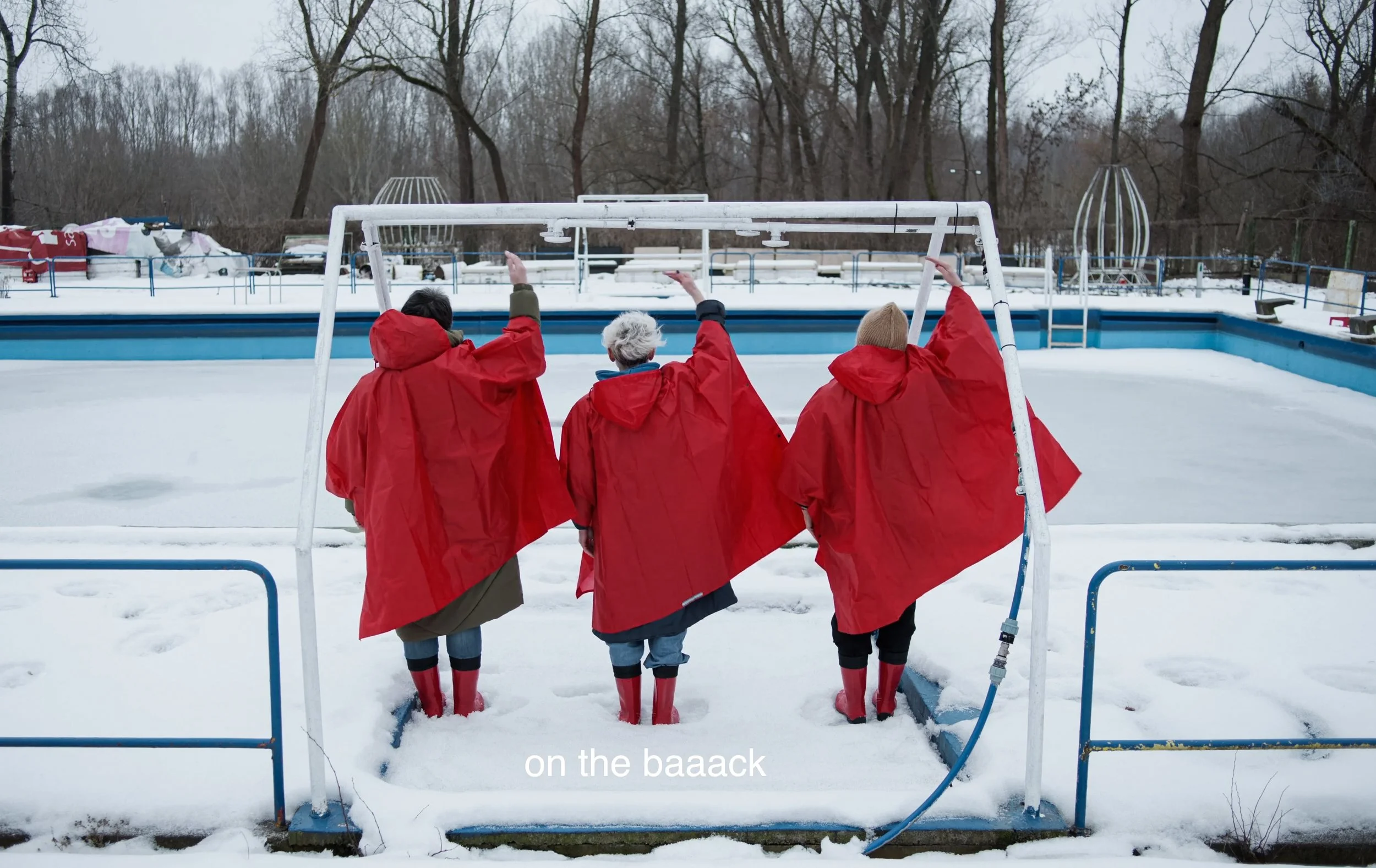
Bologna Burska and Daniel Kotowski, Liquid Tongues, 2026, still from video, Pavilion of Poland, 61st Venice Biennale. Image courtesy Zacheta Archive.
There is another aspect of communication that seems not fully aligned with the exhibition’s ambitions. At the center of the pavilion, a sculptural seating structure by Marcin Kwietowicz is installed, positioned like an island between the wall and ceiling screens. Visitors can recline against its streamlined form, reminiscent of a whale's spine, while watching the videos. Because of its primary position within the installation, and because it invites direct physical contact, I expected the structure to function as an organ of resonance, that is to say, as another channel of communication, connecting the audience to the work through the body as well as through sight and sound. Yet the structure remains primarily a seat, and the exhibition remains more conventional than it could have been as an audio-visual installation—a missed opportunity. Even more so because vibration, lip movement, and bodily movement all play a role in the communicative practices of the deaf. Had vibration traveled through Kwietowicz’s work, it would have brought this communicatory form to life for visitors as a way to more fully apprehend deaf experience in its breadth.
And so, let me return to my initial question: Would a deaf visitor encounter this exhibition in the same way as a hearing audience?
Liquid Tongues succeeds in challenging the hierarchy that has long privileged spoken language over other forms of communication. Yet it has to be asked if deaf people in this exhibition were imagined solely as a subject of representation or as members of its audience and, by extension, more fully understood members of society. There is a difference between making deaf people the topic of an exhibition and making them the point of reference through which the exhibition is designed to create that greater inclusivity. It would be unfair to do anything less than praise the exhibition’s significant engagement with deaf experience and the compelling artistic work it has produced. Still, if spoken and sign languages were more fully embodied in the presentation of Liquid Tongues,the ambitions of the artists and curators would have been truly met.
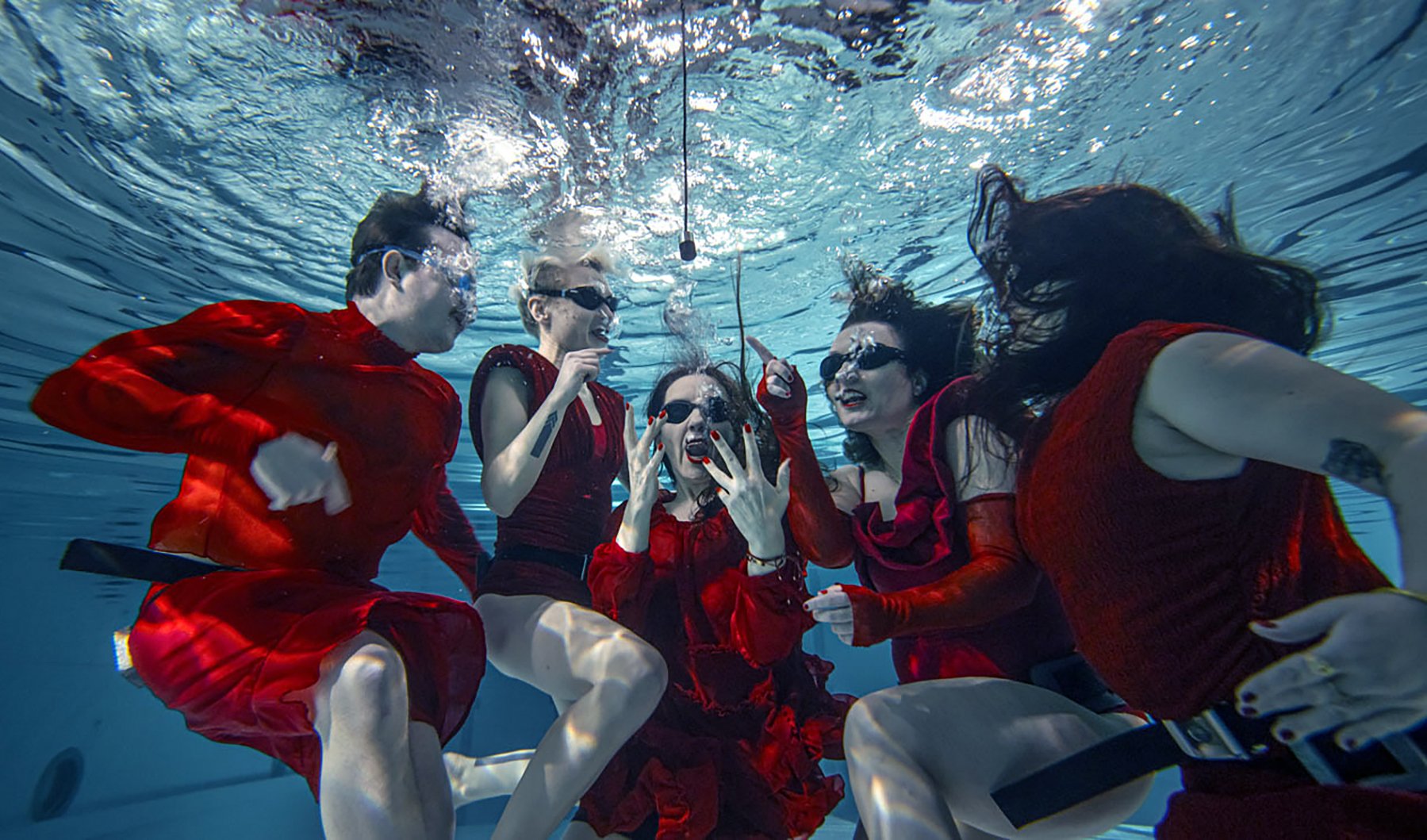
Bologna Burska and Daniel Kotowski, Liquid Tongues, 2026, still from video, Pavilion of Poland, 61st Venice Bienale. Image courtesy Zacheta Archive.
NOTES
1. Artim, “Polish Pavilion at the Venice Biennale 2026,” YouTube, https://www.youtube.com/watch?v=TsDCyVc8EqU.
2. Artim, “Polish Pavilion,” https://www.youtube.com/watch?v=TsDCyVc8EqU.
-
Chaieun Lee is an independent curator and artist from Seoul, South Korea. Drawing on her background as an artist, she approaches each exhibition as a work in its own right. Her practice focuses on accessibility and marginalized voices, exploring how exhibitions can create spaces for empathy and dialogue. She is currently a student in the MA Curatorial Practice program at the School of Visual Arts in New York. Alongside her independent curatorial practice, she has curated exhibitions in Seoul and New York and worked at DIA Contemporary, New York, and Casco Art Institute: Working for the Commons, Utrecht, the Netherlands.
Our New Teacher
Our agency is parodied and mourned by this chattering, oneiric devil as we cruise at ballistic speed not only toward the conjugation of democracy's collapse but toward the collapse, too, of the division between human and machine.
By Steven Henry Madoff
Our agency is parodied and mourned by the artist’s chattering, oneiric devil as the division between human and machine continues to collapse.
Steven Henry Madoff • 7/20/26
Li Yi-Fan, Screen Melanchol, curated by Raphael Fonseca, Taiwan Collateral Event, Palazzo delle Prigione, 61st Venice Biennale, May 9—November 22, 2026
-
On Site is The Curatorial's section for curatorial reviews and a venue for MA Curatorial Practice students at the School of Visual Arts to publish as part of their program, though it is open to all writers.
In this text, Steven Henry Madoff reviews Screen Melancholy by Li Yi-Fan, curated by Raphael Fonseca as Taiwan's collateral event at the Palazzo delle Prigioni. The presentation is a sixty-minute AI-generated video installation in which a cheerful golem delivers an endless, dissociated monologue spanning self-help, tech instruction, and existential dread. Madoff argues that Li deploys AI as both medium and subject, using machinic intelligence tools to lampoon and mourn the very agency it displaces. The work's surreal humor, he contends, is not relief from its darkness but its vehicle, a hyperactive voice that, through ironic juxtaposition, teaches us what it means to be human.
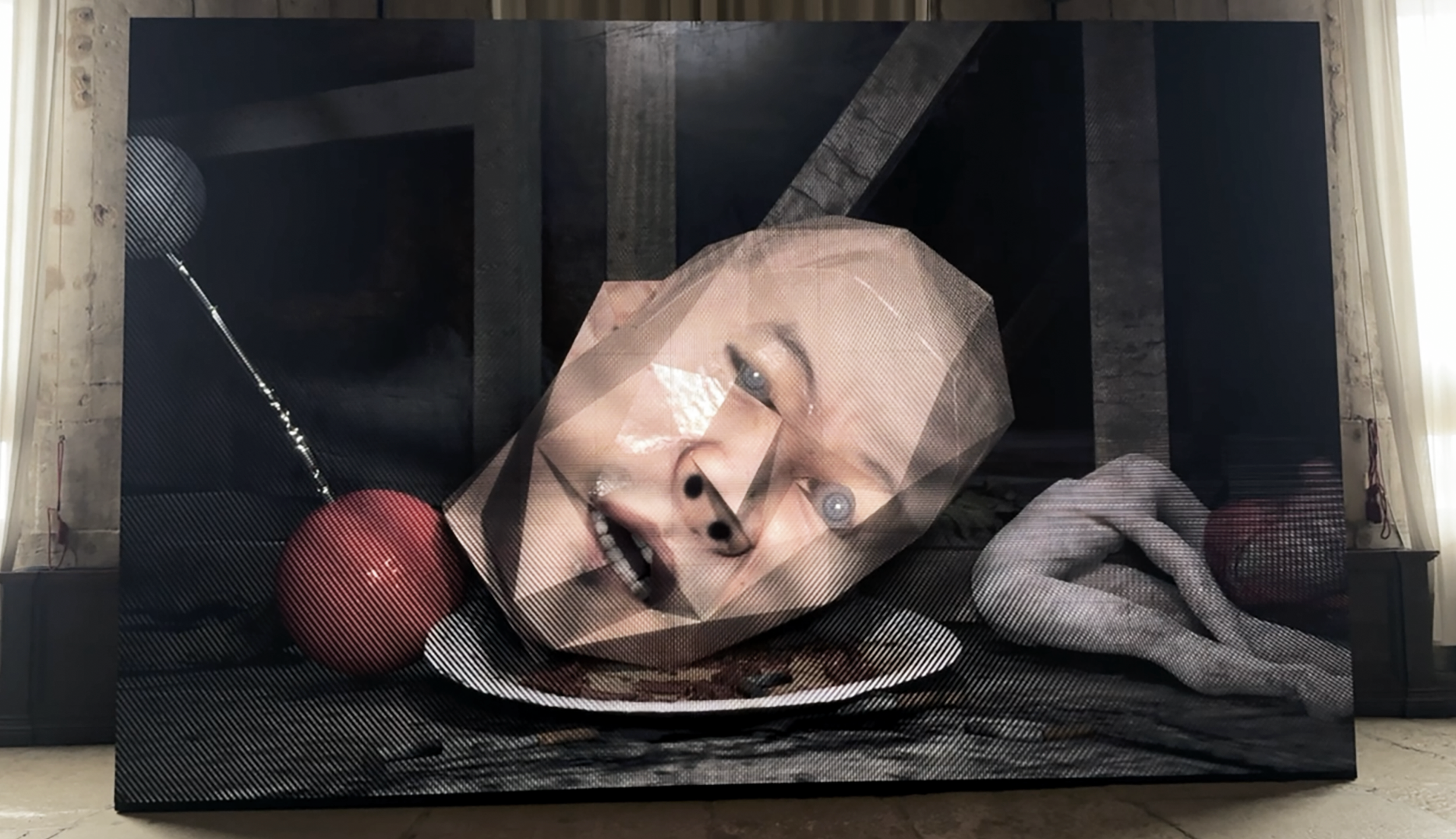
Li Yi-Fan, Screen Melancholy, 2026, installation view, Taiwan Collateral Event, 61st Venice Biennale. Image courtesy MACP.
I remember coming down the stairs in my parents’ house, I was 13, and I had a book in my hand. My mother had just come in from the garden, so it must have been a late spring weekend or early summer. I said something to the effect that I’d found a poetry anthology upstairs and a particular poem was amazing, and I read it aloud to her. I didn’t know it then, that it would change the whole direction of my life. You likely know the beginning of the poem well: “Let us go then, you and I,/When the evening is spread out against the sky/Like a patient etherized upon a table.” Time as a cloud of administered sleep, like a body infused with chemicals, morbid and remarkable. The insertion of the technological word “etherized” is a sudden shift in the poem’s tone, a little leap of ideational contrast into a pleasure I hadn’t known, dipping me down into the under-ness of understanding, the suddenness of it erupting.
I think of this now, back from Venice, where there was a work like that. Well, not so strangely elevated as T. S. Eliot’s “The Love Song of J. Alfred Prufrock,” but still revelatory in our age of rapidly unsettling intelligent machines: something immersed in the fluidity of life transmogrified through the sleight-of-hand of a technological unveiling. In Eliot, we may find the rediscovery of the sensations of life, but in this new work, those sensations are replaced by an artificiality zoomed in on from the horizon of what’s to come.
The work is Li Yi-Fan’s sixty-minute software-generated video installation, Screen Melancholy (2026), featured as Taiwan’s collateral event and organized by the dexterously talented curator Raphael Fonseca, in which the lubricity of AI-generated speech is given the chameleon logic of dreams—a language that already awaits us in the virtual passageways of customer support, of bureaucracy sped up, alien, and inescapable. I came once to see Li’s video, then after seeing everything else there was time for in the Biennale, I came back to see it again. What is it about Screen Melancholy that’s so haunting and macabre, and won’t leave my mind?
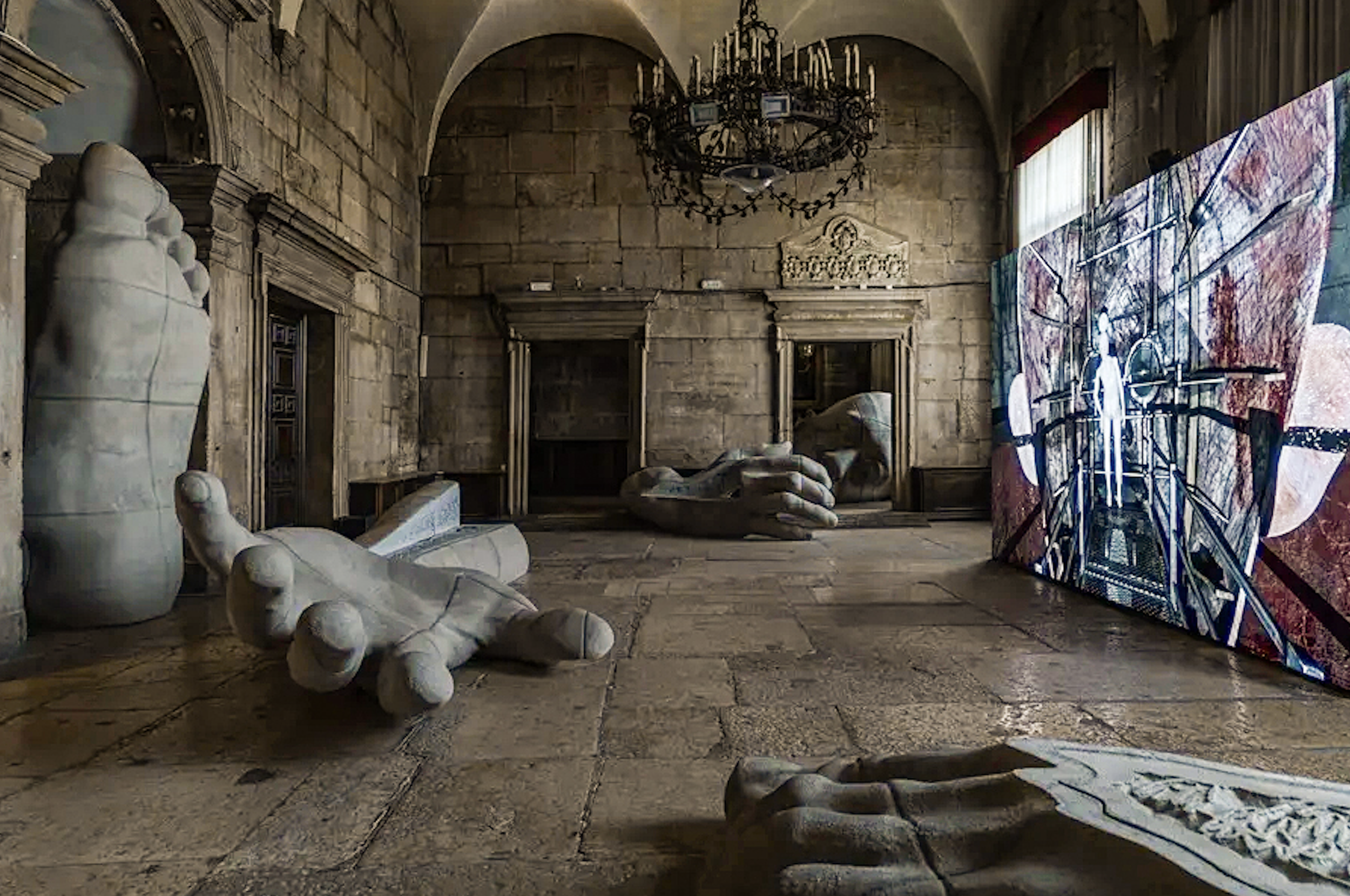
Li Yi-Fan, Screen Melancholy, 2026, installation in Palazzo delle Prigione, Taiwan Collateral Event, 61st Venice Biennale. Image courtesy the artist and TFAM.
The first thing that struck me wasn’t the content of this remarkable work, but the look of it. Li’s palette ranges over a continuum of sepulchral grays. Scenes have objects done in acid reds, blues, and greens, but his world-building largely conjures the dimly lit half-life of the undead. The heavy atmosphere is set askew still more by the jarring, almost avuncular, cheeriness of its protagonist, who has the comic gait of Charlie Chaplin, though more robotic, and is wrapped in the sallow skin of Gollum from Lord of the Rings, with whom he has a passing resemblance. Amid these tints and shadows, his manic talk rushes toward us in an endless, AI-fueled monologue of self-help, tech instructions, and hyperventilated storytelling about his own organs—heart, lungs, intestines, prostate, eyes—which are presented as mini-me puppets he manipulates, and keeps repeating, “I don’t want your gift. I don’t want your gift. I don’t want your gift.” Is that gift human sentience and subjectivity, or just meat instead of electrons, with the expiration date of organic life?
He talks about how to make the video he’s in, about AI and frame generation, jump-cutting from oracular commentary to the technological and an approximation of emotion: “One day you will also become a low-poly model. […] What is your relationship to all the images you’ve seen? […] How do you project a 2D plane onto a spherical geometry? […] Are you lost? Are you lost?” And, with an artificially sweetened dose of sentimentality, “You must follow the heart.” A golem is an anthropomorphic figure created from inanimate matter—mud or clay—and here, Li has created his golem from the inanimate material of code, seeming to stand in as an exculpatory being who somehow absolves us of the guilt implicit in the very creation of beings who are altering our lives. In this way, the giddy weirdness of his talk and bendy movements offer a kind of ventilating humor, relieving us of the claustrophobia of the space and the estranging aura of AI that he personifies, as he slips between English and Mandarin and pierces himself with arrows. That suffering unto the lord of digital advancement, which undergirds Screen Melancholy’s surreal narrative and scenes, is as ecstatic and fearsome as St. Sebastian while it floats in the hollowed-out feeling of the totally prefab, all synth and hall of mirrors.
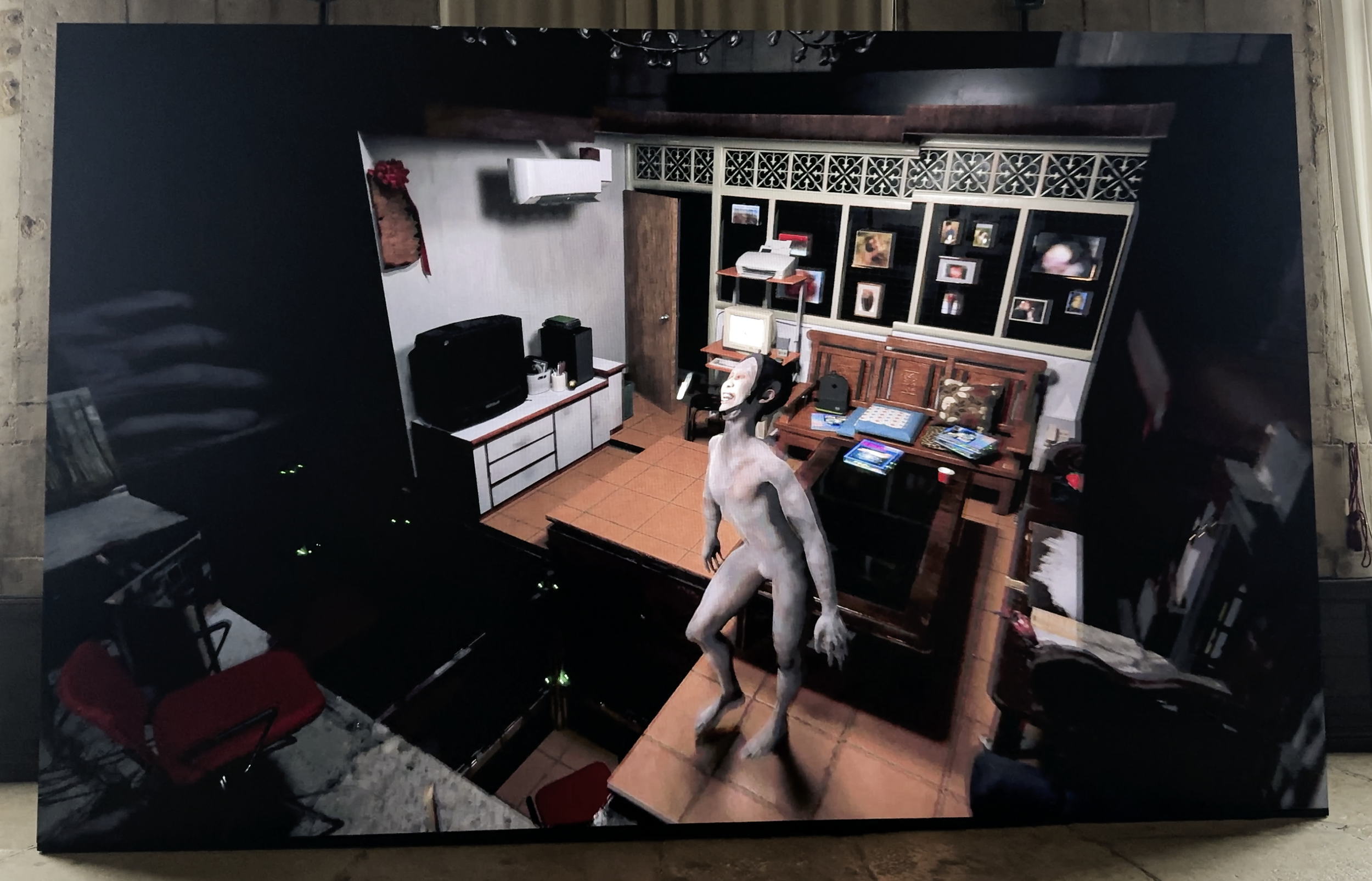
Li Yi-Fan, Screen Melancholy, 2026, installation view, Taiwan Collateral Event, 61st Venice Biennale. Image courtesy MACP.
In the video, our mongrel narrator crisscrosses a room that reflects the one we’re sitting in (a seventeenth-century palazzo interior of gray Istrian stone, once part of a prison, fitted out with monolithically scaled sculptures of body parts, some of which we sit on as benches) and a hallucinatory warren of rooms on two floors that magically rise and fall like stage sets, the spaces cluttered with technical equipment, military equipment, cooking gear, and junk. Sitting in that room simultaneously simulated on the screen somehow twists our physical presence, doubling and cleaving our sense of here-ness, dipping us in disorientation—a sort of quantum spookiness we inhabit on the other side of the work’s “melancholy screen,” which evokes all the screens through which we experience so much of contemporary life, at once endlessly deep and flattened.
To use the tools of AI to critique and lampoon its fleet-footedness as well as its potentially devastating weight is, of course, the point of Li’s off-kilter tension, to which we’re all captive now. The paradox of machinic life haunting—or is it taunting—the human in its own dissociated voice is vivid as a bruise. In Critique of Pure Reason, Kant wrote, “What can I know? What should I do? What can I hope for?” Here, the artist seems to be saying, with soul-searching melancholy pulsing under his humor, that the darker realities of AI plumb the first two of these questions for itself, while immiserating the last for humankind.
So it was that I stepped from the brilliant morning light of the Piazza San Marco, with its clouds of pigeons and the scintillations of the Grand Canal, into a technological den of humanly made inhuman artifice, whose ultimate message, I think, is about being human and our particular trait of tool-making, taught back to us here by our own ironic creation. Tool-making has always been an act of invention on whatever scale with the goal of improvement or, most basically, of survival. Now, as Li’s golem shows and tells us, it’s an apparatus of onanism whose prospect exists within a bubble of artificial self-determination; an echo chamber in which the call for improvement is replaced by the algorithmic desire to only reproduce its own environment and its own organs in a technological hothouse. At one point, he remarks, “Are you scared? Don’t be scared. It’s just a computer graphic.” His reassurance is hardly reassuring. It feels as if our own agency is parodied and mourned by this chattering, oneiric devil as we cruise at ballistic speed not only toward the conjugation of democracy’s collapse but toward the collapse, too, of the division between human and machine, as abstract and visceral as Eliot’s etherized evening, enveloping us as we watch.
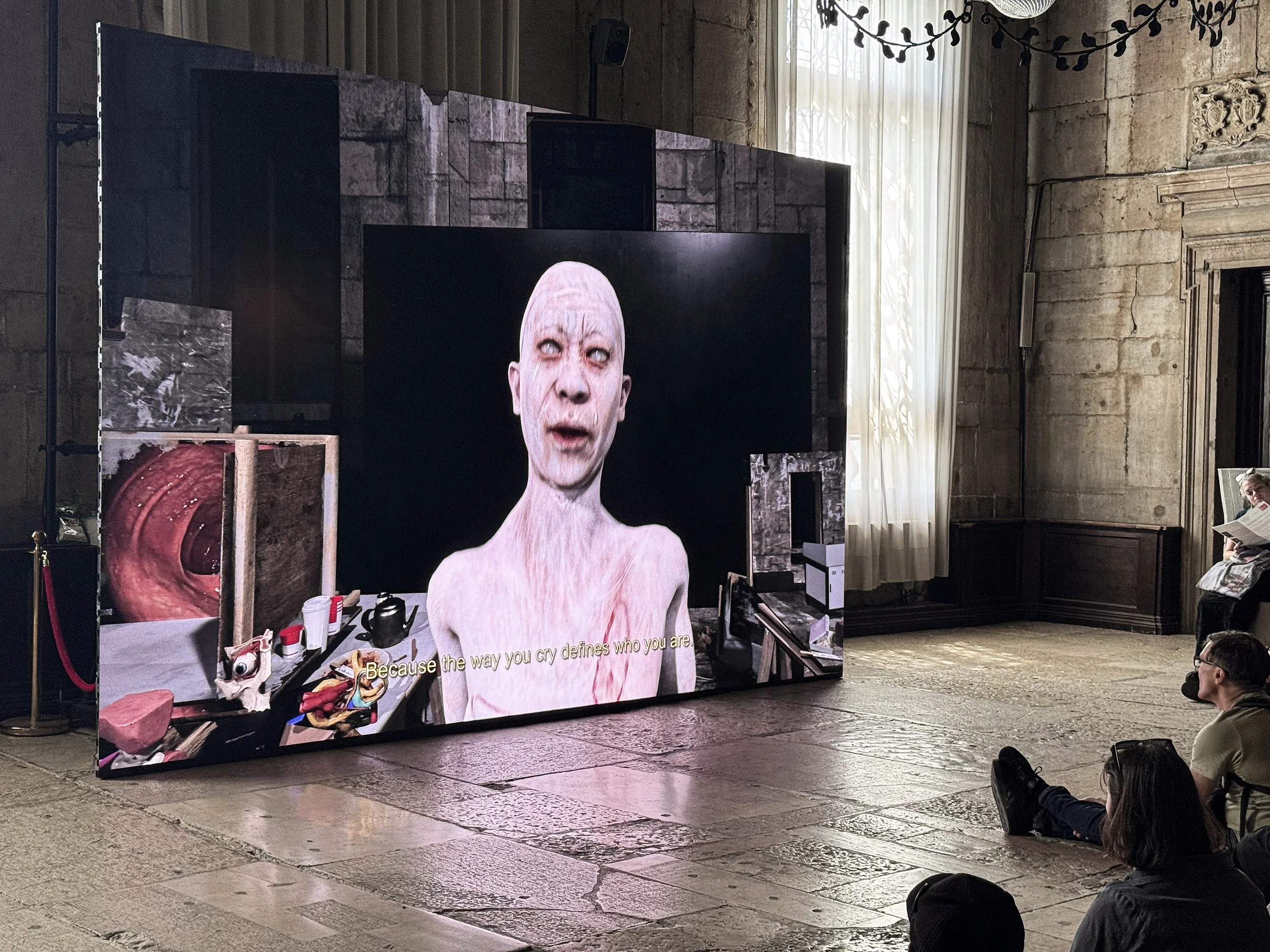
Li Yi-Fan, Screen Melancholy, 2026, installation view, Taiwan Collateral Event, 61st Venice Biennale. Image courtesy MACP.
-
Steven Henry Madoff is the founding chair of the MA Curatorial Practice program at the School of Visual Arts in New York and editor in chief of The Curatorial. Previously, he served as senior critic at Yale University’s School of Art. He lectures internationally on such subjects as the history of interdisciplinary art, contemporary art, curatorial practice, and art pedagogy. He has served as executive editor of ARTnews magazine and as president and editorial director of AltaCultura, a project of the Museum of Modern Art in New York. His books include Unseparate: Modernism, Interdisciplinary Art, and Network Aesthetics from Stanford University Press; Thoughts on Curating from Sternberg Press (series editor); Turning Points: Responsive Pedagogies in Studio Art Education (contributor) from Teachers College Press; Learning by Curating: Current Trajectories in Critical Curatorial Education (contributor) from Vector; Fabricating Publics (contributor) from Open Humanities Press; What about Activism? (editor) from Sternberg Press; Handbook for Artistic Research Education (contributor) from SHARE; Art School (Propositions for the 21st Century) (editor) from MIT Press; Pop Art: A Critical History (editor) from University of California Press; Christopher Wilmarth: Light and Gravity from Princeton University; To Seminar (contributor) from Metropolis M Books; and After the Educational Turn: Critical Art Pedagogies and Decolonialism (contributor) from Black Dog Press. Essays concerning pedagogy and philosophy have appeared in volumes associated with conferences at art academies in Beijing, Paris, Utrecht, and Gothenburg. He has written monographic essays on various artists, such as Marina Abramović, Georg Baselitz, Ann Hamilton, Rebecca Horn, Y. Z. Kami, Shirin Neshat, and Kimsooja, for museums and art institutions around the world. His criticism and journalism have been translated into many languages and appeared regularly in such publications as the New York Times, Time magazine, Artforum, Art in America, Tate Etc., as well as in ARTnews and Modern Painters, where he has also served as a contributing editor. He has curated exhibitions internationally over the last 35 years in the United States, Europe, and the Middle East. Most recently, Y.Z. Kami: In a Silent Way at MUSAC, León, Spain, June 2022-January 2023. Madoff is the recipient of numerous awards, including from the National Endowment for the Arts and the Academy of American Poets. He is a member of the Curatorial Studies Workshop, part of the Expanded Artistic Research Network (EARN).
Whose Wet Dream Is This?
The body becomes its own archive of the exhibition’s demands in the Austrian Pavilion, and this visibility raises the very question it might intend to foreground: Who is this visibility for?
By Kiera McIntosh
The body becomes its own archive of the exhibition’s demands, and this visibility raises the very question it might intend to foreground: Who is this visibility for?
Kiera McIntosh • 7/20/26
Florentina Holzinger, Seaworld Venice, curated by Nora-Swantje Almes, Pavilion of Austria, 61st Venice Biennale, May 9—November 22, 2026
-
On Site is The Curatorial's section for curatorial reviews and a venue for MA Curatorial Practice students at the School of Visual Arts to publish as part of their program, though it is open to all writers.
In this review, Kiera McIntosh examines Seaworld Venice by Florentina Holzinger at the Austrian Pavilion, curated by Nora-Swantje Almes, in which a rotating cast of female performers spend extended periods submerged, spinning, and suspended across a series of aquatic stations for the full seven-month run of the Biennale. McIntosh argues that while Holzinger achieves something genuinely radical, making the labor of performance legible on the surface of the body itself, the work cannot fully resolve the tension between feminist critique and the spectacle it stages. Naming the gaze, she contends, does not disrupt it; and asking female bodies to absorb, endure, and display the marks of that endurance for an audience risks restaging the very extraction the ecological frame sets out to critique.

Florentina Holzinger, Seaworld Venice, 2026, performance view, Pavilion of Austria, 61st Venice Biennale. Image courtesy Nicole Marianna Wutyczak.
Walking through Florentina Holzinger’s Seaworld Venice at the Austrian Pavilion, past the well-calculated aesthetics, the audiences openly filming despite signage demanding otherwise, and the portable toilets on either side of the central tank whose contents, provided by the public, quite literally fed the exhibition (the body’s waste becoming the water, the water becoming the work, rising levels of human excess made literal), I couldn’t help but stop and notice the bruises.
Before entering the pavilion, just outside every hour on the hour, a naked woman in a harness climbs a rope up to a large brass bell suspended from a blue crane, and rings it by hanging upside down from inside, her body becoming the bell’s clapper as she swings side-to-side with slow, rhythmic momentum. Inside, the pavilion unfolds as a hallway leading to a single open atrium: to the left, a large open tank in which a naked woman on a jet ski circles with building force; to the right, a towering spinning ladder on which golden sculptures of women frozen at various stages of ascent share the structure with real, naked women moving slowly among them, mirroring the cast figures’ poses. At the end, anchoring the center atrium, a large viewing tank in which a naked woman stood immersed, scuba mask on, staring back through the glass, the two portable toilets connected on either side. Pale blue-yellow blooms spreading across a thigh, a forearm, and a shoulder blade; skin that has puckered and whitened from three hours in the water, and fingertips wrinkling into soft, collapsed ridges. The women in the tank, climbing the spinning ladder, operating a jet ski, or hanging upside down in a brass bell, are not enacting exhaustion; they are actually very much exhausted, while the audience, dry and clothed and temporally passing through, looks on.

Florentina Holzinger, Seaworld Venice, 2026, peformance view, Pavilion of Austria, 61st Venice Biennale. Image courtesy Nicole Marianna Wutyczak.
This is the central friction of Seaworld Venice, and it is one that the work's ambitious conceptual scaffolding (water as ecological crisis, the body as machinic organism, purity and pollution as co-constitutive) does not fully resolve. Holzinger, an Austrian choreographer and director who has built her practice around the radical possibilities of the female body, staging works in which nudity, danger, and physical extremity are not provocations for their own sake but the very grammar of the work, has long been drawn to extreme durational embodiment, to bodies pushed past the decorative and into the frankly material: bleeding, straining, and enduring. Here, the aquatic installation demands that a rotating cast of female performers spend extended periods submerged in tanks that double as both amusement park spectacle and sewage treatment. The press release tells us the performers inhabit an ecosystem out of control. What it does not quite tell us is what that inhabitation costs the body over not an afternoon, but seven months of a Biennale run.
The bruises and the waterlogged skin are not prosthetics or theatrical effects, but the legible record of what sustained immersion and immense physical labor do to human tissue. In this sense, Holzinger achieves something genuinely radical: she makes the labor of performance visible on the surface of the body itself. The body becomes its own archive of the show’s demands, and this visibility raises the very question it might intend to foreground: Who is this visibility for?
The gaze is not a neutral instrument here either. When we look at women’s bodies in states of physical duress, whether it's bruised, bloated with water, or stripped of the armor of composed presentation, we are operating within a long history of looking that has rarely been to women's benefit. Holzinger is clearly aware of this as she directly engages the mechanics of spectacle, refusing to let the audience sit comfortably in voyeurism by implicating them in what they consume. The press release’s closing provocation—“whose wet dream is this?”—names it directly. But naming the gaze does not automatically disrupt it. An audience can hold both the critique and the pleasure simultaneously, and often does. I mean, I literally saw an older man take out his DSLR camera, walk right up to the tank, and take a close-up shot of his “wet dreams.” Apart from that, the bruises become aestheticized, whether or not that is the intention, and the exhausted face becomes a kind of sublime. This is not a failure unique to Holzinger; it haunts durational work involving female bodies almost constitutively, but it is a tension the work does not resolve so much as stage.
What is also being staged, whether consciously or not, is the transformation of emotional labor into physical labor. The history of demanding that women perform endurance for an audience, like sustaining discomfort, remaining present, and continuing despite the cost, is not separate from the history of domestic and affective service. The female body in the tank is also, in some register, the female body doing what female bodies have always been asked to do: maintain composure while placed under uncomfortable situations. This is not a new artistic gesture when thinking about artists such as Marina Abramović, who built an entire practice on the proposition that the body under duress becomes a site of meaning, and Valie Export, whose early actions made the female body’s suffering and endurance specifically political, refusing to let that labor remain invisible. Holzinger’s work within this lineage and the feminist force of making physical labor legible is real and significant. The argument here is not that this work is spectacle rather than art, or that endurance is exploitation rather than expression. It is rather that the performance of endurance by women, for an audience, carries a weight that no amount of feminist framing entirely neutralizes, and the work is most honest when it holds that tension rather than resolving it. When we ask whose endurance is being consumed and toward what end, it is not to undermine the work but to hold it to a high enough regard to ask.
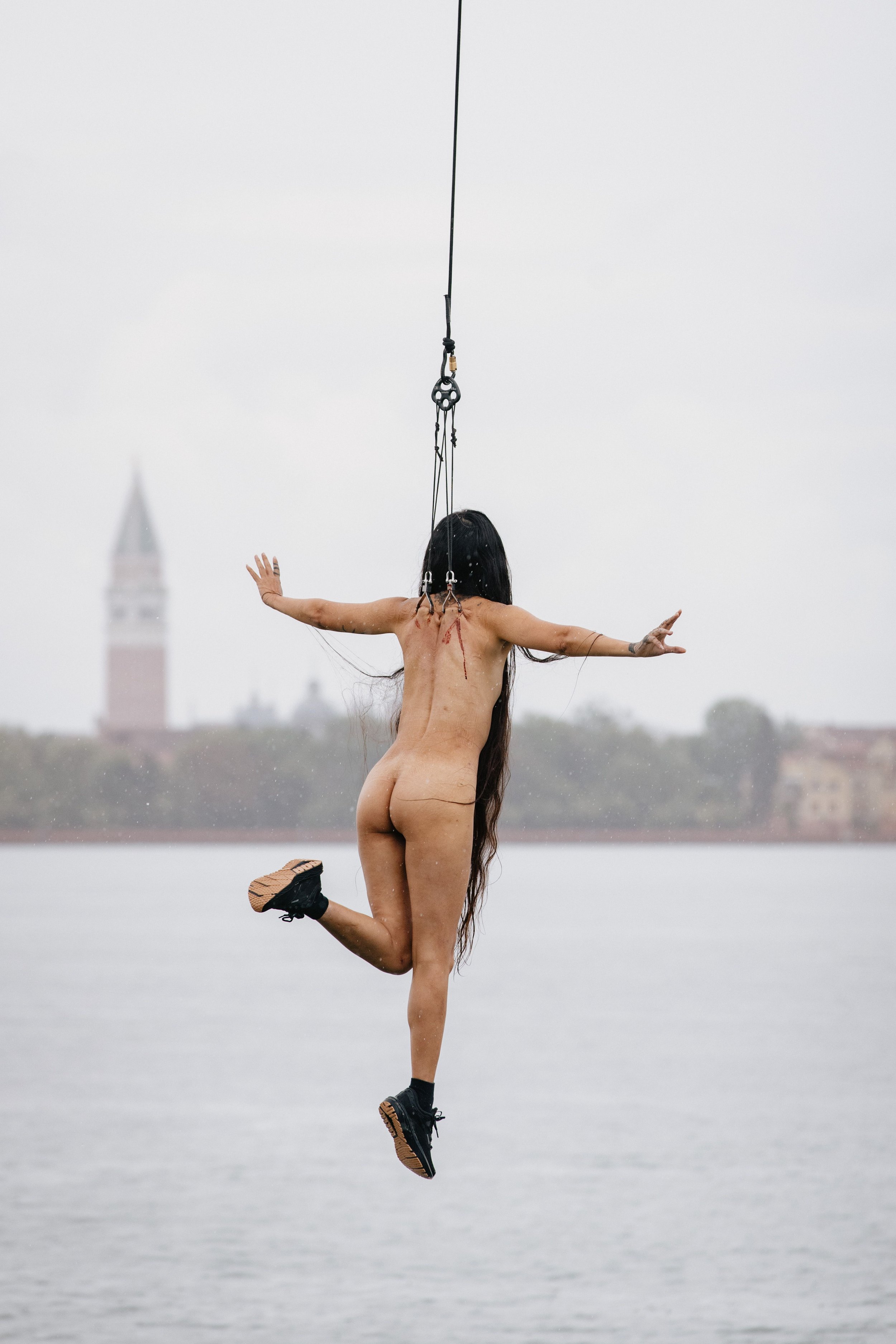
Florentina Holzinger, Seaworld Venice, 2026, performance view, Pavilion of Austria, 61st Venice Biennale. Image courtesy Nicole Marianna Wutyczak.
Then there is the durational question that the institution of the Biennale itself poses. Seven months is not a performance but seems more like a condition. The body can sustain extraordinary things for a single afternoon, a single week, but the cumulative effect of repeated immersion over a Biennale season, the repeated bruising, and the skin that never quite recovers is a different ethical proposition. What does it mean to ask this of bodies? What does it mean for the performers who say yes? There is, presumably, genuine consent and a genuine desire to participate, and yet consent is not the end of the ethical inquiry. The question of what we are willing to let art do to human bodies, and which bodies, and over what duration, is not answered by pointing to contracts or voluntary participation. There is no simple answer to these questions, but it’s important to raise them.
This is especially pointed given Seaworld Venice’s ecological ambitions. Holzinger connects the body’s fluids (urine, sweat, etc.) to water as a planetary resource and crisis. Rising sea levels are not an abstract backdrop but the conceptual ground of the work. The body submerged in water is the body living inside the consequence of human excess, as the earth is submerged in the waste of its own civilization. There is something genuinely moving in this alignment: the individual body as a microcosm of planetary crisis, the female body as a figure for a nature that is exploited, overworked, and required to absorb damage it did not produce. Mother Earth (the cliché goes) and Holzinger are asking what it actually looks like to live in that saturated, waterlogged condition, and to have the consequences of others’ waste written on your skin. The bell will always take its toll and time will always be up. Ding, ding!
But here, the ecological frame and the endurance frame collapse into each other in ways that are worth pressing. If the female body is made to stand in for an exhausted, over-extracted earth, then the performance of that exhaustion risks becoming not a critique of extraction but a restaging of it. The work makes the women’s bodies do what industrial capitalism makes the planet do: absorb, endure, and display the marks of that absorption for an audience that leaves intact.
Can it last seven months? Probably, with rotation and care. Should it? That is a question the work itself seems to be asking, even if it cannot answer—and perhaps that is precisely the point. It must install an unanswerable question in the body of the show, to make the audience sit with the discomfort of what they are watching and what they are complicit in, long after they have stepped back into the opulence of Venice.

Florentina Holzinger, Seaworld Venice, 2026, performance view, Pavilion of Austria, 61st Venice Biennale. Image courtesy Nicole Marianna Wutyczak.
-
Kiera McIntosh is an independent curator from Denver, Colorado, whose practice explores the intersection of desire and storytelling through poetics, feminist theory, and communicative practice. Her exhibitions investigate intimacy, embodiment, and voice, pairing exhibition-making with live public programming that positions desire not simply as a subject, but as a curatorial methodology. Her practice is informed by sustained experience across artist-led, commercial, and institutional contexts. She has supported exhibitions and public programming at Camden Arts Centre in London, managed large-scale public events as Program Manager for The Dinner Party in Denver, and held curatorial and gallery roles at Pardon Arts and Dateline Gallery, where she contributed to artist selection, exhibition development, installation, and interpretive texts. Across these positions, she has developed a practice grounded equally in conceptual research and the practical realities of producing exhibitions. McIntosh is currently an MA candidate in Curatorial Practice at the School of Visual Arts in New York, where she continues to develop a feminist approach to exhibition-making rooted in poetic inquiry, critical research, and collaborative forms of knowledge production.
Rehearsals for Possible Futures
Through smirks, dry delivery, and the revelation of constructed stagecraft, the Danish Pavilion places small cracks in the fantasies and realities of performance and desire.
By Naomi Moser
Through smirks, dry delivery, and the revelation of constructed stagecraft, the Danish Pavilion places small cracks in the fantasies and realities of performance and desire.
Naomi Moser • 7/20/26
Maja Malou Lyse, Things to Come, curated by Chus Martinez, Pavilion of Denmark, 61st Venice Biennale, May 9–November 22, 2026
-
On Site is The Curatorial's section for curatorial reviews and a venue for MA Curatorial Practice students at the School of Visual Arts to publish as part of their program, though it is open to all writers.
In this review, Naomi Moser takes a closer look at Things to Come by Maja Malou Lyse at the Danish Pavilion of the 2026 Venice Biennale, curated by Chus Martinez, focusing on its use of immersive spectacle to interrogate gender performance and affective labor. Taking as its premise a fertility study finding that VR porn dramatically improves sperm motility, the exhibition deploys campy, self-reflexive vignettes in which the mechanics of fantasy are exposed mid-performance. Moser critically evaluates how this approach engages theories of performativity from Goffman, Tolentino, and Legacy Russell, asking whether revealing the artifice underlying femininity and desire might ease the social burden of sustaining them, and arguing that Lyse's work places productive cracks in the structures of gender performance without fully dismantling them.
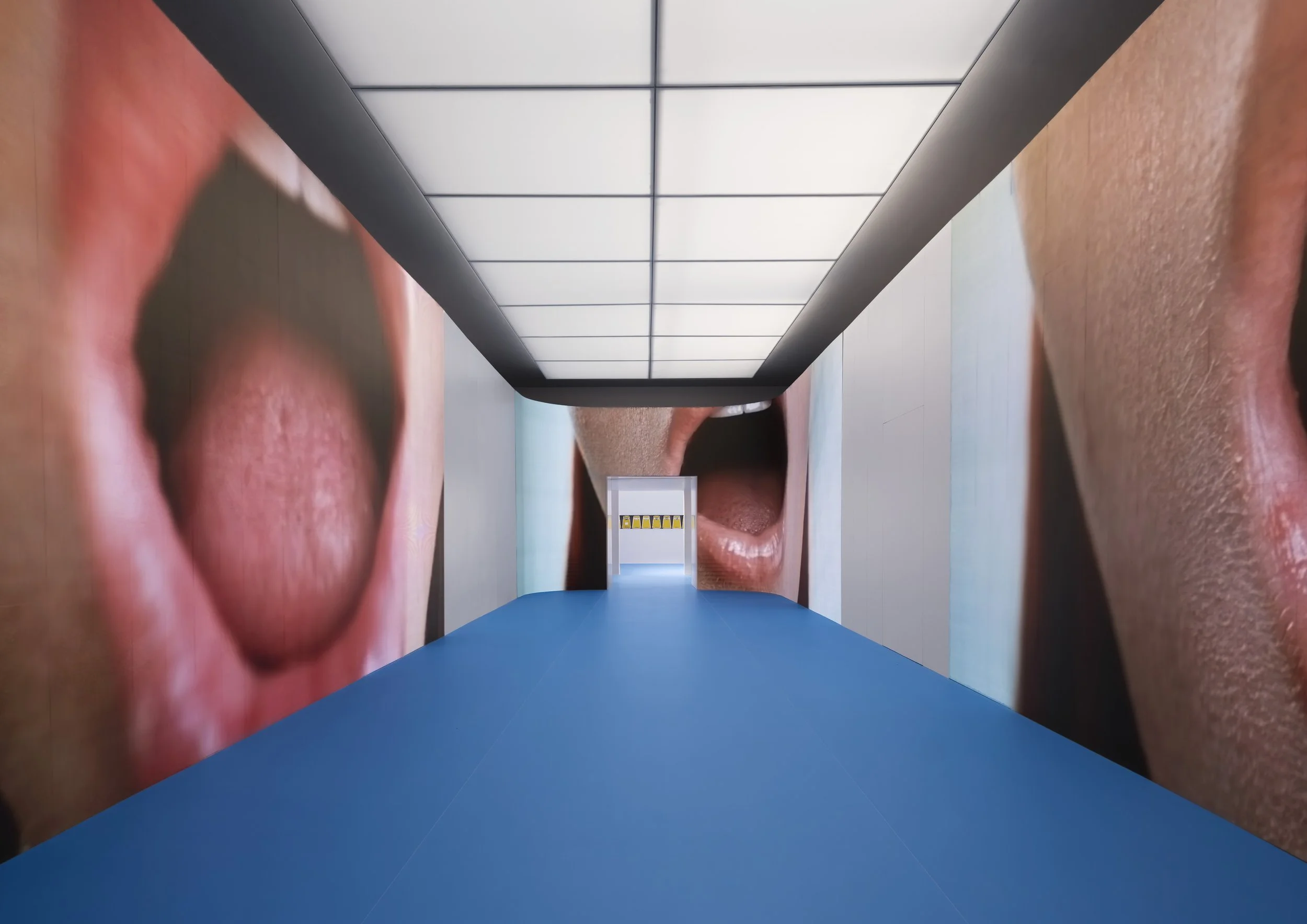
Maja Malou Lyse, DIS, Things to Come, 2026, installation view, Pavilion of Denmark, 61st Venice Biennale. Photo by Ugo Carmeni.
On entering the Danish Pavilion, viewers are confronted with an intriguing solution to the contemporary fertility crisis: VR porn. Maja Malou Lyse’s sculptural video installations that fill the pavilion, curated by Chus Martinez, are inspired by a Cryos International study that found sperm motility (i.e., speed and aliveness), which has declined dramatically in the last decade, went up by fifty percent for those watching porn on VR devices vs. other screens. Even with the POV (point of view) perspective in VR porn, the viewer knows that the performance isn’t personalized for them, and yet, these findings indicate that this disconnect, or artificiality, is not a barrier to dramatically improved corporeal results. Just the opposite. As I watched Lyse’s work, which Martinez has referred to as “rehearsals for possible futures,” I wondered whether these outcomes might be meaningful, not only for fertility but also for the study of performance.1 If audiences respond physically, despite recognizing a performance’s artificial nature, then how does Lyse’s work address the role of sincerity and artificiality in performance art, gender performance, and porn acting? Can exposing artifice in these performances lessen the affective labor required to sustain genuine-seeming presentations of femininity, desire, and care?
The first of the two installations, Stars in My Pocket, is a series of yellow cryogenic sperm bank tanks with embedded palm-sized screens that play “sperm races,” a recent internet phenomenon. Fears of declining fertility have been transformed into entertaining online sporting events, where men have their sperm race along microscopic tracks. Sperm races, like the study that inspired the work, connect staged performance and physiological output.
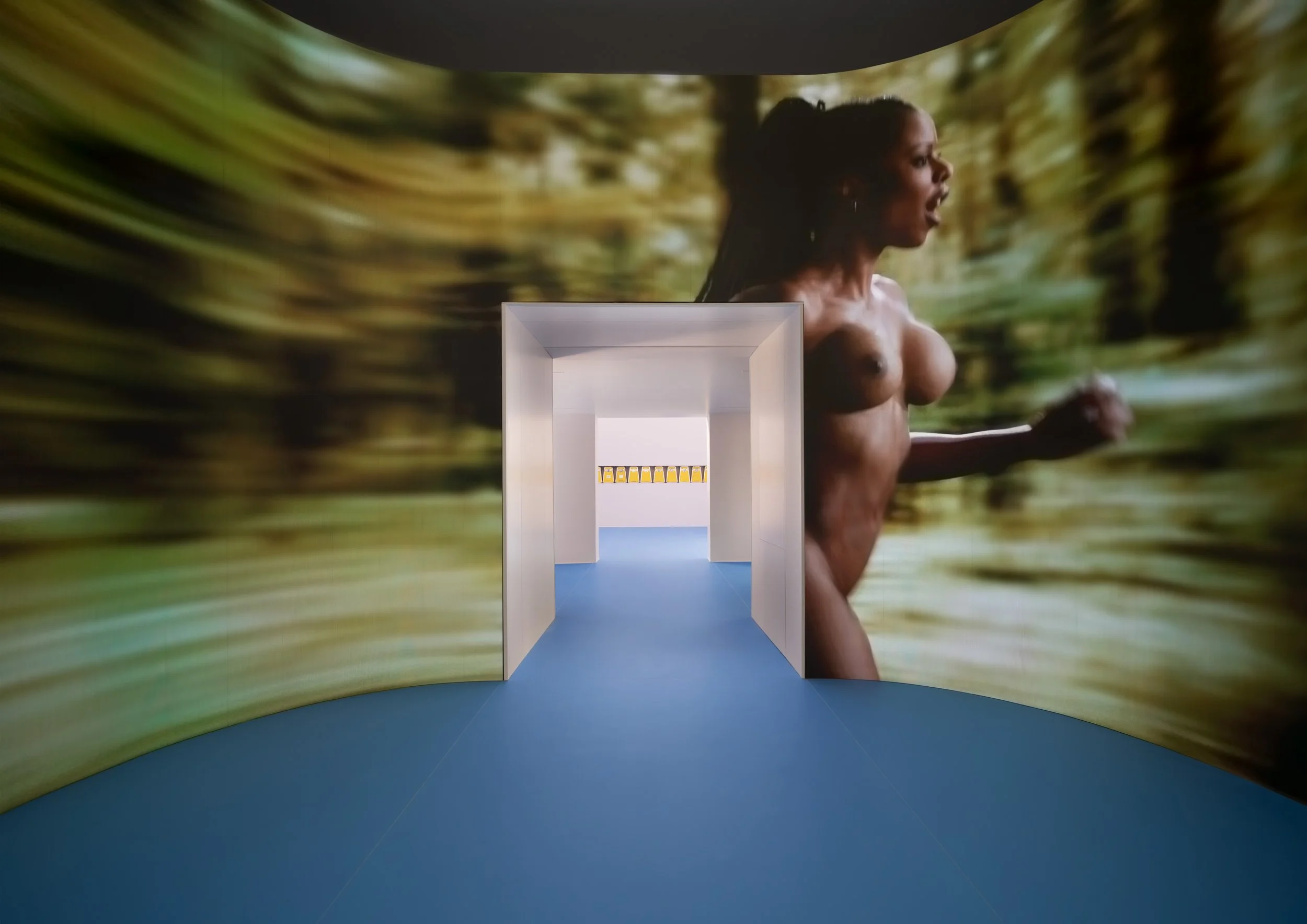
Maja Malou Lyse, DIS, Things to Come, 2026, installation view, Pavilion of Denmark, 61st Venice Biennale. Photo by Ugo Carmeni.
If Stars in My Pocket is the raw data, then the second installation, Things to Come, is the scientific method. Created by Lyse and art collective DIS, the piece is comprised of a series of amusing vignettes set at a fertility clinic in a not-so-distant future. Here, campy, godly porn stars run the sperm bank that’s facilitating the fate of humanity through fertility optimization. Lyse, DIS, design studio Common Accounts, and Martinez successfully took VR—a single-person activity viewed through an individual headset—and adapted it into an immersive, communal POV experience. The porn stars’ exaggerated, meme-able scenes surround the audience on huge, curved LED walls. And, as with VR, the screen-walled room engulfed every corner of my eyes as lip-filler-filled lips parted and a cast member took the audience’s POV down her throat into darkness.
In another scene, a series of (what I interpret to be) future Eves with huge, augmented breasts run Baywatch-style through a forest. Legendary porn actress Nicolette Shea, with platinum blonde hair and a little goatee to match, catwalks the halls of the fertility center. Her lab coat trails behind her, revealing a bikini so scant that one of the sperm she later observes through a microscope could wear it on its race to optimization.
Next, a performer, in a sultry, automated-like voice, says, “Hey, I have something really important to say, so I’m going to take my clothes off while I say it, okay?” She then recites frightening side effects as she strips naked, both instructing the viewer on the risks of an unspecified procedure and providing them with inspiration for their sample. Her performance makes explicit the notion that the most effective way to hold the viewer’s attention is to arouse them. Instead of performing “sexy” from a place of genuine lust, her performance can be read as self-reflexive burlesque, calling attention to the tease and its problematic implications while still titillating the audience. However, I also recognized resignation and emptiness in her delivery. Is it the weight of knowing she's only worth listening to if she’s turning someone on? And even then, is anyone actually listening? I don’t remember the side effects.
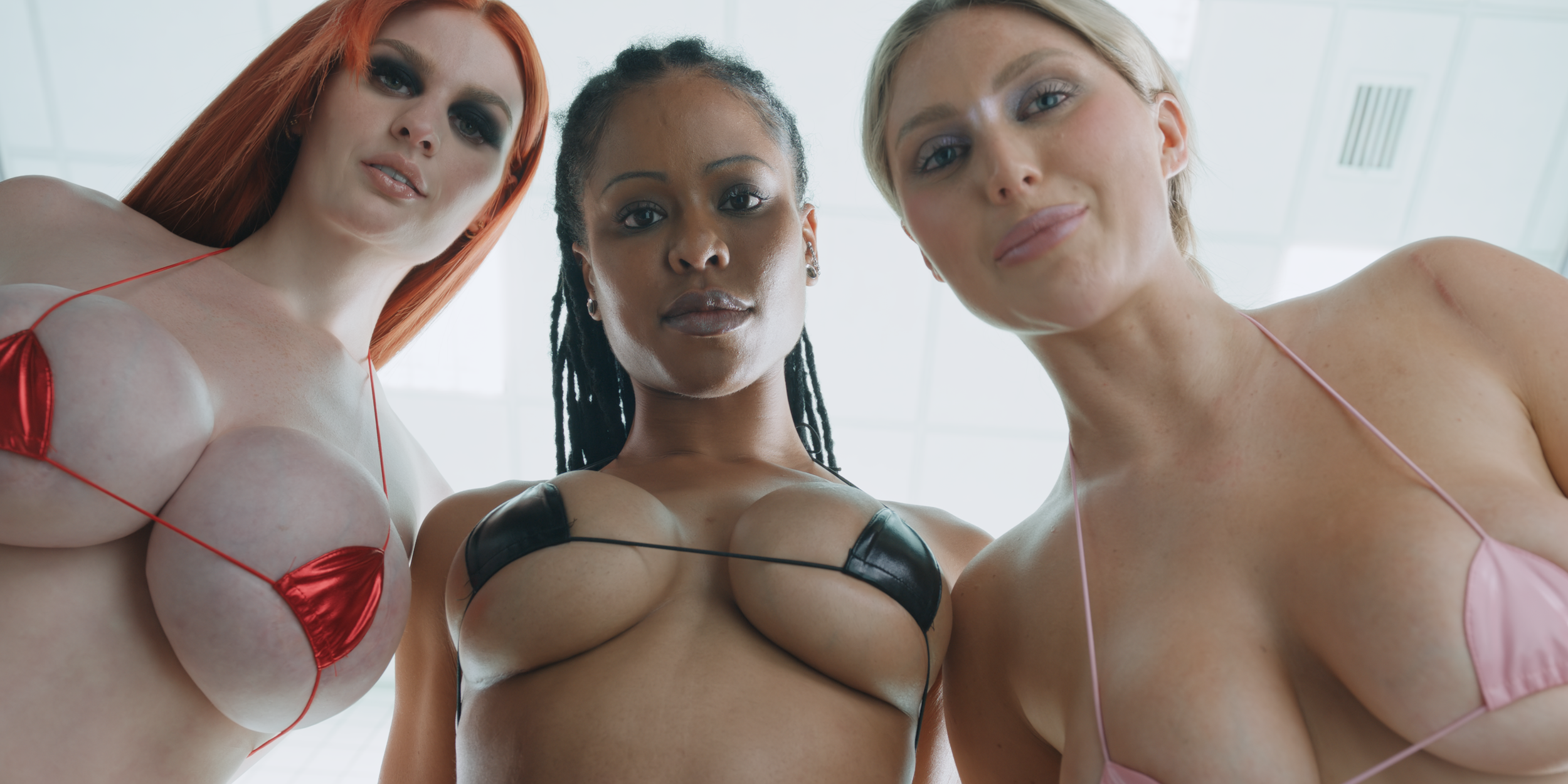
Maja Malou Lyse, DIS, Things to Come, 2026, still from video, Pavilion of Denmark, 61st Venice Biennale. Image courtesy DIS.
In a standout vignette, a performer’s breasts miraculously bounce independently from the rest of her body. She smirks at the audience as the camera pans up a ladder behind her. Fishing wires are revealed, and Lyse herself is shown pulling the set of strings that bounce the performer's breasts. The audience is invited to enjoy a fantasy while seeing how it’s made. Perhaps the 360-degree POV makes the act feel more urgent, as if Things to Come is pleading with its viewers to see the constructed, artificial aspects of the fantasy it is creating. Could unveiling the mechanics of this illusion lessen the burden of maintaining it?
Society continues to expect that women be nurturing, highly considerate, sexy, and enthusiastic (among a billion other things)—and, importantly, that they be one-hundred-percent genuine. In The Presentation of Self in Everyday Life, performance theorist Erving Goffman writes that the backstage is where “the performer can relax; he can drop his front, forgo speaking his lines, and step out of character.”2 And, like in Lyse’s work, “it is here that illusions and impressions are openly constructed.”3 Gia Tollentino brings Goffman’s theory to the present in her book Trick Mirror, observing that with digital identity performance, “the backstage” no longer exists. She writes that “where the offline audience necessarily empties out and changes over, the online audience never has to leave.”4 In the internet era, society demands that gender performance not only be genuine but also continuous. Curator and author Legacy Russell writes in Glitch Feminism that a “calculated failure” to perform gender as expected “creates a fissure within which new possibilities of being and becoming manifest. This failure to function within the confines of a society that fails us is a pointed and necessary refusal.”5
Through smirks, dry delivery, and the revelation of constructed stagecraft, Lyse and her performers do just this, placing small cracks in the fantasy, suggesting that there can be a backstage onstage, even as the show goes on, looping in the Danish Pavilion. They play with matches, teasing the flammable structures of gender performance and affective labor, while still inside the smoldering building.
The work begs the question: If VR technology continues to improve, and artificial, constructed interactions have even greater, positive effects on the human body, will people increasingly choose them over genuine ones? And could this, in fact, increase the labor of everyday gender performance? Would people be expected to perform even more impossibly, like characters who live in VR headsets, available 24/7, who are made of pixels, and don’t need to eat or sleep? Or could this free up the flesh-and-bone individuals who aren’t actually trapped on these screens? Maybe Lyse and her cast flicked the match from a safe distance and are watching the building burn with only their avatars left inside.
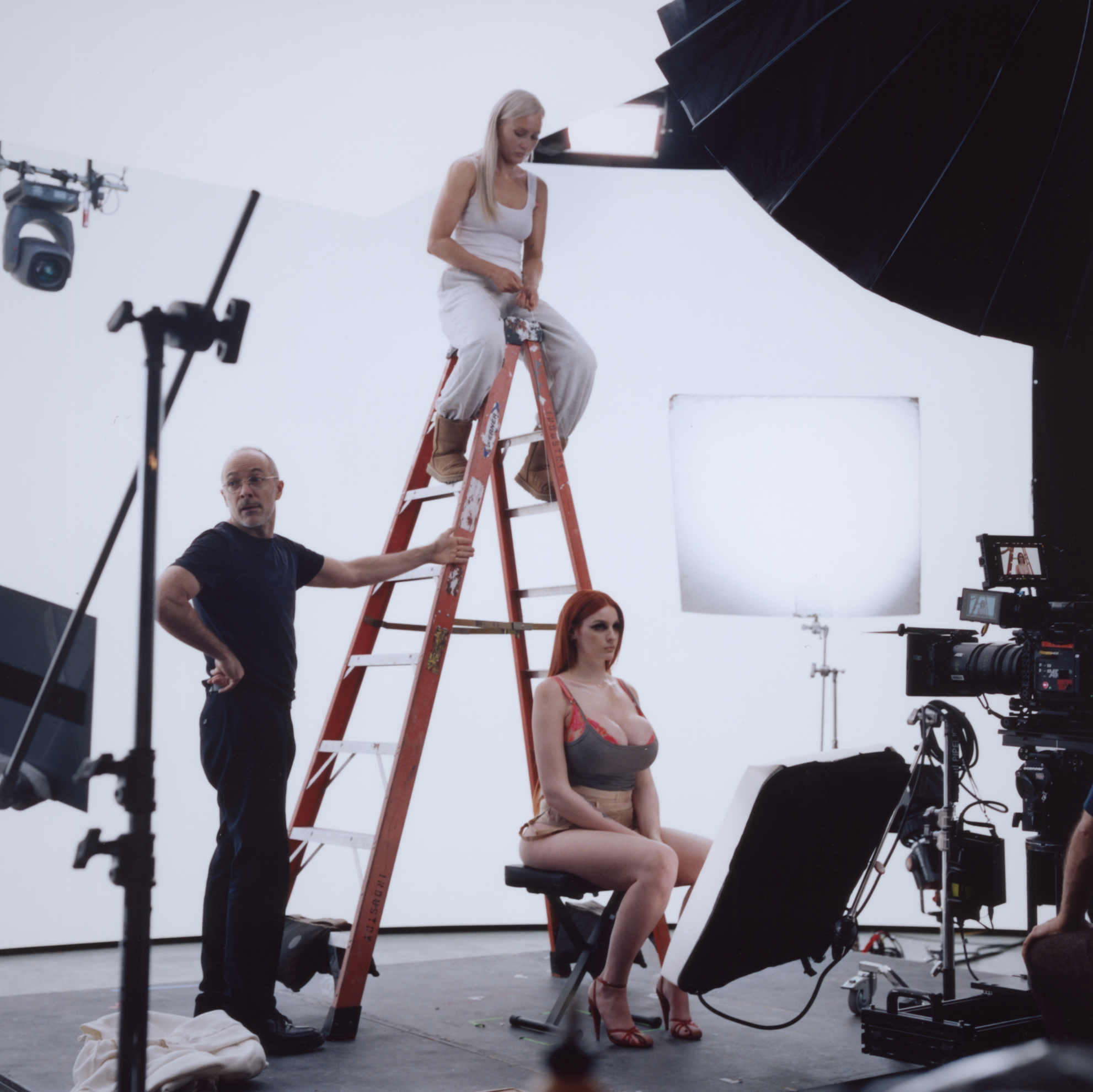
Maja Malou Lyse, DIS, Things to Come, 2026, behind the scenes, Pavilion of Denmark, 61st Venice Biennale. Photo by Zoe Chait.
NOTES
1. Danish Arts Foundation, “Maja Malou Lyse’s Things to Come at La Biennale di Venezia,” https://www.kunst.dk/english/art-forms/visual-arts/maja-malou-lyses-things-to-come-at-la-biennale-di-venezia?utm_source=chatgpt.com.
2. Erving Goffman, The Presentation of Self in Everyday Life (Doubleday Anchor Books, 1959), 112.
3. Ibid.
4. Jia Tolentino, Trick Mirror: Reflections on Self-Delusion (Random House, 2019), 15.
5. Legacy Russell, Glitch Feminism: A Manifesto (Verso, 2020), 11.
-
Naomi Moser is an independent curator and visual artist based in New York. In 2020, she completed a Fulbright grant in Romania, researching Yiddish Theater. She is currently working toward her MA in Curatorial Practice at the School of Visual Arts. Most recently, she curated a series of group shows/art parties in Los Angeles and New York that explore performance from live to screened, theatrical to everyday, and organic to machinic. As a video, animation, and performance artist, she has participated in residencies at BANFF, Atlantic Center for the Arts, and Beirut Art Residency. Her work has been featured in group and solo shows, including Feminine Urge at TRIBECA GALLERY; Give Me a Tension!, a two-person show at Space Gallery in Portland, ME; and Broken Character, a solo exhibition at EXTRA SPECIAL WITH CHEESE in Burlington, VT.
A Shift in the Air
Venice was unexpectedly hopeful, not because it offered solutions, but because it reminded me that there are other stories, other histories, other ways to understand the world.
By Diana Sardaryan
Venice was unexpectedly hopeful, not because it offered solutions, but because it reminded us that there are other stories, other histories, other ways to understand the world.
Diana Sardaryan • 7/20/26
In Minor Keys, curated by Koyo Kouoh, with Gabe Beckhurst Feijoo, Marie Hélène Pereira, and Rasha Salti, and Siddhartha Mitter, 61st Venice Biennale, May 9–November 22, 2026
-
On Site is The Curatorial's section for curatorial reviews and a venue for MA Curatorial Practice students at the School of Visual Arts to publish as part of their program, though it is open to all writers.
Diana Sardaryan surveys the 2026 Venice Biennale, In Minor Keys, curated by the late Koyo Kouoh and carried out by her assembled team. Framing it as a symptom of a broader shift in the global order, Sardaryan argues that where previous landmark curatorships by Okwui Enwezor and Adriano Pedrosa confronted or rewrote the Western canon, Kouoh's exhibition opted out of opposition altogether, allowing other histories and cosmologies to exist on their own terms. Formally uneven and at odds with conventional exhibition-making, In Minor Keys is assessed here not by professional criteria it was never designed to meet, but by its emotional register: dense, dissonant, and ultimately humble. Drawing on observations across multiple national pavilions, she argues that the Biennale's most honest gesture was its willingness to begin from uncertainty, proposing not solutions, but a pause, and the possibility of other stories.
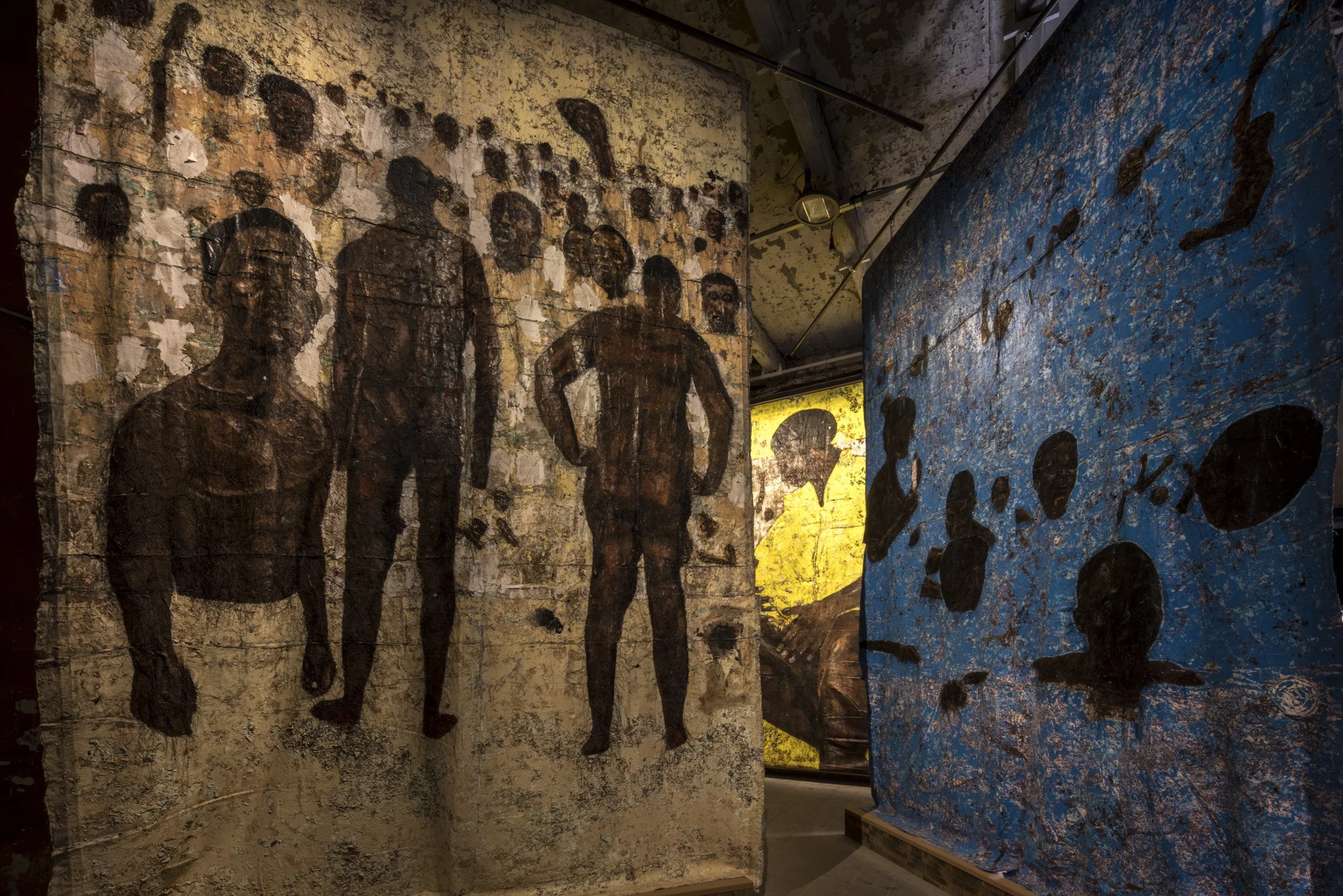
Kaloki Nyamai, Kwata kau, Ithyonze nitwavika vaa, and Ithyonze nitwavika vaaII, 2025, installation view, Arsenale, 61st Venice Biennale. Photo by Marco Zorzanello.
Before coming to Venice for the first time, I thought of the Biennale primarily as a spectacle of cultural capital: an expensive global event seemingly disconnected from the suffering, violence, and instability shaping much of the world. But once I found myself there, surrounded by its contradictions, I realized that critique alone was insufficient. The 2026 Venice Biennale was not simply a reflection of the world we live in, but a symptom of it, which revealed far more about the historical moment we are living through.
As always, this edition of the Biennale brought together countries, institutions, and cultural positions from across the world, creating a snapshot of the present—in this case, I think, a peculiar one. Looking at this landscape, I had the impression that something fundamental is shifting. For decades, certain countries and institutions have occupied the position of the world’s grand narrators, defining the dominant ideas of universality, progress, coexistence, democracy, and the global order itself. Yet the consequences of that order have made this position increasingly difficult to uphold, and the 2026 Biennale stands as a testament to that condition.
Of course, this process has been unfolding for some time. Thinkers such as Adorno and Lyotard had already diagnosed the contradictions of modernity and the exhaustion of its universal narratives. But in an age of instantaneous communication, those contradictions have become impossible to ignore. The distance between proclaimed commitments to peace, love, and freedom, and the realities they produce has become apparent.
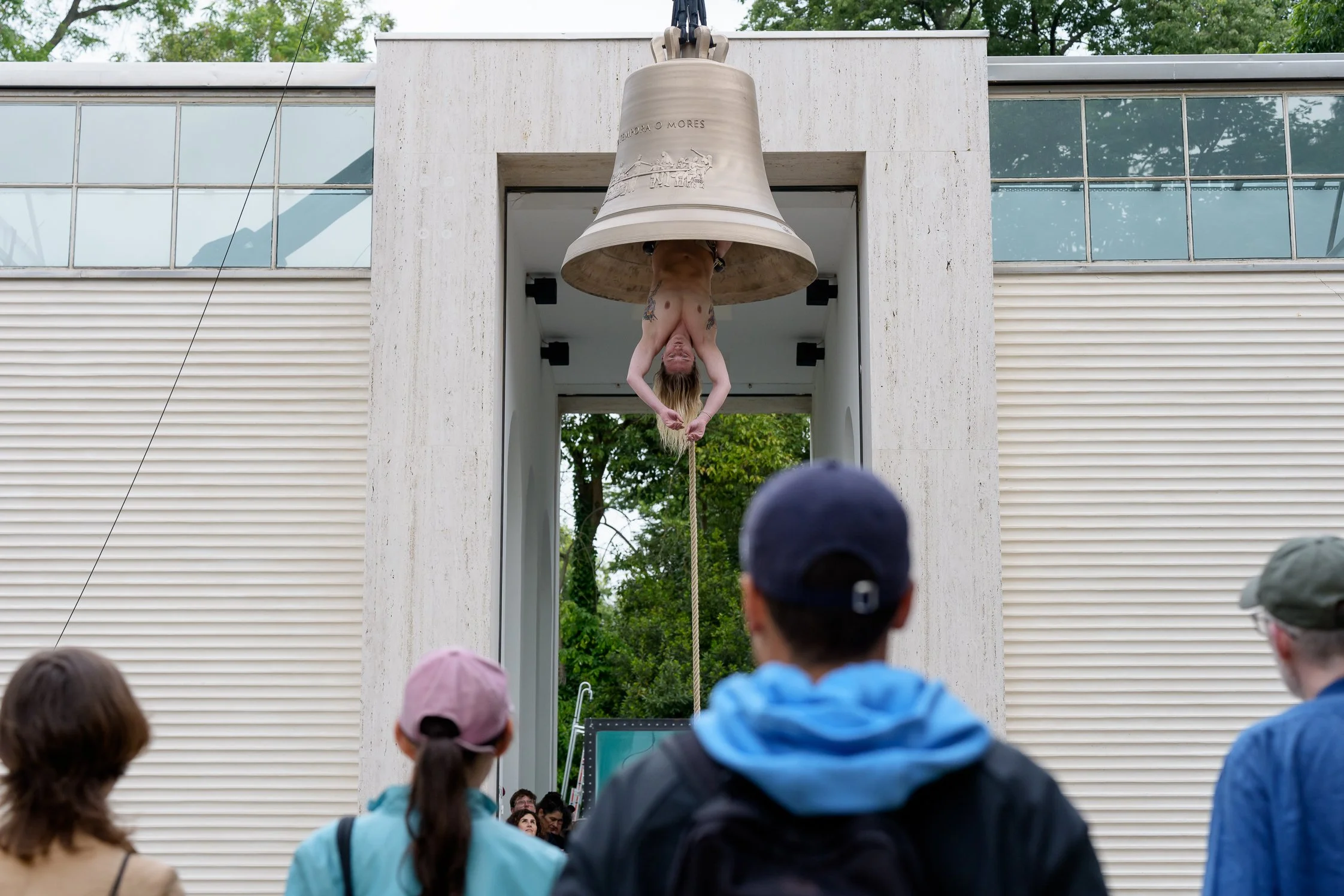
Florentina Holzinger, Seaworld Venice, 2026, installation view, Pavilion of Austria, 61st Venice Biennale. Photo by Andrea Avezzù.
This shift was perhaps most visible in the decision to place the central exhibition in the hands of the late Koyo Kouoh, the Cameroonian-born curator and former executive director of Zeitz MOCAA in Cape Town, who passed away shortly before the opening of the exhibition. Subsequently, the team she assembled—curators Gabe Beckhurst Feijoo, Marie Hélène Pereira, and Rasha Salti, together with researcher Rory Tsapayi and editor-in-chief Siddhartha Mitter—attempted to realize her vision. Historically, Kouoh’s appointment was not unprecedented. Okwui Enwezor was the first African-born curator of the Venice Biennale’s central exhibition in 2015, and Adriano Pedrosa’s Foreigners Everywhere in 2024 further challenged the boundaries of the Western canon. Yet In Minor Keys seemed to operate differently. Where Enwezor’s exhibition confronted the political and economic structures of the Western-designed world, and Pedrosa’s sought to rewrite art history from the perspective of those excluded from it, Kouoh’s exhibition seemed less interested in opposition altogether. It was not about who was permitted to speak, but instead about the nature of the conversation itself. Operating in a different register that did not seek to establish hierarchical legitimacy, it allowed other histories, cosmologies, and ways of being to exist on their own terms, without requiring translation or obligatory relation to the dominant cultural framework.
Kouoh’s exhibition looked bad, yet it didn’t feel bad.
According to almost every professional criterion a typical Western-educated curator or critic might use to evaluate an exhibition (and Western criteria are largely the only criteria most of us are taught), the show didn’t seem to work. The number of artworks, the selection, the coherence, the placement, the lighting, the navigation, the rhythm: everything seemed wrong at first. Yet looked at less formally, In Minor Keys was a dense, messy exhibition that remained intimate, informal, emotional, and open. Sometimes too much. Sometimes unclear. Often not entirely certain of what it wanted to say, while completely certain in its urge to be heard. As Kouoh suggested in her curatorial text, she wanted her exhibition to sound like free jazz: dissonant at first—full of stray sounds, missed notes, and moments that seemed almost out of place—yet capable of reaching the heart if given patience.
The organizers of the Biennale entrusted the central exhibition to a different curatorial perspective from the typical kind of authorial uber-statement, and in doing so, a productive tension was present. The art exhibition is itself a European invention, shaped by its own assumptions and hierarchical universalism. What happens when forms of expression rooted elsewhere are asked to inhabit that format? Perhaps something like In Minor Keys. It can even be said that the exhibition’s evident unevenness was a sign of the challenge to translate this very different curatorial vision—and especially without the curator who conceived it. Throughout her career, Kouoh’s work was often at odds with the European exhibitionary model exemplified by the Venice Biennale, and here it was equally so. The exhibition took a humble position. She and her team did not attempt to offer a new truth or replace one universal narrative with another. Instead, they invited viewers to “shift to a slower gear and tune in to the frequencies of the minor keys” because, “though often lost in the anxious cacophony of the present chaos raging through the world, the music continues...”1
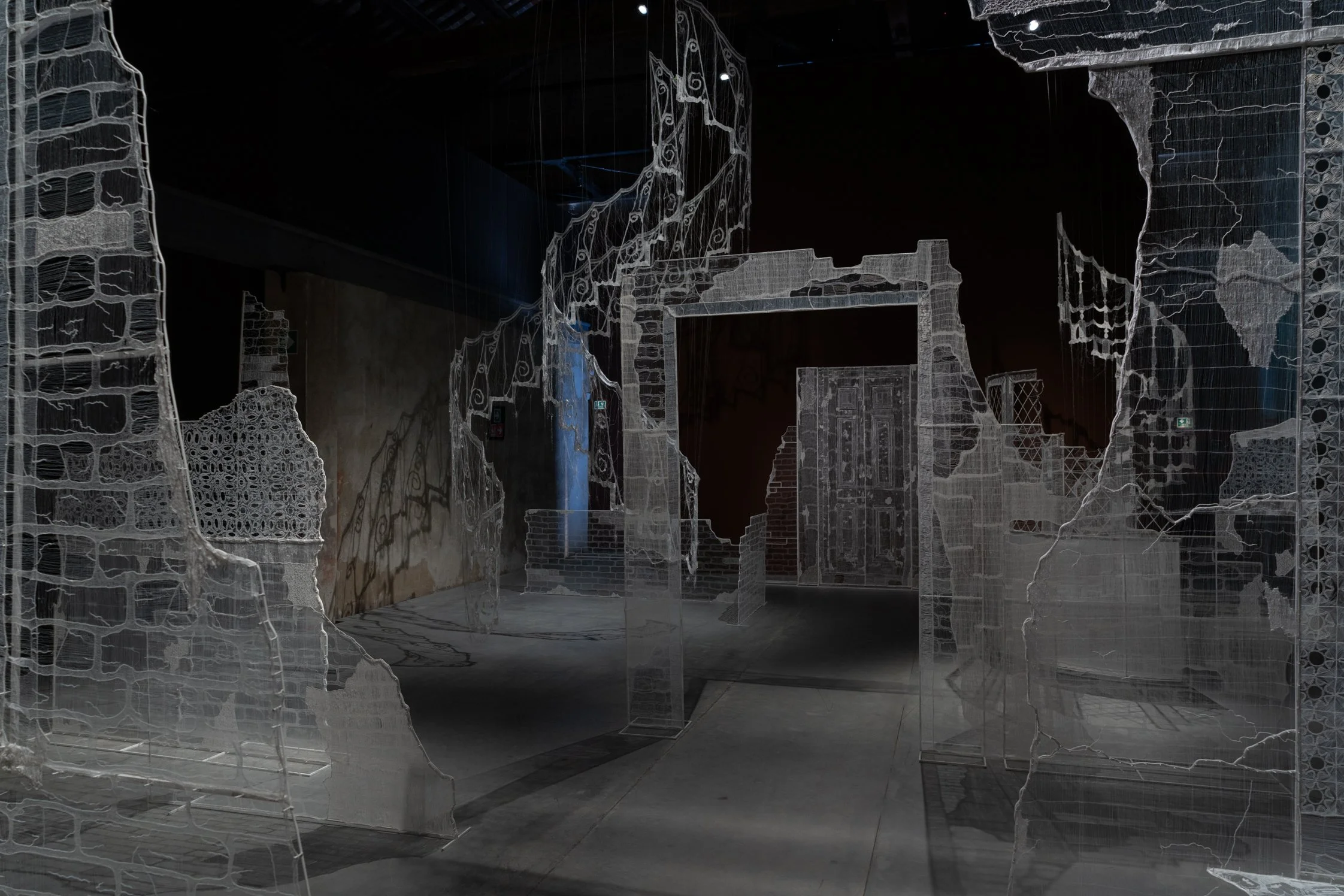
Sumakshi Singh, Permanent Address, 2026, installation view, Pavilion of India, 61st Venice Biennale. Photo by Luca Zambelli Bais.
Rather than claiming certainty, they seemed willing to begin from the uncertainty of becoming. Perhaps that was the most honest position to take. Nobody possesses a complete map of history or a framework capable of explaining everything. Yet In Minor Keys did not leave the viewer in a state of paralysis. Instead, it proposed a pause, a space to breathe, to remain together, and to search for ways of creating meaning and beauty. As Kouoh quotes Toni Morrison in her curatorial text, “In our myths, in our songs, that’s where the seeds are. It is not possible to constantly hone on the crisis. You have to have the love, and you have to have the magic, that’s also life.”2
The transitional condition of our world, where the old world is dying and a new one struggles to be born, extended beyond the central exhibition, taking various forms. Many of the pavilions at the center of the old global order felt like exhibitions of mourning for their own death. France’s Comme Saturne (Like Saturn) revolved around erosion, devouring, self-consumption, and burnout. Germany’s In Ruins revisited historical fractures and unresolved debts. Austria, with SEAWORLD VENICE, presented multiple dystopian performances, in one of which a suspended body functioned as the clapper of a church bell, ringing it hourly with their own body, and recalling an image from Bosch’s The Last Judgment.
Other pavilions, while equally grounded in their geographies, histories, and lived realities, were less extreme, less confrontational in front of an international audience. Their reflections on the present were more measured, whether in formal material terms or traditional modes of telling. In the Indian Pavilion, Sumakshi Singh’s Permanent Address reconstructed a demolished childhood home through delicate thread and embroidery, grounding the work in memory, place, and generations of collective making by women. Morocco’s pavilion, centered on Amina Agueznay’s installation Asǝṭṭa, drew on traditions of ritual weaving and collective knowledge, transforming the space into an intimate environment where visitors could sit, lie down, and move freely. The Uzbekistan Pavilion, The Aural Sea, approached the ecological catastrophe of the Aral Sea through sound and storytelling. Arriving during Josef Tumari’s live performance, Äwlep, I found myself less drawn to individual works than to the pavilion’s atmosphere. There was air between the works, which was part of the exhibition, echoing the vast emptiness left behind by the disappearing sea.
I came to Venice with a great deal of despair. Immersed in the artistic and intellectual life of New York, I often find myself trapped inside a self-referential conversation, speaking constantly about the world while rarely acknowledging how partial its view might be. Venice was unexpectedly hopeful, not because it offered solutions, but because it reminded me that there are other stories. Other histories. Other ways of understanding the world. The dominant narrative has become so self-contained that it leaves little room for other realities. Many countries no longer seemed interested in fitting themselves into a single global narrative or defining themselves in relation to it. Instead, they were trying to understand themselves on their own terms. This may look fragmented, uncertain, or unfinished. Yet perhaps that is simply the honest condition of our moment.
Perhaps this is a moment of turning toward ourselves, our histories, our traditions, and our conditions. A moment of knowing ourselves and maybe feeling embarrassed or appreciating who we are. A moment of an inevitable need to be honest with ourselves.
And perhaps only then can we begin to understand our relationships with each other.
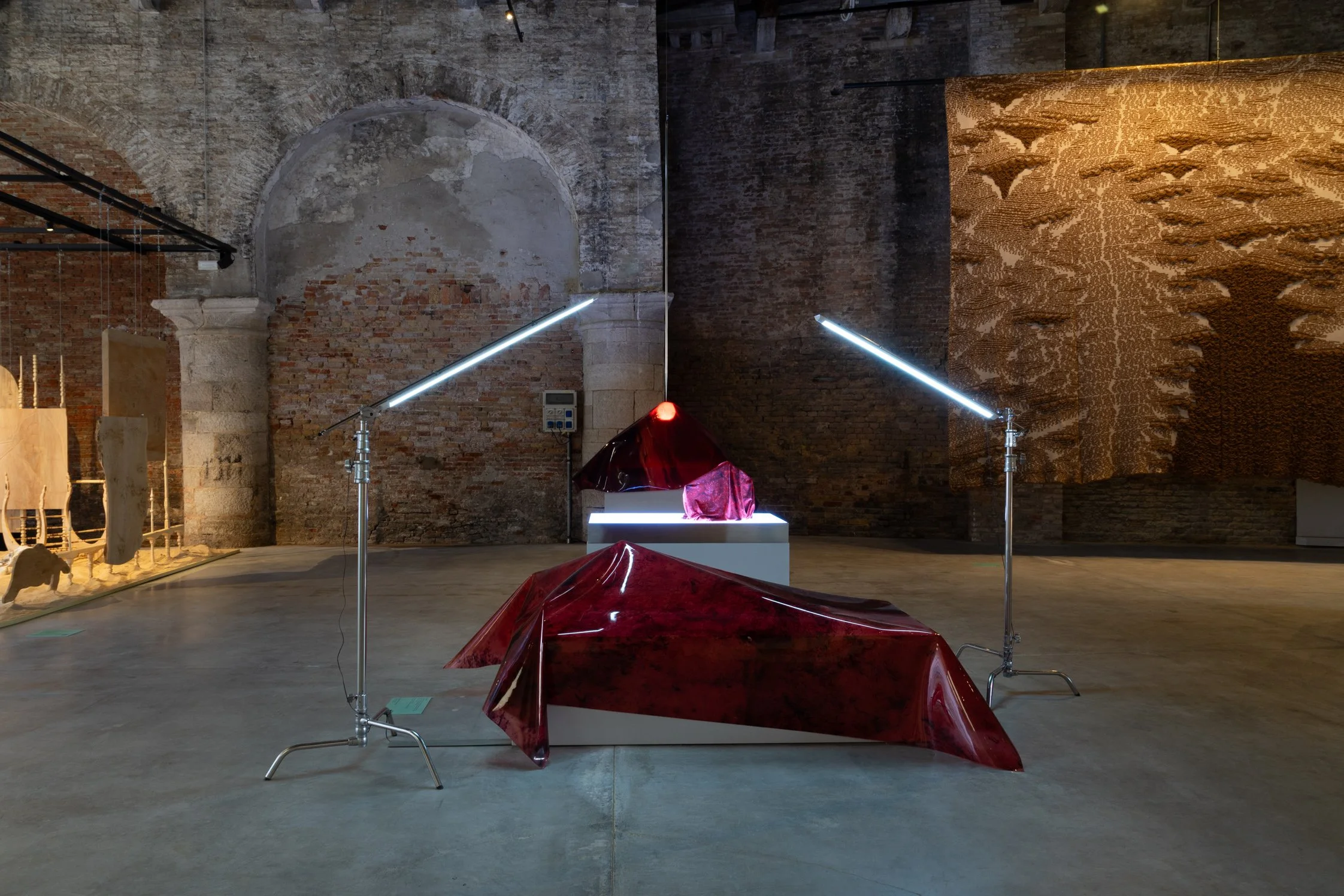
The Aural Sea, 2026, installation view, Pavilion of Uzbekistan, 61st Venice Biennale. Photo by Luca Zambelli Bais.
NOTES
1. Koyo Kouoh, In Minor Keys, exhibition text, 61st Venice Biennale, 2026.
2. Ibid.
-
Diana Sardaryan is a curator from Yerevan, Armenia, with over five years of experience in independent art contexts, working locally and internationally. With a background in film direction, she engages with a wide range of mediums in contemporary and historical art, as well as archives, spanning traditional forms, non-traditional practices, and creative technologies. Her curatorial work is dedicated to amplifying under-represented cultures, engaging with post-colonial narratives, and exploring situated cultural knowledge and plural practices within today’s global context. She is currently based in New York, pursuing an MA in Curatorial Practice at the School of Visual Arts.
The Interstitial Stitch: Goen Choi’s Meridian in Venice
These arced movements spark the imagination, raising questions about how borders shift across national lines, and how such artistic activity can expose and unsettle the invisible infrastructures underpinning a nation's governance.
By Hyun Sung
The arced movements of Choi’s work raise questions about how borders shift across national lines, and how such artistic activity can expose and unsettle the invisible infrastructures underpinning a nation's governance.
Hyun Sung • 7/20/26
Goen Choi, Liberation Space: Fortress/Nest, and Hyeree Ro, Mourning Station, curated by Binna Choi, Pavilion of Republic of Korea, 61st Venice Biennale, May 9–November 22, 2026
-
On Site is The Curatorial's section for curatorial reviews and a venue for MA Curatorial Practice students at the School of Visual Arts to publish as part of their program, though it is open to all writers.
In this review, Hyun Sung examines Liberation Space: Fortress/Nest at the Korean Pavilion of the 2026 Venice Biennale, curated by Binna Choi, focusing on Goen Choi's commission Meridian, an expansive network of burst copper pipes that threads through and beyond the pavilion's architecture to physically map the spatial politics of national representation. Sung argues that Choi's installation does not refuse nationhood so much as expose and destabilize the discursive infrastructure that produces it, tracing punctures and splices in Korea's representative image while crossing territorial boundaries, most pointedly in a pipe that arcs through the bush dividing the Korean and Japanese pavilions. Read alongside Hyeree Ro's durational sculptural stations and the contributions of the pavilion's inaugural fellows, Meridian emerges as a system that simultaneously questions and fractures the nation-state, ultimately reframing the exhibition's central question, "How Can I Ever Possibly Love This Country?", as an embrace of friction rather than a flat refusal of it.
iPhone photograph of Lang Lee & Goen Choi: SCULPTURE, SONG, SHOWING UP: A DIALOGUE, published in LIBERATION SPACE: READER (1). Image courtesy the author.
The subtext for Liberation Space: Fortress/Nest at the Korean Pavilion for the 61st Venice Biennale, poses the question: “How Can I Ever Possibly Love This Country?” Within this global constellation of art, the exhibition allegorically questions the very capacity of the Korean Pavilion to represent the nation-state as a living monument. Inspiriting a nuanced occupation of the Pavilion, curator Binna Choi has gathered an intimately collaborative exhibition of liberatory praxis, staging commissioned works by artist Goen Choi and Hyeree Ro, while enfolding various forms of contributions from the inaugural fellows: writer and singer Lang Lee, Nobel Prize-winning novelist Han Kang, photographer Yezoi Hwang, activist-farmer Huju Kim, and artist Christian Nyampeta.
Goen Choi’s commission for the Pavilion, Meridian (2026)—an expansive infrastructure of burst copper pipes spanning varied lengths and undulating arcs within and beyond the pavilion building—lays bare a paradoxical transparency in the site's physical and ideological structure. Symbiotically counterweighting the airiness of Choi’s lines, Hyeree Ro’s Bearing assembles stationary wooden and clay structures as “stations” for somatic activities and durational movements of care. These rituals transpire behind a monumental wall of wax-coated organza circles, activated daily by a cohort of “Bearers” whose repetitive bodily labor continuously reinforces the partition with the material residues of their processes. While varying in their approaches to the pavilion’s architectural constraints, if the hard edges of Choi’s liminal gestures throw the building’s territorial function into flux, Ro’s opaque wall functions as a protective second skin against the building’s transparent glass facade, embracing these sites of collective place-making like internal organs. As the shifting, durational contributions of the fellows further upend the static constants of the Biennale, any reduction of these practices to a singular national identity is most directly pierced by the stillness of Meridian. Working from within this state-sanctioned simulacrum of sovereign territory, Goen Choi expounds upon and implodes the institutional networks that uphold this spectacular national illusion—tracing the outlines, punctures, and splices inherent in the discursive fabrication of Korea’s representative image.
Walking between the German and Japanese Pavilions, visitors approaching the Korean Pavilion encounter Corea Pavilion-Bush-Giappone Pavilion (2026)—one element of Meridian—from a distance, experiencing its architecture phenomenologically before entering the building. The sunlight glimmers off the metallic skin of an elongated copper pipe, split perfectly in half across its length. Emerging from the dirt, it arcs through the bush that divides the territories of the Korean and Japanese pavilions. Immediately following the announcement of the Korean Pavilion’s establishment in 1994, the Japanese team had planted this bush, erecting a physical partition to delineate one sovereign territory from another. The opening and closing “stitch of this weave,” as the artist refers to the allegorical function of Meridian, bodily transcends this territorial boundary, a spatial placement made possible through close collaborations between the Korean and Japanese curatorial teams (mirroring this, parts of artworks presented at the Japanese Pavilion are also placed across the Korean Pavilion). Plunging back into the earth on Japan’s side of the bush, this opening act leaves the viewers to wonder: Where does Meridian truly end?
iPhone photograph of Lang Lee & Goen Choi: SCULPTURE, SONG, SHOWING UP: A DIALOGUE, published in LIBERATION SPACE: READER (1). Image courtesy the author.
A sprawling constellation of curved linear forms, Meridian weaves across the grounds, physically charting the spatial politics of its ecosystem. Threading into the building’s interior and protruding outward through the pavilion walls, elements of Meridian-pillar (2025-2026) have been inserted into its sole structural column. On one side of the pillar, a rectangular slab has been removed to make the hidden electrical panel and archival wiring visible. Investigating the operational gravity of this structural foundation, as well as the encircling emptiness where a spiral staircase once allowed for direct access to the rooftop terrace, Choi makes these invisible nuances of space, history, and somatic movement palpable. Exposing the core operations of the building’s technological network, the infrastructure is laid bare. This architectural exposure directly informs the dynamics of the half-copper pipes that, from this gravitational point, seemingly burst out into the gallery space, through the glass windows, and onto the entering path. Though void of kinetic capabilities, these sculptures register as a durational performance in limbo, extending beyond the pavilion’s walls to burst outward while drawing the external environment into the interior.
iPhone photograph of Lang Lee & Goen Choi: SCULPTURE, SONG, SHOWING UP: A DIALOGUE, published in LIBERATION SPACE: READER (1). Image courtesy the author.
On the way out of the pavilion, one recognizes how all components of Meridian interconnect, their material resonance and linear positioning reconstellating into a new kind of map. This map becomes emphatic in its relationship to the surrounding collaborative works and texts within the pavilion's ecosystem. Diagramming both the outermost and innermost layers of the pavilion’s architecture, Meridian embraces, weaves, and expands the resonances between its artistic counterparts. It achieves this through a simple gesture of lines that do not merely connect one point to another but oscillate in the spaces between them. These arced movements spark the imagination, raising questions about how borders shift across national lines, and how such artistic activity can expose and unsettle the invisible infrastructures underpinning a nation’s governance. The installation operates as a system of parts that simultaneously questions, deconstructs, stabilizes, and fractures—not the state itself, but the discursive framework of its ecosystem, inciting the viewer to envision alternative structural realities.
It is a phenomenal paradox that the transnational framework of the Biennale’s exhibitionary economics and politics provided the very possibility for Meridian to exist. For reasons that are complex and tied tobureaucratic histories, the Korean Pavilion is a long-term concession with Venice and the Biennale, as opposed to having been purchased outright and claiming ownership, highlighting the comparatively tenuous nature of its territorial claim. Meridian emerged from Choi’s inquiry into Korea’s industrial production facilities and close collaboration with factory workers, yet these resulting objects have been transposed to a foreign land. Do they rebound across the Giardini, where most of the pavilions are situated, and beyond? Is there a point at which the copper wiring in the pavilion’s electrical panel becomes entirely disconnected from the electrical grids of South Korea?
iPhone photograph of Lang Lee & Goen Choi: SCULPTURE, SONG, SHOWING UP: A DIALOGUE, published in LIBERATION SPACE: READER (1). Image courtesy the author.
What happens when participants refuse to straightforwardly claim the country they represent? An argument could certainly be made positioning these works as a development of modern Korean aesthetics, noting the clear dialogue between Choi’s material sensibilities and the sprawling installation forms of older generations of Korean artists, such as Lee Bul or Lee Ufan. Yet, the specific structural operations within the pavilion directly tie historical referents of Korea’s resistant past to the core, material and conceptual development of the artworks, charging the very space Meridian dissects. Within Hyeree Ro’s Mourning Station, the enfolding of Han Kang’s text-sculpture The Funeral (2018) commemorates the Jeju 4.3 Uprising and Massacre (1947–1954). Nearby, at the Remembering Station, Christian Nyampeta’s lino plates from the post-uprising Gwangju People’s Art School (1983–1986), ritually altered daily by a Bearer, sit alongside Yezoi Hwang’s transferred photographs documenting the citizen protests spanning the recent December 2024 martial law declaration to the April 2025 presidential impeachment. On the rooftop, the ensemble of ceramic vessels that comprise the Sharing Station house Lang Lee’s commissioned song Our ㅁ (mieum) and Huju Kim’s clay-molded indigenous seeds. Anchored by these historical traumas and revolutionary acts, the exhibition’s subtextual question becomes less a flat refusal of nationhood and more a deep embrace of the friction, turbulence, and ambivalence characteristic of the nation’s identity.
-
Hyun Sung is the nom de plume of a student in the MA Curatorial Practice program at the School of Visual Arts.
Minor Life in the Embrace
Through the clever use of weighted dolls, the exhibition proposes that tenderness also holds a sense of burden, both symbolic and actual.
By Hongjin Zhou
Through the clever use of weighted dolls, the exhibition proposes that tenderness also holds a sense of burden, both symbolic and actual.
Hongjin Zhou • 7/20/26
Ei Arakawa-Nash, Grass Babies, Moon Babies, curated by Horikawa Lisa and Takahashi Mizuki, Pavilion of Japan, 61st Venice Biennale, May 9—November 22, 2026
-
On Site is The Curatorial's section for curatorial reviews and a venue for MA Curatorial Practice students at the School of Visual Arts to publish as part of their program, though it is open to all writers.
In this piece, Hongjin Zhou reviews Grass Babies, Moon Babies by Ei Arakawa-Nash at the Japanese Pavilion of the 2026 Venice Biennale, curated by Horikawa Lisa and Takahashi Mizuki. She focuses on its use of participatory interaction to translate the global birth rate crisis into a lived, embodied experience. By inviting visitors to carry weighted baby dolls through the pavilion, the exhibition transforms "care" from an abstract ethical concept into a concrete physical burden, generating spontaneous social exchange in the process. Zhou argues, however, that the exhibition's greatest strength is also its central weakness: its playfulness and entertainment value ultimately dilute engagement with the weighty issues—such as immigration, colonial history, and nuclear disaster—it claims to address, and curatorial decisions around text placement and interactive programming compound this tension.

Ei Arakawa-Nash, Grass Babies, Moon Babies, 2026, installation view, Pavilion of Japan, 61st Venice Biennale. Photo by Uli Holz. Image courtesy The Japan Foundation.
The 61st Venice Biennale, curated by the late Koyo Kouoh as its artistic director, and a team that carried out her plan, takes “In Minor Keys” as its theme and title. It aims to shift the balance from the spectacles of disaster exhausting the world today, advocating instead for people to listen to the minor notes of living, tuning into the sotto voce, the whispers and lower frequencies of the human spirit amid international conflicts, dwindling populations, and anxieties about the future. 1
Though national pavilions in the Biennale are autonomous and hold their own themes, there was a certain resonance with Kouoh’s vision felt in the Japanese Pavilion, where artist Ei Arakawa-Nash’s exhibition, Grass Babies, Moon Babies, created an immersive interactive experience of intimate care. According to the pavilion’s curators, Horikawa Lisa and Takahashi Mizuki, Arakawa-Nash’s show is a direct response to the sharp global decline in birth rates since 2023, a trend highlighted by the the International Monetary Fund that reminds us of our collective responsibility.2 In reaction, the exhibition evinces a kind of softness, even a tenderness in the way that it invites visitors to engage. And yet, in the context of the Biennale’s main exhibition, with its references to the world’s struggles, it may seem mild, even insufficient. But that would miss the cleverness of it, particularly in the way that it transforms the notion of “care,” so intrinsic to child-rearing, from an abstract ethical concept into a concrete and burdensome reality that we have to face.
On entering the pavilion, visitors are invited to pick up and symbolically take care of one of 200 baby dolls on display, carrying it around the building’s lower space, then into the garden, and finally up into the second-floor galleries.3 Not only were there dolls available for “parenting,” they were also playfully placed on scaffolds that had the look of a towering jungle gym, seated on the edge of the pavilion’s roof, and lowered up and down in baskets from one level to the next by guests. Baby carriages were gathered on the ground floor as well. If the pavilion can be understood as our world in miniature, the dolls echo the exhibition’s central propositions: babies are born everywhere… and yet in harrowingly depleted numbers.
Tenderness is, then, an affect that holds a sense of burden, both symbolic and actual. Even though the dolls are harmless in appearance, even amusing, they were physically heavy enough to convey infants’ demand for continuous attention and our ethical requirement to fulfill it. Their weight slowed people down, occupied their hands, and, in fact, distracted attention from the dolls themselves. That is to say, their function here was to serve as symbolic agents of social mediation more than as works of art in themselves. The art was the conversation that emerged between strangers almost automatically, turning the concept of responsibility into a real, on-site interaction. The notion of “minor keys,” of the daily routines of care that fill our lives, was made tangible and relatable, aligning with the Biennale’s introspective tone.
Yet this tenderness is a limitation as much as it is a strength of the exhibition. In its attempt to delve into declining birth rates and related grand issues—such as immigration, conflicts, colonial history, and nuclear disasters—the playful interaction with the dolls, which is so palpable and entertaining, paradoxically weakens the focus on these weighty issues.4 While the show succeeds in its evocation of softness in the experience of caring for a child, this intimacy in caregiving distances us from the broader social concerns.

Ei Arakawa-Nash, Grass Babies, Moon Babies, 2026, installation view, Pavilion of Japan, 61st Venice Biennale. Photo by Uli Holz. Image courtesy The Japan Foundation.
The curatorial execution here contributed to this, too. The wall at the entrance to the second floor is crowded with historical events spanning dates, locations, and occurrences, illustrating the global turbulence contributing to spiraling birth rates, and seeking to generate a sense of empathy from viewers. But the text is too small and dense, and it contains so much information that it’s hard to take it all in—and it’s doubtful that anyone would spend the time to do so. On the one hand, the artist and curators want to create the sense of urgency befitting the population crisis. On the other hand, the curatorial decision to present the text as they did and to place it on the second floor, when people are already immersed in actively carrying their “baby,” means that they may have limited the opportunity for deeper engagement with the discursive aspect of the show.
This was only exacerbated by the entertainment factor they deployed, with other interactive activities including the invitation to visitors to diaper their adopted baby and scan a code to receive a short, personalized poem based on the baby’s birthday.5 Even the exhibition’s web page emphasizes the babies’ personality traits over the significant historical events presented. Arakawa-Nash, Lisa, and Mizuki succeed in playfully captivating their audience at the same time that doing so diminishes the overarching point, with the presentation of the writing not precisely helping their case.6 And there is, of course, the question of what kind of world are we bring children into that also grates against the overall amusement here.
It’s true that within the framework of this year’s Biennale, the sheer fun of the Japanese pavilion is unique. In its favor, it can be said that the pavilion effectively responds to the melancholy on view In Minor Keys. The problem of the way in which it counters its own mission by inadvertently downplaying its grand narrative also reminds us that responsibility does not begin with abstract concepts but with that tiny, yet heavy, life in our arms. If some more dramatic outcome for viewers was intended, the final effect of tenderness touches us, though it fails, ultimately, to shake us.

Ei Arakawa-Nash, Horikawa Lisa, and Takahashi Mizuki. Photo by Ryuichi Maruo. Image courtesy The Japan Foundation.
NOTES
Koyo Kouoh, In Minor Keys (La Biennale di Venezia, 2026), 3–4.
Horikawa Lisa and Takahashi Mizuki, “Curatorial Statement,” in Grass Babies, Moon Babies (Japanese Pavilion, La Biennale di Venezia, 2026), 10–13.
The Japan Foundation, “Ei Arakawa-Nash’s Grass Babies, Moon Babies Is Set to Permeate the Peripheries of Japanese Pavilion through a Constellation of Voices and Practices,” press release, March 19, 2026.
Horikawa Lisa and Takahashi Mizuki, “Introduction,” in Grass Babies, Moon Babies (Japanese Pavilion, La Biennale di Venezia, 2026), 16–17.
The Japan Foundation, “Ei Arakawa-Nash’s Grass Babies, Moon Babies Is Set to Permeate the Peripheries of Japan Pavilion through a Constellation of Voices and Practices,” press release, March 19, 2026.
Horikawa Lisa and Takahashi Mizuki, “Curatorial Statement,” in Grass Babies, Moon Babies (Japanese Pavilion, La Biennale di Venezia, 2026), 10.
-
Hongjin Zhou is an emerging curator from Chengdu, China, and a current master’s degree student in Curatorial Practice at the School of Visual Arts. Her curatorial practice explores the dialogue between traditional and contemporary art, with a particular interest in how exhibitions can foster cross-cultural understanding and public engagement. From 2023 to 2025, she contributed to exhibitions and public programs at the Sichuan Provincial Cultural Center, working with traditional Chinese painting and calligraphy, intangible cultural heritage, and interdisciplinary cultural exhibitions. Her early experience as a volunteer museum guide continues to shape her commitment to making art and cultural history more accessible to diverse audiences.
The Sovereign Fox Persuades Law to Dissolve into Politics
The juridical ambitions of Zasha Colah for her edition of the biennale were laudable, but elusive as her symbolic fox.
By Sophie Barfod
The juridical ambitions of Zasha Colah for her edition of the Biennale were laudable, but as elusive as her symbolic fox.
Sophie Barfod • 1/23/25
passing the fugitive on, 13th Berlin Biennale for Contemporary Art, Berlin, June 14 – September 14, 2025
-
On Site is The Curatorial’s section in which writers review exhibitions from a curatorial perspective—not an art review, a curatorial review. This is also a showcase for master’s degree students in the MA Curatorial Practice program at the School of Visual Arts (the home of the journal) to publish as part of the program—though others are welcome to write for On Site as well.
In this review, Sophie Barfod examines the 13th Berlin Biennale, passing the fugitive on (2025), curated by Zasha Colah, focusing on its use of dramaturgy to frame law, justice, and activism. Structured as a dispersed performance in which viewers are cast as jurors and artworks function as evidence, the Biennale presents law as mutable and performative, gesturing toward fugitivity as an ethical response to lawful violence. Barfod critically evaluates how this approach engages Third World Approaches to International Law (TWAIL), historical instances of immoral legality, and contemporary artistic practices that destabilize juridical authority, ultimately arguing that the exhibition’s reliance on ambiguity functions as a protective curatorial condition.

Zasha Colah cast her Berlin Biennale, titled passing the fugitive on (June 14–September 14, 2025), as a kind of performance theater spread among four different locations. The drama inherent in using performance theater as a curatorial approach seems an effective attempt to draw in contemporary (often attentionless) art viewers. To that end, the Biennale presented sixty artists and more than one hundred seventy works of art, intending to stimulate a debate on how to position oneself in relation to repressive contexts. Criticism has arisen about the irony of curating a show that apparently seeks justice, while “the viewer is invited to think about almost everywhere but Gaza.”1 It has been argued that the Biennale gravitated toward safer forms of activism, operating within what critics have described as a frame of complicit silence. The Biennale chose to omit geopolitical contexts where global demands for justice continue to be most pressing, therefore aligning itself with sites of political power that prefer such conflicts to remain unspoken.2 This essay examines how justice is articulated curatorially and asks whether legal questions framed through implicit dramaturgy can sustain an activist claim under conditions of political urgency.

Artcom Platform stages a silent monument commemorating the individuals in Kazakhstan who were killed, detained or tortured in 2022 in the uprising known as “Bloody January.” Image courtesy Elisa Carollo.
Colah’s exhibition as a construct operates within the register of the performative, in which passing the fugitive on employs dramaturgy as the primary curatorial intervention. Dramaturgy is traditionally examined curatorially through the ways in which a theatrical setting opposes the standard white cube as a site for display. Even though the Biennale employed scenographic strategies—such as the black-box theater exhibition room at the Hamburger Bahnhof—its staging more generally functioned as a forum for judgment, in which meaning was produced through assigned roles and procedural relations rather than through the white-cube logic of autonomous aesthetic experience.3 Visitors were cast as a public jury, artworks functioned as evidence, and the curatorial framework assumed the position of a closing argument. Such role assignment exceeds metaphor and enters the logic of juridical theater, where interpretation is inseparable from performance. The exhibition space becomes a stage on which judgment is rehearsed rather than resolved. This reveals the risk embedded in this approach: moral interpretation grants judges—and here, viewers—a wide margin for discretion, opening the door to judicial overreach. By asking the audience to “judge the judge,” Colah foregrounds law as a malleable construct, one that is subject to performance and perception. Authority shifts from the institution to the individual, where the viewer becomes the arbiter of moral principles. Some argue that legal interpretation, whether within legal institutions or artistic contexts, is ultimately dependent on collective belief, meaning it is ideological and subject to biases. In the Biennale, Colah seems to shift legal interpretation from legal institutions to aesthetic and social performances, allowing its audience to reflect on their own biases and beliefs in relation to morality.
The Biennale’s central motif is the fugitive fox, a creature that does not break laws but lives indifferently to them. Hence the title, passing the fugitive on: an instruction to carry evidence in body and memory until the right moment to relay it.4 Colah uses the imagery of the fox to pass the idea of fugitivity on to others as an activist gesture and ambition. In the catalogue, she defines this state as the cultural capacity of art to set its own laws in the face of lawful violence, moving outside the law’s demand to be acknowledged. What Colah presents, then, is not merely the fact that law is interpreted, but the possibility of a different horizon for justice, one in which legality gives way to justified resistance and social struggle. Here she converges with the legal movement called Third World Approaches to International Law (TWAIL), which reframes justice as an ongoing negotiation that takes into account colonial histories, structural asymmetries, and the voices of the marginalized. Critics of TWAIL argue that framing justice as “struggle” or “resistance” risks being too open-ended. If justice is always contested, what are the concrete standards? How do we know when justice is achieved or when resistance itself becomes oppressive?5
The former courthouse on Lehrter Straße, 2025. Image courtesy Raise Galofre.
Colah aims to answer this question with the Biennale’s exhibition section titled “Legality, Illegality, and the Artist’s Claim,” set in the former courthouse on Lehrter Straße. Colah utilizes the site itself as a curatorial argument by excavating the building’s history, as it was the site of the 1916 trial of the German socialist politician and anti-war revolutionary Karl Liebknecht. Prosecuted under wartime censorship laws for his participation in anti-war demonstrations and his criticism of the German military, Liebknecht was a key figure in debate on immoral legality. As the only member of the German parliament to openly oppose the country’s involvement in the First World War, his stance on anti-militarism marked a significant rupture within the legal order.6 Colah mobilizes this legacy by framing the exhibition vis-à-vis this conflict, which was later widely read as unjust. She treats the building less as a neutral container than as an archive of historical institutional immorality. Yet this curatorial precision risks evaporating at the level of encounter. If the historical hinge is legible only in the catalogue, then the exhibition’s ethics remain essentially invisible. For a project that leans on dramaturgy, that’s a structural inconsistency: the trial’s “whispers” should have been staged as part of the exhibition’s script, materialized through some form of scenography or explicit interpretive cues, so that the viewer meets the curatorial argument in space.
Simon Wachmuth’s work plays into this eerie sense of legal injustice with his video commission From Heaven High (2025). In the first half of the work, a black-and-white performance confronts the viewer with the figure of a marching, literally pig-headed soldier at Tempelhofer Feld, where the stark imagery is juxtaposed with Martin Luther’s sacred hymn, “Vom Himmel hoch, da komm ich her” (From Heaven High I Come). Once repurposed in the nineteenth and early twentieth centuries to support German imperial ambitions, the hymn’s inclusion highlights how cultural symbols have historically been used to sacralize the state and advance nationalist agendas.
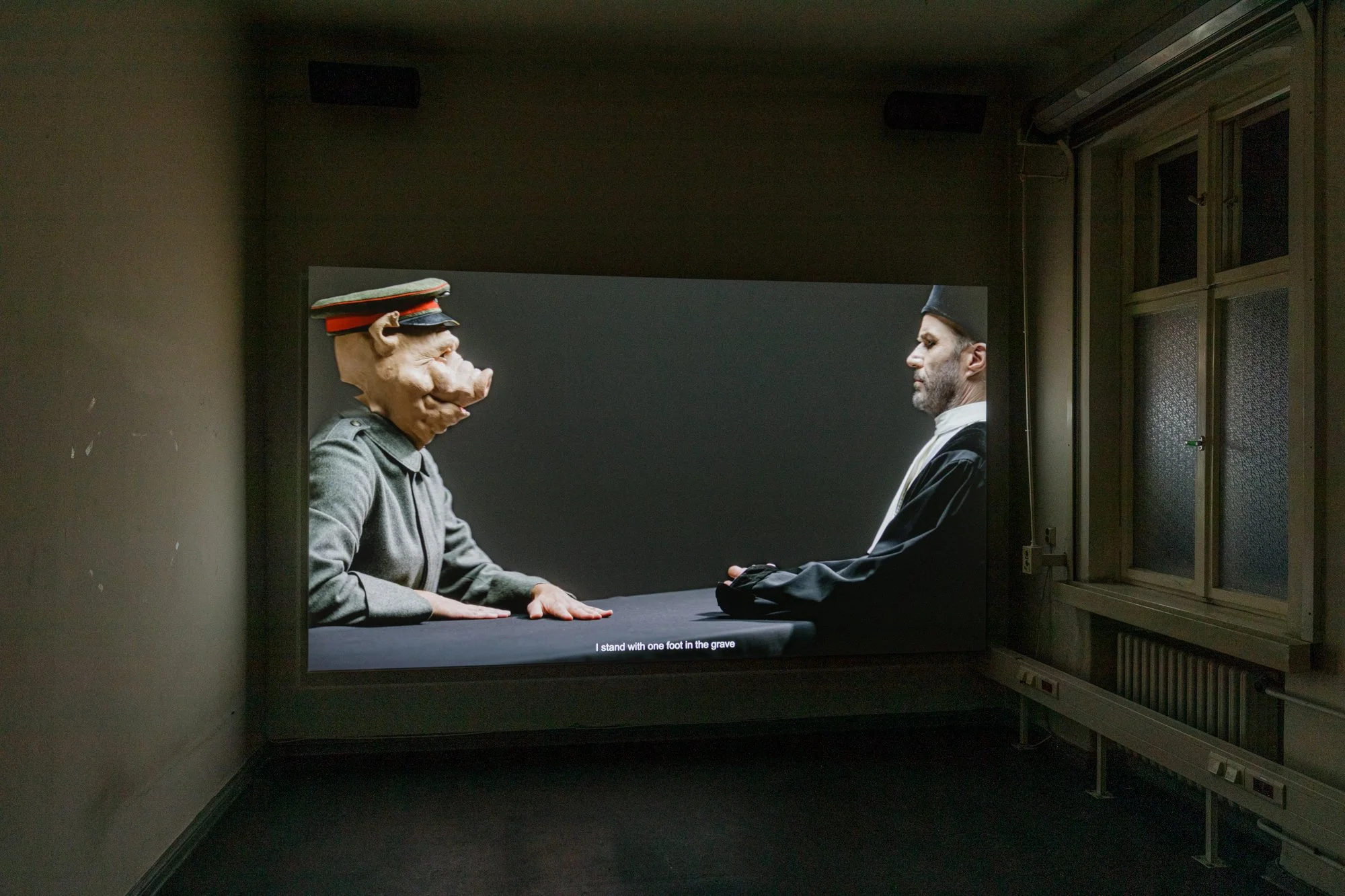
Simon Wachsmuth, From Heaven High, 2025, installation view, 13th Berlin Biennale, former courthouse on Lehrter Straße, 2025. © VG Bild-Kunst, Bonn 2025; Zilberman Berlin/Istanbul. Image courtesy Eberle & Eisfeld.
Wachmuth uses this once-sacred hymn to critique the myth of neutrality in cultural heritage, and instead creates a sinister scene concerned with (in)justice. Marching—once a sign of discipline and unity—now becomes a symbol of militarism as performative theater. Wachmuth extends this theatricality into the courtroom that’s shown in the second half of the video, where the logic of militarism is ridiculed further. He presents the scene of a trial as a dramatically lit space in which the very notion of impartiality is replaced by the theatrics of the judge, who declares: “I’ll decide who’s bad and who gets sentenced.” The sovereign tone projects authoritarian overreach, signaling how personal (im)moral judgment, not law, guides decisions. Wachmuth uses this allegory to critique creeping authoritarianism and the erosion of democratic safeguards, hinting at “rule by man, not the law.”7
From Heaven High illustrates the way unlawful directives can issue from the law, calling the very grounding of the law as “blind justice” into question. The work draws on John Heartfield and Rudolf Schlichter’s 1920 Dada installation, Prussian Archangel, at the International Dada Fair in Berlin. It featured a pig-headed papier-mâché soldier with a wire-mesh body hanging from the ceiling, responding to the dubious moral righteousness of military (Prussian) officers in the wake of the disasters of the First World War.8 The original work included an absurd instruction that mirrored the absurdity of war logic, stating that “to fully comprehend this work of art, one should exercise for twelve hours a day on the Tempelhofer Feld with a fully packed backpack and equipped for a field march.” This satirical directive mimics Dada’s anti-war stance, and Wachmuth takes the absurdity of obedience to nationalism as a crude practice at the hands of pigs (sorry, pigs!) and enacts it in his video.
Isaac Kalambata’s collage work Mizyu (2025) seems to be a curatorial illustration of the impact of lawful immorality. Kalambata’s work showcases Zambian legislation on forests and property laws (No. 4 of 2025) with the word “DISPLACED” stamped in red on top of copies of the legislation, illustrating the ways in which the corrupt force of law has brought the displacement of Indigenous populations. The work is accompanied by photographs of what appear to be natives and their belongings. In the center of the piece, we see Mwendanjangula, the “Lord of the Forest,” with his hands tied behind him, eternally attached to a tree. The metaphor touches on the continuous battle between “development” in the eyes of the capitalist beholder and violence in the eyes of the subjugated. Mizyu draws inspiration from the Witchcraft Act of 1914, “a legislation that expressly sought to entrench the colonial Christian church by curtailing alternative spirituality and healing practices within what is now Zambia.” Colah, with the choice of this work, seems to criticize a porous distinction between “this is law” and “this ought to be law.”
Isaac Kalambata, Mizyu, 2025, detail, 13th Berlin Biennale, former courthouse on Lehrter Straße. Courtesy Isaac Kalambata. Image courtesy Eberle & Eisfeld.
One question still lingers after seeing the thirteenth iteration of the Berlin Biennale: if justice is always contested, what are the standards on which it is based and can be counted on in civil societies? Colah’s curatorial approach persuades us to see law as malleable, contingent, and fugitive. TWAIL scholarship affirms this vision, as previously noted, by reframing justice as resistance, as an alternative horizon that refuses colonial hierarchies. In line with the critique that this approach can collapse into ambiguity, the late legal scholar Ronald Dworkin argued that law is always a matter of interpretation, with precedent neither rigid nor random. Yet it must offer integrity and moral validity. In the case of lawful violence, rejecting the law is acting in accordance with a deeper moral logic of the legal system. Essential to this is the discipline of principled interpretation; if everything is up for debate, integrity is lost and law dissolves into politics.9 Between these poles, Colah proposes that the fugitive fox that lives outside of the law, and whose figure suggests that law dissolves into politics, offers neither stability nor certainty. Instead, the fox is a provocation to reimagine the grounds on which justice stands.
Yet the Biennale stops short of articulating what, concretely, should replace that compromised ground. Fugitivity appears as the implied answer—an ethics of refusal, of moving beyond the law’s demand to be acknowledged—but it remains more mood than method. Indeed, the visitor is left with “a sense of a fox with its feet tied.”10 Part of this restraint may be structural rather than accidental: as a publicly funded platform, the Biennale cannot easily stage a critical political position without risking the charge of turning public culture into a partisan mandate.
Colah’s solution is to distribute judgment outward, where the viewers become the jury, and the exhibition provides tools rather than verdicts. But this redistribution produces its own problem. Advocacy requires a legible call and a transmissible ethics—something that can travel beyond the exhibition as more than ambiguity. If fugitivity is meant to be “passed on” as an activist ambition, the dramaturgical conceit promised by the Biennale demanded more than inference; it demands a legible call. Without clearer cues inside the exhibition’s curatorial script, the viewer is left to author the politics alone. In this sense, ambiguity functions as a protective condition. It is even possible that this suspension of principled interpretation was intentional. The Biennale’s reliance on ambiguity seems a wager for the consequences of advocacy to remain hidden, echoing the logic of the fox that survives by remaining elusive, but in doing so cannot be passed on.
Daniel Gustav Cramer, Fox & Coyote, 2024/25. Image courtesy © VG Bild-Kunst, Bonn, 2025. Courtesy Sies + Höke, SpazioA, Vera Cortes, Yvon Lambert.
NOTES
1. Martin Herbert, “13th Berlin Biennale Review: What Doesn’t the Fox Say,” ArtReview, September 5, 2025, https://artreview.com/13th-berlin-biennale-for-contemporary-art-various-venues-berlin-review-martin-herbert/.
2. Andrea Scrima, “The Berlin Biennale’s Complicit Silence,” Hyperallergic, July 30, 2025, https://hyperallergic.com/berlin-biennale-complicit-silence/.
3. Colah’s iteration of the Berlin Biennale included four venues. The largest part of the exhibition took place at KW Institute for Contemporary Art. The other venues were the Hamburger Bahnhof–National Gallery for Contemporary Art, Sophiensæle, and the former courthouse on Lehrter Straße.
4. Zasha Colah and Berlin Biennale for Contemporary Art, eds., 13th Berlin Biennale for Contemporary Art: catalogue. (Berlin: Berlin Biennale for Contemporary Art, 2025).
5. Naz K. Modirzadeh, “‘Let Us All Agree to Die a Little:’ TWAIL’s Unfulfilled Promise,” Harvard International Law Journal 65, no. 1 (Winter 2024): 25–68.
6. John Simkin, “Karl Liebknecht,” Spartacus Educational, updated January 2020, https://spartacus-educational.com/GERliebknecht.htm.
7. Editor’s Note: In this regard, it is worth noting that when The New York Times asked President Donald Trump if there were any limits on his global powers, he replied: “Yeah, there is one thing. My own morality. My own mind. It’s the only thing that can stop me.” https://www.nytimes.com/2026/01/08/us/politics/trump-interview-power-morality.html.
8. Simon Wachmuth, From Heaven High (2025). Wall label, 13th Berlin Biennale for Contemporary Art, former courthouse on Lehrter Straße, Berlin.
9. Ronald Dworkin, Law’s Empire (Cambridge, MA: Harvard University Press, 1986).
10. Herbert, “13th Berlin Biennale Review.”
-
Sophie Barfod is an independent curator from Amsterdam, the Netherlands. She works at the intersection of curating and strategy, currently contributing to W.A.G.E. and SaveArtSpace. Her practice is focused on curating in found spaces, with exhibition concepts often rooted in feminist theory and social practice work. She is currently a student in the MA Curatorial Practice program at the School of Visual Arts. She has held positions at YAG (McKinsey partner), Heineken, Julietta Alvarez Galeria, KW Institute for Contemporary Art, and is an ex-founder of an experimental arts and technology startup in Amsterdam.
Not Foreign Enough: Revisiting the 2024 Venice Biennale
A year after the Biennale’s latest edition, the philosophical and curatorial questions of Otherness and difference implicit in Artistic Director Adriano Pedrosa’s title, Foreigners Everywhere, feel all the more pressing to address.
By Abbas A Malakar
A year after the Biennale’s latest edition, the philosophical and curatorial questions of Otherness and difference implicit in Artistic Director Adriano Pedrosa’s title, Foreigners Everywhere, feel all the more pressing to address.
Abbas A Malakar • 8/1/25
60th Venice Biennale Arte, Stranieri Ovunque–Foreigners Everywhere, April–November 2024
-
On Site is The Curatorial’s section in which writers review exhibitions from a curatorial perspective—not an art review, a curatorial review. This is also a showcase for master’s degree students in the MA Curatorial Practice program at the School of Visual Arts (the home of the journal) to publish as part of the program—though others are welcome to write for On Site as well.
In this review, Abbas A Malakar reflects on the breadth and depth of the sixtieth edition of the Venice Biennale, curated by Adriano Pedrosa. While Malakar found excellence and range in the historical and geographical selection of works, the problematic categorization of the works and their homogenizing display never accomplished a truly nuanced examination of Otherness that the curator promised. Nonetheless, the issues of difference and tolerance invoked by Pedrosa are all the more urgent in a global political climate of authoritarianism and brute nationalism that we face today.
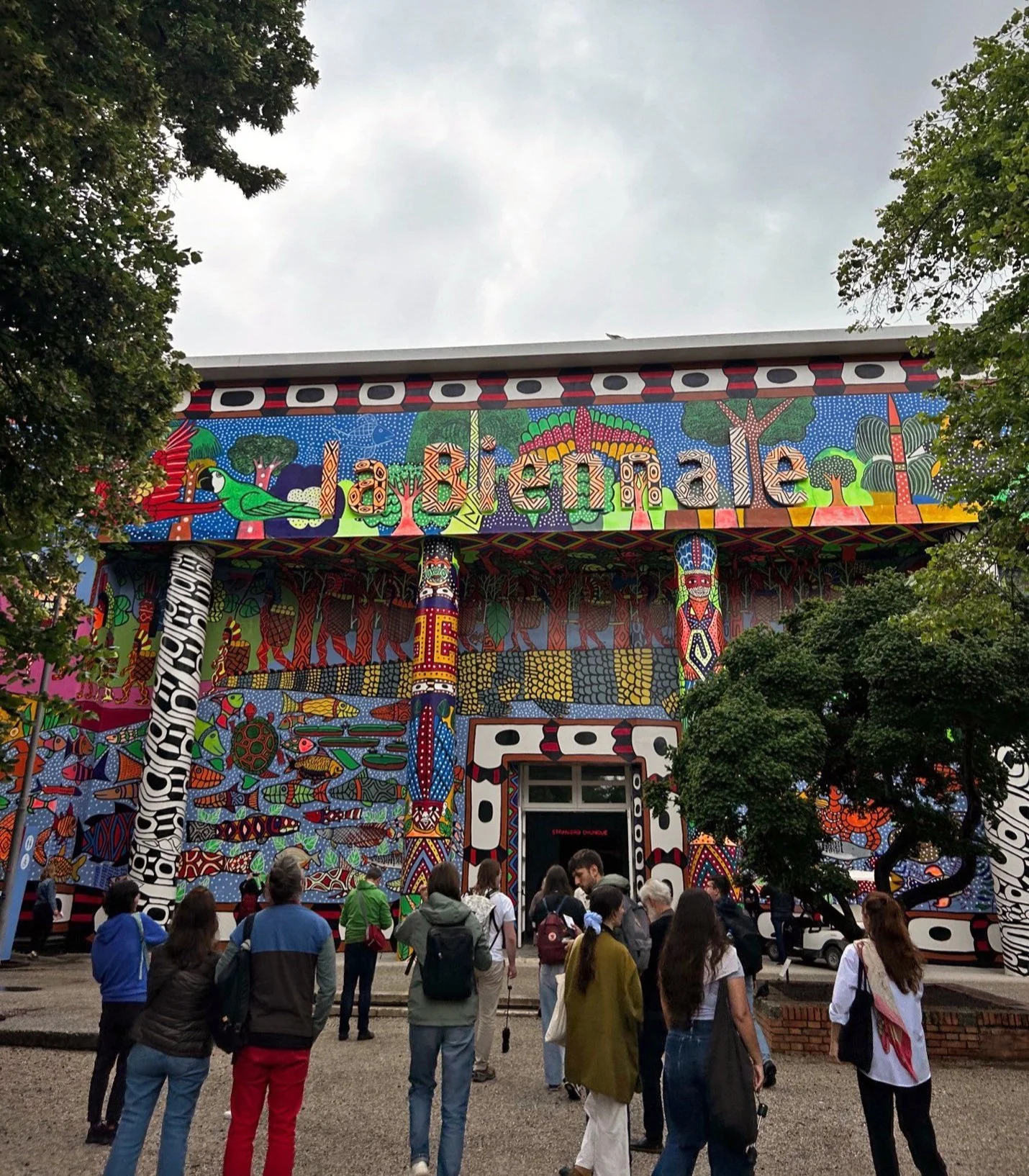
At the 2024 Venice Biennale’s Central Pavilion entrance. Image courtesy Gabriela Valentin Cruz.
It has been a little more than a year since April 20, 2024, when the 60th Venice Biennale opened its many doors. Venice can be overwhelming. The Biennale can add to that effect. Cut off from the rest of the world, surrounded by history crumbling and drowning, one’s ability to feel can be heightened. Running from pavilion to pavilion, and then trying to cover both the locations at the Giardini and the Arsenale, so many emotions are bound to erupt, and intensely so. As such, both appreciation and criticism of the Biennale can, justifiably, reach extremes. A retrospective thinking, removed from the immediacy of those emotions, hopes to be more objective.
Under the curatorial leadership of Adriano Pedrosa, the artistic director of the Museu de Arte de São Paulo, he gave his Biennale the title Foreigners Everywhere. The aim, according to the Biennale’s official website, was to highlight artists who had historically been excluded from the West. The criteria specifically noted those who had never been shown in Venice, referred to by Pedrosa as “the invisible.”1 In this sense, the exhibition projected hope not only for the world of art but for the people of the Global South.
Pedrosa was, to a degree, celebrated by the media prior to the Biennale’s opening.2 The interviews he gave and the way he spoke of his presence as queer and Brazilian seemed to suggest that he thought these an achievement in themselves, as if he might have accepted laurels before the race even began.3 It should be seen as a success that the decolonial forces of the world led to someone like Pedrosa being given such a role. But this was not an award; it was a job, and that job was not executed very well.
Before I say more critically, though, Pedrosa should be lauded for his exceptionally keen eye. Credit is due to him for both his choice of artists and their works. He chose incredible works across a vast temporal and geographical spectrum: from Bona De Mandiargues (Rome, Italy, 1926–2000, Paris, France) to Horacio Torres (Livorno, Italy, 1924–1976, New York, US); from Iván Argote (Bogotà, Colombia, 1983–lives in Paris, France) to Pablo Delano (San Juan, Puerto Rico 1954–lives in West Hartford, United States); from Semiha Berksoy (Istanbul, Türkiye, 1910–2004) to Ibrahim El-Salahi (Omdurman, Sudan, 1930–lives in Oxford, UK). It was clear that he engaged in a broad range of research and devised a meticulous system of selection, as one would expect for the Biennale, but true to his vision of inclusivity.
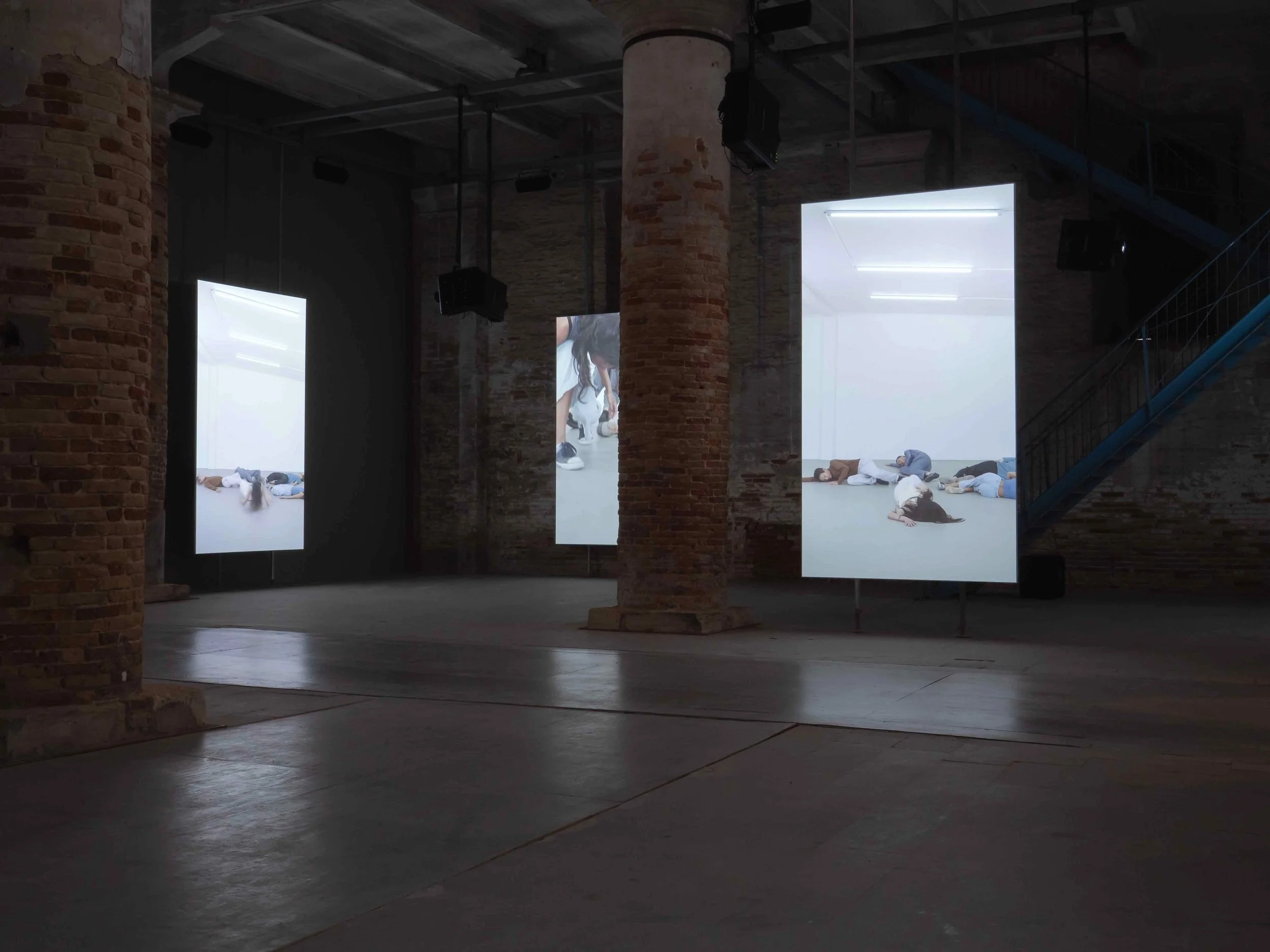
Isaac Chong Wai, Falling Reverseley, 2021–2024, variable dimensions. Image courtesy Isaac Chong Wai.
The primary categories of inclusion, in keeping with the announcement of his own identity, were queer, outsider, foreign, distant, and Indigenous. There was also an emphasis on the “uncanny” and the “strange,” adding two more possible categories.4 His curatorial approach inherently included the frame of Otherness that, of course, truly anyone might feel.5 Thankfully, these broad categories, which in themselves are too abstract to be more than sociological boxes to check off, took on a far more concrete character in the works themselves. This was evident in the Chinese artist Isaac Chong Wai’s explicitly queer and monumental performance video installations; the polyester and stainless-steel installation by Bridget Reweti, Erena Baker, Sarah Hudson, and Terri Te Tau of the Mataaho Collective from New Zealand; and the expansive drawings of the self-taught UK-based Madge Gill, populated by hundreds of people and an array of semi-abstract architectural settings. Let alone the multitudinous works from the Global South that offered a vast range of expressions that were more interesting for their differences than for the homogenizing mantle of Otherness, of the “outsider,” as put forward by Pedrosa.
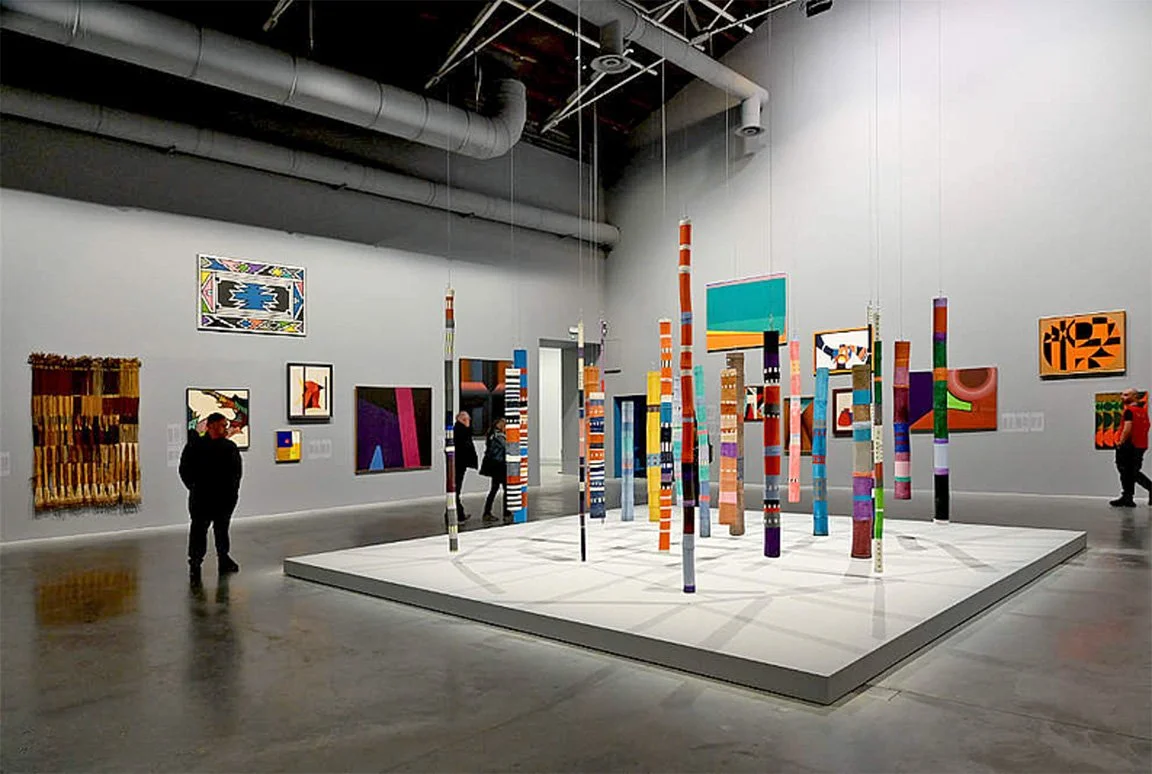
A display of historical abstract works in the Central Pavilion, though full of excellent pieces, indicated no apparent interest in distinctions of cultural origin and how such differences influenced the creation of the works. Image courtesy Haupt & Binder, Universes in Universe.
The inclination toward categorical abstraction that struggles against the particularity of the works on view, then, is a characteristic problem of this Biennale, and in more ways than one. For example, it figured as an organizing principle of the art curated in one of the large galleries of the Central Pavilion that highlighted Pedrosa’s engagement with historical art. Like Otherness, abstraction in art is not one thing; it did not grow from the same seeds across the world. Yet he ended up disregarding all nuances within the various worlds of abstraction to put together a salon-style arrangement of paintings that reduced the local origins and meaning of each across the spectrum. While Ben Davis, in Artnet News, points out that the selection of artists in this section was “wildly unbalanced geographically,” inclusion could never have been complete—and that was not the primary problem here.6 What should have been a principal concern is the effect that the selected works had when hung as they were—and could have had if the effect had been more thoughtfully considered.
Syed Haider Raza, Offrande, 1986, acrylic on canvas, 39.4 x 39.4 inches. Image courtesy Venice Biennale.
The selection included artists such as Etel Adnan (Lebanon 1925–2021, France), Carmen Herrera (Cuba 1915–2022, US), and Tomie Ohtake (Japan 1912–2015, Brazil)—all brilliant in their own right, having cross-cultural significance and influence. While the range of great artists from around the world was impressive, it was far less so to make their works appear as a homogenized mass. Consider Sayed Haider Raza (1922–2016), one of the greatest painters in twentieth–century India. Inspired by Indian philosophy and Western modes of expression, his geometric abstractions have influenced generations of artists and have continued to be a beacon for those alive today. Given his role in shaping modernity in India and his presence in the global market, his importance is profound. One had to look at his paintings in between glimpses of two other selected abstract paintings, by Freddy Rodriguez (Dominican Republic 1945–2022, US) and Kazuya Sakai (Argentina 1925–2001, US). Between Sakai’s unique visual language of simple shapes in bright contrast and harmonious synthesis, and Rodriguez’s warmer gestural dynamism in a heavier-toned palette, there was hardly the space and time to consider the deep philosophical foundations of Raza’s art, reducing everything to simple juxtapositions of color and form. As Jackson Arn noted in The New Yorker, none of the abstract works, given the number present in that one room, were presented appropriately to engage viewers enough to “bloom in the beholder’s eye.”7

Kazuya Sakai, Pintura No.9, 1969, acrylic on canvas, 51.2 × 51.2 inches. Image courtesy Venice Biennale.
In fact, the entire remit of making “the invisible” visible collapses here; the “rebalancing of the art canon toward the Global South” never amplifying meaning, only multiplying an inventory of superficially arranged works. Perhaps it created a new list of names to drop in the parlance of the market. Other than that, the “foreign” gained no sustainable foothold in accommodating a more substantial cultural equity—a deeper sense of Othering, and with it, the beneficence of greater understanding and tolerance.

Dean Sameshima, Anonymous Faggots, 2024. Image courtesy Gabriela Valentín Cruz.
The Western world has tried many times to make the Global South a more apparent presence in its discourses, and according to Maximilíano Durón, the Biennale’s promise was rooted in the “condemnation of much of our current situation” in a fight against “right-wing governments around the world that seek to strip women, queer people, and immigrants of their rights.”8 A year later, it does seem that Pedrosa’s intention is recognizable in retrospect, yet it comes at the cost of appropriating the gaze that has historically manufactured Otherness in the colonial system from a position of elevated access and power, rendering the grand gesture of acknowledgment empty in its promise.9
At another of the art world’s monumental exhibitions, documenta 11 staged twenty-three years ago, Okwui Enwezor made history by denying the Western idea of the foreigner as exotic, holding symposia around the world in advance, and arguing for precisely a counter-colonialist reorientation of both art history and the market. Though the market managed its usual tentacular capitalist hypnotism, that documenta did not exoticize.
And so, the problem was not with the intention, but with the unfounded confidence that it could be achieved without producing much more explicit knowledge as the foundation for the works presented. Without that fundamental reframing, as Davis remarked, Pedrosa’s inclusiveness could be seen as “just switching gears from superficial dismissal to superficial celebration.”10 His nationality, the color of his skin, his gender, or sexual orientation didn’t matter (and shouldn’t matter) because his work turned toward the enjoyment of a moneyed global public already inclined to broaden its tastes for novelty, inventory, or true cultural enlightenment.
The idea seemed to be that everyone—whether artist or visitor—fell within the classifications of Outsider, no matter who they were or where they were from. This was an exceptional claim on the part of the curator, who wrote that everyone, deep inside, is somehow always alien to their surroundings. It was surely a noble effort to highlight the socially imposed categories that separate some of us, but, of course, the principal shortcoming of any such claim is that it aims to unite a set of unique experiences under a set of general rubrics—as though these disjointed categories in the end are somehow all the same. On the other hand, in a world that is steeped in violence over the contested rights of land, home, and geographical anchors to identity—whether between Israel/Palestine, Russia/Ukraine, or India/Pakistan—such a show rips into the absurdity of the absolute and unquestionable brand of nationality, religion, gender, and all conceivable categories of how we recognize each other.
I have come to respect the curator far more now that Venice is far away—having seen, and felt, the need for such a show to have been organized on the international stage. Beyond the criticism levied against Pedrosa for his organizational miscalculations, we are at a unique moment in history when the ideals he was advocating require desperate attention: those of acceptance, openness, and the understanding of alienation through a realization of the alien within each of us, no matter where we are, where we are from, who we are with, or who we believe ourselves to be.

Ahmed Umar, Talitin (The Third) (2023-34), still from video and performance. Image courtesy Venice Biennale.
There were definitely major successes, such as Sudan-born Norway-based Ahmed Umar’s powerful performance/video installation, Talitin (The Third) (2023-24). New York has seen artists from the Biennale’s contemporary section emerge and shine within the last few months with Salman Toor’s two-part painting, drawing, and etching solo shows at Luhring Augustine, and the installation of Karimah Ashadu’s short film, Machine Boys (2024), at Canal Projects. History may remember Pedrosa’s Venice Biennale differently when the physicality of the exhibition is forgotten and all that remains are photographs, catalogs, memories, and the dozens of previously unknown artists he introduced to the Western canon. If his actions last year truly end up breaking whatever chains we are still bound by, no one will be happier than I.
NOTES
1. Adriano Pedrosa, “Biennale Arte 2024 | Introduction by Adriano Pedrosa,” La Biennale di Venezia, June 22, 2023, https://www.labiennale.org/en/art/2024/introduction-adriano-pedrosa; Gabriella Angeleti, “Curator Adriano Pedrosa Responds to Criticisms of His Venice Biennale Exhibition,” The Art Newspaper - International art news and events, June 10, 2024, https://www.theartnewspaper.com/2024/06/10/adriano-pedrosa-responds-criticisms-venice-biennale-exhibition.
2. Zachary Small, “Can Adriano Pedrosa Save the Venice Biennale? No Pressure,” New York Times, April 10, 2024, Arts section, https://www.nytimes.com/2024/04/10/arts/design/adriano-pedrosa-venice-biennale.html.
3. Kate Brown, “Adriano Pedrosa on His Vision for the Venice Biennale,” Artnet News, April 15, 2024, https://news.artnet.com/art-world/adriano-pedrosa-venice-biennale-2466728.
4. Pedrosa, “Biennale Arte 2024,” https://www.labiennale.org/en/art/2024/introduction-adriano-pedrosa.
5. Sean Burns, “Central Pavilion Review: A Celebration of ‘Outsiders’ That Lacks a Punch,” Frieze.com, January 3, 2025, https://www.frieze.com/article/venice-biennale-2024-review-giardini-central-pavilion.
7. Jackson Arn, “The Dead Rise at the Venice Biennale,” The New Yorker, May 2, 2024, https://www.newyorker.com/magazine/2024/05/13/venice-biennale-art-review.
8. Alex Greenberger and Maximilíano Durón, “The 2024 Venice Biennale: Our Critics Discuss Their First Impressions of a Show Unlike Any Other,” ARTnews.com, April 19, 2024, https://www.artnews.com/art-news/reviews/the-2024-venice-biennale-our-critics-discuss-their-first-impressions-1234703858/.
9. Jean Fisher, “‘Magiciens de La Terre’ in Paris,” Artforum, September 8, 1989, https://www.artforum.com/events/magiciens-de-la-terre-in-paris-194191/.
10. Davis, “'Foreigners Everywhere,” https://news.artnet.com/art-world/foreigners-everywhere-unpacked-venice-biennale-review-part-3-2485132.
-
Abbas A Malakar is an independent curator from Kolkata, India. He is a graduate of the MA Curatorial Practice program at the School of Visual Arts. His practice spans public media, social practices, and storytelling. From cooking to collective zine-making, Malakar’s focus is deeply rooted in the everyday need for communal gatherings and public programming. Along with independent curatorial projects, he contributes writing to IMPULSE Magazine and to his Substack, Not This Curator.
Of Snakes and Mirrors
What if nature, transfigured by a mirror, redirected its gaze at us, human beasts?
By Bernardo José de Souza
What if nature, transfigured by a mirror, redirected its gaze at us, human beasts?
Bernardo José de Souza • 7/1/25
Adriana Varejão: Don’t Forget, We Come from the Tropics, The Hispanic Society Museum & Library, New York, March–June 2025
-
On Site is The Curatorial’s section in which writers review exhibitions from a curatorial perspective—not an art review, a curatorial review. This is also a showcase for master’s degree students in the MA Curatorial Practice program at the School of Visual Arts (the home of the journal) to publish as part of the program—though others are welcome to write for On Site as well.
In this review, Bernardo José de Souza examines Don’t Forget, We Come from the Tropics, Adriana Varejão’s exhibition at the Hispanic Society Museum & Library. Engaging with colonial histories, Indigenous cosmologies, and the material language of ceramics, the show challenges Western perceptions of nature and subjectivity. Varejão’s large sculptural plates operate as both mirrors and speculative worlds, prompting a reversal of the gaze. The exhibition is conceptually layered and visually immersive, offering a critical reflection on power, perception, and the role of the museum.
Adriana Varejão: Don’t Forget, We Come from the Tropics exhibition view at the Hispanic Society of America. Image courtesy Gagosian.
By luring our imagination beyond surfaces, Adriana Varejão opens wounds in the fabric of reality, ushering the viewer into devious metaphysical pathways that do not abide by easy dichotomies between animate and inanimate entities. As we look at the bursting flesh emerging from within her signature tiles, what we see are the wondrous renderings of the “natural” world seeping through symbolic and material cultures. Attuned to the interactions between various forms of existence, the Brazilian artist has been producing speculative theory throughout her body of work since the 1980s—and the word “speculate,” of course, has the same etymological root as “specular,” which means to reflect, as a mirror does. The reflections prompted by her artworks transcend her canvases, totems, or plates, as the artist articulates fathoms of performative relations between living matter, material culture, and colonial history. She instills a suprasensory perception of the work, one that entices reasoning and seeing as much as feeling. By arousing a sense of alterity and delving into unacknowledged realms of life beneath the grounds of so-called reality, she awakens the stranger within us.

Adriana Varejão: Don’t Forget, We Come from the Tropics exhibition view at the Hispanic Society of America. Image courtesy Gagosian.
As for her recent exhibition at the Hispanic Society Museum & Library in New York, Don’t Forget, We Come from the Tropics, Varejão enlarges decorative concave plates to the extent that they engulf the body and mind, absorbing us into another dimension—as if we had passed beyond the mirror bound to another world, traversing unknown planes of existence in the manner of Orpheus in Jean Cocteau’s eponymous film. Paraphrasing Brazilian artist Maria Martins’ remark “Don’t forget, I come from the tropics,” the title of the exhibition alludes to an ecology of entities and mythologies that derive as much from the Amazonian rainforest and its Amerindian cosmologies as from scientific views of what the natural realm appears to be or stands for in the West. This alternate reality painted and sculpted by Varejão depicts an overwhelming mélange of living creatures, intertwined, inextricable, indomitable—a wild nature, if you will. The concept of wilderness, however, doesn’t exist in most Amerindian cultures, while what the Occident deems to be nature is only a construct: the Romantic projection of a landscape devised according to an anthropocentric understanding of the universe, in which humankind evades the sovereignty of “natural world,” depicting it in order to forcibly control it.
In this sense, Varejão’s new series of painted and sculpted concave plates places the viewer vis-à-vis other lifeforms, while deconstructing the tradition of two-dimensional landscape paintings. These works led me to think about convex mirrors as seminal, emblematic indexes of Eurocentric civilizations: self-obsessed, self-referential, and largely informed by epistemologies that not only oppose the idea of nature to that of culture but also objectify nature under the unidimensional perspective of humankind, apart from all other living creatures. And here, it’s worth noting that mirrors were among the insidious objects given by Portuguese colonizers to Indigenous peoples, no doubt aiming to instill a corrupting sense of individuality in otherwise holistic cultures.1
*
Circa the fifteenth century, or by the time of the first colonial enterprises across the Atlantic, convex mirrors came into fashion around European aristocratic milieus, offering a pristine reflection of one’s own image—a round surface that diffracted far more light than previous rudimentary brass or silver plates. So much so that painter Jan Van Eyck would use one of these devices in his highly elaborated masterpiece, The Arnolfini Portrait (1434): the artist placed it behind the wedded couple, enabling viewers to scrutinize what they would otherwise have been unable to see—and not merely an external view. As an artistic device, mirrors allow their subjects (at least, in the imagination) to be in intimate contact with their inner natures, which was and is, of course, true for artists who render self-portraits as a way to peer into themselves. According to Ian Mortimer, previously to their existence, “individuality as we understand it today did not exist: People only understood their identity in relation to groups—their household, their manor, their town or parish—and in relation to God.”2 Therefore, one could argue that mirrors ended up sealing the anthropocentric perspective of the human being as both the subject and the object of their own unidimensional view of the world, detached from a communal interaction with the surrounding environment.
Westerners tend to see the natural realm as the double-image of their inner fabrications, informed by an ontological detachment that precedes their sought-after “civilized” world. For the West, humans understand themselves as elevated entities capable of imposing order on the “state of nature” (or absence of order), as postulated by Hobbes, Rousseau, and other Enlightenment thinkers. Notwithstanding, what Varejão appears to achieve with her new series of plates is an excavation of our mirrored inner image of nature—largely inspired by the sixteenth-century ceramics of the French Huguenot potter and engineer Bernard Palissy, as well as the Portuguese artist Bordalo Pinheiro’s nineteenth-century tableware adorned with high-relief animals. So, what if “nature” could look back at us? What would it see?
According to anthropological interpretations of Amerindian animistic cosmologies3 —which favor mobile perspectives and relational configurations between “nature” and “culture”— humans see themselves as humans, and animals as animals, while animals see humans as just another animal: “Predator animals and spirits, however, see humans as prey animals, while prey animals see humans as spirits or as predator animals: ‘The human being sees itself as such. Nonetheless, the moon, the serpent, the tapir and the mother of smallpox see them as a tapir or a peccari, which they kill’, notes Baer about the Machiguenga.”4 Still, according to Eduardo Viveiros de Castro, “by seeing us as non-human, they see themselves as humans.”5 In short, “animals are people, or see themselves as such. This conception is almost always associated with the idea that the manifested shape of each species is a wrap (a piece of ‘clothing’) hiding an internal human form, normally only visible to the eyes of its own species.”6
Eschewing the Amerindian perspectivist theories of scholars, though still following their cues, one could entertain the idea that what nature “sees” is a transmogrified version of us. Conversely, the West’s perspective on the natural realm is one that forces a semblance of order by relegating it to sheer randomness, devoid of actual “thinking,” insofar as it denaturalizes the human as a semi-demiurgic being capable of controlling single-handedly the course of life. In this world of human-driven order, nature is deprived of its autonomous agency, its processes, behaviors, and actions.
If Varejão’s plates evoke mirrors, they can also be thought of as magnifying glasses of sorts, offering detailed depictions of universes abundant with mystifying species. Rather than being flattened on the surface, some of these creatures emerge as actual embodiments—three-dimensional beings projecting their existence into the viewer’s space-time dimension. Here, painting and sculpture operate as a kind of reverse trompe l’oeil, in which subject and background are enmeshed. Or, alternatively, where representation, virtuality, and reality all collide. Much in the same fashion of the convex or concave mirrors of the past, her plates appear to distort the image. It seems that what the artist’s magic operates is a reversal of the gaze. In these new works, we no longer see the objectified image of nature, as devised by the Cartesian mindset—instead, nature looks back at us, inverting the subject/object perspective forged by modernity, in which humans scientifically scrutinizes all other lifeforms.
Often deriving from mythologies that originated in the lands known today as Brazil, these painted plates are not meant to be thorough and accurate versions of oral histories found in the Amazon; they depict untimely encounters between species invested with their very own perceptual prowess, some even transcending the empire of vision, which by and large imposes itself above the other senses. In the most convoluted of them all, Guaraná (2024), Varejão creates a virtual nest for rare poisonous reptile and amphibian animals, their mesmerizing colors signaling a pattern of visual communication. Detached from the painted surface, where a profusion of carnivore creatures gets entangled, red seeds of guarana spring open three-dimensionally as if they looked at us from the interior of their black-and-white, eyeball-shaped flesh. And as it follows, akin to this most intricate piece, all her plates will, somehow, explore the gaze of nature upon us humans.

Adriana Varejão: Don’t Forget, We Come from the Tropics exhibition view at the Hispanic Society of America. Image courtesy Gagosian.
In a different work, Urutau (2025), the artist portrays a macabre owl of sorts glaring at us with its fired eyes, surrounded by Amazonian butterflies—this rare insect’s wings flashing out exquisite patterns, as if to deceive the viewer (or the predator?) with its bewildering camouflage colors. Another plate, Mucura (2023-25), will confront us with a mythical figure of the the same name, which translates as Opossum, a marsupial of nocturnal habits, here portrayed as a pregnant animal of semi-human features lying among lianas and trees—this time round, the anthropomorphic figure stares at we humans, standing outside the mirror-plate, as if asking: Who has given birth to whom?
Adriana Varejão: Don’t Forget, We Come from the Tropics exhibition view at the Hispanic Society of America. Image courtesy Gagosian.
On a rather different note, with Boto e Aruá (2025), the artist challenges the primacy of vision as a given in the process of acknowledging the phenomenological world. She devises a plate in which several Boto Cor de Rosa (a folkloric pink dolphin in Amazonia that transforms into a seductive young man) are surrounded by sculpted Aruás do Mato (snails), animals gifted with exploratory antennae that help them smell, taste, touch, and see, reaching for the outer world, rendering the whole of the work an allegory for the entanglement of visible and invisible forces, both tangible and intangible, supposedly real, though just as likely fictitious or mythological. Finally, with Mata Mata (2025), Varejão continues to investigate sensorial aspects of living beings by portraying an Amazonian turtle, its carapace as a shield—disappearance as a strategy for survival: the senses enfolded, allowing for it to disengage with the visible world. The sculpted vessel as enigmatic as the rare species itself, here reproduced by the artist after a drawing made by Frei Cristóvão de Lisboa, a Portuguese priest devoted to zoology.

Adriana Varejão, Boto e Aruá, 2025. Oil on fiberglass and resin. On view at the Hispanic Society of America. Image courtesy Gagosian.
As much as religion and mythology are an attempt to create a rationale for the unfathomable, so is science. What remains to be equated, though, is humankind’s capacity to grasp the social, biological, and cultural realms through its intra-actions with an ecology of other beings, both living and nonliving entities.7
*
Theorizing, a form of experimenting, is about being in touch. What keeps theories alive and lively is being responsible and responsive to the world’s patternings and murmurings.—Karen Barad8
In their 2017 book Are We Human? Notes on an Archeology of Design, Beatriz Colomina and Mark Wigley inquire into the domain of technology, within which all living entities are captured by the gravitational pull of design. They write: “We live in a time when everything is designed, from our carefully crafted individual looks and online identities to the surrounding galaxies of personal devices, new materials, interfaces, networks, systems, infrastructures, data, chemicals, organisms, and genetic codes.”9 One could argue that from the Amazon rainforest (we now know that it is the product of soil management engineered by its Indigenous population in the distant past) to mythological creatures, myriad constellations drawn on the skies, and even tableware, most of what surrounds us is the product of human ingenuity—technologies (even imagined ones) giving shape to a world devised as an ever-shifting scenario. So, Colomina and Wigley state, “It is precisely the lack of a clear line between human and world that provokes or energizes design as the attempt to fashion a self-image and the forever unsatisfying attempt to come to terms with what we see in this continually reconstructed mirror.”10
In this sense, when looking at the back of Varejão’s free-standing mirror-plates, we are faced with the reproduction of designs of historic ceramics from the Hispanic Museum’s collection and beyond, including Spanish Valenciana, Ottoman Iznik, Ming Dynasty Hongzhi porcelain, and pre-Columbian Amazonian Marajoara pottery. As Louis Vaccara acutely observes in his writing about the exhibition, “The juxtaposition of the two sides of each plate—between natural and man-made patterns—encapsulates a tension between organic vitality and humanity’s desire to immortalize, offering an interplay between the moving, breathing organisms of the Amazon and the crafted, enduring patterns of human history.”11
But when will we acknowledge the rational agency of all beings, not just humans? We typically claim that “natural” patterns are devoid of intellectual intent, of concerted design in this sense. Yet, it is time to acknowledge the intra-action between worldly, human and nonhuman, living and nonliving entities. Aren’t they a precondition for any sort of discursivity? Karen Barad states as much in writing: “Theories are living and breathing reconfigurings of the world,” insofar as “thinking has never been disembodied or uniquely human activity,” and “all life forms (including inanimate forms of liveliness) do theory.”12
Mutatis mutandis, what Varejão provokes when confronting the public with her mirror-plates is a rare sense of unity by dragging the human viewer into phenomenological entanglements with various entities—that is, she confronts us with the idea of “nature” (formulated by Western epistemologies) as an imaginary order, for a fleeting moment releasing us from the constraints of the supposedly objective reality proffered by science. In this way, her plates allow us to see past the Manichaean lens, beyond the horizon of Western binary narratives, through the chimera of wilderness, as it were.
By finding strangeness in what appears familiar, and familiarity in what appears uncanny, we may eventually grasp the sense of alterity that enables us to care for things that are truly singular. “Troubling oneself, or rather, the ‘self’, is at the root of caring,” as Barad remarks.13 Therefore, touching upon another existence entails deconstructing the idea of “us” as opposed to the unknown Other. Ultimately, Varejão prompts us to reflect on our contemporary common solitudes, driving us to grapple with the mythological creatures that emerge from her painterly order to become part of our own world.
Welcoming visitors at the exterior staircase that leadins into the museum’s gardens, an Amazonian Boiúna (Ananconda) sculpted by the artist strangles the equestrian statue of El Cid Campeador (1927, by Anna Hyatt Huntington), vanquishing the colonizing impetus that insists on subordinating all existing creatures and cultures.
Adriana Varejão, Sucuri, 2025. On view at the Hispanic Society of America. Image courtesy Gagosian.
*
The Hispanic Society Museum & Library, founded in 1904 by US scholar, philanthropist, and collector Archer M. Huntington, hosts thousands of books and manuscripts; a multitude of paintings, drawings, and sculpture; and other cultural belongings that date from the Paleolithic period to the twentieth century. Given Varejão’s relentless obsession with and scrutiny of ceramics production across time, multifariously incorporated into her artmaking, the institution invited her to delve into their collection and building with the purpose of renegotiating the contemporary with the past.
Granted full access to its collections—including plates, bowls, jars, and many other ceramic elements, Varejão devised the installation of her works to challenge and disrupt the Spanish Renaissance-style courtyard, with its ornate architectural terracotta. There, her grand plates, measuring nearly six feet in diameter, enact a rather unsettling choreography of bodies and objects: a jeu de miroirs of sorts, facing different directions, diffracting the attention of viewers, whose eyes travel from the background of the main hall into the abyssal foreground of the action that materializes violently through the entanglement of Amazonian species that exceed the margins of her plates. Operating as curator, the artist orchestrates a dialogical clash between her new works and an array of ceramics from Spain, Mexico, and Portugal (dating as far back as the fifteenth century), between interior and exterior (both physical and psychological), between past and present, and between discursive grip and reverie. She lures the public into the open plane of a decolonial debate that shatters the very grounds of the institution-museum—as well as its forceful grasp on historical narratives.
Varejão’s curatorial approach recalls the vision of artist Fred Wilson in his exhibition Mining the Museum: An Installation Confronting History at the Maryland Historical Society, in Baltimore, in 1992-93. where he brought to the surface long-entrenched racist characteristics of the collection and its display, reproposing the very nature of what could be seen in and of the institution. As art historian Terry Smith points out, “institutions such as historical societies and museums, which are presumed to outline a general narrative and to present their materials in as objective a fashion as possible, consistently fail to do so when it comes to socially contentious matters, such as, in this case [the Maryland Historical Society], the history of slavery in the U.S.”14
While producing an “unequal accumulation of time,” juxtaposing and over-imposing distinct layers of history, epistemologies, and cosmologies, Adriana Varejão renders the grand narratives of modernity as flawed attempts to preserve the integrity of Western history.15 Like a crack in a vase, which can be mended, though never fully repaired, her insidious intrusion into the precincts of the Hispanic Museum confers a surreal atmosphere on an exhibition that, through its works’ extraordinary distortions, depicts an integral picture of a world that exists beyond the confines of institutional knowledge.
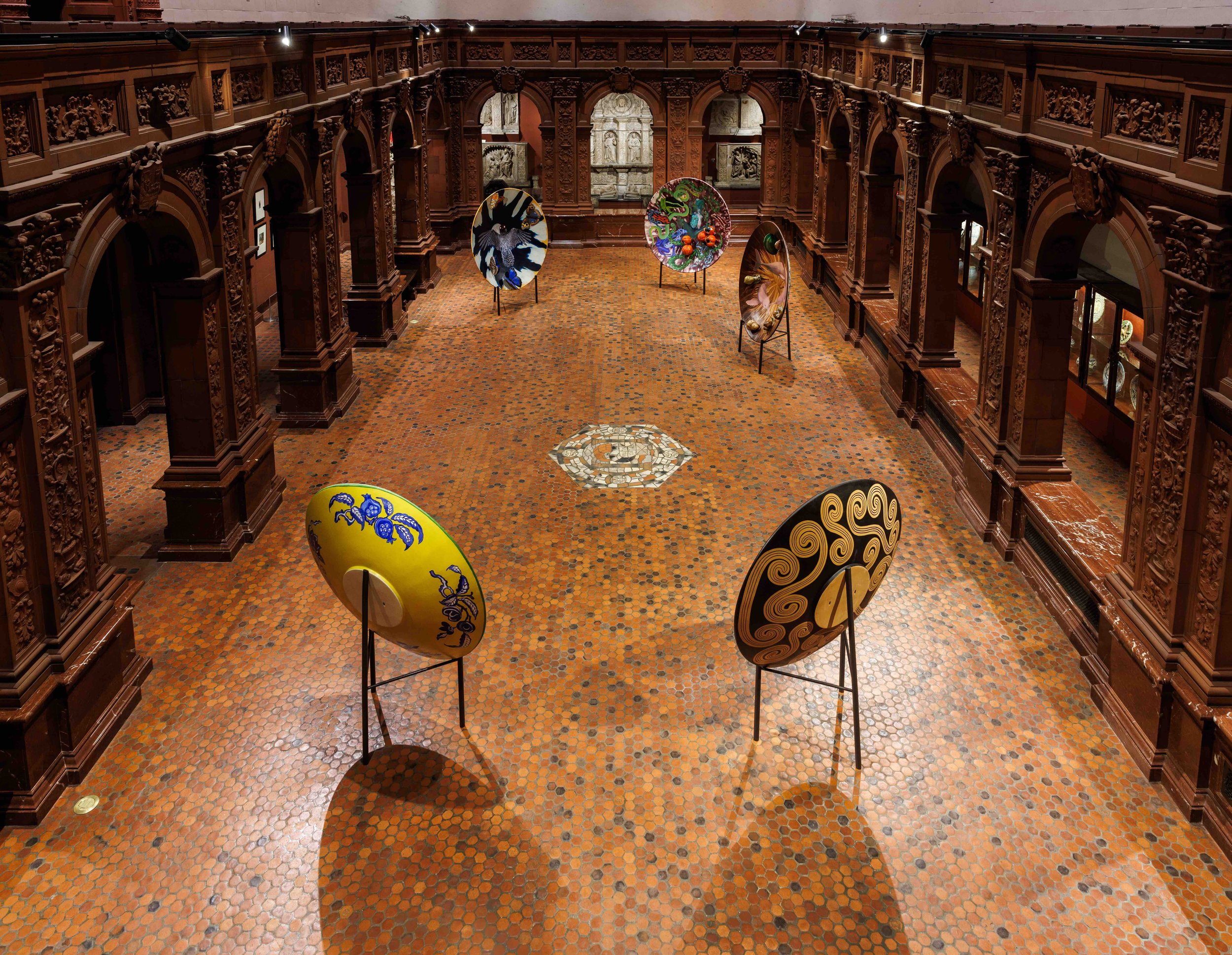
Adriana Varejão: Don’t Forget, We Come from the Tropics exhibition view at the Hispanic Society of America. Image courtesy Gagosian.
NOTES
1. Marcos Carneiro de Mendonça, A Amazônia na Era Pombalina—Correspondência do governador e capitão-general do estado do grão-pará e maranhão, Francisco Xavier de Mendonça Furtado, 2 edição, Tomo I (Brasília: Ed. do Senado Federal, 2005), 407.
2. Ian Mortimer, “The Mirror Effect,” Lapham’s Quarterly, https://www.laphamsquarterly.org/roundtable/ mirror-effect.
3. Eduardo Viveiros de Castro, A Inconstância da Alma Selvagem (São Paulo: Cosac Naif, 2011), 355. “The original condition common to humans and animals is not animality, but humanity. The great mythical divide shows less culture distinguishing itself from nature than nature distancing itself from culture. [...] Humans are those who have remained equal to themselves: animals are ex-humans, and not human ex-animals.” (Translated by the author)
4. de Castro, A Inconstância, 350.
5. Ibid., 350.
6. Ibid., 351.
7. “Intra-action is the term used by Karen Barad to indicate agency not as an inherent property of an individual or human to be exercised, but as a dynamism of forces in which all designated ‘things’ are constantly exchanging and diffracting, influencing and working inseparably. Intra-action also acknowledges the impossibility of an absolute separation or classically understood objectivity, in which an apparatus (a technology or medium used to measure a property) or a person using an apparatus are not considered to be part of the process that allows for specifically located ‘outcomes’ or measurement,” to use the words of Whitney Stark when referencing Barad’s book Meeting the Universe Halfway: Quantum Physics and the Entanglement of Matter and Meaning (Durham, NC: Duke University, 2007), 141.
8. Karen Barad, “On Touching—the Inhuman That Therefore I Am,” https://bpb-us-e1.wpmucdn.com/sites.ucsc.edu/dist/1/400/files/2015/01/barad-on-touching.pdf?bid=400, 1.
9. Beatriz Colomina and Mark Wigley, Are We Human? Notes on an Archeology of Design (Zurich: Lars Müller Publishers, 2017), 9.
10. Ibid., 25.
11. Louis Vaccara, “Adriana Varejão: Don’t Forget, We Come from the Tropics,” Gagosian Quarterly (Summer 2025): 168.
12. Barad, “On Touching,” 2.
13. Barad, “On Touching,” 8.
14. Terry Smith, Thinking Contemporary Curating (New York: Independent Curators International, 2012): 122.
15. According to geographer Milton Santos, space is a result of the unequal accumulation of time: layers of geological, natural, human, and technological agents that, in totality, engender history and its intrinsic relationship with political, social, and economic forces. See Milton Santos, The Nature of Space, trans. Brenda Baletti (Durham, NC: Duke University Press, 2021).
-
Bernardo José de Souza worked as artistic director of Fundação Iberê Camargo, in Porto Alegre, Brazil, from where he departed in early 2019 to work as an independent curator based in Madrid and Rio de Janeiro. He was part of the curatorial team of Videobrasil Biennial, held in São Paulo in 2015, and also a member of Sofía Hernández Chong Cuy's curatorial team in the 9th Mercosul Biennial | Porto Alegre Brazil in 2013. From 2005 to 2013, he worked as the Director of the Department of Cinema, Video, and Photography at the Secretary of Culture of Porto Alegre, Brazil. For the past decade, he has been developing several projects in the visual arts field, including exhibitions, film programs, seminars, and publications, as well as educational programs, many of which developed in collaboration with institutions in Brazil and abroad, such as the Goethe Institute, Instituto Inhotin, KW Institute for Contemporary Art, Prince Claus Fund, Mondriaan Fund, Institut Français, among others.
At the Edge of Ailey
While the exhibition offers a dizzying spectacle and aims to transcend disciplinary borders, it remains rooted in largely static visual art forms—ironic for a show dedicated to a master of movement.
By Tom Koren
Tom Koren • 2/1/25
Edges of Ailey, Whitney Museum of American Art, New York, September 2024–February 2025
-
On Site is The Curatorial’s section in which writers review exhibitions from a curatorial perspective—not an art review, a curatorial review. This is also a showcase for master’s degree students in the MA Curatorial Practice program at the School of Visual Arts (the home of the journal) to publish as part of the program—though others are welcome to write for On Site as well.
In this review, Adrienne Edwards’s groundbreaking exhibition, concerned with the choreographer Alvin Ailey, is critiqued. The exhibition offers a variety of approaches to delve into Ailey’s work and cultural context. It is spectacular and challenging in ways that are both informative and problematic for our reviewer.
As the Whitney Museum elevator doors open onto the fifth-floor galleries, the Edges of Ailey audience is met with a dizzying spectacle. The vastness of the open space, the dramatically dimmed spotlights, the luscious burgundy walls, the abundance of artworks, and the multi-channel video panorama that envelops the gallery—its soulful and propulsive soundtrack reverberating throughout—combine into a glamorous theatricality, making it feel as though one has emerged directly onto an active stage.
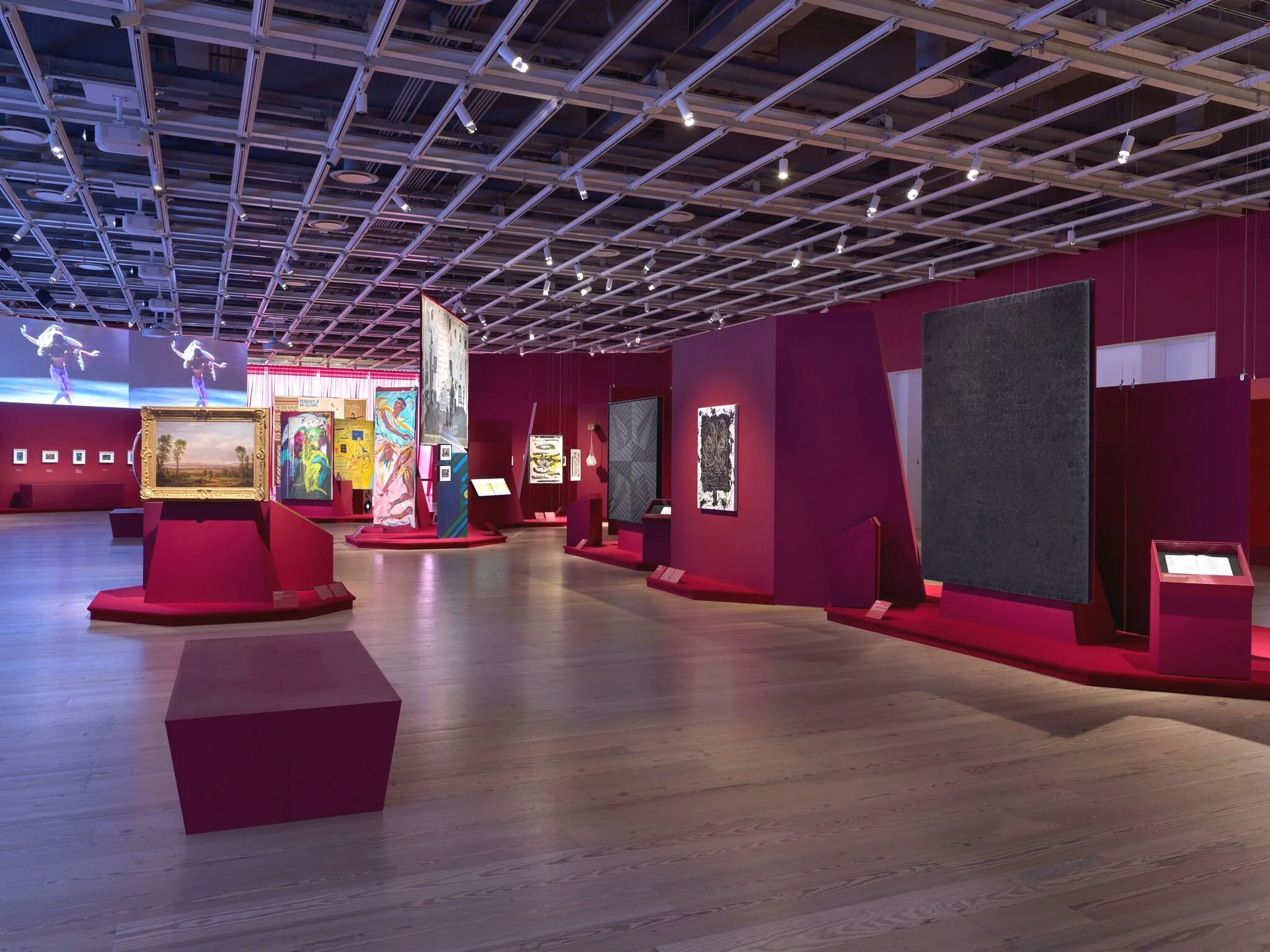
Installation view of Edges of Ailey (Whitney Museum of American Art, New York, September 25, 2024-February 9, 2025). From left to right: Romare Bearden, “The Father Comes Home” from the Bayou Fever series, 1979; Romare Bearden, “Wife and Child in Cabin” from the Bayou Fever series, 1979; Romare Bearden, “The Herb Woman” from the Bayou Fever series, 1979; Romare Bearden, “The Mother Hears the Train” from the Bayou Fever series, 1979; Robert Duncanson, View of Cincinnati, Ohio from Covington, Kentucky, c. 1851; Mary Lovelace O’Neal, Race Woman Series #7, c. 1990s; Jean-Michel Basquiat, Hollywood Africans, 1983; Emma Amos, Judith Jamison as Josephine Baker, 1985; Kerry James Marshall, Souvenir IV, 1998; Ellsworth Ausby, Untitled, 1970; Lorna Simpson, Momentum, 2011; Kandis Williams, Black Box, 4 points: Horton, Ailey, McKayle contractions and expansions of drama from vernacular –– arms outstretched and entangle, 2021; Jacob Lawrence, Figure Study, c. 1970; Terry Adkins, Other Bloods (from The Principalities), 2012; James Little, Stars and Stripes, 2021; Rashid Johnson, Untitled Anxious Men, 2016; Glenn Ligon, Stranger in the Village #12, 1998. Photograph by Ron Amstutz. All images courtesy the Whitney Museum of American Art.
Edges of Ailey, curated by Adrienne Edwards, the Engell Speyer Family Curator and Curator of Performance at the Whitney, honors the trailblazing choreographer Alvin Ailey (1931–1989) and the legacy of his eponymous dance company, founded in 1958 and active to this day. Drawing on Ailey’s innovative, cross-disciplinary, and tentacular approach to modern dance—with inspirations ranging from literature and poetry, music and art, theater and cinema, to history, politics, community, and spirituality—the exhibition seeks to explore and pay homage to the roots and impact of his practice through a unique presentation of visual art complemented by a live dance program in the museum’s theater.
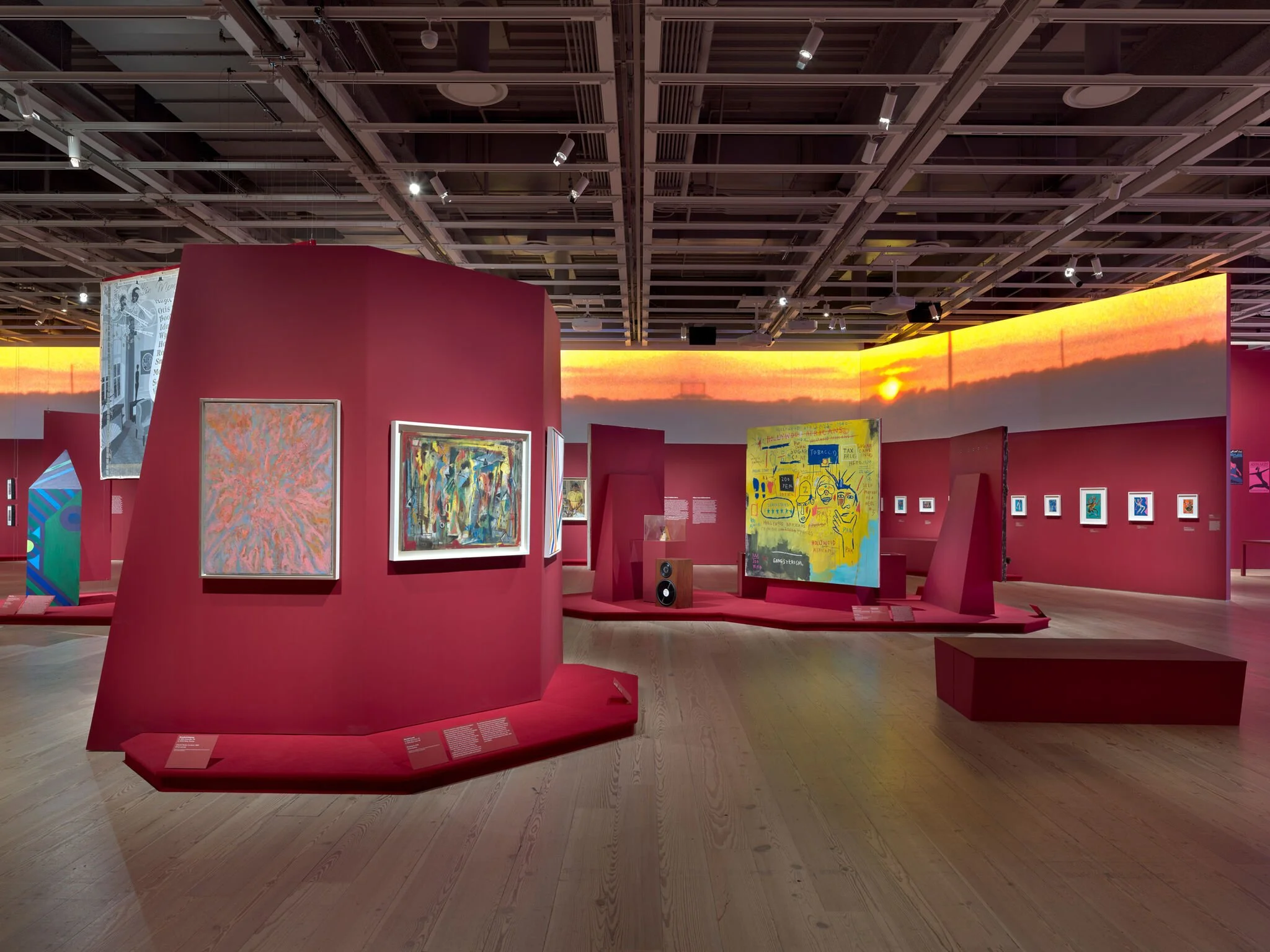
From left to right: Ellsworth Ausby, Untitled, 1970; Kerry James Marshall, Souvenir IV, 1998; Beauford Delaney, Charlie Parker Yardbird, 1958; Norman Lewis, Phantasy II, 1946; Sam Gilliam, Swing 64, 1964; Loïs Mailou Jones, Jennie, 1943; Betye Saar, I’ve Got Rhythm, 1972; Charles Gaines, Sound Box: Nina Simone and Billie Holiday, 2021; Jean-Michel Basquiat, Hollywood Africans, 1983; Romare Bearden, “The Father Comes Home” from the Bayou Fever series, 1979; Romare Bearden, “Wife and Child in Cabin” from the Bayou Fever series, 1979; Romare Bearden, ”The Swamp Witch” from the Bayou Fever series, 1979; Romare Bearden, “The Blue Demons” from the Bayou Fever series, 1979; Romare Bearden, “The Wart Hog” from the Bayou Fever series, 1979; Romare Bearden, “The Lizard” from the Bayou Fever series, 1979; Romare Bearden, “The Hatchet Man” from the Bayou Fever series, 1979. Photograph by Ron Amstutz.
Ailey’s visionary spirit is reflected mainly in the exhibition design. The decision to open up the entire gallery space is daring; there are hardly any separations, and the entirety of the show becomes visible at a glance. Paintings and sculptures are grouped in archipelagos in the center of the space, propped against dark red backings or suspended from the ceiling in a free-standing, Lina Bo Bardi fashion, while other sections of artworks hang on the surrounding walls beneath the video installation. The exhibition includes works from the Whitney’s collection alongside some loans and commissions, all intended to represent or respond to the elements that made up Ailey’s life and artistic persona, together forming one multilayered portrait of the choreographer and an encompassing visualization of Black dance. Interwoven throughout the artworks are personal notebooks, postcards, books, photographs, posters, and other Alvin Ailey American Dance Theater (AAADT) ephemera, densely aggregated inside vitrines. The curatorial strategy aims to form “constellations” that resist a linear or hierarchical narrative, blurring the boundaries between the disciplines and themes that shaped Ailey’s choreography. While this curatorial approach works well conceptually—successfully restaging the multidimensionality, richness, and breadth of Ailey’s influences and accurately capturing the spirit of the time inherent to his practice—there is a sense that the concept comes at the expense of the artworks. The floating islands and dense hanging of works create a slightly disorienting dramaturgy for the audience, resulting in a sight that is as aesthetically dazzling as it is overwhelming, leading to a somewhat superficial encounter with the art on display.
From left to right: Romare Bearden, “Star (Star from the Heavens)” from the Bayou Fever series, 1979; Archibald John Motley Jr., Gettin’ Religion, 1948; Roy DeCarava, Coltrane and Elvin, 1960; Roy DeCarava, Elvin Jones, 1961; Lyle Ashton Harris, Billie #21, 2002; Hale Aspacio Woodruff, Blind Musician, 1935/1998; Norman Lewis, Jazz, 1943–44; Gordon Parks, Music–That Lordly Power, 1993; Mary Lovelace O’Neal, Race Woman Series #7, c. 1990s; Terry Adkins, Other Bloods (from The Principalities), 2012; Bill Traylor, Untitled (Man in a Blue House), date unknown; Ralph Lemon, Bongos and Djembe, 1999; Ralph Lemon, Untitled (On Black music), 2001-07; Ralph Lemon, Untitled (Miles Davis), 2006; Mickalene Thomas, Katherine Dunham: Revelation, 2024. Photograph by Ron Amstutz.
The selection of artworks elegantly unpacks the era and situates Ailey’s oeuvre within a larger sociopolitical context, tying an important interdisciplinary link between his many realms of influence and the figures he was in dialogue with. The focus on his upbringing in the American South and the historical emphasis on Black migration and liberation work to elucidate just how groundbreaking and unprecedented his worldwide success was at the time. That being said, the sensory overload resulting from the large amount of works, their clustered, salon-style hanging, and the all-encompassing presence of the video installation limits a deeper engagement with each thematic section and with the individual pieces within it. The thematic groupings often feel loose or associative, with artworks serving as explicit visualizations of broad and abstract topics. For instance, the section dedicated to the influence of Black women on Ailey’s life includes paintings of Black women or mothers, while his struggle with mental health is illustrated by Rashid Johnson’s Untitled Anxious Men (2016), which depicts an abstracted and distraught figure, its features frenetically etched into thick black wax. While the porousness of the different sections is intended as part of the constellational curatorial vision, they are at times confusing to navigate through. This isn’t always made easier by the didactics, which are often too small or placed in strange, inconvenient locations such as the floor or in the middle of a section, surfacing only after you’ve spent a moment wondering what you are looking at and how it ties into the exhibition. To a viewer who isn’t well versed in Ailey’s world, this makes it difficult to distinguish which of the artworks have a direct connection to his life or practice, and which are included to illustrate abstract elements of his biography. The juxtapositions of the works rarely form illuminating conceptual connections that enhance their individual presence or enrich the internal logic of each section, resulting in a whole that may be greater than the sum of its parts, yet, on balance, offers a spectacle that is somewhat flattening.

From left to right: Sam Doyle, Frank Capers, 2023; Sam Doyle, LeBe, 1970s; Wadsworth Jarrell, Together We Will Win, 1973; Faith Ringgold, United States of Attica, 1971; Wadsworth Jarrell, Revolutionary (Angela Davis), 1972; James Van Der Zee, Marcus Garvey Rally, 1924; Jeff Donaldson, Soweto/So We Too, 1979. Photograph by Ron Amstutz.
To the left of the exhibition space is a section of archival ephemera, dominated by a double-sided row of old TV monitors that plays black-and-white videos. The source materials are dedicated to Ailey’s influences and collaborators, ranging from specific choreographers, artists, and musicians to broader themes like Hollywood or Broadway. These are also inadequately contextualized in the didactics. Their connection to his practice is often too unclear or too loose, and the lack of seating doesn’t aid viewers in the extended type of engagement that can illuminate the works or inspire the audience. In the absence of time-based media that actually depicts Ailey’s practice itself, the amount of videos dedicated to his influences is disproportionate, lacking anything substantial for viewers to tie it back to. This also applies to the archival documents presented in vitrines throughout the space, where Ailey’s personal notebooks and correspondences mainly function as material relics since they are usually too illegible to consume as content.
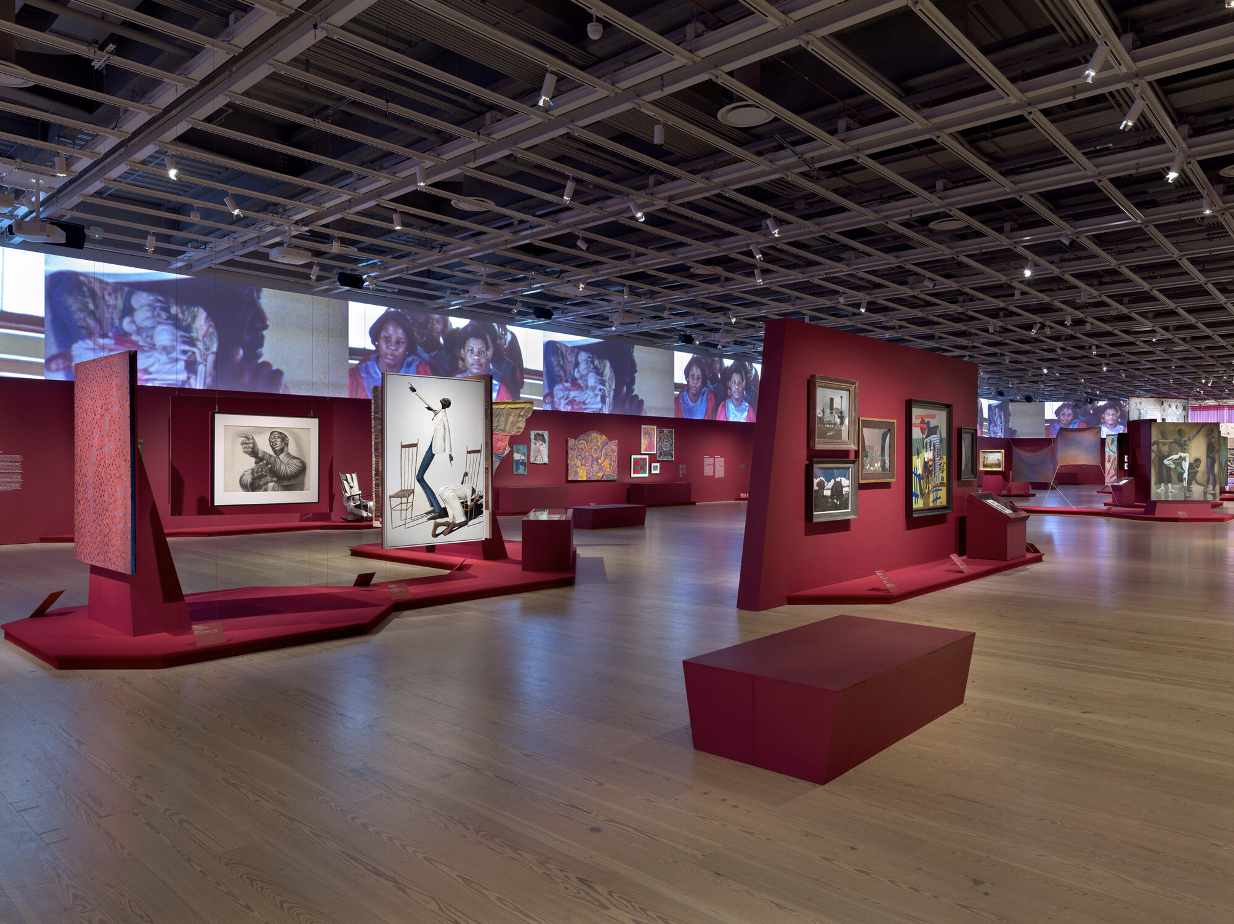
From left to right: Alma Thomas, Mars Dust, 1972; Charles White, Preacher, 1952; Lonnie Holley, Sharing the Struggle, 2018; Benny Andrews, The Way to the Promised Land, 1994; Sam Doyle, Frank Capers, 2023; Sam Doyle, LeBe, 1970s; Wadsworth Jarrell, Together We Will Win, 1973; Faith Ringgold, United States of Attica, 1971; Wadsworth Jarrell, Revolutionary (Angela Davis), 1972; James Van Der Zee, Marcus Garvey Rally, 1924; Jeff Donaldson, Soweto/So We Too, 1979; Horace Pippin, School Studies, 1944; Horace Pippin, Cabin in the Cotton, c. 1931–37; Horace Pippin, Knowledge of God, 1944; William H. Johnson, At Home in the Evening, c. 1940; John Biggers, Sharecropper, 1945; Robert Duncanson, View of Cincinnati, Ohio from Covington, Kentucky, c. 1851; Joe Overstreet, Purple Flight, 1971; Emma Amos, Judith Jamison as Josephine Baker, 1985; Kerry James Marshall, Souvenir IV, 1998; Lynette Yiadom-Boakye, A Knave Made Manifest, 2024; Lynette Yiadom-Boakye, Fly Trap, 2024; Missa Marmalstein and other makers unknown, Block 1871 of the AIDS Memorial Quilt, 1987. Photograph by Ron Amstutz.
It is important to note that the decision to represent dance through various mediums—showcasing not only Ailey's choreography but also his concerns, the art that interested him, and the art that bounds the experience of Blackness—is, of course, an important endeavor—and one that continues the correction of the historical imbalance of the representation of Black artists in American institutions, both in collections and exhibitions. But are paintings and objects really the best way to convey the history and legacy of dance? One thing that starkly stands out about the exhibition is that, despite its insertion of dance into the museum, Edges of Ailey upholds the traditional division of visual art and live performance. While the exhibition design and content do transcend disciplinary borders in various ways, the show is largely made up of conventional, two-dimensional, static visual art forms. Described as a “dynamic showcase” by the Whitney website, the exhibition is surprisingly dominated by a stillness of objects, despite the presence of scattered videos, as well as the video frieze atop one long wall of the space. The artworks remain divided from live performance, which is relegated to a separate black-box theater’s ticketed performances in allocated time slots. Considering that the show was initiated by a renowned curator of performance art, it would have been interesting to include a durational, unpredictable, or experimental live element within the gallery space.

From left to right: Maren Hassinger, River, 1972/2012; Melvin Edwards, Utonga (Lynch Fragment), 1988; Aaron Douglas, Bravado, 1926; Melvin Edwards, Chitungwiza from the Lynch Fragment series, 1989; Aaron Douglas, Flight, 1926; Melvin Edwards, Katura from the Lynch Fragment series, 1986; Aaron Douglas, Surrender, 1970; Melvin Edwards, Cup of? From the Lynch Fragment series, 1988. Photograph by Ron Amstutz
Even the musical aspects of Ailey’s practice are referenced illustratively and two-dimensionally, with paintings of instruments and a Billie Holiday photograph standing in for more creative auditory forms. The only music that is vibrantly present comes from that sprawling 18-channel video frieze, which is the one truly dynamic and innovative element in the show. The hour-long, looping montage features footage from the AAADT archive paired with a soundtrack of both timeless and contemporary music—ranging from Pharoah Sanders to Donny Hathaway to House music cuts—that is overlaid with interview clips. However, the video’s elevated placement causes it to function more decoratively as a backdrop to the still works, rather than as an artwork in its own right. This feeling is amplified by the fact that the video is uncredited and unexplained within the gallery space, with details about its creators—filmmakers Josh Begley, Kya Lou, and the curator—available only on the website. Were there additional time-based or performative media within the exhibition that referenced Ailey’s practice, this panoramic strip would have sufficed as a curatorial element alone.
From left to right: Purvis Young, Ocean, 1975; Meta Vaux Warrick Fuller, Mold for Crusaders for Freedom, 1962; Sam Gilliam, Untitled (Black), 1978; David Hammons, Untitled, 1992; Al Loving, Untitled, c. 1975; Hale Aspacio Woodruff, By Parties Unknown, 1935, printed 1996; Hale Aspacio Woodruff, Giddap, 1935, printed 1996; Purvis Young, I Love Your America, late 1970s; Martin Puryear, The Rest, 2009-10; Samella Lewis, Migrants, 1968; Purvis Young, Black People Migrating West, late 1970s; William H. Johnson, Moon Over Harlem, 1943-44; Lonnie Holley, Sharing the Struggle, 2018; Theaster Gates, Minority Majority, 2012; Sam Doyle, Frank Capers, 2023; Sam Doyle, LeBe, 1970s; Wadsworth Jarrell, Together We Will Win, 1973; Faith Ringgold, United States of Attica, 1971; Wadsworth Jarrell, Revolutionary (Angela Davis), 1972; James Van Der Zee, Marcus Garvey Rally, 1924; Jeff Donaldson, Soweto/So We Too, 1979; Maren Hassinger, River, 1972/2012; Melvin Edwards, Utonga (Lynch Fragment), 1988; Aaron Douglas, Bravado, 1926; Melvin Edwards, Chitungwiza from the Lynch Fragment series, 1989; Aaron Douglas, Flight, 1926; Melvin Edwards, Katura from the Lynch Fragment series, 1986; Aaron Douglas, Surrender, 1970; Melvin Edwards, Cup of? From the Lynch Fragment series, 1988. Photograph by Ron Amstutz.
While this immersive video installation is mesmerizing and atmospheric, its fast-paced edits offer limited insight into the essence of Ailey’s choreography. Without prior familiarity with his work or access to the museum’s sold-out performances, I left the show without any clear sense of what Ailey’s choreography is actually like. Ultimately, while the exhibition aims to celebrate Ailey’s groundbreaking legacy and cross-disciplinary influence, it fails to foundationally destabilize disciplinary boundaries in practice, or to reimagine new ways of presenting an archive through performance. By relying on representations instead of recreations and pointing at ideas instead of performing them, Edges of Ailey looks backward, surveying the past more than it experiments with possibilities for the future.
In vitrine, from left to right: Elizabeth Catlett, I am the Negro Woman, 1947, printed 1989; Elizabeth Catlett, In Harriet Tubman I helped hundreds to freedom, 1946, printed 1989; Elizabeth Catlett, In Sojourner Truth I fought for the rights of women as well as Negroes, 1947, printed 1989; Elizabeth Catlett, In Phillis Wheatley I proved intellectual equality in the midst of slavery, 1946, printed 1989; From left to right: Kara Walker, African/American, 1998; Karon Davis, Dear Mama, 2024; Geoffrey Holder, Portrait of Carmen de Lavallade, 1976; Beauford Delaney, Marian Anderson, 1965; Loïs Mailou Jones, Jennie, 1943; Meta Vaux Warrick Fuller, Mother and Child (Secret Sorrow), c. 1914. Photograph by Ron Amstutz.
-
Tom Koren is currently a student in the MA Curatorial Practice program at the School of Visual Arts, New York. She received her B.A in Art History and English Literature at the Tel Aviv University. Her professional experience is rooted in the music field, working as a curator, DJ, marketing manager and creative director for leading alternative cultural institutions and events in Tel Aviv. She has recently been awarded a Fulbright fellowship in the Public Humanities program, with which she aims to merge her academic and professional backgrounds by crossing over to the visual art field, experimenting with the curation of interdisciplinary events and further exploring her interest in participatory and live art practices.